Best Master's in Nutrition Programs in Ohio
Compare 20 accredited Nutrition programs in Ohio at 11 schools, with graduate earnings, cost, debt, and completion data from IPEDS and the U.S. College Scorecard.

Since January 2024, candidates for the registered dietitian nutritionist (RDN) credential need a graduate degree, so a registered dietitian master's program now doubles as the entry ticket to the profession. Ohio programs vary widely in what they deliver: some include ACEND-accredited supervised practice, others are research degrees that leave the internship to you.
The choice usually comes down to budget, schedule, and whether RDN eligibility is the goal. Online and campus options are compared together here, since a cheaper format can still carry costly placement requirements.
Per-credit price tells you little until you know who arranges your clinical hours.
Key Points
- Case Western graduates earn $67,363 four years out, versus $66,093 at Ohio University.
- Ohio University's online M.S. costs $593 per credit for residents and $1,113 for nonresidents.
- Ohio licensure runs through the State Medical Board, and RDN eligibility requires ACEND-accredited training.
Best Master's in Nutrition Programs in Ohio: Our Rankings
These nine Ohio schools cover campus, hybrid, and online master's in nutrition options, from research degrees to programs built around RDN eligibility. Graduation rates cited below are each school's institution-wide figure, not the nutrition program's own rate, so read them as a general signal about the university.
Case Western Reserve University
#1Cleveland, OH · ~$54,000/yr (est.)
Best for: Career changers without a nutrition background
Case Western Reserve University in Cleveland offers a flexible, interdisciplinary master's in nutrition that does not require an undergraduate nutrition degree, though chemistry, biology, and biochemistry prerequisites apply. Students can go full or part time and finish in one to two years, with a premedical track and a combined dietetic internship available. Institution-wide graduation is about 87%, and it is the highest-priced school on this list, with listed graduate tuition of about $66,600 for in-state and out-of-state students alike.
- 30 credit hours, finish in one to two years
- Full-time and part-time options
- No undergraduate nutrition degree required
- Post-bacc premedical track approved by the AAMC
- Integrated BS/MS pathway available
- Prerequisite coursework in chemistry, biology, biochemistry
- 17-month hybrid format with 30 credit hours
- Concentrations: Diabetes Prevention and Management, Culinary Medicine and Counseling
- 3.0 GPA minimum and DPD verification required
- Clinical rotations at a VA Medical Center
- Capstone required; $7,000 tuition assistance noted
Ohio State University
#2Columbus, OH · ~$14,000/yr (est.)
Best for: Aspiring clinical dietitians seeking RDN eligibility
Ohio State in Columbus runs the Master of Dietetics and Nutrition, a two-year clinical program that traces back to the nation's first medical dietetics program in 1961. It is a joint effort of two colleges and prepares graduates for the RDN exam. A separate research-oriented Master of Science in Human Nutrition offers 13 concentration options. Institution-wide graduation is about 88%, and listed graduate tuition is roughly $13,200 in-state and $40,000 out-of-state.
- Two-year clinical program with capstone
- Follows the competency-based ACEND Future Education Model
- Eligible for the RDN exam upon graduation
- Program lists an 80% licensure pass rate
- Emphasis on applied medical nutrition therapy
- 13 concentration options
- Thesis or capstone option
- Research project built into the curriculum
Ohio University
#3Athens, OH · ~$10,000/yr (est.)
Best for: Research-minded students designing custom concentrations
Ohio University in Athens offers a Master of Science in Food and Nutrition Sciences that welcomes students outside nutrition and lets them design their own concentration, with diabetes research through the OHIO Diabetes Institute among the options. A combined MS and dietetic internship takes only 10 interns a year. Institution-wide graduation is about 65%, and listed graduate tuition is about $14,200 in-state and $24,800 out-of-state.
- Design your own concentration
- Diabetes research with the OHIO Diabetes Institute
- Open to students without a nutrition undergraduate degree
- Advising and writing assistance offered
- Financial aid available
- Four-semester program with capstone
- DPD coursework prerequisite required
- Accepts only 10 interns annually
- Internship rotations in Columbus or Athens
- Prepares for the Registered Dietitian exam
Bluffton University
#4Bluffton, OH · ~$9,000/yr (est.)
Bluffton University's Master of Nutrition and Dietetics aims to take students to RDN eligibility in a single calendar year. Students pick a sports nutrition or eating disorders track, or stay generalist. The school arranges all supervised placements, so students do not hunt for preceptors. Institution-wide graduation is about 53%, and the next listed cohort starts in summer 2027.
- Complete in one calendar year, summer start
- Tracks: sports nutrition, eating disorders
- At least 1,000 supervised practice hours
- Placements arranged by the program
- Cohort-based; summer opens with online courses
- Capstone required
Miami University
#5Oxford, OH · $17,000 – $38,000/yr (est.)
Miami University in Oxford offers a 30-credit Master of Science in Kinesiology, Nutrition, and Health with Exercise and Health Science or Public Health Education and Health Promotion concentrations. It also has a combined MS and ACEND-accredited dietetic internship route. Spring, summer, and fall starts suit working professionals. Institution-wide graduation is about 80%.
- 30 credit hours, 12 to 18 months
- Starts spring, summer, or fall
- Thesis or non-thesis track
- Combined MS and dietetic internship option
- Graduate assistantships available
- Listed at $726 per credit
- Focus on physiological and psychological functioning
- Combined bachelor's-master's option
Bowling Green State University
#6Bowling Green, OH · ~$10,000/yr (est.)
Bowling Green State University's 31-credit Master of Food and Nutrition can be taken on campus or fully online, with thesis and non-thesis plans and a dietetic internship portfolio option for those pursuing RDN credentials. BGSU states that online pricing is the same for Ohio residents and out-of-state students, which helps nonresidents. Institution-wide graduation is about 64%.
- 31 credit hours; online or on-campus study
- Complete in 1.5 academic years, full or part time
- Thesis or capstone option
- Dietetic internship portfolio option
- Prerequisite courses required
- Graduate assistantships and scholarships available
University of Akron
#7Akron, OH · $10,000 – $15,000/yr (est.)
The University of Akron's Dietetics Graduate Program awards a Master of Public Health and pairs coursework in community nutrition and food systems with supervised experiential learning. The online-friendly format uses proctored exams. Institution-wide graduation is about 52%, and listed graduate tuition is roughly $13,100 in-state and $20,800 out-of-state.
- Master of Public Health with a dietetics focus
- Online-friendly with proctored exams
- Prerequisite courses required
- Two letters of recommendation minimum
- 3.0 GPA required for graduation
- No international students accepted
Antioch University
#8Yellow Springs, OH · ~$28,000/yr (est.)
Antioch University in Yellow Springs offers a fully online MS in Nutrition and Dietetics that includes supervised practice at program-provided sites, so students do not arrange placements themselves. The cohort is small, about 13 students, and the curriculum emphasizes social justice and health equity. The program lists $28,600 total tuition at $650 per credit.
- 21-month, 44-credit program
- Rolling admissions, fully online option
- About 1,025 clinical hours at program-provided sites
- Two in-person workshops at Otterbein
- 3.0 GPA minimum, two recommendation letters
- Prior learning experience credit accepted
Miami University-Hamilton
#9Hamilton, OH · $16,000 – $37,000/yr (est.)
Miami University-Hamilton delivers the Exercise and Health Science concentration of the Kinesiology, Nutrition, and Health master's, a 30-credit degree with thesis and non-thesis tracks. It leans toward exercise physiology and wellness rather than dietetics. Institution-wide graduation at this regional campus is about 25%, the lowest on this list.
- 30 credit hours, 12 to 18 months
- Starts spring, summer, or fall
- Thesis or non-thesis track
- Listed at $726 per credit
- Combined bachelor's-master's option
Cost & outcomes by school
Federal data for the highest-earning Nutrition programs, independent of the ranking above. Earnings are this field's master's graduates four years after completing, where the Scorecard reports them.
| School | Earnings | Tuition / yr | Debt | Grads/yr | Format |
|---|---|---|---|---|---|
| Case Western Reserve University OH | $67,363 | $53,980 | $70,658 | 28 | Campus |
| Ohio University OH | $66,093 | $9,720 | — | — | Campus |
| Bluffton University OH | — | $9,430 | — | — | Hybrid |
| Bowling Green State University OH | — | $10,291 | — | — | Online |
| Kent State University OH | — | $12,483 | — | — | Campus |
| University of Cincinnati OH | — | $14,902 | — | — | Campus |
| Miami University-Hamilton OH | — | $16,359 | — | — | Campus |
| Miami University OH | — | $16,751 | — | — | Campus |
| Antioch University OH | — | $27,846 | — | — | Online |
| University of Akron OH | — | $10,125 | — | — | Online |
| Ohio State University OH | — | $13,901 | — | 3 | Campus |
Sources: U.S. Department of Education. Tuition and graduates: IPEDS. Earnings and debt: College Scorecard, this field's master's graduates; a dash means no figure is reported.
Online and Hybrid Master's in Nutrition Programs in Ohio
Formats at a Glance
For online master's in nutrition programs, the core tradeoff is flexibility versus logistics. Online coursework fits around a job, but supervised practice still happens in person. Among master's programs in Ohio, Bowling Green State, the University of Akron and Antioch University deliver their programs online, and BGSU also lists an on-campus route. Ohio University offers its MS in Food and Nutrition Sciences online as well as in Athens. Bluffton University runs a hybrid model. Case Western Reserve, Ohio State1, Miami University and Miami University-Hamilton are campus-based.
Online Coursework vs In-Person Practice
Coursework is the flexible part. Clinical hours are not. Bluffton opens its summer start with four online courses. A clinical educator then arranges supervised learning at hospitals in Findlay and Lima, so students don't have to find their own preceptors. Antioch also provides supervised practice sites and adds two in-person workshops. Akron builds supervised experiential learning rotations into its online dietetics track. Ask how placements near you are secured before you enroll.
Length and Start Dates
- Bluffton: One calendar year, 1,000 clinical hours, a single summer start each year.
- Antioch: 44 credits over 21 months, 1,025 clinical hours, rolling admissions.
- Bowling Green State: 31 credits, with thesis and non-thesis plans.
- Ohio University: 31 credits for the thesis option, at least 34 for the non-thesis project.
Confirm start terms and application deadlines directly with BGSU, Akron and Ohio University before planning your timeline.
Which Ohio Master's in Nutrition Programs Waive or Make the GRE Optional?
Published GRE policies for Ohio master's in nutrition programs are patchy. Where a school's admissions page gave no GRE policy in the sources we reviewed, we say so rather than guess. Confirm current rules with each program before you apply.
- Case Western Reserve University: GRE policy not publishedNo GRE requirement or minimum GPA appears in the program bulletin. It lists general chemistry, organic chemistry, biology, anatomy and physiology, statistics, and biochemistry as prerequisites before matriculation.
- Ohio State University: GRE policy not publishedThe admissions page sets a 3.0 cumulative GPA across all undergraduate coursework. Prerequisites need a C- or higher and are due before the professional program, not necessarily at application. Completing an accredited DPD program satisfies all of them.
- Ohio University: GRE policy not publishedWe found no current GRE, GPA, or prerequisite details on official pages. Check the program's graduate admissions page.
- Bluffton University: GRE policy not publishedNo current GRE or GPA requirement was available to us. Check the program's admissions page.
- Miami University: GRE policy not publishedWe found no current GRE, GPA, or prerequisite details for the Kinesiology, Nutrition, and Health master's. Ask the program directly.
- Bowling Green State University: GRE policy not publishedNo current GRE, GPA, or prerequisite policy was available to us. Confirm with the program.
- University of Akron: GRE policy not publishedThe program lists required prerequisite courses and at least two recommendation letters. A 3.0 GPA is required for graduation, and no admission GPA or GRE rule was available to us.
- Antioch University: GRE policy not publishedThe program lists a 3.0 minimum GPA, required prerequisite courses, and at least two recommendation letters. No GRE policy was available to us.
- Miami University-Hamilton: GRE policy not publishedThis campus shares the Kinesiology, Nutrition, and Health master's with Miami University. We found no separate GRE, GPA, or prerequisite details.
- Common prerequisites if you lack a nutrition bachelor'sExpect general chemistry, organic chemistry or biochemistry, anatomy and physiology, biology, statistics, and introductory nutrition. Ohio State adds microbiology, food science, and lifecycle nutrition. Case Western says no undergraduate nutrition degree is required. Verify each list before enrolling in coursework.
Related Articles
Accreditation and RDN Eligibility: Which Ohio Programs Lead to Licensure
Accreditation here means approval from the Accreditation Council for Education in Nutrition and Dietetics (ACEND), the body that decides whether a degree can lead to the registered dietitian nutritionist (RDN) credential. Since January 2024, candidates need a graduate degree plus ACEND-accredited coursework and supervised practice before sitting for the national RDN exam.
Programs With a Built-In Path to the RDN
- Ohio State University: The Master of Dietetics and Nutrition is fully ACEND-accredited and describes a competency-based Future Education Model curriculum. Its handbook targets at least 90% of graduates taking the exam within 12 months and at least 80% passing within one year.1
- Bluffton University and Antioch University: Both list ACEND accreditation with about 1,000 supervised clinical hours built in.
- University of Akron: Its dietetics graduate program is ACEND-accredited.
- Ohio University and Miami University: Each offers a combined MS and dietetic internship track.
Nutrition-Science Degrees
Case Western Reserve's MS in Nutrition, Ohio University's standard Food and Nutrition Sciences master's, and Miami's kinesiology, nutrition, and health degree (also offered through Miami University-Hamilton) suit research, wellness, or pre-health goals. On their own, they do not confer RDN eligibility unless paired with an accredited internship.
Pass-rate figures these schools publish are mostly ACEND benchmarks, not actual first-time results, so ask admissions for recent outcomes. The rule is simple: if you want to become a dietitian, confirm current ACEND status before you apply.
Ohio Dietitian Licensure Requirements
What Ohio Nutrition Master's Graduates Earn After Finishing
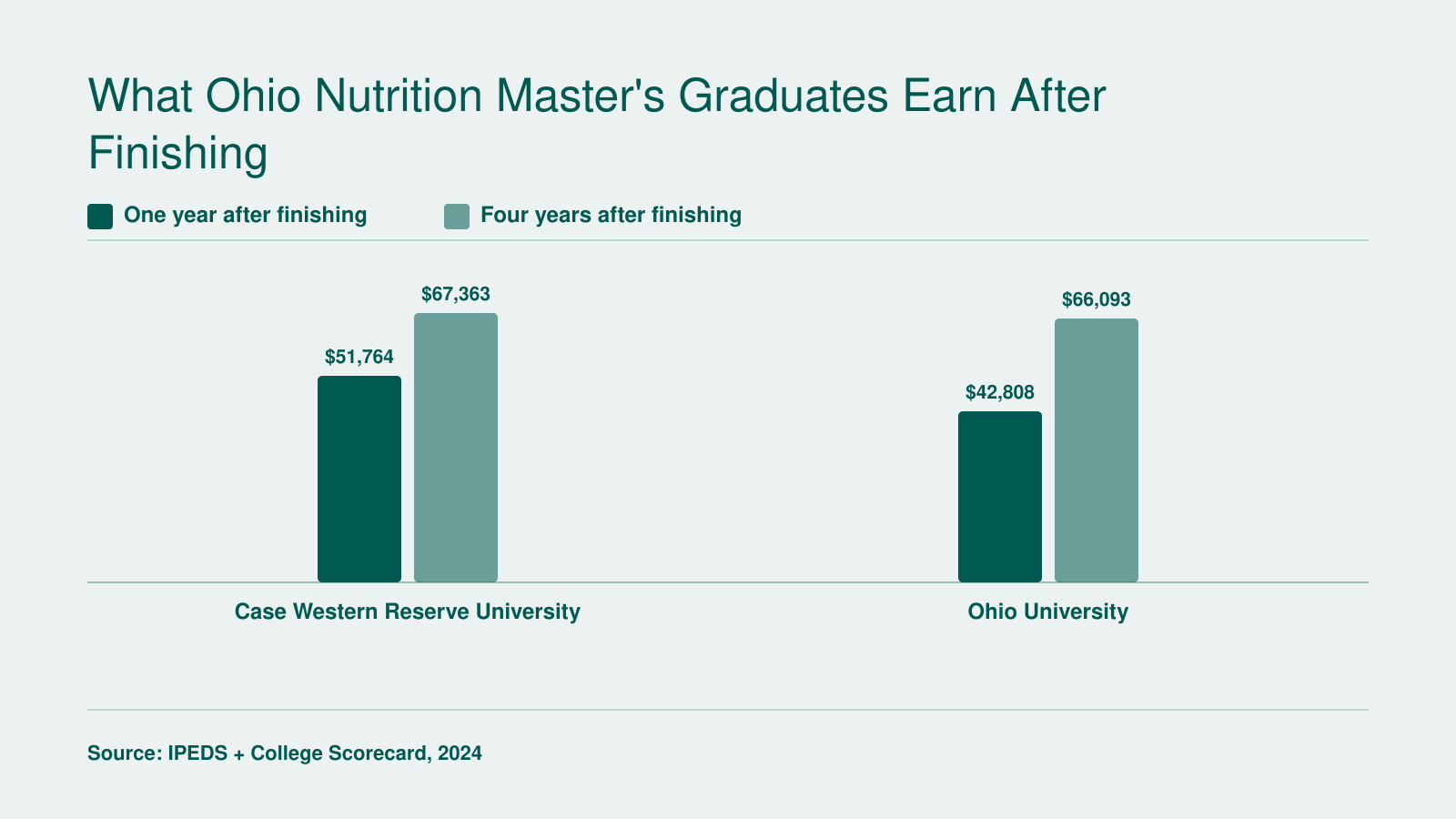
Program-level median earnings are reported for only two of the schools here: Case Western Reserve University and Ohio University. Case Western graduates earn $67,363 four years after finishing, against $66,093 at Ohio University. Case Western's median program debt is $70,658, which is more than a year of those earnings. Ohio University's program debt is not reported, though its public tuition is far lower.
Nutrition Master's Program Cost in Ohio: Online vs Campus
Online master's in nutrition programs in Ohio are not cheaper across the board. Ohio University's online M.S. charges $593 per credit for residents and $1,113 for nonresidents, so out-of-state online students do not get the in-state rate. Ohio State's 2026-27 schedule is the exception: qualifying online-only nonresidents pay a $200 per-term surcharge instead of $1,949.44 per credit, but its Human Nutrition MS is in person. Net price is an approximate institution-wide average, not a program-specific cost.
| School | Format | Graduate tuition (in-state) | Graduate tuition (out-of-state) | Approx. net price (institution-wide) | Per-credit rate and estimated total |
|---|---|---|---|---|---|
| Miami University-Hamilton | Campus | $16,359 | $37,399 | $11,286 | $726 per credit; 30 credits is about $21,780 |
| University of Akron | Online | $10,125 | $15,885 | $13,946 | N/A (credits not established) |
| Ohio State University | Campus | $13,901 | $42,740 | $17,339 | About $898 per credit in listed 2026-27 fees; nonresident surcharge $1,949.44 per credit; total credits not established |
| Bluffton University | Hybrid | $9,430 | $9,430 | $19,943 | N/A (one-year program) |
| Ohio University | Campus; online M.S. also offered | $9,720 | $17,712 | $21,637 | Online M.S.: $593 in-state, $1,113 out-of-state per credit; total credits not established |
Compare Nutrition programs on the data that matters
Explore more Healthcare specializations or browse every graduate field.
All Healthcare programs