Best Master's in Nutrition Programs in Minnesota
Compare 3 accredited Nutrition programs in Minnesota, with graduate earnings, cost, debt, and completion data from IPEDS and the U.S. College Scorecard.
A research-focused MS and a RDN-preparedness program serve different ends, and Minnesota's options sit across that divide. Since 2024, the Commission on Dietetic Registration exam has required a graduate degree, so the specific program you pick now controls your eligibility, not just your coursework.
Minnesota's ranked programs are a small field, and they differ sharply on price, delivery format, GRE expectations, and whether they lead to RDN exam eligibility. For most applicants, the Most Affordable Master's in Nutrition Programs and the Best Online Master's in Nutrition Programs are useful comparison points, but the real question is not which school is best known, but which credential track the degree actually qualifies you for.
Key Points
- Minnesota State University-Mankato offers a Distance Option with online asynchronous or HyFlex coursework.
- The University of Minnesota-Twin Cities dietetics master's runs 30 credits at $1,827 per credit (2026-2027).
- Licensure requires current CDR registration, or a qualifying degree plus at least 900 supervised practice hours.
Top-Ranked Master's in Nutrition Schools in Minnesota
Minnesota has three master's options in our data, and they serve different goals: a research-focused MS in Nutrition, a career-changer route to the RDN credential, and a competency-based dietetics degree with distance elements. Check each program's ACEND status before you apply. Two of the three currently hold candidacy rather than full accreditation, and the third's RDN pathway runs through a separate dietetics track.
University of Minnesota-Twin Cities
#1Minneapolis, MN · ~$22,000/yr (est.)
Best for: Research-minded students heading toward doctoral study
The University of Minnesota-Twin Cities offers a research-heavy MS in Nutrition covering vitamin and mineral biochemistry, nutritional genetics, physiology, and biostatistics, with thesis (Plan A) or project (Plan B) tracks. The school graduates about 85% of its students, the highest rate of the three. Listed graduate tuition is $19,980 in-state and $31,212 out-of-state. ACEND note: the university is listed as under review, with a review date of October 18, 2026. The MS is research-oriented, so a graduate is not automatically eligible for the RDN exam. The separate Dietetics MPS requires an ACEND-accredited DPD first, so confirm your RDN route with the department.
- Thesis (Plan A) or project (Plan B) options
- Thesis track: at least 20 coursework credits plus 10 research credits
- Average completion time of 2.3 years
- Small cohort of 9 current MS students
- GRE scores are no longer required
- Fall review takes about four months, with faculty adviser contact at stage two
- Integrated BS/MS Plan B for UMN nutrition undergraduates (3.0 GPA, May 1 deadline)
St Catherine University
#2Saint Paul, MN · $15,000 – $20,000/yr (est.)
Best for: Career changers from non-nutrition bachelor's degrees
St. Catherine University (St. Kate's) in Saint Paul builds its MS in Nutrition and Dietetics around 1,035 hours of supervised rotations at hospitals, nursing facilities, clinics, and community sites within about 60 minutes of the Twin Cities. Applicants may hold a bachelor's degree in any field if they finish the prerequisites. The school graduates about 61% of its students, and listed graduate tuition is $17,910 for residents and nonresidents alike. ACEND note: the program holds candidacy accreditation, not full accreditation. The university states that it prepares graduates for the RDN registration exam.
- 21-month, 48-credit full-time program starting each fall
- 1,035 supervised practice hours across diverse clinical sites
- At least five prerequisite courses, including foundational nutrition, before applying
- 3.0 GPA expected; applicants below it may submit an explanatory statement
- Rolling review; Feb 1 deadline (entry-level), Oct 1 (dual-degree)
- 3+2 dual-degree option available
- Emphasis on social justice, health equity, and interprofessional learning
Minnesota State University-Mankato
#3Mankato, MN · $10,000 – $20,000/yr (est.)
Best for: Cost-conscious students wanting flexible delivery
Minnesota State University-Mankato offers the lowest listed graduate tuition of the three: $9,540 in-state and $19,080 out-of-state. Its MS in Dietetics is a competency-based Future Education Model program with 1,000 supervised hours and multiple entry routes, including a BS-to-MS coordinated stream and an option to pair it with an MPH. The school graduates about 54% of its students. ACEND note: the program holds candidate status, not full accreditation. The program states that graduates are eligible to sit for the RDN credentialing exam.
- Future Education Model, competency-based graduate program
- 40 credits, completed in about two years
- 1,000 hours of supervised experiential learning
- Three start dates per year (fall, spring, summer) with rolling admissions
- 3.0 GPA minimum; prerequisite courses required
- Graduate assistantships available
- Supervised experiential courses carry an extra $500-per-credit differential
- BS-to-MS Coordinated Program takes about five years, with distance learning in the master's phase
Cost & outcomes by school
Federal data for the highest-earning Nutrition programs, independent of the ranking above. Earnings are this field's master's graduates four years after completing, where the Scorecard reports them.
| School | Earnings | Tuition / yr | Debt | Grads/yr | Format |
|---|---|---|---|---|---|
| Minnesota State University-Mankato MN | — | $10,449 | — | — | Hybrid |
| St Catherine University MN | — | $18,570 | — | — | Campus |
| University of Minnesota-Twin Cities MN | — | $22,017 | — | — | Campus |
Sources: U.S. Department of Education. Tuition and graduates: IPEDS. Earnings and debt: College Scorecard, this field's master's graduates; a dash means no figure is reported.
Online and Hybrid Master's in Nutrition Options in Minnesota
Online coursework has spread through dietetics education, and online master's in nutrition programs still tie students to real sites for supervised practice. Minnesota State University-Mankato comes closest to distance learning. Its Master of Science in Dietetics offers a Distance Option with online asynchronous or HyFlex courses that distance students can join by Zoom. It is not fully remote: students must stay available to come to the Mankato campus when coursework or supervised experiential learning requires it. The program arranges preceptors for its 1,000 hours of community, clinical, and foodservice practice.
St Catherine University runs its Master of Science in Nutrition and Dietetics on campus and full time, with some hybrid courses.1 Its 1,014 supervised hours span acute care, skilled nursing, outpatient, community, and foodservice rotations, and placement travel is typically no more than 60 minutes outside the Twin Cities.2
Ask the University of Minnesota-Twin Cities directly about format and placements. Out-of-state applicants eyeing Mankato's distance route should confirm the program is authorized in their state before choosing among online master's programs in Minnesota.
Minnesota Master's in Nutrition Programs That Don't Require the GRE
Most dietetics and nutrition graduate programs have dropped the GRE, but policies change, so confirm against each program's current admissions page before you apply. Where a school publishes nothing, the table says so rather than guessing.
| School | Program | GRE Policy | Notes |
|---|---|---|---|
| University of Minnesota-Twin Cities | Nutrition graduate program | Not required | Applicants are asked not to submit GRE scores, even if they have them. |
| University of Minnesota-Twin Cities | Dietetics Master of Professional Studies (MPS) | Not required | Applicants should not upload GRE scores. |
| University of Minnesota-Twin Cities | Public Health Nutrition MPH | Not required | The School of Public Health does not require the GRE for its master's and doctoral programs. |
| Minnesota State University-Mankato | Dietetics, Master of Science (MS) | No published policy | Listed requirements include a bachelor's degree and a 3.0 GPA; the GRE is not listed. |
| St Catherine University | Nutrition/dietetics master's program | No published policy | No GRE policy was found on an official page, which does not show whether the test is required. |
Related Articles
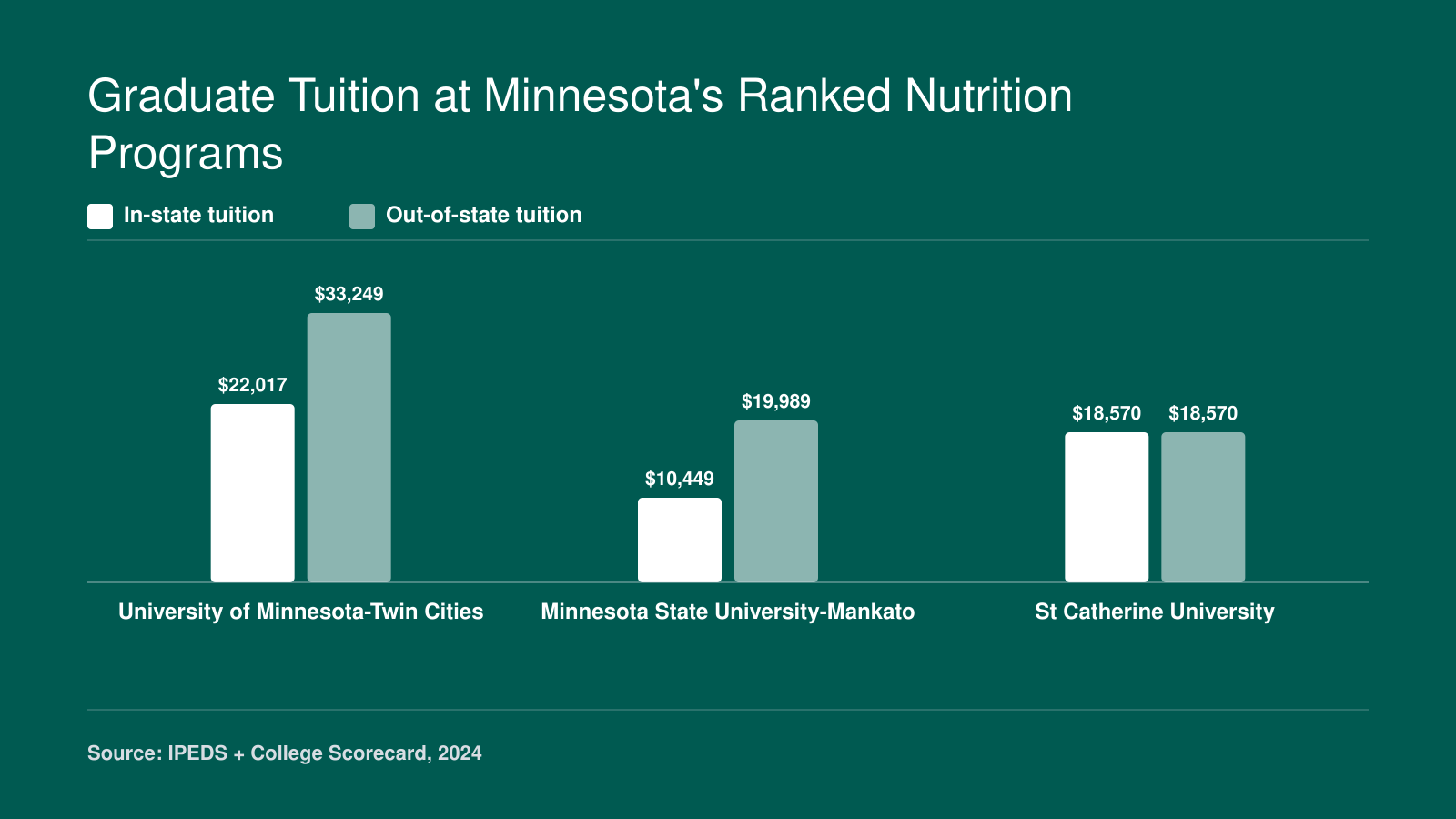
Graduate Tuition at Minnesota's Ranked Nutrition Programs
These bars show annual graduate tuition and fees for in-state and out-of-state students at each school. They are yearly figures, not total program cost, so multiply by the length of your program and add living expenses. Private schools often charge one rate regardless of residency, which is why St Catherine University shows identical bars.
Master's in Nutrition Cost and Minnesota Dietitian Licensure
Total program cost, not the per-credit rate, separates these schools, and the gap is wide. At the University of Minnesota-Twin Cities, the 30-credit Master of Professional Studies in Dietetics runs two semesters at $1,827 per credit (2026-2027), about $54,810 in tuition before university and collegiate fees, which vary by student. St Catherine University's 48-credit MS in Nutrition and Dietetics totals $36,480 at $760 per credit. Minnesota State University-Mankato charges $570 per credit for residents and $826 for nonresidents, plus $48.39 per credit in fees, and FCS593 and FCS693 carry a $500-per-credit differential. Its total depends on the credits required, so confirm that figure with the department.
Paying for It
Ask each program about graduate assistantships, department scholarships, and Master's in Nutrition Programs With No GRE Required. Federal Direct Unsubsidized loans are available, and Grad PLUS may apply depending on current federal rules, so check with the financial aid office before budgeting around it.
The Minnesota Path to Licensure
Earn an ACEND-accredited graduate degree, complete at least 900 hours of supervised practice, pass the CDR registration exam for RDNs, then apply to the Minnesota Board of Dietetics and Nutrition Practice as a Licensed Dietitian. Initial board charges total $357 as of 2026, including a $175 application fee.
Minnesota also licenses nutritionists separately. Licensed Nutritionist initial charges total $360, and the requirements differ from the dietitian track.
Minnesota Dietitian Licensing at a Glance
Research, Clinical, or Public Health: Choosing Your Master's in Nutrition Track
The track you choose decides whether you finish ready for research or ready to sit for the RDN exam, and the two are not interchangeable.
- Thesis-based MS: University of Minnesota-Twin Cities offers a research master's through its Department of Food Science and Nutrition, with 20 coursework credits, 10 research credits, and a required thesis. Research focus includes dietary patterns and nutritional biochemistry. It suits PhD preparation.
- Professional dietetics master's: Minnesota State University-Mankato's Dietetics MS runs 24 months and includes 1,000 supervised hours. St Catherine University's program builds supervised experiential learning toward the Registered Dietitian exam.1
- MPH nutrition: Minnesota State University-Mankato pairs its dietetics degree with an online MPH in Minnesota, the Public Health: Dietetics track. Its separate Public Health: Nutrition MPH requires an RDN already.
Only ACEND-accredited graduate programs lead to RDN exam eligibility. A research MS alone does not. Mankato lists candidate status, so confirm current standing before you apply.
Career and Salary Outcomes for Minnesota Nutrition Graduates
What jobs do nutrition master's graduates actually land in Minnesota? Clinical work is the biggest lane, and it usually requires RDN eligibility or ACEND coursework plus supervised practice. Openings posted in 2026 included clinical dietitian roles at CentraCare in Willmar and the Minnesota Department of Veterans Affairs in Preston1, an inpatient acute-care dietitian post at Allina's Abbott Northwestern Hospital2, and a Sodexo campus dietitian job at Minnesota State University-Mankato that asked for registered status and a master's.3
- Health systems: Clinical, outpatient, or acute-care dietitian and nutrition manager, at employers such as Mayo Clinic and CentraCare.
- Public health: WIC professional (Rice County posted one in 20261), community nutritionist (Sherburne County1), nutrition educator, and policy analyst.4
- Food service and industry: Food service management through Sodexo, schools, and long-term care, plus regulatory, labeling, and product-development work at General Mills or Land O'Lakes, often without the RDN.
- Research: Research nutritionist roles, which may carry extra lab or experience requirements.
Admission Requirements and Deadlines
Requirements below come from each program's published pages and handbook. Confirm current dates and materials with the school before you apply. Published details for the University of Minnesota-Twin Cities were not specific enough to list here.
- Bachelor's degree and GPAMinnesota State University-Mankato and St Catherine University each state a 3.0 minimum GPA. St Catherine lets applicants below 3.0 submit an explanatory statement.
- Prerequisite coursesMankato expects a dietetics bachelor's with DPD background, or another degree plus the required courses (anatomy, physiology, nutrition, medical terminology, chemistry) at C or better. St Catherine lists anatomy and physiology, general chemistry, psychology, statistics, microbiology, and foundational nutrition, with at least five finished by application.
- Deadlines and start termsMankato admits for fall, spring, and summer on a rolling basis; international deadlines are May 1 (fall) and September 1 (spring). St Catherine starts each fall, with deadlines of February 1 (Entry-Level) and October 1 (Dual-Degree).
- Essays, experience, and formsSt Catherine applicants apply through DICAS, write four essays of about 200 words, and document at least 125 hours of relevant experience. Entry-Level ACEND graduates also submit a degree verification or intent-to-complete form. Mankato applicants use its D2L site and the Graduate School application; its published pages don't give a full list of essays or recommendations.
- GREMankato does not require the GRE. St Catherine's application instructions list no GRE requirement. See the GRE section above for details.
Frequently Asked Questions About Minnesota Master's in Nutrition Programs
Which Minnesota nutrition master's program is best for becoming an RDN?
Can I become a registered dietitian with a master's in nutrition from Minnesota State Mankato?
What is the difference between a Master of Science and a Master of Professional Studies in nutrition?
Can I enter a dietetics master's in Minnesota without an undergraduate nutrition degree?
Compare Nutrition programs on the data that matters
Explore more Healthcare specializations or browse every graduate field.
All Healthcare programs