Best Master's in Nutrition Programs in Massachusetts
Compare 18 accredited Nutrition programs in Massachusetts at 8 schools, with graduate earnings, cost, debt, and completion data from IPEDS and the U.S. College Scorecard.

In Massachusetts, the credential you want should pick your nutrition master's before the brand name does. Published program tuition runs from $10,965 for in-state students at Framingham State University to $67,626 at Boston University, and only some programs carry the ACEND accreditation that leads to the Registered Dietitian exam.
The real choice pits Boston research universities against smaller private schools, campus against online. Online study rarely removes supervised practice, which both RD and CNS routes require before Massachusetts licensure.
Key Points
- Tufts offers a 100% online, 30-credit M.S. in Nutrition with no residency.
- Tufts Friedman's on-campus M.S. runs about $53,376 a year across 48 credits.
- Massachusetts licenses both RDNs and CNS holders as LDNs through the state board.
Best Master's in Nutrition Programs in Massachusetts, Ranked
Several schools below offer more than one nutrition master's listing, so each program is listed by its own concentration and format rather than as a single school entry. Accreditation matters here: regional accreditation covers the institution, while only ACEND accreditation tied to a dietetics pathway leads to the registered dietitian route. Read each accreditation line closely before you apply.
Merrimack College
#1North Andover, MA · ~$37,000/yr (est.)
Best for: Aspiring sports dietitians wanting integrated training
Merrimack College in North Andover runs an on-campus, two-year Master of Science in Nutrition and Human Performance built around 1,000 hours of supervised practice, with sports and Division I athletic settings alongside clinical and community rotations. It is described as the first ACEND-accredited nutrition graduate program of its kind in Massachusetts and uses the Future Education Model, so graduates can sit for the CDR exam without a separate internship match. The school's overall graduation rate is 70%. Accreditation: the program is listed as ACEND-accredited.
- 54 credits over two years, on campus, cohort model
- 1,000 hours of supervised experiential learning
- Prepares graduates to sit for the CDR exam
- Test optional, no entrance exam required
- 3.0 GPA minimum, one recommendation, prerequisites required
- Priority deadline Feb. 15, then rolling admission
- Sports nutrition focus with Division I athlete exposure
- One-step design removes the competitive internship application
- STEM-designated, with a success coach from admission on
- Clinical concentration with Medical Nutrition Therapy coursework
- Full-time, fall start, five concentration options
- Dean Scholarships available
Simmons University
#2Boston, MA · $25,000 – $30,000/yr (est.)
Best for: Part-time students studying online or evenings
Simmons University in Boston's Longwood Medical Area offers a 30-credit, 10-course Master of Science in Nutrition and Health Promotion that can be taken online or in evening classes on campus. Students choose Applied Nutrition Science, which ends in a research project, or Entrepreneurship, which ends in a business plan, and can finish in one year full-time or two to three years part-time. The school's overall graduation rate is 72%. Accreditation: the school is regionally accredited, and ACEND covers its dietetics coursework and dietetic internship rather than clearly covering the standalone M.S.
- 30 credits, 10 courses, online or on-campus evening classes
- One year full-time or two to three years part-time
- Prerequisite courses required, faculty advisor assigned
- Option to pair the MS with a dietetic internship for the RDN route
- Applied Nutrition Science track with research and health communication focus
- Capstone research project required
- Entrepreneurship track ends in a business plan
- Capstone required
- Can combine the MS with DPD coursework and an internship
Framingham State University
#3Framingham, MA · ~$11,000/yr (est.)
Best for: In-state students watching their budget
Framingham State University is a public, on-campus option for the Food and Nutrition M.S. with a Nutrition Science specialization, combining biochemistry, research methods, applied nutrition and dietetics. It suits Massachusetts students who want a lower-cost route and plan to complete the DPD requirements for the registered dietitian pathway. The school's overall graduation rate is 48%. Accreditation: the university is NECHE-accredited (continued in 2024), and ACEND applies to the separate Coordinated Program in Dietetics, not to this specialization.
- On-campus format with Nutrition Science specialization
- 3.0 QPA required, 2.75 considered after two approved prerequisites
- Two recommendations and a 300-word personal statement
- Anatomy and physiology, biochemistry, biostatistics within five years
- ACEND DPD verification accepted for the RD pathway
- Coordinated Program in Dietetics is a separate competitive application
- Pre-admission advising by Zoom or phone with the DPD director
Tufts University
#4Medford, MA · ~$51,000/yr (est.)
Tufts University's Friedman School in Medford is a stand-alone graduate nutrition school with online and on-campus master's options, including an accelerated degree for Tufts and Holy Cross undergraduates and two online concentrations. A joint online master's in Applied AI for Food and Nutrition is planned with a first cohort in spring 2027. The school's overall graduation rate is about 94%. Accreditation: Tufts is NECHE-accredited, and ACEND accreditation applies to the combined M.S./Dietetic Internship, not to the online or accelerated M.S. listed here.
- For Tufts and Holy Cross undergraduates, online or on campus
- Specializations include Food Policy, Community Interventions, Nutrition Equity
- Application fee and tuition deposit waived
- Joint advising with the undergraduate institution
- 30 credits, 10 courses, one year full-time or two years part-time
- Four concentration options
- Only one science prerequisite course
- Three recommendations and a $70 application fee
- Concentration in climate, sustainability and food systems
- Option to design your own specialization
- Work with established research centers and institutes
Boston University
#5Boston, MA · $65,000 – $70,000/yr (est.)
Boston University offers three on-campus master's tracks in nutrition: a two-semester M.S. open to any undergraduate background, an M.S. paired with a dietetic internship, and a thesis-based Nutrition and Metabolism M.S. The internship route runs through major Boston hospital partners, including partnership sites. The school's overall graduation rate is 89%. Accreditation: the School of Public Health is listed by CEPH through July 2026, but a separate CEPH or ACEND accreditation for these nutrition master's is not confirmed, and renewal after July 2026 is not established.
- Two-semester, 32-credit, STEM-eligible program
- Build your own concentration, optional practicum
- No nutrition background required
- Graduate assistantships available
- Clinical rotations at major Boston hospitals
- Prepares for the CDR national exam
- Customizable semester-long practicum
- Standard M.S./DI or M.S. plus Partnership DI structure
- Thesis required, 32 credits, lab research placement
- Most students take 1.5 to 2 years, 12 months possible
- Study obesity, diabetes and heart disease
- Suited to medicine, dentistry or PhD plans
Northeastern University
#6Boston, MA · ~$26,000/yr (est.)
Northeastern University's Master of Science in Applied Nutrition is a fully online program from its College of Professional Studies in Boston, designed for working professionals and completed in under two years. Concentrations include Business and Entrepreneurship in Nutrition, Nutrition Education, and Nutrition and Fitness, all taught by registered dietitians and practitioners. It fits counseling, wellness and entrepreneurial careers more than the dietitian route. Accreditation: no programmatic accreditation was found, so we can say only that the school is regionally accredited.
- 100% online, five concentration options
- Builds wellness program and communication skills
- Core includes Medical Nutrition Therapy and Clinical Health Behavior Change
- Typically completed in less than two years
- Online concentration taught by registered dietitians and clinicians
- Focus on metabolism and disease prevention
- Quarter-hour credit system
- 49 total credit hours, fully online
- Prepares for nutrition counseling roles
Cost & outcomes by school
Federal data for the highest-earning Nutrition programs, independent of the ranking above. Earnings are this field's master's graduates four years after completing, where the Scorecard reports them.
| School | Earnings | Tuition / yr | Debt | Grads/yr | Format |
|---|---|---|---|---|---|
| Framingham State University MA | $83,433 | $10,965 | — | 12 | Campus |
| Simmons University MA | $74,038 | $28,561 | $41,000 | 31 | Online |
| Tufts University MA | — | $50,798 | — | — | Online |
| Northeastern University MA | — | $26,020 | — | 1 | Online |
| Northeastern University MA | — | $29,174 | — | — | Online |
| Merrimack College MA | — | $36,800 | — | 8 | Campus |
| Boston University MA | — | $67,626 | — | — | Campus |
| Harvard University MA | — | $57,248 | — | — | Campus |
Sources: U.S. Department of Education. Tuition and graduates: IPEDS. Earnings and debt: College Scorecard, this field's master's graduates; a dash means no figure is reported.
Cost, debt & payoff
Median earnings of this field's master's graduates (4 yrs after completing) vs. their median federal loan debt · U.S. College Scorecard
Across these programs the median graduate earns about $74,038 and finishes with roughly $41,000 in debt — a ratio that clears a common rule of thumb (keep debt below first-year salary). Tuition and debt vary widely school to school, so check the per-school figures in the table above before you shortlist.
Online and Hybrid Master's in Nutrition Options in Massachusetts
Online master's in nutrition programs let you complete graduate coursework from home, though not every requirement moves off campus. Tufts University offers a 100% online M.S. in Nutrition (30 credits) with no on-campus residency. Format varies by course: some are hybrid, some fully synchronous, some fully asynchronous. Published materials don't say whether live sessions meet at fixed evening or weekend times, so ask admissions before you enroll.
Framingham State University's Nutrition Education M.Ed. is also delivered online. Its page doesn't describe the synchronous mix or typical time to completion. School Nutrition Specialist applicants must pass a timed online comprehensive exam and apply by June 1 of the preceding academic year to start the fall internship.1 Confirm whether that internship is in person.
Pacing and Completion Time
Tufts typically takes one year full time or two years part time, with the part-time route spreading 10 courses over a longer period. Simmons and Merrimack's online program also offer 1-year nutrition master's programs, so Tufts is not the only fast option.
What Online Can't Remove
Tufts requires at least 120 hours of approved experiential learning, and published materials don't establish whether those hours can always be completed remotely. Students on a registered dietitian track should expect supervised practice to happen in person, whatever the coursework format.
Working professionals will generally fit best with a part-time online route, provided they can arrange supervised hours around their jobs.
Which Massachusetts Nutrition Master's Programs Waive the GRE
Some programs drop the GRE outright; others leave it optional as a way to strengthen a thin academic record. Across the schools ranked here, none of the nutrition master's programs treat the exam as a hard requirement, a stance common among No-GRE master's programs, so your transcripts, statement, and recommendations carry the weight.
- Boston University (MS in Nutrition and Metabolism): GRE not required. Applications for 2027 are paused; the prior cycle closed August 1 for international and August 15 for domestic applicants. Submit letters of recommendation, a personal statement, and research experience.
- Tufts University (MS in Nutrition): No GRE listed. On-campus deadlines are October 15 (spring) and January 15 (fall); online deadlines run December 1, April 1, and July 15. Send three recommendations, a one-page statement, transcripts, and the $70 fee.
- Merrimack College (MS in Nutrition and Human Performance): No GRE required; scores are optional. Priority deadline February 15, then rolling. Requires a bachelor's and a 3.0 GPA.
Most programs expect prerequisite science coursework, typically biology and chemistry, completed before you start.
Related Articles
Cost of a Master's in Nutrition in Massachusetts and How to Pay for It
The real tradeoff here, as with many master's programs in Massachusetts, is sticker price against the financing a school can actually put behind it. Among the published 2026-27 figures, Tufts Friedman's on-campus M.S. in Nutrition runs about $53,376 a year across 48 credits, roughly $106,752 in tuition before fees, over the two-year program. Boston University's Sargent M.S. in Nutrition charges about $36,512 per semester, with an estimated full-program cost near $74,072.1 That leaves a spread of more than $30,000 between the two over the length of the degree, driven mainly by Tufts's larger credit load.
Where Numbers Are Thin
Average net price figures you may see quoted are institution-wide after aid, not a quote specific to nutrition master's students, so treat them as context, not a program bill. Current per-credit rates and nutrition-specific funding for Framingham State were not published at the time of writing, so compare on what each school documents rather than filling gaps.
Aid Worth Chasing
- Tufts Friedman: scholarships, grants, funded research employment, and teaching assistantships are offered, with scholarship deadlines of Oct. 15 (spring) and Jan. 15 (fall).
- Simmons: qualified applicants may receive up to $20,000, and M.S./D.I. applicants are reviewed for $6,000 to $16,000.
- Boston University: graduate assistantships are available.
- UMass Amherst: master's students can be considered for research and teaching assistantships.
Massachusetts Licensure for Dietitians and Nutritionists
Which Programs Lead to the CNS or Registered Dietitian Credential
Two credentials drive most nutrition master's decisions, and they run on separate tracks. The Registered Dietitian (RD) route goes through ACEND-accredited education and the CDR exam. The Certified Nutrition Specialist (CNS) route, run by BCNS, requires a master's degree, 1,000 supervised practice hours, and an exam.
RD Pathways Among the Ranked Schools
- Tufts University: The combined MS/DI requires a bachelor's plus an ACEND DPD. Optional rotations include Joslin Diabetes Center, Children's Hospital Boston, and Kate Farms. Confirm whether Tufts assigns every placement.
- Boston University: The MS/DI requires a DPD or FDE verification statement, then 29 weeks of full-time supervised practice at an affiliate site. The standalone MS in Nutrition is not an RD pathway.
- Simmons University: The M.S. in Nutrition and Health Promotion is not itself ACEND-accredited. Students add a DPD and either a 21-month combined M.S./internship or a 35-week DI. The internship requires at least 1,000 unpaid hours, with placements at Simmons and Boston-area partners.
- Northeastern University: No ACEND-accredited program.
A research-focused MS without an ACEND component does not make you RD-eligible on its own. For Merrimack College and Framingham State University, check the ACEND directory and ask admissions directly about supervised practice before applying.
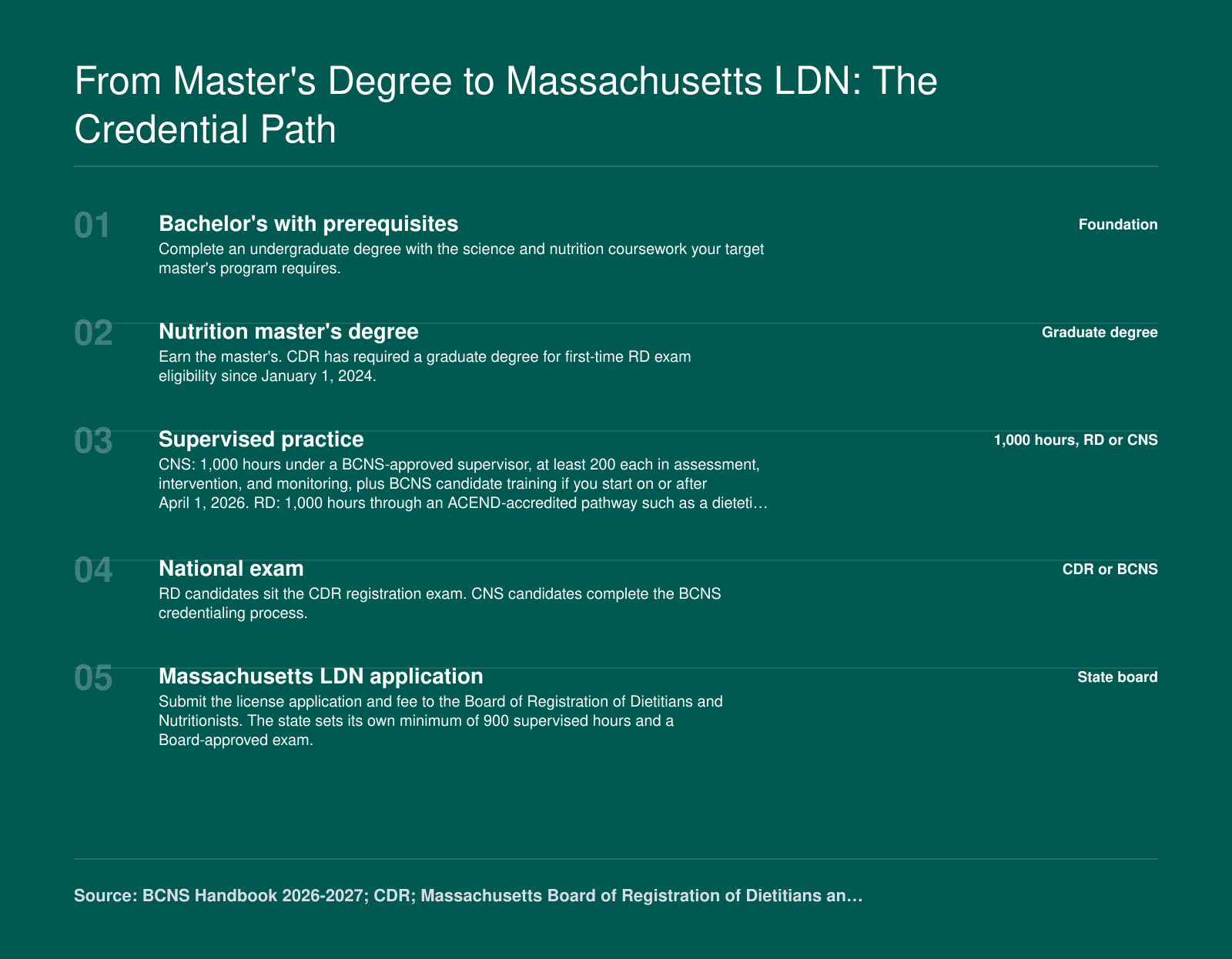
From Master's Degree to Massachusetts LDN: The Credential Path
The RD and CNS routes split at supervised practice and the national exam, then meet again at the Massachusetts LDN application to the state board.
Frequently Asked Questions About Master's in Nutrition Programs in Massachusetts
Which Massachusetts nutrition master's program is the least expensive?
Can I complete a master's in nutrition in Massachusetts in one year or part time?
When are application deadlines for Massachusetts nutrition master's programs?
Can I become a dietitian in Massachusetts with an online master's?
Compare Nutrition programs on the data that matters
Explore more Healthcare specializations or browse every graduate field.
All Healthcare programs