Best Online Master's in Nutrition Programs
Compare 130+ accredited online Nutrition programs, with graduate earnings, cost, debt, and completion data from IPEDS and the U.S. College Scorecard.

Two routes lead into nutrition: a degree built around the registered dietitian pathway, or one aimed at the CNS credential and advanced practice roles outside dietetics. Both now require a graduate degree, and both can be completed from home.
Every program on this list is 100% online, with no hybrid sessions or in-person residency. Average net price after grant aid runs from about $12,800 at Wayne State University to about $32,700 at the University of Southern California, so cost separates these options as much as concentration does.
An online degree alone does not make you eligible for the RDN exam. ACEND accreditation and supervised practice requirements decide that.
Key Points
- Fully online nutrition master's programs vary widely in net price after aid.
- Simmons University leads ranked programs for early-career earnings.
- A graduate degree is now required for the registered dietitian exam.
Top 10 Fully Online Master's in Nutrition Programs for 2027
These 10 programs are fully online: none require hybrid or in-person components to earn the degree. Each entry highlights a distinct concentration, format, and audience, from longevity science and plant-based nutrition to clinical management and personalized nutrition pathways.
University of Southern California
#1Los Angeles, CA · ~$72,000/yr (est.)
Best for: Future RDNs focused on aging and wellness
USC's Leonard Davis School focuses its online Master of Science in Nutritional Science on healthspan and longevity. The 32-unit, STEM-designated program is built for students with a nutrition background, such as verified DPD holders or current registered dietitians. Full-time students can finish in as little as a year, and graduates work in hospitals, long-term care, wellness coaching, research, and policy. Annual graduate tuition and required fees are about $72,097 for both in-state and out-of-state students.
- 32 total credit hours
- STEM Visa eligible
- Synchronous online classes
- Full-time in 12 to 18 months
- Part-time in 18 to 36 months
- 24 units didactic, 8 units research
- GRE required
- Financial aid and scholarships available
Loma Linda University
#2Loma Linda, CA · ~$34,000/yr (est.)
Best for: Plant-based nutrition dietitians seeking faith-integrated training
Loma Linda University offers the first fully online Master of Science in Plant-Based Nutrition, aimed at dietitians and healthcare professionals. The competency-based curriculum covers advanced nutritional science, health promotion, and research methods while integrating faith and health. Graduates typically pursue research roles or continue to doctoral study. Reported graduate tuition is around $25,500 in-state and $30,000 out-of-state.
- ACEND accredited
- First online MS in plant-based nutrition
- Competency-based curriculum
- Designed for dietitians and health professionals
- Starts fall, spring, and summer
- Prepares for researcher or PhD pathway
- Financial aid and scholarships available
University of Connecticut
#3Storrs, CT · ~$23,000/yr (est.)
Best for: Working professionals needing CNS credential preparation
UConn's online Master of Science in Personalized Nutrition is a 30-credit, two-year program blending nutrigenomics, biochemical pathways, and clinical applications. The asynchronous format suits working professionals, and the coursework fulfills academic requirements for the Certified Nutrition Specialist credential. Annual graduate tuition and fees are $21,044 for Connecticut residents and $43,712 for nonresidents.
- 30 total credit hours
- Asynchronous online classes
- Two-year program
- Fulfills CNS academic requirements
- Prerequisite courses required
- Focus on nutrigenomics and clinical nutrition
- Three start dates per year
- 3.0 GPA minimum
University of Houston
#4Houston, TX · $10,000 – $19,000/yr (est.)
The University of Houston's fully online Master of Science in Nutrition is a 30-credit, non-thesis program for working professionals and dietetic interns. It emphasizes evidence-based medical nutrition therapy, advanced physical assessment, and clinical management leadership. Annual graduate tuition and fees run $9,717 in-state and $22,547 out-of-state, making it one of the more affordable options in this list.
- 30 total credit hours
- Fully online non-thesis program
- ACEND accredited
- Focus on medical nutrition therapies
- Advanced physical assessment training
- Targets dietetic interns and RDs
- Clinical management leadership focus
Arizona State University
#5Scottsdale, AZ · ~$11,000/yr (est.)
ASU's Medical Nutrition MS is delivered through ASU Online and focuses on assessing and prescribing nutrition practices to prevent disease. The program is part of the College of Health Solutions and offers a straightforward online pathway for working adults.
- Delivered through ASU Online
- Master of Science degree
- Focus on preventing disease
- Assess and prescribe nutrition practices
West Chester University of Pennsylvania
#6West Chester, PA · $10,000 – $15,000/yr (est.)
West Chester University offers a 33-credit, fully online Master of Science in Community Nutrition for registered dietitians, dietetics graduates, and other health professionals. The ACEND-accredited curriculum includes public health nutrition, maternal and child nutrition, obesity prevention, and a capstone. A separate Dietetic Internship concentration adds supervised practice and clinical hours. Annual graduate tuition and fees are $10,775 in-state and $22,599 out-of-state.
- 33 total credit hours
- Fully online program
- ACEND accredited
- Capstone project required
- Focus on community nutrition
- Small classes and doctoral faculty
- Employer reimbursement supported
- Full-time or part-time options
- 42 total credit hours
- 11-month full-time internship
- 1,000 clinical hours
- 80% licensure pass rate
- 85% job placement rate
- Prepares for CDR credentialing exam
- 3-day on-campus orientation
- Accepts 36 dietetic interns per year
University of Arizona
#7Tucson, AZ · ~$15,000/yr (est.)
The University of Arizona's online Professional Science Master's in Applied Nutrition: Nutrition and Wellness combines 30 credit hours with an 11-unit graduate practicum totaling 270 supervised hours. The ACEND-accredited program includes a capstone and PLUS coursework tailored to career goals, and it can be completed in about 18 months while working. Annual graduate tuition and fees are $13,926 in-state and $42,278 out-of-state.
- ACEND accredited
- 30 total credit hours
- 270 supervised clinical hours
- 18-month completion timeline
- Capstone project required
- 11-unit graduate practicum
- Designed for working professionals
Wayne State University
#8Detroit, MI · ~$18,000/yr (est.)
Wayne State's Master of Science in Nutrition and Food Science is offered fully online with 8-week half-semester courses and a capstone, completing in three semesters. The 32-credit program covers biochemistry, genomics, neurobiology, food safety, and epidemiology, and online out-of-state students pay in-state tuition. Annual graduate tuition and fees are $15,190 in-state and $32,037 out-of-state.
- 32 total credit hours
- No GRE required
- Three-semester completion
- 8-week half-semester courses
- In-state tuition for online out-of-state students
- Up to six credits waived for RDs
- Capstone included
- ACEND accredited
Kansas State University
#9Manhattan, KS · $12,000 – $26,000/yr (est.)
Kansas State's online master's in Nutrition, Dietetics and Sensory Sciences is a 30-credit program with five concentrations, including sensory analysis, nutrition and exercise sciences, public health nutrition, and nutrition education. Students choose a thesis, report, or coursework-only path, and the same tuition applies wherever they live. Annual graduate tuition and fees are $11,221 in-state and $28,568 out-of-state.
- 30 total credit hours
- Five concentration options
- Fully online available
- Thesis, report, or coursework-only paths
- Same tuition for all students
- 18 credits at 700 level or above
- Oral presentation required
The University of Alabama
#10Tuscaloosa, AL · ~$12,000/yr (est.)
The University of Alabama's online Master of Science in Human Nutrition is a 30-credit program with Clinical, Community, and Generalist concentration paths. It includes biostatistics and epidemiology coursework, a capstone, and no GRE requirement, with an accelerated option for UA undergraduates. Annual graduate tuition and fees are $12,180 in-state and $34,172 out-of-state.
- 30 total credit hours
- 3 concentration options
- No GRE required
- Capstone required
- 100% online option
- Accelerated master's for undergrads
- Dietetic internship partnerships
- 3.0 GPA minimum
- Clinical concentration
- Designed for registered dietitians
- No entrance exam required
- 30 total credit hours
- 10 total courses
- Starts fall, spring, summer
- Community concentration
- Includes epidemiology coursework
- 100% online or on campus
- Partners with dietetic internships
- Capstone required
- 3.0 GPA minimum
Cost & outcomes by school
Federal data for the highest-earning Nutrition programs, independent of the ranking above. Earnings are this field's master's graduates four years after completing, where the Scorecard reports them.
| School | Earnings | Tuition / yr | Debt | Grads/yr | Format |
|---|---|---|---|---|---|
| Saint Elizabeth University NJ | $75,352 | $19,178 | — | 20 | Hybrid |
| Simmons University MA | $74,038 | $28,561 | $41,000 | 31 | Online |
| Benedictine University IL | $72,603 | $19,584 | $40,312 | 17 | Online |
| Central Michigan University MI | $69,324 | $17,187 | $16,080 | 12 | Online |
| Indiana University of Pennsylvania PA | $68,605 | $12,672 | $31,856 | 8 | Online |
| Arizona State University AZ | $65,743 | $10,843 | $29,120 | 48 | Online |
| The University of Alabama AL | $64,913 | $11,980 | — | 123 | Online |
| Lamar University TX | — | $8,642 | — | 98 | Online |
| Northeastern State University OK | — | $5,771 | — | — | Online or campus |
| New Mexico State University NM | — | $6,605 | — | — | Hybrid |
| Arkansas State University AR | — | $7,322 | — | — | Online |
| Southeast Missouri State University MO | — | $7,702 | — | — | Hybrid |
Sources: U.S. Department of Education. Tuition and graduates: IPEDS. Earnings and debt: College Scorecard, this field's master's graduates; a dash means no figure is reported.
Cost, debt & payoff
Median earnings of this field's master's graduates (4 yrs after completing) vs. their median federal loan debt · U.S. College Scorecard
Across these programs the median graduate earns about $65,918 and finishes with roughly $34,200 in debt — a ratio that clears a common rule of thumb (keep debt below first-year salary). Tuition and debt vary widely school to school, so check the per-school figures in the table above before you shortlist.
How We Ranked 100% Online Nutrition Master's Programs
Since the Commission on Dietetic Registration began requiring a graduate degree to sit for the registered dietitian exam in January 2024, online nutrition master's programs have multiplied faster than reliable information about them. Our approach is to start with verifiable federal data and be clear about what that data can and cannot settle.
Fully online programs only
The first filter is delivery format. A program qualified only if coursework is delivered entirely online. Hybrid programs requiring regular campus attendance and campus-based degrees with a few remote courses were removed before anything was scored, so no program earned a spot by being strong on cost while quietly requiring you to relocate. Supervised practice hours, where a program includes them, are arranged locally and are not treated as campus residency.
The data behind the score
Scores draw on federal IPEDS reporting and the U.S. Department of Education's College Scorecard: graduate tuition, average net price, institutional graduation rate, and program-level earnings and debt where the Department publishes them. Those inputs are combined into a blended quality composite rather than a single-factor list, so an affordable online nutrition master's program with weak completion does not outrank a moderately priced one with strong outcomes.
Known limits
Net price is an average across the entire institution after aid, not a figure specific to a nutrition cohort. Graduation rates are school-wide. Smaller programs fall below the Department's reporting threshold, so earnings and debt simply are not published for some of them, and those programs are judged on what is available.
What the score leaves out
No composite captures curriculum fit, ACEND accreditation status, faculty expertise, or whether a program includes a dietetic internship pathway. Those decide whether a degree works for your career, which is why the sections that follow address them directly.
Cheapest Online Master's in Nutrition Programs and What You'll Really Pay
Published graduate tuition is only part of what you will pay. The table below compares each program's listed graduate tuition for in-state and out-of-state students with the school's average net price after grants and scholarships. That net price is an approximate, institution-wide figure, not a program-specific promise. Sticker prices can also hide technology or distance-learning fees, supervised practice or internship fees, books, and exam fees. For example, George Mason lists a $146 per-credit student fee and a one-time $60 new-student fee, while Old Dominion charges a $300 matriculation fee credited toward the first semester. Some public universities charge out-of-state online learners the same rate as residents; Wayne State on the table below confirms in-state tuition for online out-of-state students, and Northwest Missouri State and Oregon State also list flat out-of-state online rates at $492 and $609 per credit respectively. To estimate full program cost, multiply a program's published per-credit rate by its total required credits and add any practicum or technology fees.
| School | Program | Graduate tuition (in-state) | Graduate tuition (out-of-state) | Average net price |
|---|---|---|---|---|
| Lamar University | Master of Science in Nutrition | $8,642 | $16,022 | $9,366 |
| Wayne State University | Master of Science in Nutrition and Food Science | $17,960 | $36,542 | $12,766 |
| Middle Tennessee State University | Professional Studies, Leadership in Nutrition | $11,718 | $29,700 | $13,359 |
Is an Online Master's in Nutrition Worth It? Earnings, Debt, and ROI
The honest answer: it depends on what you pay and where you land afterward. For a handful of the programs here, graduate-level earnings data lets us check the math directly rather than rely on prestige. Where that program-specific data exists, the picture is encouraging.
What the Numbers Actually Show
Arizona State University's medical nutrition track is the clearest case. Graduates report median earnings of about $53,500 one year after finishing, against median program debt of roughly $29,100 and a typical ten-year monthly payment near $331. American University's nutrition education degree shows about $48,300 one year out, with higher borrowing (around $51,250 in median debt) and a monthly payment close to $583. Both climb meaningfully by year four, with ASU graduates near $65,700 and American graduates near $74,600.
The contrast matters. ASU graduates earn slightly more at one year while carrying roughly half the debt, and that lower monthly payment reshapes the whole ROI calculation. American's larger loan load means a bigger bite each month, even on respectable earnings.
Reading the ROI Proxy
Our ROI figure is a simple ratio: institution-wide 10-year earnings weighed against median graduate debt. A higher number signals more earnings relative to median debt. It is a useful first filter, not a guarantee. It cannot account for the city you work in, whether you pursue the RDN or CNS credential, or how long you stay in the field. Treat it as a starting point, then pressure-test it against your own numbers.
Who Gains the Most
Two groups see the strongest return. Career changers moving toward RDN or CNS roles may use online nutrition master's no gre programs to meet the graduate-degree requirement those credentials now demand. Working dietitians, especially those in accelerated master's in nutrition programs, use them to move into management, clinical specialties, or community and public-health leadership, where the master's often qualifies them for a pay band they could not reach otherwise. If you already have a clinical foothold, the degree tends to pay for itself faster.
Top Early-Career Earnings Among Ranked Programs
The strongest early-career earnings among ranked programs belong to Simmons University.
Related Articles
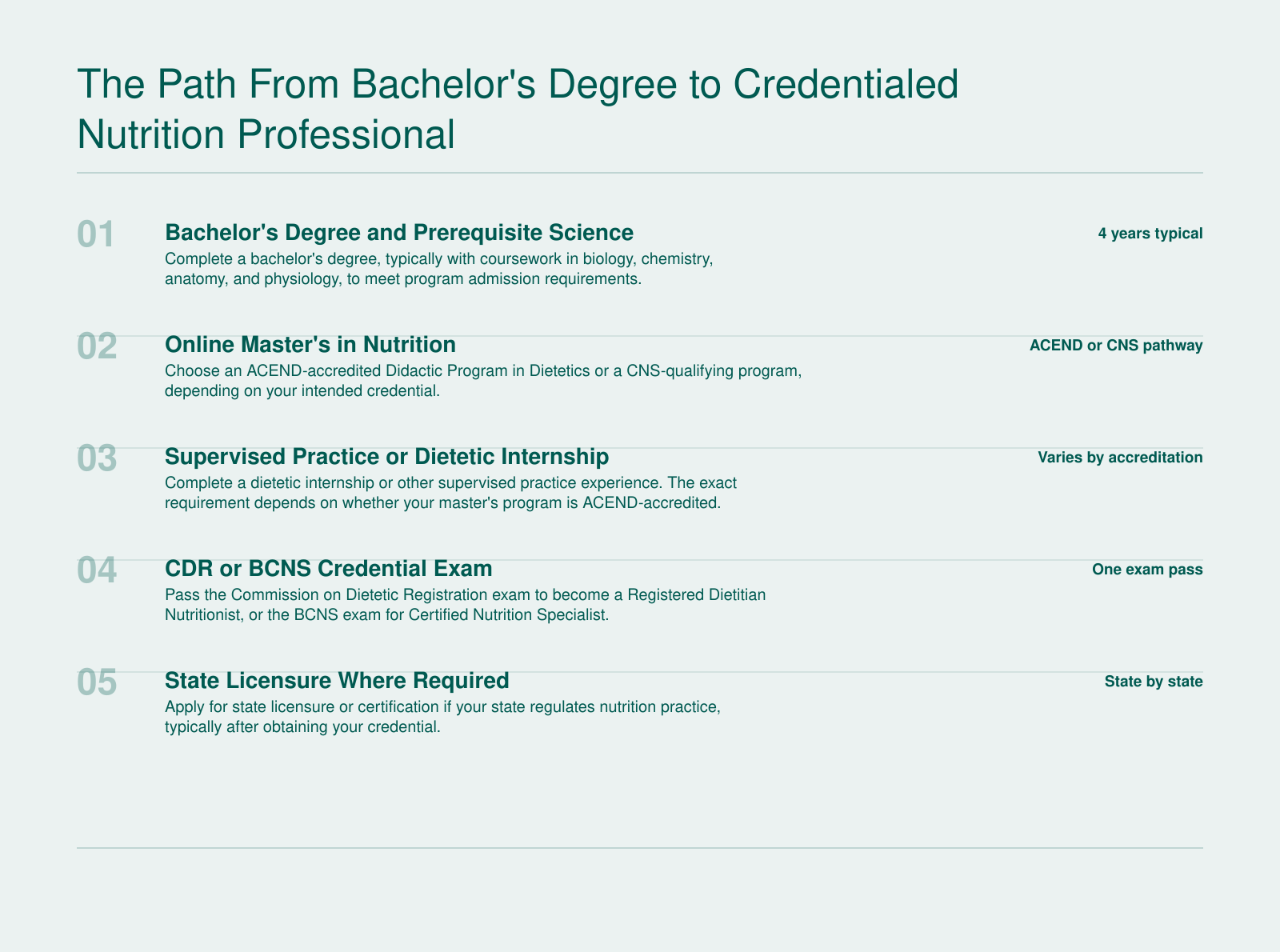
The Path From Bachelor's Degree to Credentialed Nutrition Professional
The path from a bachelor's degree to a credentialed nutrition professional has five main milestones. The order and the supervised practice requirement depend on whether your online master's program is ACEND-accredited or qualifies you for the CNS credential. For ACEND-accredited programs, supervised practice is embedded or coordinated; for CNS pathways, it may follow graduation.
Admissions Requirements and Prerequisites
Online nutrition master's programs expect a regionally accredited bachelor's degree, but the academic background and GPA threshold vary by school.
- Bachelor's degree and GPAA regionally accredited bachelor's degree is required. Published minimum GPAs among the programs below generally run from 2.75 to 3.25, with several schools citing a 3.0 floor.
- GRE policyA GRE is not universally required. Johnson & Wales and Georgia do not require it; Georgia accepts optional scores. Winthrop considers GRE scores when GPA is below 3.0.
- Supporting materialsMost applications also ask for letters of recommendation, a statement of purpose, and a current resume.
- Science prerequisitesCommon prerequisites include general chemistry, organic chemistry or biochemistry, anatomy and physiology, and introductory nutrition. Western States offers conditional admission without biochemistry; Saybrook lets students complete missing nutrition, biochemistry/organic chemistry, and anatomy/physiology in the first year with a B or better; Georgia may review an application with a third prerequisite in progress.
- Without a nutrition bachelor's degreeJohnson & Wales accepts a bachelor's in any field and adds leveling coursework in Foundations of Nutrition first. Old Dominion welcomes related fields such as public health, exercise science, or kinesiology. Maine offers additional science/engineering and biology/chemistry routes. SUNY Oneonta requires a nutrition and dietetics bachelor's or foreign equivalent.
- International applicantsInternational students should plan for English proficiency testing and possible credential evaluation; check each school's international admissions page.
According to the Bureau of Labor Statistics Occupational Outlook Handbook, employment of dietitians and nutritionists is projected to grow 8 percent from 2025 to 2035. That projection points to steady demand for nutrition professionals over the decade.
Nutrition programs by state
Frequently Asked Questions About Online Nutrition Master's Programs
Prospective students often ask whether online master's programs in nutrition lead to the registered dietitian credential, which program is the most affordable, and how to balance study with a job. These answers reflect current accreditation rules and the price and delivery details behind this page.
Can you become a registered dietitian with an online master's in nutrition?
What is the cheapest online master's in nutrition program?
Do I still need a dietetic internship if my online master's isn't ACEND-accredited?
Can I complete an online master's in nutrition while working full time?
Compare Nutrition programs on the data that matters
Explore more Healthcare specializations or browse every graduate field.
All Healthcare programs