Best Master's in Nutrition Programs in Washington
Compare 4 accredited Nutrition programs in Washington at 3 schools, with graduate earnings, cost, debt, and completion data from IPEDS and the U.S. College Scorecard.

A registered dietitian master's program built to qualify you for the RDN exam is a different purchase from a research-oriented nutrition degree, and Washington offers few of either. Since 2024, the Commission on Dietetic Registration has required a graduate degree for RDN eligibility, so program type matters more than it once did.
Net price runs from $14,971 at Washington State University to $18,476 at Central Washington University, and reaches $49,364 at private Bastyr University, a spread that matters when comparing the most affordable master's in nutrition programs. Format, accreditation status, and cost rarely line up in a single program.
Anyone targeting dietetics should confirm supervised-practice requirements before comparing tuition.
Key Points
- Bastyr's online integrative nutrition master's is fully asynchronous.
- Bastyr University's nutrition master's totals $61,745 for 78 credits.
- Washington dietitians and nutritionists earned a median $84,220 in May 2025.
Best Master's in Nutrition Schools in Washington, Ranked
Washington's master's in nutrition programs fall into three distinct paths: Bastyr's whole-foods didactic training, Washington State's research and coordinated dietetics options, and Central Washington's community-focused clinical curriculum. These profiles are ordered by institutional outcomes data, then edited for fit and transparency. Tuition and net price are listed for each school so you can weigh cost against the training you will actually receive.
Bastyr University
#1Kenmore, WA · ~$38,000/yr (est.)
Best for: Whole-foods integrative nutrition learners
Bastyr University in Kenmore offers a whole-foods, integrative master's in nutrition that combines 78 credits of didactic coursework with more than 90 hours of supervised clinical training at Bastyr Center for Natural Health in Seattle. The curriculum covers counseling, food science, medical nutrition therapy, and disease processes, and includes an integrative clinic practicum. Students are prepared to pursue a dietetic internship and the registered dietitian nutritionist credential.
- 78 total credit hours
- 92 clinical hours
- 3.0 GPA minimum
- Whole-foods and integrative medicine focus
- Prepares for CDR credentialing exam
- Clinical training at Bastyr Center
- Integrative clinic practicum in curriculum
- Next start: September 2027
Washington State University
#2Pullman, WA · ~$15,000/yr (est.)
Best for: Research-driven exercise physiology students
Washington State University in Pullman hosts two graduate nutrition routes: a thesis-based Master of Science in Nutrition and Exercise Physiology and a coordinated program in dietetics, nutrition, and exercise physiology. The thesis track offers three concentration options and research opportunities in labs such as the Food Lab and the Washington State Twin Registry, while the coordinated program includes 1,020 clinical hours and supervised practice across Washington and Idaho. The university graduates about 60 percent of its students institution-wide.
- 3 concentration options
- 30 total credit hours
- Thesis required
- Research team: Washington State Twin Registry
- Research labs: Food Lab, Nutrition and Gut Microbiome Lab
- Application deadline: January 31
- ACEND accredited
- 35 total credit hours
- 100% job placement rate
- 1020 clinical hours
- Prepares for Registration Examination for Dietetics
- Prepares for ACSM-EP credential
- Supervised practice across Washington and Idaho
- Distance education options for some coursework
Central Washington University
#3Ellensburg, WA · ~$13,000/yr (est.)
Best for: Community-engaged clinical nutrition seekers
Central Washington University in Ellensburg offers a Master of Science in Nutrition with thesis and non-thesis tracks, backed by four research labs and more than 100 community partnerships around the state. The curriculum emphasizes evidence-based practice, advanced micronutrient metabolism, nutritional biochemistry, and medical nutrition therapy.
- ACEND accredited
- Thesis or capstone option
- Four specialized research labs
- Over 100 community partnerships
- Evidence-based practice emphasis
Cost & outcomes by school
Federal data for the highest-earning Nutrition programs, independent of the ranking above. Earnings are this field's master's graduates four years after completing, where the Scorecard reports them.
| School | Earnings | Tuition / yr | Debt | Grads/yr | Format |
|---|---|---|---|---|---|
| Central Washington University WA | — | $13,220 | — | — | Campus |
| Washington State University WA | — | $14,845 | — | — | Campus |
| Bastyr University WA | — | $37,951 | — | 13 | Campus |
Sources: U.S. Department of Education. Tuition and graduates: IPEDS. Earnings and debt: College Scorecard, this field's master's graduates; a dash means no figure is reported.
Online and Hybrid Master's in Nutrition Options in Washington
Washington's accredited master's in nutrition programs still lean heavily on campus study, especially for anyone aiming at dietetics, where in-person clinical work is built into the degree.
- Fully online: Bastyr University's MS in Integrative Nutrition is entirely online and asynchronous, with no required on-site component. It totals 54 quarter credits and is designed as a two-year full-time program.1
- Campus-based: Bastyr's MS in Nutrition with Didactic Program in Dietetics is taught in Kenmore and runs 78 quarter credits over two full-time years, including more than 90 supervised clinical hours with real patients.2 Washington State University's MS in Nutrition and Exercise Physiology is a 30-credit, two-year program in Pullman with a required thesis. Central Washington University's MS in Nutrition is campus-based in Ellensburg and offers a thesis or capstone option.
Washington State's coordinated program uses limited distance education, and none of these schools lists a standard part-time timeline, so ask admissions directly if you need a reduced course load.
For working professionals, Bastyr's asynchronous online degree is the most realistic fit among online master's programs in Washington. If your goal is the RDN credential, though, plan for a campus program and its in-person clinical requirements.
ACEND-Accredited Master's and RDN Pathway Programs in Washington
Since 2024, the RDN exam has required a graduate degree, so ACEND accreditation type is the main deciding factor for future dietitians. Coordinated programs blend the master's coursework with supervised practice and grant direct exam eligibility, while a standalone dietetic internship is the post-baccalaureate practice pathway. Use the table below to compare how each Washington program sets up the RDN route.
| School | Program | ACEND Accreditation Type | RDN Exam Eligibility on Completion | Supervised Practice Included |
|---|---|---|---|---|
| University of Washington | Graduate Coordinated Program in Dietetics (GCPD), integrated with an MS, MPH, or PhD in nutritional sciences | Coordinated program (Graduate Coordinated Program in Dietetics); includes an ACEND-accredited internship | Graduates who complete the ACEND-accredited GCPD and the associated graduate degree requirements are eligible to apply for the CDR RDN credentialing exam | Yes, 1200+ hours of supervised practice |
| Washington State University | Master of Science Coordinated Program in Dietetics (MS CPD) | Coordinated program | Designed to prepare graduates for RDN credentialing through the CDR examination process | Yes, incorporates 1,000 hours of supervised practice |
| Central Washington University | Dietetic Internship Program, a post-baccalaureate supervised practice program | Dietetic internship | Graduates qualify to take the CDR examination to become Registered Dietitian Nutritionists | Yes, the program is a post-baccalaureate supervised practice program |
Related Articles
Which Washington Master's in Nutrition Programs Waive or Make the GRE Optional?
GRE rules, deadlines, and start terms are set program by program at Bastyr University, Washington State University, and Central Washington University, so check each admissions page before you plan your application calendar, guidance that applies broadly to no-GRE master's programs.
For these schools, we could not confirm a published GRE policy (required, optional, waived, or not required), a current application deadline, or a start term, so they remain unverified in the list of master's in nutrition programs with no GRE required. If a program's admissions page says nothing about the GRE, email the admissions office and ask directly, then save the reply.
Prerequisites for non-nutrition majors
Applicants without a nutrition bachelor's degree are commonly asked to complete science coursework before enrolling. Expect to see some mix of:
- Chemistry: general chemistry, and often organic chemistry.
- Biochemistry: typically one term or more.
- Physiology: human or anatomy and physiology.
- Intro nutrition: a general nutrition course.
Exact lists vary by program and degree track. Confirm which courses can be in progress at the time you apply and which must be finished before the first term.
What a Master's in Nutrition Costs in Washington
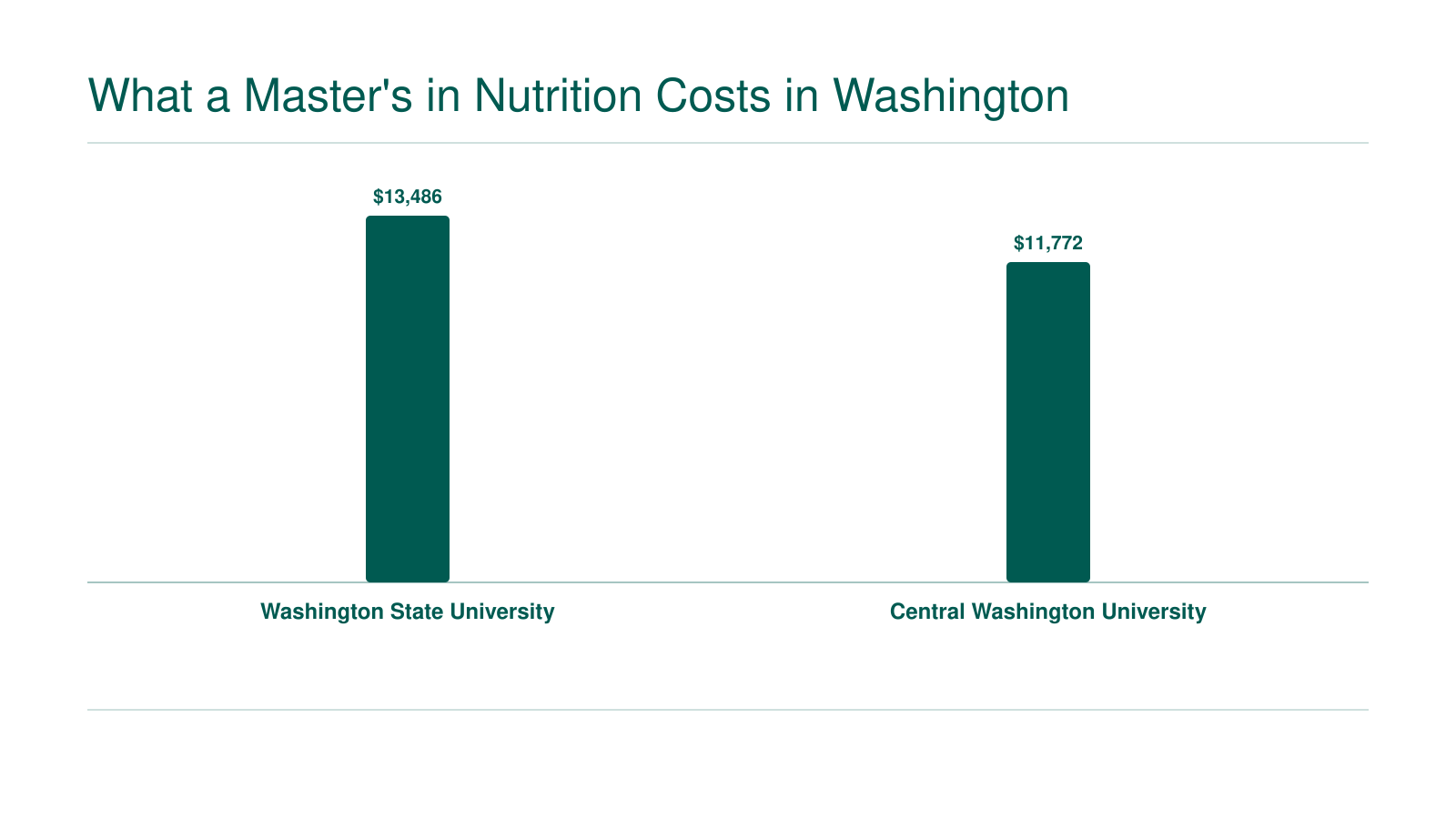
Tuition figures are not standardized across Washington's nutrition master's programs. Bastyr University publishes a total program cost of $61,745 for its 78-credit M.S. in Nutrition, while Washington State and Central Washington publish annual resident tuition rates. Out-of-state and online rates are not consistently published for these programs. Net price is an institution-wide average after aid, not an exact quote for each student.
Washington Certification for Dietitians and Nutritionists
Nutrition Master's Salary and Career Outlook in Washington
Dietitians and nutritionists in Washington earn above the national benchmark for this occupation. In May 2025, Bureau of Labor Statistics data set the median annual wage for Washington dietitians and nutritionists at $84,220, with a median hourly rate of $40.49.1 The Seattle-Tacoma-Bellevue metro reported an hourly median of $42.11.1
The statewide median covers all dietitian and nutritionist roles, not the outcome of any single program, whether offered on campus or online. Common Washington career paths include clinical registered dietitian nutritionist positions in hospitals and outpatient clinics, public health nutrition roles that often align with a master of public health degree, community nutrition programs, and food industry roles in product development, regulatory affairs, or consumer education. Statewide employment was 1,450 in May 2025.1 For comparison, the national median annual wage for this occupation was $76,400 in May 20252, and individual earnings vary by specialty, employer, and experience.
Master's in Nutrition in Washington: Common Questions
Which Washington nutrition master's program is best overall?
How long does a master's in nutrition take to complete in Washington?
Do I need a nutrition bachelor's degree to enter a master's program in Washington?
Can I become a registered dietitian with an online master's in nutrition from a Washington school?
Compare Nutrition programs on the data that matters
Explore more Healthcare specializations or browse every graduate field.
All Healthcare programs