Master's in Nutrition Programs With No GRE Required
Compare 320+ accredited no-gre Nutrition programs at 180+ schools, with graduate earnings, cost, debt, and completion data from IPEDS and the U.S. College Scorecard.

Which nutrition master's programs let you apply without the GRE? Quite a few, and skipping the exam saves the test fee, weeks of prep, and the scheduling delay that pushes an application past a deadline. Programs like Cal Poly San Luis Obispo, Saint Elizabeth University, and the University of Georgia state outright that no GRE is required.
Timing matters more now than it used to. Since January 1, 2024, a graduate degree has been required to sit for the registered dietitian exam, so a master's is no longer optional for anyone pursuing the RDN credential.
One caution: test policies shift year to year, so confirm the current requirement with each program before you apply.
Key Points
- Texas Tech, UGA, Ball State, and UNE offer no-GRE online tracks.
- Since January 1, 2024, RDN eligibility requires an ACEND-accredited master's.
- East Texas A&M lists $407.67 per credit, Cedar Crest $796.
Top 10 No-GRE Nutrition Master's Programs
Below are ten nutrition master's programs where the GRE is waived or test-optional. Each entry highlights a distinct academic path, format, and concentration mix. Test policies change, so confirm the current requirement with each program before applying.
American University
#1Washington, DC · ~$37,000/yr (est.)
Best for: Busy professionals needing asynchronous online
American University offers an online MS in Nutrition Education focused on translating nutrition science into behavior change and community programs. The 30-credit, 10-course curriculum spans life cycle nutrition, epidemiology, and health communication, with electives in school, sports, or weight control. Students take asynchronous 8-week courses, can finish in 18 to 24 months, and are prepared for credentials such as CNS, CHES, or DipACLM.
- No GRE required to apply
- 30 credit hours and 10 courses
- Eight-week asynchronous online classes
- Full-time and part-time options
- Fall and spring start dates
- Prepares for CNS, CHES, or DipACLM credentials
- Electives in school health, sports nutrition, or weight control
- Total program tuition is $38,950
Merrimack College
#2North Andover, MA · ~$37,000/yr (est.)
Best for: Aspiring sports dietitians wanting hands-on training
Merrimack College's ACEND-accredited MS in Nutrition and Human Performance blends coursework with 1,000 hours of supervised experiential learning in clinical, community, foodservice, and sports settings. The 54-credit, two-year campus program prepares graduates to sit for the CDR exam and become registered dietitian nutritionists. Concentrations include sports/human performance and clinical, with a focus on working with Division I athletes and support from a success coach.
- ACEND-accredited
- No entrance exam required; test optional
- 54 credit hours, completed in two years
- 1,000 hours of supervised experiential learning
- Fall start with rolling admissions
- Requires 3.0 GPA and prerequisite coursework
- $0 application fee
- Sports and human performance focus
- Opportunity to work with Division I athletes
- Guaranteed eligibility for the CDR exam
- STEM designated program
- Success coach from admission through graduation
- Clinical concentration with five concentration options
- Curriculum includes medical nutrition therapy
- Rotations in clinical, community, and foodservice
- Cohort model for collaborative learning
- Dean Scholarships available
University of Rhode Island
#3Kingston, RI · ~$18,000/yr (est.)
Best for: Research-focused students wanting faculty mentorship
University of Rhode Island's MS in Nutrition is a campus-based research program that asks applicants to identify a faculty mentor before applying. Prerequisites include two semesters of chemistry and coursework in biochemistry, anatomy or biology, human physiology, nutrition, and statistics. The department does not set a minimum GPA but prefers a 3.0 or higher, and assistantships and tuition scholarships are available on a competitive basis.
- No GRE required
- Two semesters of chemistry prerequisite
- Coursework in biochemistry, physiology, and nutrition required
- No minimum GPA; 3.0 or higher preferred
- Students identify a faculty major professor before applying
- Graduate assistantships and tuition scholarships available
Lipscomb University
#4Nashville, TN · ~$17,000/yr (est.)
Lipscomb University offers an ACEND-accredited MS in Nutrition designed for current registered dietitians, plus a combined MS and dietetic internship path. The 33-credit program can be completed online or on campus and includes practice rotations for internship students. Concentrations include medical nutrition therapy, health promotion and wellness, and sports nutrition.
- ACEND accredited
- Designed for current registered dietitians
- 33 credit hours, available online or on campus
- Emphasizes advanced nutrition science and research
- Career paths in dietetics, food science, and health coaching
- Faith-based learning environment
- Medical nutrition therapy concentration
- 1,000 supervised clinical hours
- Cohort of 20 interns
- Five-semester program
- Year 1 online or on campus
- Prepares for RD exam
- Health promotion and wellness concentration
- Focus on clinical, wellness, and sports nutrition
- Preselect option for Lipscomb DPD graduates
- Hybrid online and on-campus format
- Sports nutrition concentration
- Faculty with sports dietetics specialization
- Second year is on campus
- Rotations in clinical, community, wellness settings
Meredith College
#5Raleigh, NC · ~$14,000/yr (est.)
Meredith College's MS in Nutrition offers three tracks: advanced career, didactic program in dietetics, and accelerated dietitian nutritionist. Students learn in an on-site organic garden, food lab, and patient simulation lab, and the program reports a 94% pass rate on the CDR exam. Full-time and part-time options are available, including an accelerated online track.
- No GRE required to apply
- ACEND accredited
- Three tracks: advanced career, didactic, accelerated RDN
- 94% licensure pass rate
- 100% match rate to dietetic internships
- On-site organic garden and food lab
- Full-time and part-time options
- Accelerated online track available
Benedictine University
#6Lisle, IL · ~$20,000/yr (est.)
Benedictine University's MS in Nutrition and Dietetics offers a dietetic internship track and a non-internship track, both requiring 33 graduate credits. The ACEND-accredited internship path prepares students for RDN eligibility, while the non-internship option suits those seeking advanced nutrition knowledge without supervised practice. Courses cover biostatistics, medical nutrition therapy, obesity prevention, and public health program planning.
- Two tracks: dietetic internship and non-internship
- ACEND-accredited internship track
- 33 graduate credit hours
- 1200 clinical hours for internship track
- Requires 3.0 GPA and prerequisite coursework
- On-campus instruction with hybrid elements
- Prepares for CDR registration exam
Saint Elizabeth University
#7Morristown, NJ · $15,000 – $20,000/yr (est.)
Saint Elizabeth University's M.S. in Nutrition uses an entrepreneurial nutrition practice focus, blending online coursework with in-person experiential learning. The five-semester program includes rotations in hospitals, clinics, community settings, and private practices, and a capstone project. Graduates are eligible for the CDR registration exam to become a registered dietitian nutritionist.
- ACEND accredited
- No GRE required
- 22 months or five semesters
- 38 total credit hours
- 1,000 supervised clinical hours
- Small cohort of 20 students
- Synchronous online classes with in-person rotations
- Prepares for CDR registration exam
California Polytechnic State University-San Luis Obispo
#8San Luis Obispo, CA · ~$14,000/yr (est.)
Cal Poly's MS in Nutrition is a 45-unit interdisciplinary program that connects students with faculty from nutrition, kinesiology, public health, animal science, and social sciences. Emphasis areas include molecular nutrition, public health nutrition, health and wellness, and dietetics, with a combined MS and dietetic internship option. Students work with a faculty advisor to complete a thesis or professional project.
- ACEND accredited
- No entrance exam required; no GRE required
- 45 total credit hours
- Four emphasis areas: molecular, public health, wellness, dietetics
- Combined MS and dietetic internship option
- Requires three letters of recommendation
- Thesis or professional project
- Molecular nutrition emphasis
- Interdisciplinary faculty from multiple departments
- Application deadline April 1
- Financial aid available
- Non-cohort admission model
University of Georgia
#9Athens, GA · ~$11,000/yr (est.)
University of Georgia's online MS in Nutritional Sciences has a community nutrition emphasis that prepares graduates for public health, Extension, and school nutrition roles. The 30-credit, non-thesis curriculum covers maternal and child nutrition, food policy, and community intervention design. Asynchronous courses offer flexibility, and the program meets the master's requirement for the RDN credential.
- ACEND accredited
- No GRE required; test optional
- 30 credit hours, non-thesis curriculum
- Community nutrition emphasis
- Asynchronous online classes
- Meets RDN master's requirement
- Pathway to School Nutrition Director certification
- Three start dates per year
Iowa State University
#10Ames, IA · ~$13,000/yr (est.)
Iowa State University's MS in Nutritional Sciences offers a molecular and cellular nutrition concentration within an interdisciplinary program spanning 10 disciplines. Students study nutrient effects on cellular signaling, gene expression, and metabolism while gaining hands-on research experience. Median completion is about 1.9 years, and no GRE or GMAT is required.
- ACEND accredited
- No GRE or GMAT required
- Molecular and cellular nutrition concentration
- Integrates 10 disciplines
- Median completion time 1.9 years
- Fall start; January 15 deadline
- Open to international students
- Hands-on research with faculty mentorship
Cost & outcomes by school
Federal data for the highest-earning Nutrition programs, independent of the ranking above. Earnings are this field's master's graduates four years after completing, where the Scorecard reports them.
| School | Earnings | Tuition / yr | Debt | Grads/yr | Format |
|---|---|---|---|---|---|
| Saint Elizabeth University NJ | $75,352 | $19,178 | — | 20 | Hybrid |
| New Mexico State University NM | — | $6,605 | — | — | Hybrid |
| North Carolina Central University NC | — | $7,638 | — | — | Online |
| Appalachian State University NC | — | $8,570 | — | — | Online |
| University of North Carolina at Greensboro NC | — | $8,614 | — | — | Campus |
| Liberty University VA | — | $8,730 | — | — | Online |
| Purdue University IN | — | $9,992 | — | — | Campus |
Sources: U.S. Department of Education. Tuition and graduates: IPEDS. Earnings and debt: College Scorecard, this field's master's graduates; a dash means no figure is reported.
Cost, debt & payoff
Median earnings of this field's master's graduates (4 yrs after completing) vs. their median federal loan debt · U.S. College Scorecard
Across these programs the median graduate earns about $65,918 and finishes with roughly $34,200 in debt — a ratio that clears a common rule of thumb (keep debt below first-year salary). Tuition and debt vary widely school to school, so check the per-school figures in the table above before you shortlist.
Tuition and Affordability: The Lowest-Cost No-GRE Options
Net price is an institution-wide average after aid, not a guaranteed quote. For budgeting, East Texas A&M lists $407.67 to $815.67 per credit across 30 credits, Cedar Crest lists $796 per credit across 36 credits, and University of New England lists $895 per credit across 36 credits. University of Georgia's online option advertises a flat $19,350 total program tuition. Aid examples include East Texas A&M nutrition graduate assistantships with a renewable Quick Start Grant and Merrimack's automatic Dean Scholarship plus Double Warrior alumni discount.
| School | Listed in-state program tuition | Listed out-of-state program tuition | Average net price |
|---|---|---|---|
| Cal State LA | $8,688 | $18,768 | $3,967 |
| University of North Carolina at Greensboro | $8,614 | $23,329 | $10,965 |
| University of Georgia | $11,002 | $29,774 | $13,936 |
RDN Eligibility and ACEND Accreditation: Which No-GRE Programs Qualify
Among No-GRE master's programs, a master's in nutrition and dietetics only leads to the registered dietitian exam if it is an ACEND-accredited pathway, meaning a coordinated program or a Future Education Model graduate program with supervised practice built in. A non-accredited nutrition MS does not qualify on its own. Since January 1, 2024, the CDR exam also requires a master's degree.1
Programs That Qualify
- University of New England: The accredited MSAN-D has fully online coursework and includes supervised experiential learning.2
- George Mason University: An accredited Future Education Model program, though sources only confirm some elements online.
- University of Alabama at Birmingham: An accredited coordinated program with online coursework and in-person supervised experience.3
- University of North Florida: An accredited Future Education Model program with online didactic work and onsite supervised learning.4
- Logan University: An accredited MSAND that combines coursework with supervised practice, with online delivery not confirmed.5
Check Before You Enroll
University of Northern Colorado's MS in Dietetics relies on a prior ACEND-accredited DPD verification statement.6 Texas Tech's online MS Nutritional Sciences is not established as a standalone accredited route to the exam.
If you hold a DPD verification statement, you can pair an accredited master's with a separate dietetic internship. If you want to be an RD, confirm the program in ACEND's directory before you enroll.1
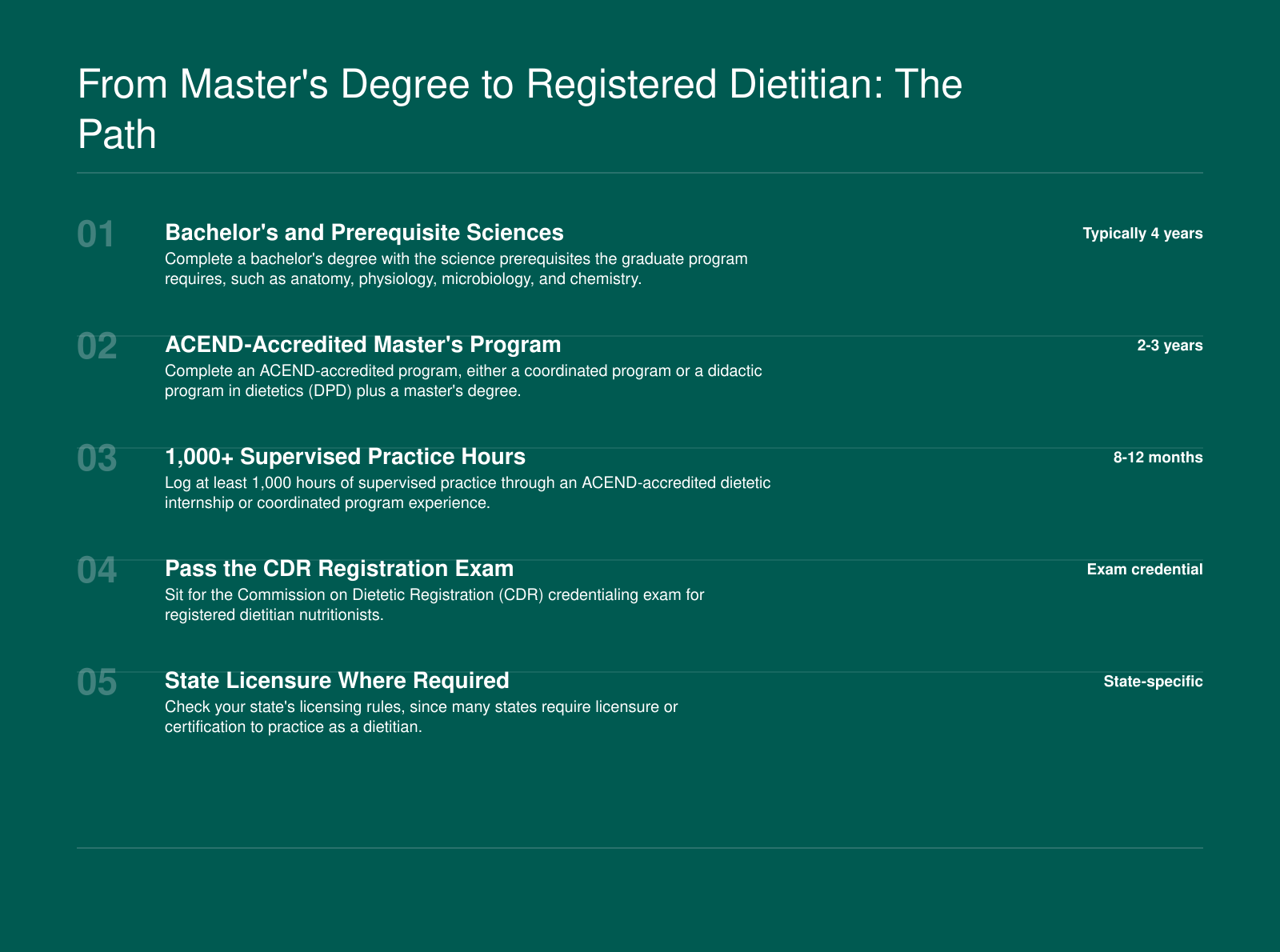
From Master's Degree to Registered Dietitian: The Path
The route to registered dietitian nutritionist status proceeds through supervised practice and a registration exam, and the graduate degree requirement for CDR exam eligibility took effect January 1, 2024. Completing an ACEND-accredited master's program is now a required step for new candidates.
Online vs. Campus: Formats and Completion Time
Nutrition master's delivery has shifted toward online and hybrid formats, yet supervised practice hours keep most dietetics-focused tracks partly in person. Online master's in nutrition programs here include Texas Tech, UGA, Ball State, and UNE,153 while accelerated master's in nutrition programs like MSU Denver blend live sessions with online coursework.2 Campus-based programs, such as Cal Poly and Iowa State, remain an option for students who want in-person labs and faculty access.
Completion time varies by pace and format. Several full-time tracks finish in 12 to 24 months, with Texas Tech and UGA offering a one-year accelerated path; UGA's part-time route typically takes about two years.1 MSU Denver's hybrid format uses 8-week courses,2 and UNE runs full-time over 24 months.3
Even fully online ACEND-aligned programs require local supervised practice. UND requires 1,000 hours beyond coursework, UNE integrates 1,050 experiential hours,3 and Adelphi includes 785 supervised hours.4 Students usually arrange clinical sites near home, so working professionals should choose asynchronous programs with nearby placement flexibility. UGA's non-thesis community nutrition track is a concrete fit: fully asynchronous, one year full-time or about two years part-time while working.1
Related Articles
Admissions Checklist: Prerequisites, Backgrounds, and GRE Waivers
- Bachelor’s degreeA bachelor’s degree from an accredited institution is the baseline. Some programs expect a nutrition or related major; others evaluate non-nutrition backgrounds case by case when science prerequisites are met.
- Minimum GPAA 3.0 cumulative GPA is common among several listed programs, including Georgia, Wisconsin–Green Bay, Merrimack, and UAB. UT Austin requires 3.0 in upper-division and prior graduate work.
- Prerequisite science coursesTypical prerequisites include general biology, general chemistry, anatomy and physiology, and introductory nutrition. Some programs add organic chemistry, biochemistry, microbiology, or statistics, and allow limited prerequisites to be in progress.
- Letters, statement, and resumeMost applications ask for letters of recommendation, a statement of purpose, and a current resume. These documents help committees weigh relevant work, research, or volunteer experience when GRE scores are absent.
- DPD verification for RD-track programsIf you are pursuing the Registered Dietitian Nutritionist path, some programs such as UAB require a Didactic Program in Dietetics verification statement or equivalent science and nutrition coursework.
- No GRE vs. GRE waiverA no-GRE policy means scores are not required for any applicant, as stated by University of North Dakota, Georgia, Wisconsin–Green Bay, UAB, and Merrimack. A GRE waiver is narrower: the GRE is normally required unless an exemption is granted, and exemption criteria vary by program.
- Deadlines and non-nutrition majorsFall deadlines range from early December to August 1, with competitive or cohort tracks often closing earlier. Non-nutrition majors may be admitted if prerequisites are completed, sometimes concurrently.
Nutrition programs by state
Frequently Asked Questions
Answers to common questions about no-GRE admission, affordability, prerequisite backgrounds, and state authorization for online students.
Which nutrition master's programs don't require the GRE?
What is the cheapest online master's in nutrition with no GRE?
Do I need a nutrition background to apply to no-GRE master's programs?
Can I enroll in an online nutrition master's program from any state?
Compare Nutrition programs on the data that matters
Explore more Healthcare specializations or browse every graduate field.
All Healthcare programs