Best Master's in Nutrition Programs in South Carolina
Compare 6 accredited Nutrition programs in South Carolina at 3 schools, with graduate earnings, cost, debt, and completion data from IPEDS and the U.S. College Scorecard.

Since 2024, a graduate degree has been required to sit for the registered dietitian nutritionist (RDN) exam. So the first decision is a fork: an ACEND-accredited route to the RDN credential, or a non-RDN master's in areas like performance or community nutrition.
The list is short, and campus, hybrid, and online programs share it. Winthrop, Clemson, and South Carolina State differ in format, cost, and credential pathway, so the job you want matters more than the school's name.
Key Points
- Winthrop's 100% online nutrition master's charges $699 per credit.
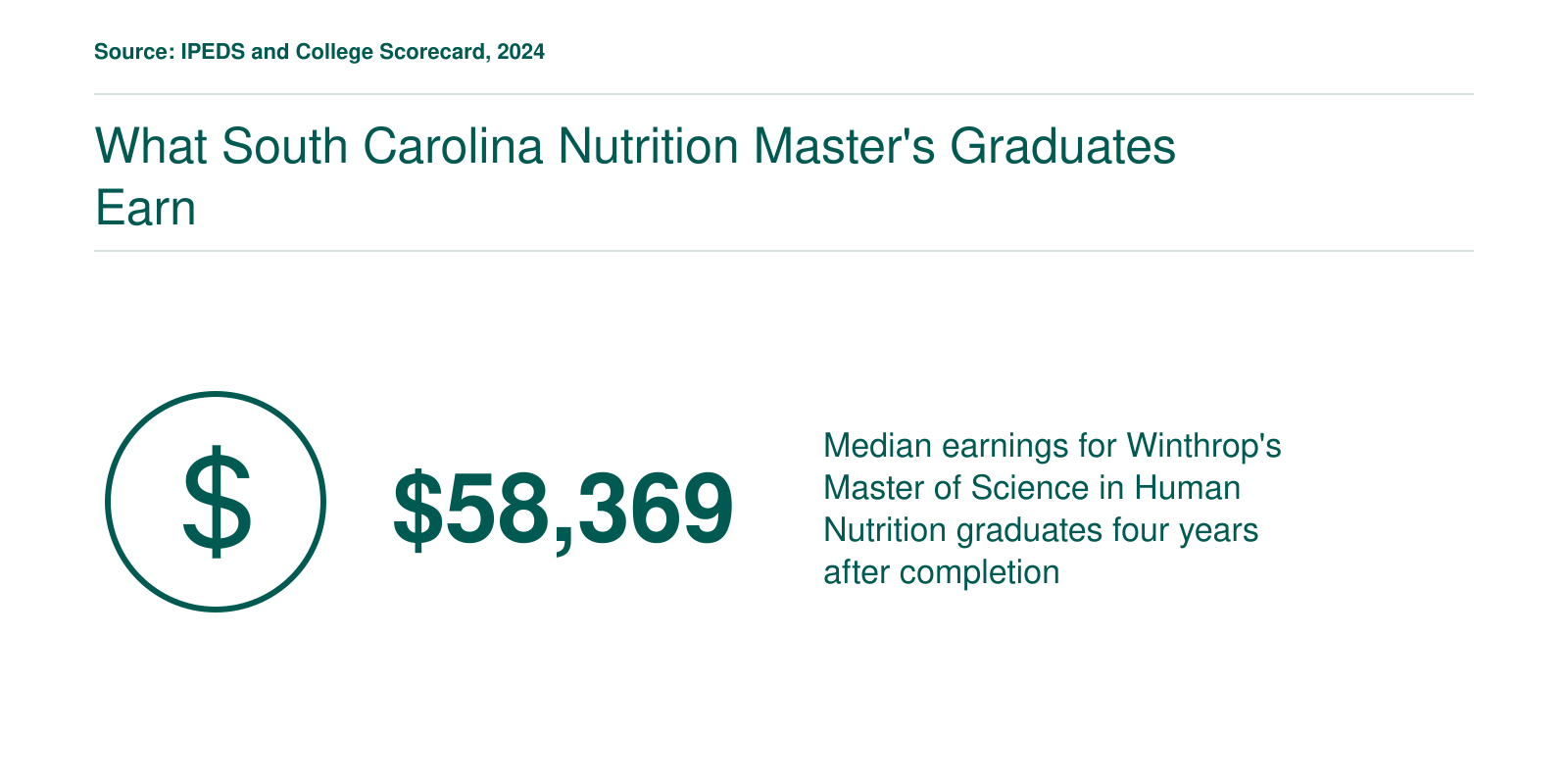
- Graduates of Winthrop's nutrition master's earned a median $58,369 after four years.
- South Carolina dietitian licensure accepts an active RDN credential, fee $175.
Top-Ranked Master's in Nutrition Programs in South Carolina for 2027
South Carolina offers three accredited nutrition master's programs across online, campus, and hybrid formats, each with a distinct focus. The ranking below weighs cost, outcomes, and format flexibility using federal data from IPEDS and College Scorecard. Graduate tuition and overall graduation rates are shown for each school so you can compare the tradeoffs directly.
Winthrop University
#1Rock Hill, SC · ~$16,000/yr (est.)
Best for: Online learners pursuing registered dietitian preparation
Winthrop University in Rock Hill combines an accredited online Master of Science in Human Nutrition with a campus thesis option and a hybrid dietetic internship. Resident graduate tuition is $14,678 and nonresident tuition is $28,676. The school's overall graduation rate is around 57 percent. The portfolio is designed to carry students from master's coursework through the 2024 CDR exam requirement.
- Complete in 1-2 years
- 100% job placement rate
- 3.0 GPA minimum
- 2 letters of recommendation minimum
- Prepares for CDR Certifying Examination
- Financial aid available
- Limited class sizes for personalized guidance
- 30 total credit hours
- Thesis required
- Electives from 20+ departments
- Transfer up to 6 graduate credits
- Prerequisite courses required
- ACEND accredited
- Starts fall
- 3 letters of recommendation minimum
- 1000 clinical hours
- Prepares for RDN exam
- 94.9% hired within 3 months
- Maximum of 21 interns per year
- Over 60 internship affiliate sites
Clemson University
#2Clemson, SC · $10,000 – $15,000/yr (est.)
Best for: Students wanting interdisciplinary nutrition science
Clemson's campus-based Food, Nutrition and Culinary Sciences M.S. offers a nutrition concentration with rolling admissions and no thesis or capstone requirement. Resident graduate tuition is $15,554 and nonresident is $40,866, making the $25,312 resident-to-nonresident gap the widest among the ranked schools. The school's overall graduation rate is roughly 87 percent. Students can design a personalized curriculum with a dedicated nutrition advisor.
- Nutrition concentration within Food, Nutrition and Culinary Sciences
- 30 total credit hours
- Rolling admissions
- Starts spring, summer, or fall
- No thesis or capstone required
- Dedicated nutrition advisor
- Customizable curriculum with advisor
- Scholarships available
South Carolina State University
#3Orangeburg, SC · ~$11,000/yr (est.)
Best for: Health equity focused community nutrition students
South Carolina State University in Orangeburg offers a hybrid Master of Science in Nutritional Sciences with concentrations in Nutritional Health Care and Food and Nutrition. Resident graduate tuition is $11,060 and nonresident is $21,750. The school's overall graduation rate is about 37 percent. As an 1890 land-grant HBCU, SC State pairs online coursework with in-person labs and field experiences, and eligible students may access a $10,000 USDA scholarship.
- ACEND accredited
- 90% job placement rate
- Low 6:1 student-to-faculty ratio
- Hybrid format with in-person and online classes
- $10,000 USDA 1890 scholarship annually
- Field experiences at health care facilities
- Flexible admission for non-nutrition majors
- Faculty include NIH-funded researchers
- Prepare for dietitian credential (master's required from 2025)
- Scholarships available
Cost & outcomes by school
Federal data for the highest-earning Nutrition programs, independent of the ranking above. Earnings are this field's master's graduates four years after completing, where the Scorecard reports them.
| School | Earnings | Tuition / yr | Debt | Grads/yr | Format |
|---|---|---|---|---|---|
| Winthrop University SC | $58,369 | $16,306 | — | 22 | Online |
| Clemson University SC | — | $12,646 | — | — | Campus |
| South Carolina State University SC | — | $11,460 | — | 3 | Hybrid |
Sources: U.S. Department of Education. Tuition and graduates: IPEDS. Earnings and debt: College Scorecard, this field's master's graduates; a dash means no figure is reported.
Which South Carolina Master's Programs Lead to RDN Eligibility?
Which master's programs in South Carolina actually make you eligible to sit for the RDN exam? Since 2024, a graduate degree is required before taking the CDR exam, so ACEND status is the single most important filter among accredited master's in nutrition programs.
Winthrop University
State documents list Winthrop's online M.S. in Human Nutrition and Dietetic Internship Program as ACEND-accredited, which signals a combined graduate and supervised-practice pathway rather than a coursework-only master's.1 The exact 2026 online structure is not fully published, so confirm supervised practice hours and any separate application directly with the program.
University of South Carolina
USC's M.S. in Performance Nutrition and Dietetics is listed in 2025-2026 materials as ACEND candidacy and integrates at least 1,200 supervised practice hours into a 44-credit, five-semester curriculum. No separate dietetic internship is described; students who complete the ACEND competencies receive a verification statement for RDN exam eligibility.
South Carolina State University
SC State's M.S. in Nutritional Sciences has an ACEND-accredited Didactic Program in Dietetics, but the master's alone does not establish integrated supervised practice hours. This track can support non-RDN nutrition careers, but plan on a separate ACEND-approved supervised practice program or qualifying graduate pathway before sitting for the RDN exam.
Online and Hybrid Master's in Nutrition Options in South Carolina
Choosing a format is less about where lectures happen than about where you will complete supervised practice and whether any on-campus time fits your schedule. Winthrop University's Master of Science in Human Nutrition is 100% online, while its separate dietetic internship pathway involves at least 1,000 supervised-practice hours. Do not assume the online M.S. automatically includes those placements; confirm with the program. Clemson University's food, nutrition and culinary sciences M.S. is campus-based. South Carolina State University's M.S. in Nutritional Sciences is hybrid, combining online classwork with in-person labs and field experiences at community health-care or food-service facilities.
Placement Questions to Ask
Before choosing an online or hybrid route, get answers in writing about who secures preceptors, whether sites can be near your home, any required campus visits or synchronous sessions, and state authorization limits for out-of-state students. Placement policies vary, so a written confirmation protects you before you enroll.
Related Articles
Master's in Nutrition Cost and Licensure in South Carolina
Cost here usually comes down to residency and format. Winthrop's online M.S. in Nutrition is the easiest to price among the most affordable master's in nutrition programs: $699 per credit across 30 credits, which includes $684 tuition and a $15 technology fee, plus a $75 library fee each semester and a $100 course fee on at least one course. That puts full tuition near $20,970, and online students pay the same rate regardless of state residency.
Resident and nonresident tuition
Among the programs ranked here, South Carolina State lists the lowest resident graduate tuition at roughly $11,460, followed by Clemson near $12,646 and Winthrop near $16,306 as an institution-wide figure. Nonresident listings run higher: about $22,570 at South Carolina State, $24,798 at Clemson, and $30,780 at Winthrop. Winthrop's online nutrition program replaces that resident/nonresident split with a single per-credit rate.
Aid-adjusted costs and licensing
Average net price after aid also varies by institution, from about $15,300 to $22,250, but that is an institution-wide average, not a program-level quote. After graduation, budget for the CDR Registered Dietitian Nutritionist exam fee and South Carolina state licensure application and renewal fees. Confirm current amounts with CDR and the state licensing board, since they change periodically.
South Carolina Dietitian Licensing at a Glance
What South Carolina Nutrition Master's Graduates Earn
Winthrop University is the school in this ranking with published program-level earnings. Graduates of its Master of Science in Human Nutrition earned a median $58,369 four years after completion, according to IPEDS and College Scorecard. Five years after completion, the median was $56,351.
Questions About South Carolina Nutrition Master's Programs
Does Winthrop's online M.S. in Human Nutrition qualify graduates for RDN examination eligibility?
Can students complete supervised practice near their home location in a South Carolina online program?
Which South Carolina nutrition master's program is best for becoming an RDN?
Is a performance nutrition master's worth it if you don't plan to become an RDN?
Compare Nutrition programs on the data that matters
Explore more Healthcare specializations or browse every graduate field.
All Healthcare programs