Best Master's in Nutrition Programs in Alabama
Compare 10 accredited Nutrition programs in Alabama at 6 schools, with graduate earnings, cost, debt, and completion data from IPEDS and the U.S. College Scorecard.

Becoming a Registered Dietitian Nutritionist now requires a graduate degree, plus supervised practice hours and a national exam. In Alabama, that path also runs through a state license. The schools here, Samford, Alabama, Auburn, Jacksonville State, and Oakwood, offer campus and online formats, but not every track leads to RDN eligibility.
Cost is the other pressure point: published graduate tuition runs from roughly $11,000 to over $34,000 a year depending on the school and residency.
Choosing well means matching the credential outcome to your budget and schedule first.
Key Points
- Alabama requires a state license to practice dietetics, and out-of-state licenses are not accepted.
- Online nutrition master's tracks still require in-person supervised practice for RDN eligibility.
- The University of Alabama and Auburn charge out-of-state students about $21,000 more annually.
Best Master's in Nutrition Schools in Alabama
Five Alabama schools offer a master's in nutrition or a closely related degree, and they differ most in whether they lead toward the registered dietitian credential. Each card below says which concentration and format it covers. Graduation rates are institution-wide, not specific to the nutrition program.
Samford University
#1Birmingham, AL · $20,000 – $25,000/yr (est.)
Best for: Career changers pursuing dietitian credentials
Samford University in Birmingham offers an online MS in Nutrition and a separate Dietetics Concentration. The 33 to 34 credit MS can be finished in one year, with a part-time option. The dietetics route adds supervised experiential learning and prepares graduates to sit for the RDN exam. Samford describes its Graduate Program in Nutrition and Dietetics as ACEND-accredited. Graduate tuition is $20,897 for in-state and out-of-state students alike, and the school's overall graduation rate is about 77 percent.
- Online, 33 to 34 credits, completed in one year with a part-time option
- Capstone or culminating research project required
- 3.0 GPA, three recommendation letters, and prerequisite courses required
- Bachelor's degree in any field accepted
- Entrance exam listed as required; TOEFL or IELTS for international applicants
- Summer and fall entry; rolling admissions
- 48 credits over two years with supervised experiential learning
- About 1,000 clinical hours; prepares for RDN exam eligibility
- Samford states the program is ACEND-accredited
- No entrance exam required; 3.0 GPA minimum
- Transfer of up to 9 graduate credits allowed
- Prerequisites must be within 10 years; B or better in all courses
The University of Alabama
#2Tuscaloosa, AL · ~$12,000/yr (est.)
Best for: Working professionals studying fully online
The University of Alabama in Tuscaloosa runs a 30-credit MS in Human Nutrition that can be completed 100 percent online or on campus. Students choose a general, Clinical, or Community path, and the program does not require the GRE. It partners with dietetic internship programs, including Morrison Healthcare, but the catalog does not establish a standalone ACEND-accredited dietetics pathway. Out-of-state fees are waived for distance learners, and the university's graduation rate is about 73 percent.
- 30 credit hours, 10 courses, thesis and non-thesis options
- Starts fall, spring, or summer; capstone required
- GRE not required; 3.0 GPA and three recommendation letters
- Accelerated master's option for UA undergraduates
- Coursework must be finished within six years
- 30 credits; designed for registered dietitians and interns
- Prepares students for doctoral study
- Dietetic internship partnerships; no entrance exam required
- 100 percent distance education available
- 30 credits; includes epidemiology coursework
- Online or on campus; built for registered dietitians and interns
- Partners with dietetic internship programs
- No entrance exam; prerequisites listed for non-nutrition majors
Auburn University
#3Auburn, AL · $13,000 – $34,000/yr (est.)
Best for: Research-minded students choosing a thesis track
Auburn University's MS in Nutrition offers thesis and non-thesis options, with the non-thesis track available on campus or online. Total credits run from 30 to 33 depending on the track. A separate dietetic internship non-thesis track prepares students for the RD exam. The MS itself is not established as an ACEND-accredited program, so confirm directory status before applying. Auburn's overall graduation rate is about 82 percent, the highest among these five schools.
- 30 to 33 credit curriculum depending on track
- 15-credit common core in advanced nutrient metabolism
- Non-thesis track available online and on campus
- Dietetic internship non-thesis track is online only
- Research seminar required; electives in sports, medical, and global nutrition
- Includes 6 thesis research credits
- 15-credit common core plus a required research methods course
- Design and Analysis in Education I and a research seminar required
- Broad elective selection available
Jacksonville State University
#4Jacksonville, AL · $10,000 – $15,000/yr (est.)
Jacksonville State University offers an MS in Education in Physical Education with a Nutrition concentration, delivered online. It centers on nutrition for sport, wellness, and chronic disease, and it prepares students for the ISSN Certified Sport Nutrition exam. It is not a route to the registered dietitian credential. Graduate tuition is $10,272 in-state and $16,704 out-of-state, and the school's overall graduation rate is about 55 percent.
- 30 credit hours; non-teacher-certification track
- Online delivery
- 2.8 GPA minimum; conditional admission at 2.5
- Nutrition or exercise science degree required
- Prepares for the ISSN Certified Sport Nutrition exam
- Coursework in diet and performance and advanced nutritional therapy
Oakwood University
#5Huntsville, AL · $10,000 – $15,000/yr (est.)
Oakwood University in Huntsville offers an online Master of Public Health in Nutrition and Wellness. The 50-credit curriculum emphasizes plant-based diets and community health, and the program says it prepares students for the RD credential. Applicants should verify the pathway on the ACEND directory. Graduate tuition is $13,680 for all students, and the school's overall graduation rate is about 45 percent.
- Online, 50 credit hours across 17 courses; as few as 24 months
- Capstone research project and practicum required
- Coursework includes Vegetarian Nutrition and Ethnic Food Practices
- 3.0 GPA minimum; prerequisite courses required
- Transfer of up to 9 graduate credits may be accepted
- Christ-centered curriculum with a cultural competence emphasis
Cost & outcomes by school
Federal data for the highest-earning Nutrition programs, independent of the ranking above. Earnings are this field's master's graduates four years after completing, where the Scorecard reports them.
| School | Earnings | Tuition / yr | Debt | Grads/yr | Format |
|---|---|---|---|---|---|
| The University of Alabama AL | $64,913 | $11,980 | — | 123 | Online |
| Jacksonville State University AL | — | $11,488 | — | — | Online |
| Auburn University AL | — | $12,890 | — | — | Hybrid |
| Oakwood University AL | — | $14,516 | — | — | Online |
| Samford University AL | — | $21,797 | — | 12 | Online |
| Tuskegee University AL | — | $26,228 | — | 4 | Campus |
Sources: U.S. Department of Education. Tuition and graduates: IPEDS. Earnings and debt: College Scorecard, this field's master's graduates; a dash means no figure is reported.
Online and Hybrid Master's in Nutrition Options in Alabama
The pull of online master's in nutrition programs is obvious: you keep your job and study from anywhere. The catch is that becoming a Registered Dietitian Nutritionist still requires supervised practice hours you complete in person, and not every online track handles that for you.
Several master's programs in Alabama run fully online. The University of Alabama delivers its 30 credit hour M.S. in Human Nutrition entirely online, with Clinical, Community, and Generalist tracks. Auburn states all its coursework is online; the non-thesis track is available online and on campus, and the thesis option is research-intensive and aimed at doctoral study. Samford, Jacksonville State, and Oakwood also offer online formats.
Where Supervised Practice Happens
This is the dividing line. Auburn's Dietetic Internship track pairs coursework with at least 1,200 supervised field hours in settings like acute care, outpatient, and community nutrition, placed regionally within about 60 miles in Alabama and Georgia, or at student-coordinated sites approved by the internship director. Coursework-only online tracks generally do not include placements, so confirm with each program whether it arranges preceptors or expects you to find your own.
Which Alabama Master's in Nutrition Programs Waive or Make the GRE Optional?
Do you still need a GRE score to apply to a master's in nutrition and dietetics program in Alabama? In most cases here, no.
Exam policies
The University of Alabama's admissions material for its human nutrition master's lists no GRE requirement, placing it among No-GRE master's programs. Samford waives the GRE for the current application cycle, a cycle-specific decision rather than a standing policy, so confirm it before applying. Auburn, Jacksonville State and Oakwood do not publish a clear exam policy on their program pages; ask the graduate school directly rather than assuming.
Deadlines and GPA floors
Alabama accepts applications by July 1 for fall, December 1 for spring and April 15 for summer. Samford's fall 2027 cycle opens August 5, 2026 and closes October 1, 2026. A 3.0 undergraduate GPA is the common floor at Alabama, Samford and Oakwood. Jacksonville State sets 2.8, with conditional admission possible at 2.5 and a $35 application fee.
Do you need a nutrition bachelor's?
Not everywhere. Samford accepts a bachelor's in any field and no DPD verification statement, but prerequisites (chemistry, biochemistry, microbiology, anatomy and physiology, statistics, psychology, nutrition) need a C or better, with a B in introductory nutrition, which can be taken the summer before starting. Alabama admits applicants without an ACEND background, who may face roughly 35 prerequisite hours, and notes the degree alone does not qualify you for a dietetic internship or the registration exam. Jacksonville State expects a nutrition or exercise science degree.
Related Articles
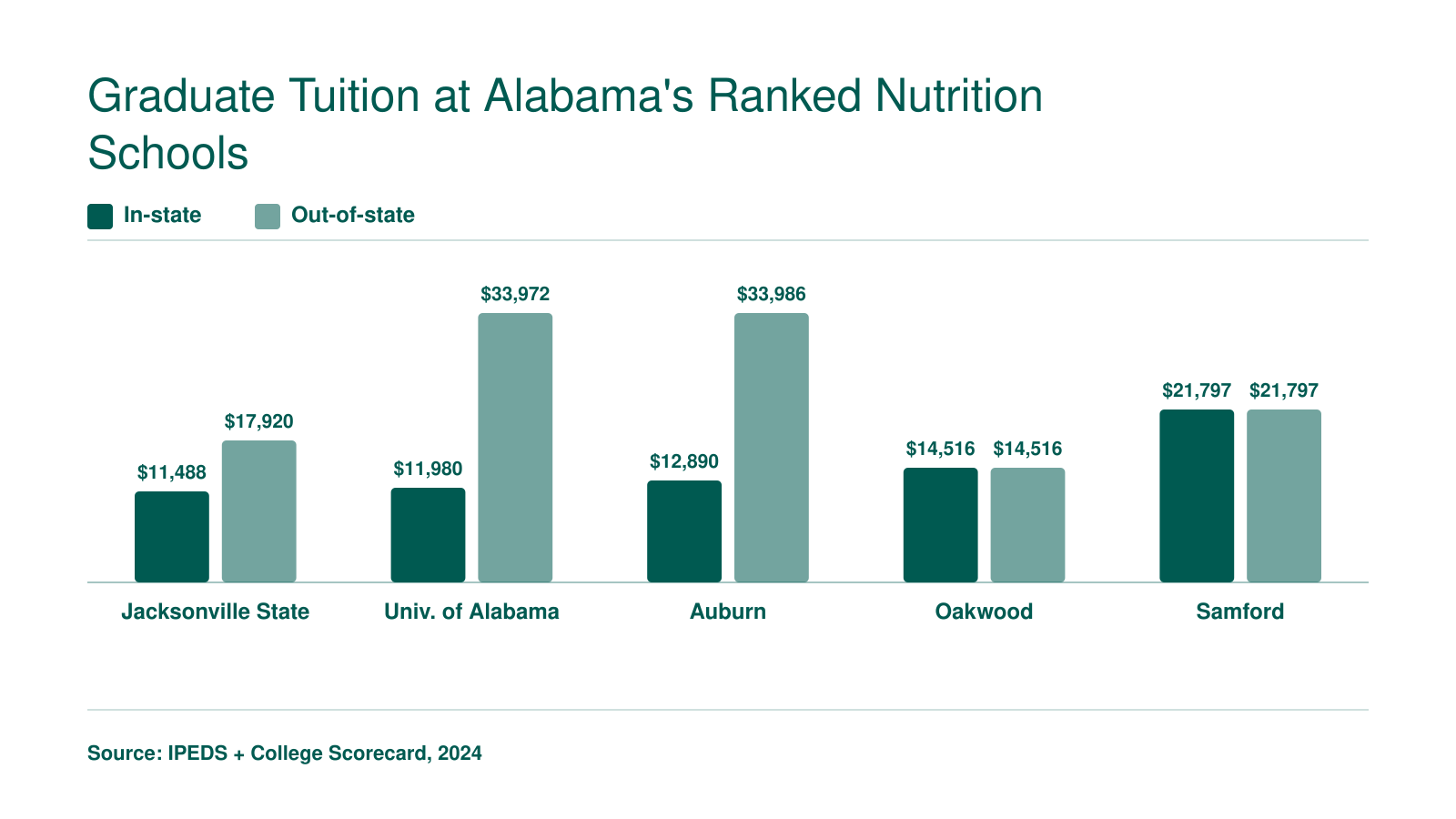
Graduate Tuition at Alabama's Ranked Nutrition Schools
The chart compares annual published graduate tuition and fees for the master's programs at the schools ranked here. The public universities charge out-of-state students far more. At The University of Alabama and Auburn University the gap is about $21,000 a year, while Jacksonville State University's is smaller. Samford University and Oakwood University are private and charge one rate to everyone. These are published tuition figures, not net price, so scholarships and aid will change what you actually pay.
Cost of a Master's in Nutrition and Alabama Licensure for Graduates
What will a master's in nutrition actually cost in Alabama, how do those costs compare with the Most Affordable Master's in Nutrition Programs, and which tracks lead to RDN exam eligibility?
Tuition and program costs
Published per-credit figures vary. The University of Alabama's online M.S. in Human Nutrition is 30 credits at $480 per credit, or about $14,400 total before separate fees. Auburn's M.S. in Nutrition lists $533 per credit, about $17,589 for the degree; published Fall 2026 graduate rates are $643 resident and $1,975 nonresident per credit, and Auburn states the distance rate includes tuition and fees. Auburn's M.S. with Dietetic Internship totals about $27,240 because it adds supervised practice. Alabama's coordinated program in dietetics has separate estimates: roughly $26,629 in-state and $74,641 out-of-state plus a $49 per hour technology fee. For context, institution-wide net price after aid averages about $14,279 at Jacksonville State, $22,420 at Alabama, $24,323 at Auburn, and $32,622 at Samford; these are campus-wide figures, not program quotes. Among programs reporting outcome data, Alabama's M.S. in Human Nutrition lists median earnings around $58,400 one year after completion.
RDN eligibility and supervised practice
Since Jan. 1, 2024, the Commission on Dietetic Registration requires a graduate degree to sit for the RDN exam, plus an ACEND-accredited pathway with at least 1,000 supervised practice hours. Alabama's coordinated program in dietetics and Auburn's M.S. with Dietetic Internship are both registered dietitian master's programs designed to pair the degree with that supervised practice; Auburn's internship includes 1,200 hours. Oakwood pairs an online master's with a separate distance dietetic internship certificate that supplies the hours. A general nutrition master's, such as Alabama's online M.S. or Auburn's M.S., may meet the graduate degree requirement but not the supervised practice by itself. Samford's M.S. in Nutrition does not clearly publish ACEND supervised practice hours, so students should confirm before relying on it for RDN eligibility.
Alabama Dietitian Licensure at a Glance
Frequently Asked Questions About a Master's in Nutrition in Alabama
These answers cover the questions applicants ask most often about admission, RDN eligibility, and timelines for a master's in nutrition in Alabama. Requirements differ by school, so confirm details on each program's admissions page.
Do I need a nutrition bachelor's degree to apply to a master's in nutrition in Alabama?
Which Alabama programs qualify graduates for the RDN exam?
How long does a master's in nutrition take to finish in Alabama, full time vs. part time?
Can I become an RDN in Alabama with a non-dietetics nutrition science master's?
Compare Nutrition programs on the data that matters
Explore more Healthcare specializations or browse every graduate field.
All Healthcare programs