Best Master's in Nutrition Programs in Missouri
Compare 8 accredited Nutrition programs in Missouri at 4 schools, with graduate earnings, cost, debt, and completion data from IPEDS and the U.S. College Scorecard.

Since 2024, a graduate degree has been the minimum to sit for the registered dietitian exam, pushing more aspiring RDNs into master's programs.
Missouri has only a handful of ranked options, all at public universities. With so few choices, ACEND accreditation, delivery format, and cost matter more than prestige. Campus, hybrid, and online programs share this list.
Price gaps between them are modest. The real divide is how each one gets you into supervised practice.
Key Points
- Northwest Missouri State costs least: $492 per credit, $14,760 in tuition.
- RDN eligibility requires a graduate degree since 2024, plus supervised practice.
- Missouri State's MSND publishes no GRE policy, so confirm before applying.
Best Master's in Nutrition Programs in Missouri, Ranked
Four Missouri public universities offer ACEND-accredited master's in nutrition options, and they differ more in format and pathway than in price. Some schools appear with more than one listing, such as separate clinical and sport nutrition options or a general track and a dietetics internship track, so check which one matches your goal before you compare costs.
University of Central Missouri
#1Warrensburg, MO · ~$10,000/yr (est.)
Best for: Aspiring RDNs preferring small cohorts
The University of Central Missouri in Warrensburg lists three entries. Two describe the hybrid Clinical Nutrition option, a cohort-based route to RDN eligibility with supervised learning in the Kansas City area. The third is the online Sport Nutrition option. Published graduate tuition is $8,796 in-state and $17,592 out-of-state, and the university graduates about 54% of its students. Cohorts of 15 and an automatic $1,000 scholarship are the standout features of the clinical option.
- Hybrid format with online coursework and supervised learning in Kansas City
- 16-month cohort program, 43 credit hours, capstone required
- Listed total program tuition of $21,360
- Automatic $1,000 scholarship; 15 students per cohort
- Faculty are practicing RDNs; food lab and Human Performance Lab access
- Online delivery with hybrid class options
- 33 credit hours, finish in as little as 24 months
- Thesis or capstone option; 3.0 GPA minimum; prerequisites required
- Listed total program tuition of $16,390
- Prepares graduates for sports nutritionist careers
Missouri State University
#2Springfield, MO · ~$8,000/yr (est.)
Best for: Campus students drawn to public health
Missouri State University in Springfield offers an on-campus Master of Science in Nutrition and Dietetics with an emphasis on population health and health promotion. It has two admission paths, one for current RDNs and one for those new to the field. Published graduate tuition is $6,822 in-state and $13,608 out-of-state, the lowest in-state figure among the four schools, and the university graduates about 58% of its students. The program handbook notes that a graduate assistantship can cover tuition.
- On-campus program emphasizing population health and health promotion
- Separate admission paths for RDNs and non-RDNs
- Transfer up to 11 credit hours
- Qualifies graduates for the RDN registration exam
- Program cites an average salary above $63,000
- 35 credit hours with thesis or capstone option
- 3.0 GPA minimum
- Clinical track and Population Health track
- Accelerated master's option available
Southeast Missouri State University
#3Cape Girardeau, MO · ~$8,000/yr (est.)
Best for: Distance learners needing multi-state placements
Southeast Missouri State University in Cape Girardeau runs a Master of Science in Applied Nutrition that is delivered online with in-person supervised experiential learning. Published graduate tuition is $6,894 for both residents and nonresidents, and the university graduates about 58% of its students. Students complete over 1,000 hours of field experience at sites across seven states or through a remote distance option. SEMO also offers a pre-select pathway for graduates of its own undergraduate dietetics program.
- 100% online coursework with in-person supervised experiential learning
- 15-month cohort, 36 credit hours, capstone required
- Over 1,000 hours of experiential learning; remote option available
- Summer start only; apply by January 15
- 3.0 GPA minimum; prerequisites and work experience required
- Prior learning credit for credentialed dietitians
Northwest Missouri State University
#4Maryville, MO · $5,000 – $10,000/yr (est.)
Northwest Missouri State University in Maryville delivers its Master of Science in Nutrition fully online, with two listings: a General Nutrition track and a Dietetics Internship track. Published graduate tuition is $6,978 for residents and nonresidents alike, so out-of-state students pay no surcharge. The university graduates about 54% of its students. Seven-week courses and multiple start dates suit working professionals.
- 100% online with accelerated 7-week courses
- 30 credit hours, finish in as few as 12 months
- Listed total program tuition of $13,920 ($464 per credit)
- Multiple start dates per year; 3.0 GPA minimum
- Coursework covers nutrition policy, grant writing and data analytics
- Nine-month supervised practice route within the online program
- 30 credit hours; same listed tuition of $13,920
- Up to six hours of prior learning credit from accredited internships
- Four start dates per year; 3.0 GPA minimum and prerequisites required
Cost & outcomes by school
Federal data for the highest-earning Nutrition programs, independent of the ranking above. Earnings are this field's master's graduates four years after completing, where the Scorecard reports them.
| School | Earnings | Tuition / yr | Debt | Grads/yr | Format |
|---|---|---|---|---|---|
| Southeast Missouri State University MO | — | $7,702 | — | — | Hybrid |
| Northwest Missouri State University MO | — | $8,096 | — | — | Online |
| Missouri State University MO | — | $8,204 | — | — | Campus |
| University of Central Missouri MO | — | $10,296 | — | 7 | Hybrid |
Sources: U.S. Department of Education. Tuition and graduates: IPEDS. Earnings and debt: College Scorecard, this field's master's graduates; a dash means no figure is reported.
ACEND Accreditation and the Path to Becoming an RDN
A master's that leads to the RDN credential and one that does not can look nearly identical on a transcript, so the difference matters before you apply. Since 2024, a graduate degree is required to sit for the Commission on Dietetic Registration's exam, which makes ACEND accreditation the first filter for anyone pursuing registered dietitian nutritionist status through a master's in nutrition and dietetics.
Among the Master's Programs in Missouri covered here, several carry ACEND accreditation and integrate the supervised practice that counts toward eligibility:
- University of Central Missouri: Master of Science in Clinical Nutrition, a Future Education Model graduate program with full accreditation since fall 2024; completers earn a verification statement and qualify for the RDN exam.
- Southeast Missouri State University: Master of Science in Applied Nutrition, currently an ACEND-accredited Future Education Model graduate program (slated to shift to a coordinated program in 2027).
- Northwest Missouri State University: its Dietetics Internship Track is ACEND-accredited and includes nine months of supervised practice.
For combining accreditation with built-in supervised practice in one degree, the University of Central Missouri is the strongest choice for aspiring RDNs. General nutrition science or sports-focused degrees without accreditation will not, on their own, make you exam-eligible.
Online and Hybrid Master's in Nutrition Options in Missouri
Online master's in nutrition programs and hybrid formats let you complete coursework from home, but the supervised practice that leads to RDN eligibility still happens in person. Northwest Missouri State is fully online. Southeast Missouri State and the University of Central Missouri are hybrid, pairing online coursework with on-site experience. Missouri State is campus-based.
Supervised practice
Missouri State and Central Missouri each require 1,000 hours, and Southeast advertises more than 1,000. Central uses program-led matching with preceptors, and Northwest arranges its nine-month rotations at 32 to 40 hours a week. Southeast lists placements in Missouri, Illinois, Texas, Florida, Louisiana, North Carolina and Oklahoma, plus a remote distance option. Ask whether you may propose your own site. Missouri State's handbook specifies 13 practicum credits but does not say whether the program secures sites.
Out-of-state tuition
Northwest charges the same rate regardless of residency. Southeast's $457 per credit is reported to apply to all domestic students. Central's online didactic rate is $445 per credit, but out-of-state students pay $645 per credit for supervised experiential learning. Missouri State's campus program totals $19,776 for residents and $28,008 for nonresidents.
Which Missouri Nutrition Master's Programs Waive or Make the GRE Optional
For Master's in Nutrition Programs With No GRE Required, test-optional policies help only if you already have the prerequisite coursework, so check both requirements before applying.
GRE policies
The University of Missouri's coordinated MS in Dietetics does not require the GRE, with a 3.0 minimum graduate GPA and a 2.7 prerequisite GPA.1 Missouri State University's 2026-27 MSND handbook publishes no GRE policy, so treat the test as neither required nor formally waived. The University of Central Missouri, Southeast Missouri State, and Northwest Missouri State also publish no GRE policy on the pages reviewed. Ask the program directly before counting on a waiver.
GPA and prerequisites
Missouri State requires a 3.00 cumulative GPA over the last 60 hours for the standard MSND route and a 3.00 undergraduate GPA for the accelerated option. Southeast Missouri State and Northwest Missouri State each list a 3.0 minimum GPA. Southeast Missouri State publishes a January 15 application deadline for its summer-start cohort.
Prior nutrition coursework
Missouri State's standard route accepts non-RDN applicants only with an ACEND-approved Didactic Program in Dietetics verification or declaration of intent, so a general bachelor's alone is not enough. Missouri State's accelerated master's in nutrition programs route requires a Nutrition and Dietetics major or pre-major and courses such as CHM 201, DTN 335, DTN 532, and BMS 308 or KIN 252.
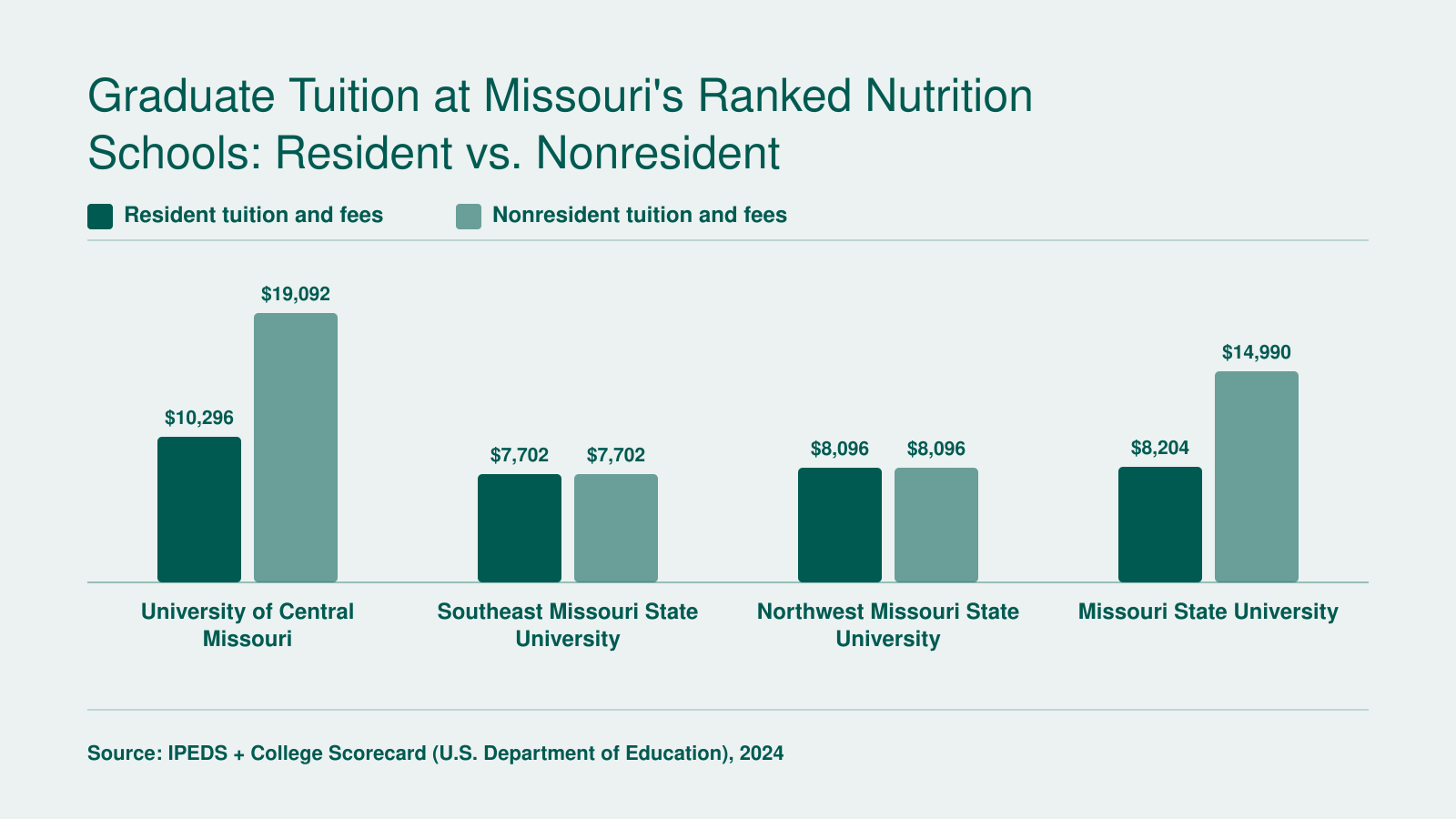
Graduate Tuition at Missouri's Ranked Nutrition Schools: Resident vs. Nonresident
The chart compares annual graduate tuition and fees for Missouri residents and nonresidents. Southeast Missouri State and Northwest Missouri State list the same rate for both groups, which fits their online delivery and flat-rate pricing. Central Missouri and Missouri State show a clear nonresident premium. These are published graduate rates, not the institution-wide net price, so your actual cost depends on credit load, program length, and aid.
Cost of a Nutrition Master's and Missouri Licensure Requirements
The real price of a nutrition master's is the per-credit rate times the credits required, plus fees that differ by school, the same pattern the Most Affordable Master's in Nutrition Programs ranking uses to compare costs. Northwest Missouri State is the least expensive on tuition: $492 per credit across 30 credits is $14,760, and out-of-state students pay the same. Its dietetic internship adds a separate fee, listed at $7,488 under 2024-2025 rates. Central Missouri's Sport Nutrition option estimates $16,640 for 33 credits in 2026-2027. Southeast Missouri State runs $17,452 for 36 credits at $457 per credit, including a $100 course fee and an $800 field-experience fee. Missouri State is the priciest: $19,776 in-state and $28,008 out-of-state, with service, enrollment, and program fees included.
Costs outside the tuition bill
Budget for background checks, liability insurance, travel to supervised practice sites, and the Commission on Dietetic Registration exam fee. Ask each program for current amounts.
Credentials by degree type
ACEND-track degrees lead to the RDN exam and Missouri licensure through the State Committee of Dietitians. A non-accredited nutrition degree does not qualify you for the Missouri dietitian license.
Related Articles
Licensed Dietitian Requirements in Missouri
Compare Nutrition programs on the data that matters
Explore more Healthcare specializations or browse every graduate field.
All Healthcare programs