Best Master's in Nutrition Programs in Texas
Compare 23 accredited Nutrition programs in Texas at 15 schools, with graduate earnings, cost, debt, and completion data from IPEDS and the U.S. College Scorecard.

A master's in nutrition in Texas is a 30- to 66-credit graduate degree, and the programs behind it are not interchangeable. Formats run from fully online to campus-only, and published in-state tuition spans roughly $8,500 at Texas Woman's University to $43,600 at Baylor University.
GRE requirements differ school to school. So does the bigger question: whether the degree leads to registered dietitian eligibility or stops at academic training. That eligibility turns on ACEND-accredited education and supervised practice, not the degree title.
Key Points
- A nutrition master's alone doesn't qualify you for the RD exam; ACEND-accredited supervised practice does.
- University of Houston's 30-credit, non-thesis master's is fully online, but online formats differ by school.
- Texas Licensed Dietitians need at least 900 supervised practice hours, an accredited degree, and the CDR exam.
The 10 Best Master's in Nutrition Programs in Texas
Texas master's nutrition options range from fully online clinical degrees to military-only and dietetics-track programs. A nutrition master's alone does not make you eligible for the registered dietitian exam. That depends on ACEND-accredited education and supervised practice, so confirm the specific track before you apply. Graduation rates below are institution-wide, and program-level earnings are not yet published for these programs.
University of Houston
#1Houston, TX · $10,000 – $19,000/yr (est.)
Best for: Dietetic interns studying fully online
The University of Houston offers a fully online, 30-credit non-thesis M.S. in Nutrition built for dietetic interns and credentialed dietitians who want advanced clinical and management skills. Listed graduate tuition is about $9,019 in-state and $18,199 out-of-state, and the institution-wide graduation rate is about 65%. Applicants generally need to be current or accepted dietetic interns, or already registered dietitians, so it is not an entry route into the profession.
- 30 total credit hours, fully online, non-thesis
- Focus on medical nutrition therapy and advanced physical assessment
- Includes clinical management leadership coursework
- Aimed at dietetic interns and registered dietitians
- Texas residents apply through a separate plan code
- Fall, spring and summer starts
Baylor University
#2Waco, TX · ~$44,000/yr (est.)
Best for: Army officers pursuing military dietetics
Baylor University runs a distinctive 24-month M.S. in Nutrition in Waco that is open only to U.S. Army officers. It pairs coursework with more than 1,300 supervised practice hours and prepares graduates for the registered dietitian exam. A separate Nutrition Sciences M.S. serves civilian students. Listed graduate tuition is about $43,578, and the institution-wide graduation rate is about 80%.
- 24-month campus program exclusively for Army officers
- 66 total credit hours with about 1,300 supervised practice hours
- GRE listed as an entrance exam requirement
- 3.3 GPA minimum and 27 hours of prerequisites
- Research project with oral defense and comprehensive exams
- Prepares graduates for the CDR registration exam
- 30 total credit hours on campus
- Fall, spring and summer starts
- Prerequisites in chemistry, biochemistry and anatomy
- Two-semester special project required
- Aimed at healthcare and public health careers
Texas State University
#3San Marcos, TX · ~$9,000/yr (est.)
Best for: Thesis-track students seeking research training
Texas State University in San Marcos offers a research-oriented M.S. in Human Nutrition with thesis and non-thesis paths. Its listed graduate tuition is about $6,432 in-state and $13,812 out-of-state, among the lower figures on this list. The institution-wide graduation rate is about 55%. The program lists no entrance exam requirement, and early applicants may receive priority funding.
- 33 total credit hours with thesis or capstone option
- No entrance exam required
- Rolling admissions with fall and spring starts
- 3.0 GPA minimum and three recommendation letters
- Prerequisite courses required
- Priority funding for early applicants
Texas Woman's University
#4Denton, TX · ~$9,000/yr (est.)
Eligibility for the dietitian exam comes only when the degree is completed alongside TWU's ACEND-accredited RDN preparation program, so students should plan that pairing deliberately. Listed graduate tuition is about $5,814 in-state and $13,194 out-of-state, with an institution-wide graduation rate near 49%.
- Can be finished in as little as 12 months
- Thesis or capstone option
- Online, hybrid and face-to-face courses
- Standalone degree; RDN eligibility requires the ACEND-accredited preparation program
- School Nutrition Specialist practicum available
- Combines the master's with an ACEND-accredited dietetic internship
- Medical nutrition therapy emphasis
- Houston M.S./DI no longer accepts applications; final cohort began August 2026
- Confirm current Denton availability before applying
Lamar University
#5Beaumont, TX · ~$9,000/yr (est.)
Lamar University in Beaumont delivers a 100% online, 36-credit M.S. in Nutrition with Applied Nutrition and Sport Nutrition concentrations. The emphasis is community nutrition and applied practice rather than a dietetics credential. Registered dietitians can transfer up to six credits. Listed graduate tuition is about $6,471 in-state and $13,851 out-of-state, with an institution-wide graduation rate near 37%.
- 36 credit hours, 100% online
- Community nutrition emphasis
- Capstone with career exploration
- Up to six transfer credits for registered dietitians
- Portfolio completed at the end of the program
- 36 credit hours, 100% online
- Sport nutrition concentration
- Capstone required
- Prior RDN credit accepted
- Aimed at managers, researchers and educators
The University of Texas at Austin
#6Austin, TX · ~$12,000/yr (est.)
The University of Texas at Austin offers an online, cohort-based M.S. in Nutritional Sciences and a campus thesis program. The online degree is science-focused and meets part of the Certified Nutrition Specialist requirements, rather than serving as a dietitian credential route. Listed graduate tuition is about $12,006 in-state and $44,908 out-of-state, and the institution-wide graduation rate is near 89%. Admission is described as highly competitive.
- 100% online, cohort-based
- One-year and two-year completion tracks
- Meets part of the CNS certification requirements
- Topics include gut microbiome and gene-nutrient interactions
- Prerequisite science coursework may be required
- Two-year campus program
- 30 total credit hours with thesis required
- Biochemical and clinical curriculum components
- Focus on nutrition and disease prevention
Texas A&M University-College Station
#7College Station, TX · ~$12,000/yr (est.)
Texas A&M University in College Station offers three paths: a thesis or non-thesis M.S. in Nutrition, a combined Master of Clinical Nutrition and dietetic internship, and a nutrition and kinesiology dual option. The Master of Clinical Nutrition is ACEND-accredited and prepares students for the RDN exam, with only 12 spots per year. Listed graduate tuition is about $6,885 in-state and $19,642 out-of-state, with an institution-wide graduation rate near 84%. The traditional M.S. is self-funded.
- 32 to 36 credit hours depending on thesis or non-thesis route
- Three recommendation letters required
- Self-funded with scholarships via Aggie One Stop
- TOEFL required for international applicants
- Fall and spring starts
- 21-month combined master's and ACEND-accredited supervised practice
- 36 credit hours, non-thesis
- Four concentration options
- About 12 spots available each year
- Supervised practice in Houston, College Station and Temple
- Combines nutrition and kinesiology
- Clinical and sport emphasis tracks
- Thesis or non-thesis option
- Prepares for CSCS, SCCC and RCEP credentials
- Limited teaching assistant positions
The University of Texas Rio Grande Valley
#8Edinburg, TX · $5,000 – $10,000/yr (est.)
The University of Texas Rio Grande Valley in Edinburg offers an online M.S. in Health Sciences with a Nutrition concentration, plus an M.S. in Dietetics that combines coursework with supervised experiential learning. Listed graduate tuition is about $7,001 in-state and $14,379 out-of-state, with an institution-wide graduation rate near 51%. Confirm the ACEND category and RDN exam eligibility of the dietetics track directly with the program, since published details are limited.
- Online program format
- Core courses in health policy, quality improvement and research methods
- Pairs nutrition science with healthcare management
- Aimed at nutrition consulting and public health roles
- Combines didactic coursework with supervised experiential learning
- Confirm ACEND category and CDR eligibility with the program
- Format details are limited in published sources
Abilene Christian University
#9Abilene, TX · $25,000 – $30,000/yr (est.)
Abilene Christian University offers two online nutrition master's options, both with a faith-based perspective. The 36-credit M.S. in Nutrition requires a completed Didactic Program in Dietetics, while the 39-credit Nutrition/Dietetic Internship option adds 1,120 supervised practice hours. Listed graduate tuition is about $26,424, and the institution-wide graduation rate is near 59%.
- 36 credit hours, online
- Requires a completed Didactic Program in Dietetics
- 21 core credits and 15 elective credits
- Electives include diabetes, eating disorders and sports nutrition
- 39 credit hours over two years, online
- $650 per credit listed
- 1,120 supervised practice hours
- 3.0 GPA minimum and three recommendation letters
- Culinary nutrition certification included
- Prepares for the registration exam for dietitians
University of the Incarnate Word
#10San Antonio, TX · ~$23,000/yr (est.)
The University of the Incarnate Word in San Antonio offers an in-person, two-year, 30-credit M.S. in Nutrition with a capstone project. Students who want to become registered dietitians can pursue the ACEND-accredited DPD option or add a dietetic internship. Listed graduate tuition is about $20,610, and the institution-wide graduation rate is near 51%. It has one of the lower GPA minimums among ranked programs.
- Two-year campus program, 30 credit hours
- 2.5 GPA minimum and two recommendation letters
- Capstone project over two semesters
- DPD option for the RDN credential
- Dietetic Internship option available
- Prerequisites for non-nutrition majors
Cost & outcomes by school
Federal data for the highest-earning Nutrition programs, independent of the ranking above. Earnings are this field's master's graduates four years after completing, where the Scorecard reports them.
| School | Earnings | Tuition / yr | Debt | Grads/yr | Format |
|---|---|---|---|---|---|
| Texas State University TX | $64,351 | $8,997 | $35,716 | 25 | Campus |
| Lamar University TX | — | $8,642 | — | 98 | Online |
| Texas A&M University-Kingsville TX | — | $6,157 | — | — | Campus |
| Stephen F. Austin State University TX | — | $7,829 | — | — | Hybrid |
| Prairie View A & M University TX | — | $7,993 | — | — | Campus |
| The University of Texas Rio Grande Valley TX | — | $8,589 | — | — | Online |
| The University of Texas at San Antonio TX | — | $10,116 | — | — | Campus |
| Texas A&M University-College Station TX | — | $11,748 | — | — | Campus |
| The University of Texas at Austin TX | — | $12,006 | — | — | Online |
| Parker University TX | — | $14,898 | — | — | Online |
| University of the Incarnate Word TX | — | $22,650 | — | — | Campus |
| Abilene Christian University TX | — | $26,424 | — | — | Online |
Sources: U.S. Department of Education. Tuition and graduates: IPEDS. Earnings and debt: College Scorecard, this field's master's graduates; a dash means no figure is reported.
Online and Hybrid Master's in Nutrition Programs in Texas
Many of the strongest nutrition Master's Programs in Texas can be earned largely online, but "online" means something different at each school.
- University of Houston: 30 credit hours, fully online, non-thesis only.1 Students accepted into a dietetic internship can earn 6 credits for supervised practice.
- Texas Woman's University: 30 credit hours as of Fall 2026, finishable in as little as 12 months, with online, hybrid, and face-to-face courses. The coursework-only track is fully online, and a thesis track is also offered.
- Lamar University: 36 credit hours, 100% online, capstone required.
- UT Austin: 100% online and cohort-based, with two completion tracks built around Certified Nutrition Specialist requirements.
- Abilene Christian University: 36 credit hours over about 24 months. Coursework is online, but the residential dietetic internship (traditionally in Dallas-Fort Worth) requires 1,120 supervised-practice hours.2
- UTRGV: an online health sciences master's with a nutrition concentration.
If you're pursuing the RDN, online coursework won't excuse you from in-person rotations in Texas.
Pick a thesis track for research or PhD preparation. Non-thesis tracks are practice-focused and usually faster across master's in nutrition and dietetics programs.
GRE Policies: Which Texas Master's in Nutrition Programs Waive It or Make It Optional
The GRE has shifted from a default hurdle to an exception in Texas nutrition admissions, a trend visible across No-GRE master's programs, but the ranked programs still split into distinct camps. Each policy below comes from that program's own admissions materials.
- Waived or not required: UT Austin permanently waives the GRE for Nutritional Sciences applicants and does not review scores submitted voluntarily.1 Texas State's M.S. in Human Nutrition does not require the exam2, though it sets a 3.0 GPA minimum for admission.
- Required, with a GPA waiver: The University of Houston requires the GRE unless your cumulative undergraduate GPA is 3.0 or higher.3 Without the waiver, Houston typically expects scores above the 30th percentile on the quantitative and verbal sections and at least 3.5 on analytical writing, and scores older than five years are not accepted.3
- Required: Baylor's program catalog lists the GRE as an entrance exam.
- No published policy found: Texas Woman's University, Lamar University, Texas A&M University, UT Rio Grande Valley, Abilene Christian University, and the University of the Incarnate Word do not state a current GRE policy on the admissions pages we reviewed.
Policies can change between cycles, so confirm the requirement on the program page for your specific entry term before you register for or skip the test.
Related Articles
Cost of a Master's in Nutrition in Texas and Paths to Licensure or Certification
Tuition and Funding
In-state graduate tuition across the ranked programs spans roughly $8,500 to $26,000 per year for full-time study, and out-of-state rates are often much higher. The net price shown elsewhere on this page is an institution-wide average across all graduate students, not a program-specific nutrition quote.
Texas A&M offers graduate assistantships and competitive scholarships that may include a nonresident tuition waiver; some travel awards are around $1,000. Fall funding applications are due December 1. Texas Woman's University offers assistantships in Denton and Houston that can include stipends and out-of-state tuition waivers for 10 to 20 hours per week; the university reports more than $21.6 million in annual scholarship funding across its aid programs.
Texas Licensure and Certification
A master's in nutrition alone does not make you a registered dietitian or Texas Licensed Dietitian. Since 2024, the Commission on Dietetic Registration requires a graduate degree before you can take the RDN exam. After passing that exam and the Texas jurisprudence exam4, you can apply for the LD credential. The LD application requires 900 supervised practice hours and a $108 fee1; renewal is every two years with 12 continuing education hours3 and a $90 renewal fee2.
For graduates outside ACEND-accredited dietetics programs, the Certified Nutrition Specialist is an alternative: it requires a graduate degree in nutrition, 1,000 supervised hours, and an individual BCNS review5.
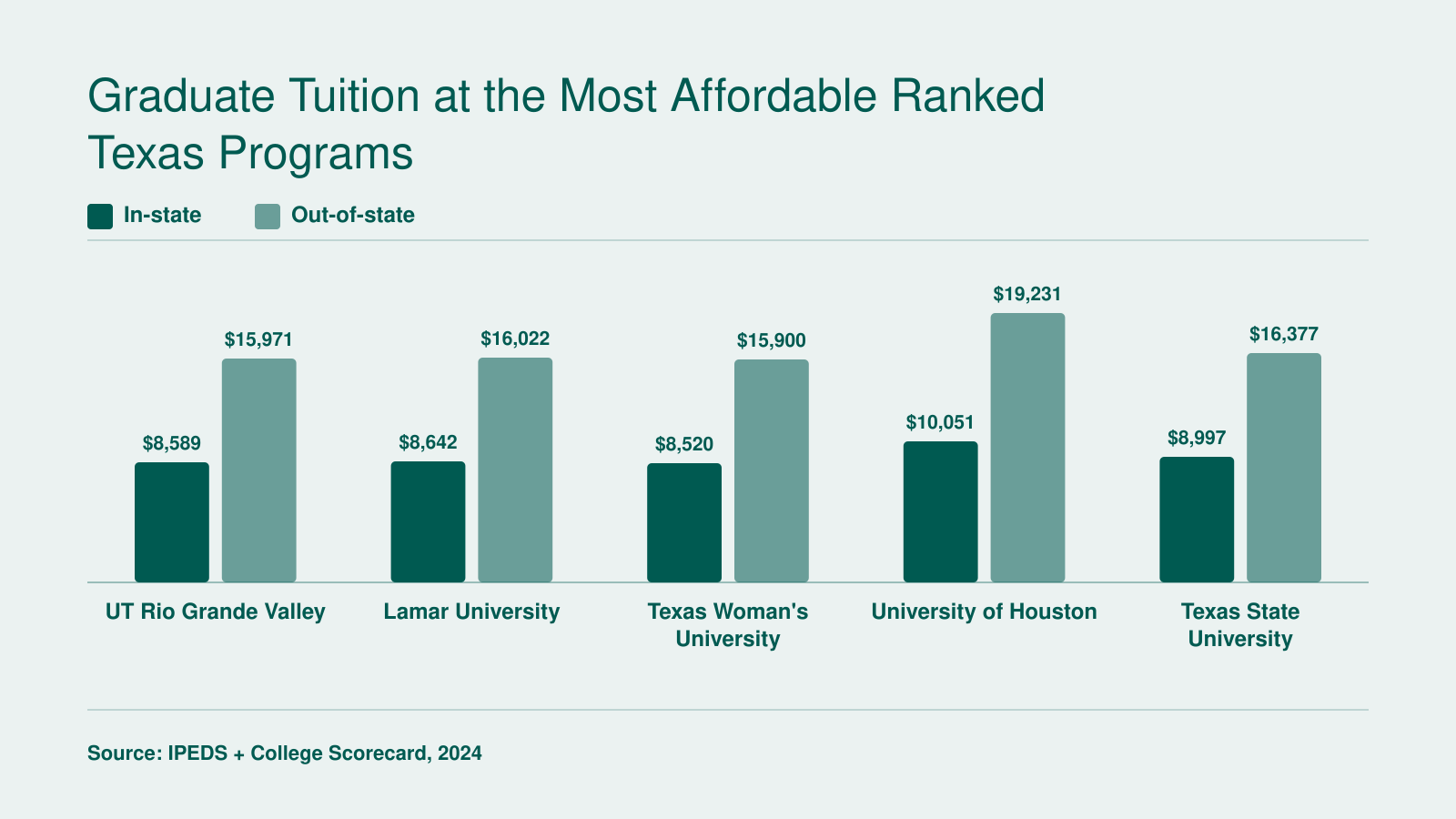
Graduate Tuition at the Most Affordable Ranked Texas Programs
Texas public universities price graduate nutrition tuition within a narrow band, and out-of-state rates run roughly twice the in-state rate. The figures below are published graduate tuition and fees for the lowest-cost programs on this list. They are not net cost after financial aid, scholarships, or assistantships.
Texas Dietitian Licensure at a Glance
Master's in Nutrition Prerequisites and Admissions Checklist for Texas Programs
Requirements vary by program, so confirm each school's current admissions page before you apply.
- Degree and GPAA bachelor's degree is expected. Texas State requires a 3.0 GPA. At UT Austin, a 3.00 applies to upper-division and prior graduate work. Texas Woman's University sets 3.25 on the last 60 undergraduate credits. Texas Tech lists 3.0 as preferred.
- Science courseworkExpect chemistry, organic chemistry, biochemistry, anatomy and physiology, and introductory nutrition. Texas Tech's online program publishes no required course list.
- DPD verificationTCU's MS-DPD track requires it. Texas Tech's online program accepts a DPD statement, dietetic internship acceptance, or RD credentials. UT Austin, Texas Woman's, and Texas State do not clearly require it for the MS.
- Application materialsSubmit transcripts, a statement of purpose, a resume, and recommendation letters. Texas Tech asks for two letters online and three for residential, where a mentor must be secured first.
- DeadlinesFall windows run from December to July. Texas State's priority date is January 1 and its standard date is March 1. UT Austin lists December 1, 2026 for Fall 2027, though another listing conflicts. No ranked school clearly publishes rolling admissions.
Frequently Asked Questions About Master's in Nutrition Programs in Texas
These answers cover the questions applicants ask most often about dietitian credentials and Texas practice rules. Requirements change, so confirm current details with each program and the Texas Department of Licensing and Regulation.
Does a master's in nutrition qualify you to become a registered dietitian?
What is the best master's in nutrition program in Texas?
Can I work as a nutritionist in Texas with a master's degree but no RDN?
Do I need a DPD verification statement to apply to a Texas master's in nutrition and dietetics program?
Compare Nutrition programs on the data that matters
Explore more Healthcare specializations or browse every graduate field.
All Healthcare programs