Best Family Nurse Practitioner (FNP) Programs in Texas
Compare 31 accredited Family Nurse Practitioner (FNP) programs in Texas at 29 schools, with graduate earnings, cost, debt, and completion data from IPEDS and the U.S. College Scorecard.

A master's-level FNP program in Texas trains registered nurses to diagnose, prescribe, and manage patients across the lifespan, typically over 2 to 3 years and at least 500 supervised clinical hours. The practical question for most working RNs isn't prestige: it's which program delivers that credential at the lowest real cost without forcing you to quit your bedside job.
Format drives a lot of that math. A fully online track may still tie you to Texas for clinicals, and net price varies more by school than by whether you ever set foot on campus.
Key Points
- UT Arlington's online MSN-FNP requires 720 supervised clinical hours, arranged in your own geographic area.
- Confirm CCNE or ACEN accreditation first, then check each school's own GRE policy.
- After certification by AANPCB or ANCC, apply to the Texas Board of Nursing for APRN licensure.
10 Family Nurse Practitioner Master's Programs in Texas for 2027
The 10 Texas master's programs below focus on the MSN-FNP pathway, with campus, online, and hybrid formats considered together. Each card shows graduate tuition for in-state and out-of-state students and an approximate institution-wide net price. Where federal outcome data are available, the notes indicate the time window for program-level earnings and the institution-wide graduation rate.
Texas A&M University-College Station
#1College Station, TX · ~$12,000/yr (est.)
Best for: Texas RNs needing local clinical placements
Texas A&M's MSN-Family Nurse Practitioner program is a 48-credit sequence that requires an active Texas RN license and Texas residency. It includes 671 clinical hours, often completed near the student's community, and admits one fall cohort each year. Applicants should already have 1,500 BSN practice hours, ideally a 3.0 GPA or better, and three references. Graduates are prepared for ANCC and AANP family nurse practitioner certification.
- 48 credit hours, full-time six semesters or part-time eight
- 671 clinical hours, often completed in the student's community
- Requires active Texas RN license and Texas residency
- Recommends 3.0 GPA and three references
- Requires 1,500 BSN practice hours
- Fall start; prepares for ANCC and AANP certification
University of Houston
#2Houston, TX · $10,000 – $19,000/yr (est.)
Best for: Houston-area nurses seeking evidence-based primary care
UH's MSN Family Nurse Practitioner track builds on BSN foundations and emphasizes theory, research, and evidence-based primary care across the lifespan. The program is structured for advanced practice, with attention to leadership, educator, and clinician roles. Applicants should contact the nursing department for specific requirements and degree plans, since published admissions details are limited.
- Family Nurse Practitioner track within the MSN
- Builds on BSN foundations for advanced practice
- Focus on theory, research, and evidence-based healthcare
- Emphasizes family care across the lifespan
- Contact the nursing department for specific requirements and degree plans
The University of Texas at Arlington
#3Arlington, TX · ~$11,000/yr (est.)
Best for: Working nurses pursuing asynchronous online FNP
UT Arlington offers both an MSN-FNP and an RN-to-MSN FNP pathway online, with asynchronous eight-week courses and multiple start dates. The MSN track is 46 credits with 720 clinical hours and placement assistance; the RN-to-MSN option is 81 credits and accelerated. Admission requires a BSN or RN-to-MSN eligibility, a 3.0 GPA, an active RN license, and undergraduate statistics. The CCNE-accredited program prepares working nurses for FNP certification.
- 46 credit hours with 720 clinical hours
- Asynchronous eight-week courses and six start dates per year
- Tuition lock and $654 per credit for the MSN track
- Placement assistance for clinical experiences in your area
- Requires BSN, 3.0 GPA, active RN license, and statistics
- CCNE accredited with no campus visits required
- 81 credit hours, 42 months, accelerated pathway
- $38,308 total program tuition with lock
- CCNE accredited and prepares for FNP certification
- Clinical placement assistance provided
- Multiple start dates per year
- Earn BSN en route to MSN
Texas Tech University Health Sciences Center
#4Lubbock, TX · ~$7,000/yr (est.)
Texas Tech University Health Sciences Center's MSN FNP track prepares primary care nurses for rural and underserved settings. The 48-credit program requires a BSN, a 3.0 GPA, a valid unencumbered RN license, and one year of RN experience. Admission also involves three professional references and a personal essay. Graduates are eligible to take the ANCC and AANP family nurse practitioner certification exams.
- 48 semester credit hours
- Requires BSN and 3.0 GPA
- One year of RN experience required
- Three professional references and personal essay required
- Fall and spring admission
- Prepares for ANCC and AANP certification
- CCNE accredited, no entrance exam required
The University of Texas Rio Grande Valley
#5Edinburg, TX · $5,000 – $10,000/yr (est.)
UTRGV's MSN Family Nurse Practitioner program focuses on multicultural communities in the Rio Grande Valley and advanced practice nursing skills. The curriculum emphasizes critical thinking, holistic care, and collaborative practice. UTRGV's Graduate Select Scholarship offers up to $1,000 for eligible graduate nursing students.
- CCNE accredited
- Focuses on multicultural Rio Grande Valley communities
- Prepares for advanced practice nursing
- Graduate Select Scholarship up to $1,000
- Emphasizes critical thinking and holistic patient care
The University of Texas Medical Branch at Galveston
#6Galveston, TX · ~$13,000/yr (est.)
UTMB's Family Nurse Practitioner MSN is a part-time, seven-semester track requiring 49 credit hours and clinical practicum experiences. Applicants need a BSN, a 3.0 GPA, one year of RN experience, and active RN licensure. The program includes limited campus visits with most coursework completed online, and it prepares graduates for ANCC or AANP certification.
- 49 credit hours across seven semesters
- Part-time option only
- Requires BSN, 3.0 GPA, and one year RN experience
- Active RN license and three recommendations required
- Limited campus visits each semester
- Prepares for ANCC or AANP certification
- CCNE accredited and Texas Board of Nursing approved
The University of Texas at Tyler
#7Tyler, TX · ~$8,000/yr (est.)
UT Tyler's MSN-FNP program combines online coursework with minimal campus visits and requires 47 credit hours, including clinical components and a capstone. Admission requires a BSN, a 3.0 GPA in the last 60 undergraduate credits, current RN licensure, one year of nursing experience, and an undergraduate statistics course. The CCNE-accredited program uses rolling admissions and a $50 application fee for domestic applicants. Graduates prepare for national certification with historically strong pass rates.
- 47 credit hours with clinical components and capstone
- Requires BSN and 3.0 GPA in last 60 credits
- One year nursing experience and current RN license required
- Undergraduate statistics prerequisite
- Rolling admissions and $50 domestic application fee
- CCNE accredited
- $200 seat deposit required
The University of Texas at El Paso
#8El Paso, TX · $5,000 – $10,000/yr (est.)
UTEP's FNP concentration focuses on primary care through a hybrid format with seven-week courses. The 49-credit program spans seven semesters and requires 775 clinical clock hours, with clinical travel sometimes extending beyond 200 miles. Admission occurs in fall and spring, and Texas residents pay a per-credit tuition rate that keeps the program comparatively accessible. Graduates are prepared for ANCC or AANP certification.
- 49 credit hours over seven semesters
- 775 clinical clock hours required
- Seven-week course format
- Clinical travel may exceed 200 miles
- $552 per credit for Texas residents
- Fall and spring admission cycles
- Prepares for ANCC or AANP certification
The University of Texas Health Science Center at Houston
#9Houston, TX · $11,000 – $34,000/yr (est.)
UTHealth Houston's Cizik School of Nursing MSN-FNP program prepares nurses for advanced practice with a strong emphasis on primary care and underserved communities. The hybrid program requires Texas residency before classes start, a BSN with a 3.0 GPA, Texas nursing licensure, and one year of clinical experience. Admission uses the NCAS system and includes an interview, background screening, and drug screening. Selected FNP students may access rural and urban underserved-area traineeships.
- Hybrid program with online and campus components
- Requires Texas residency before classes start
- One year clinical experience and 3.0 GPA required
- Three recommendations and interview required
- Rolling admissions with spring and fall starts
- Background check, drug screening, and immunization screening
- CCNE accredited
Texas Woman's University
#10Denton, TX · ~$9,000/yr (est.)
Texas Woman's University offers an MSN-FNP with online and hybrid paths, and clinical placements must be completed in Texas. Admission requires a BSN, a 3.0 GPA, current RN licensure, a statistics prerequisite, and two recommendation letters, with a $50 application fee. The CCNE-accredited program prepares graduates to manage primary care across the lifespan.
- Online and hybrid format options
- Requires BSN, 3.0 GPA, and active RN license
- Basic statistics prerequisite
- Two recommendation letters and $50 application fee
- Clinical placements must be completed in Texas
- Casper Assessment required for the online program
- Fall, spring, and summer start terms
- CCNE accredited
Cost & outcomes by school
Federal data for the highest-earning Family Nurse Practitioner (FNP) programs, independent of the ranking above. Earnings are this field's master's graduates four years after completing, where the Scorecard reports them.
| School | Earnings | Tuition / yr | Debt | Grads/yr | Format |
|---|---|---|---|---|---|
| Texas Wesleyan University TX | $219,488 | $19,499 | $147,822 | 3 | Hybrid |
| Midwestern State University TX | $132,498 | $8,198 | $31,545 | 16 | Hybrid |
| Angelo State University TX | $132,218 | $7,509 | $36,107 | 18 | Hybrid |
| Texas A & M International University TX | $131,501 | $6,650 | — | 53 | Online |
| The University of Texas Rio Grande Valley TX | $128,123 | $8,589 | $23,302 | 9 | Campus |
| The University of Texas at Tyler TX | $127,762 | $8,480 | $38,076 | 87 | Hybrid |
| The University of Texas Medical Branch at Galveston TX | $126,781 | $12,759 | $41,000 | 120 | Hybrid |
| Texas Tech University Health Sciences Center TX | $126,759 | $7,153 | $50,275 | 162 | Hybrid |
| Texas A&M University-College Station TX | $126,516 | $11,748 | — | 29 | Hybrid |
| Texas A & M University-Corpus Christi TX | $123,346 | $7,179 | $45,500 | 36 | Online |
| The University of Texas at Arlington TX | $122,994 | $11,249 | $48,470 | 867 | Online |
| The University of Texas at El Paso TX | $121,262 | $7,166 | $41,000 | 105 | Hybrid |
Sources: U.S. Department of Education. Tuition and graduates: IPEDS. Earnings and debt: College Scorecard, this field's master's graduates; a dash means no figure is reported.
Cost, debt & payoff
Median earnings of this field's master's graduates (4 yrs after completing) vs. their median federal loan debt · U.S. College Scorecard
Across these programs the median graduate earns about $122,994 and finishes with roughly $41,000 in debt — a ratio that clears a common rule of thumb (keep debt below first-year salary). Tuition and debt vary widely school to school, so check the per-school figures in the table above before you shortlist.
Online and Hybrid MSN-FNP Options for Working Texas RNs
Online Family Nurse Practitioner (FNP) programs do exist in Texas, but most still tie you to the state for clinicals. UT Arlington delivers its 46-credit program online, with 720 supervised clinical hours completed in your geographic area. Its program pages do not describe a required campus intensive. Texas Woman's University offers a 45-credit online track (14 courses) and a separate hybrid option with in-person and asynchronous sessions in Dallas. The TWU pages reviewed do not say whether the online track requires campus visits.
Texas Tech HSC runs a hybrid MSN-FNP, though its pages do not specify how many in-person visits are required. UT Tyler is online/hybrid, not fully online: expect 1-2 days on the Tyler campus each semester, with 675 clinical hours near home. Its pages list 47 or 48 credits, so confirm the current figure.
Out-of-state applicants should read the fine print. TWU's hybrid track is limited to Texas residents, with remote and clinical work done in Texas, and UT Tyler requires all clinicals in Texas.
For full-time RNs comparing online master's programs in Texas, ask each school whether classes meet synchronously and whether a part-time plan is available before you apply.
GRE Policies and Accreditation Status at Ranked Texas FNP Schools
Texas family nurse practitioner programs have moved away from treating the GRE as a default requirement, but the shift is uneven enough that applicants should check each school’s published policy. CCNE or ACEN accreditation matters before anything else: it is required to sit for national FNP certification and to qualify for federal student aid.
Among the ranked nurse practitioner programs here, Texas State’s MSN-FNP states the GRE is not required. Texas Woman’s University similarly does not require the GRE for the 2026 cycle, but it does require Casper. UT Austin is the opposite: its MSN FAQ says the GRE is required and is not waived. Texas Tech University Health Sciences Center's program is accredited by CCNE or ACEN, though its admissions bullets do not list the GRE. UT Tyler and Midwestern State show a 3.0 GPA baseline without establishing a GRE requirement, so treat the absence of GRE language as "No published policy" rather than guessing.
Accreditation for these programs falls under CCNE or ACEN, but next scheduled review dates are not consistently published in the admissions materials reviewed. Confirm current status in the CCNE or ACEN online directories before applying.
Related Articles
Texas APRN Licensure for New FNP Graduates
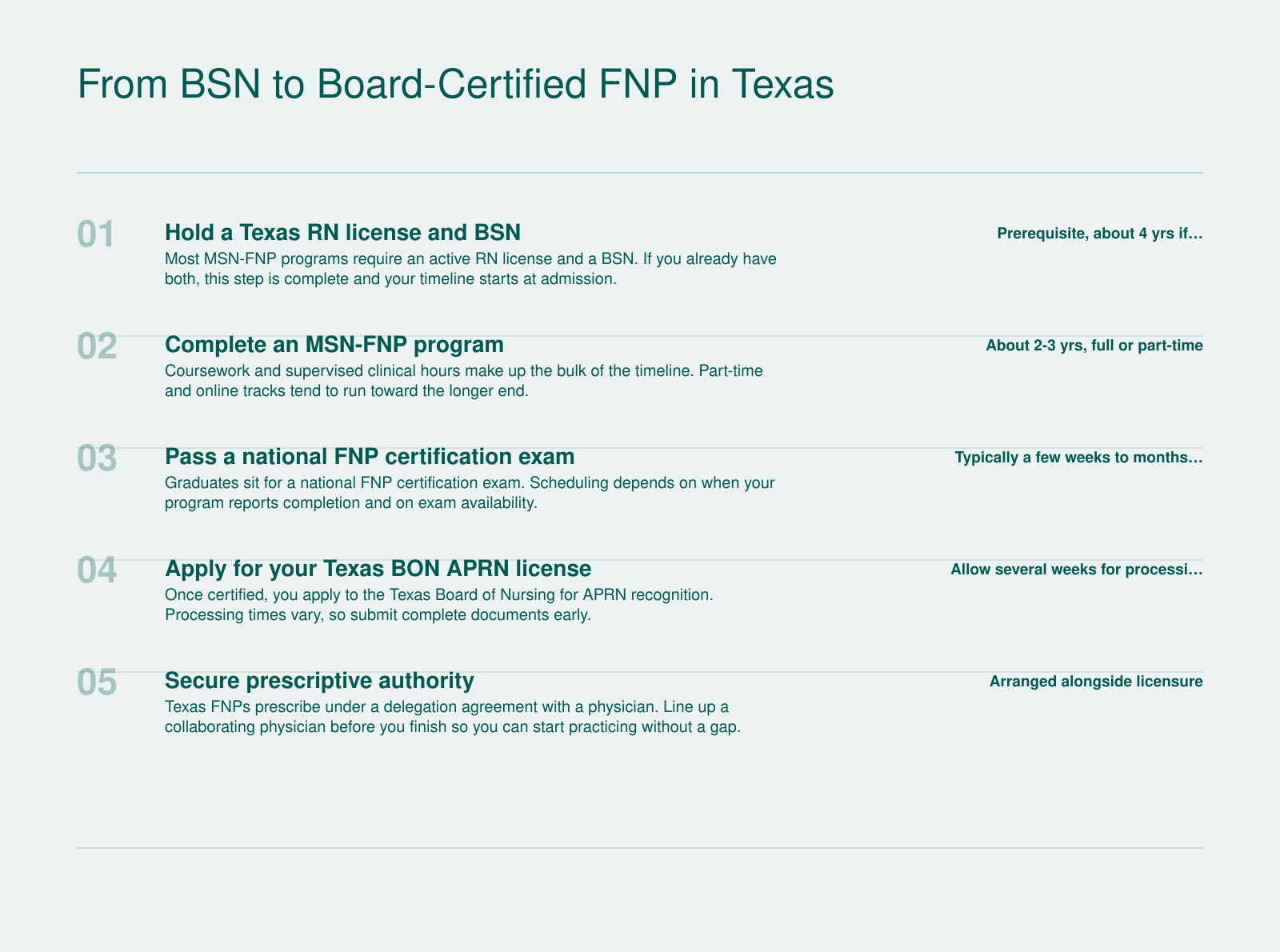
From BSN to Board-Certified FNP in Texas
Becoming an FNP in Texas takes roughly 2.5 to 3.5 years after you hold a BSN and an active RN license: about 2-3 years in an MSN-FNP program, plus a few months for certification, state licensing and a prescriptive delegation agreement. Starting from scratch with no nursing degree adds the time needed to earn a BSN.
Clinical Hours and Who Finds Your Preceptor
Who finds your preceptor matters more than the hour total in the brochure. The long-cited national floor is 500 supervised direct patient-care hours1, but AACN's 2026 FAQ cites 750 direct-care hours under the NTF Standards and 500 total practice hours under its Essentials2. Confirm the current figure with any school.
Texas totals are not directly comparable. Texas State lists 900 hours (750 direct, 150 indirect), Texas Wesleyan 855, and Texas A&M University-Corpus Christi 6303. Midwestern State lists 256, and Texas A&M cites 45 clinical hours, likely a different component. Texas A&M International's handbook sets no total4.
- Student-secured: Texas State (a coordinator helps), Texas Wesleyan (no current employer, university handles contracting), Texas A&M-Corpus Christi (faculty approval), Midwestern State (affiliation agreements can take up to six weeks), and Texas A&M International.
- Program-arranged: Texas A&M may place students who lack a preceptor, though travel and lodging can be your cost.
Distance makes this decisive for online students. If you live hours from campus and the school won't assign sites, you are cold-calling local clinics, a burden that MSN FNP programs that provide clinical placement can remove.
Tip: ask admissions how many students are waiting on placement each term.
Admission Requirements and Application Deadlines for Texas MSN-FNP Programs
Requirements vary by school, so confirm details on each admissions page. Published specifics were available for only some programs here.
- Degree and accreditationUT Arlington requires a BSN from a regionally accredited school, with the nursing program accredited by CCNE or ACEN.
- RN licenseUT Arlington requires an unencumbered RN license. Check each school's policy on Texas versus compact licenses before applying.
- GPA and RN experienceUT Arlington sets 3.0 for unconditional admission, with probationary admission possible at 2.8–2.99, and requires no RN experience. Texas Tech HSC lists a 3.0 on baccalaureate coursework and may consider science GPA. Many programs expect 1–2 years of RN experience, but neither school's published criteria confirm this.
- PrerequisitesUT Arlington requires an undergraduate basic statistics course with a grade of C or better. Texas Tech HSC's published criteria do not list prerequisite courses.
- Deadlines and start termsFall and spring cycles differ by school, and UT Arlington and Texas Tech HSC did not publish a specific deadline in the sources reviewed. Texas Woman's University, UTHealth Houston, and UT Tyler details could not be verified, so check their nursing admissions pages directly.
Texas FNP Program FAQs
What is the difference between an MSN-FNP and a DNP-FNP in Texas?
How many years does the BSN-to-FNP path take in Texas?
Do Texas FNPs need a physician to prescribe medication?
Compare Family Nurse Practitioner (FNP) programs on the data that matters
Explore more Nursing specializations or browse every graduate field.
All Nursing programs