Best RN to MSN Programs
Compare 170+ accredited RN to MSN programs at 70+ schools, with graduate earnings, cost, debt, and completion data from IPEDS and the U.S. College Scorecard.

Bridge pathways now let working nurses skip a standalone BSN, and that shortcut is reshaping graduate nursing enrollment. The typical applicant holds an ADN or a bachelor's in another field, works shifts, and wants an MSN without repeating undergraduate nursing.
This ranking uses IPEDS and College Scorecard figures, not paid placements. Published program tuition runs from $8,460 at Stevenson University to $34,460 at Elmhurst University.
Sticker prices mislead on their own. Credit loads range from 43 at Minnesota State Moorhead to well over 100 when BSN coursework is bundled in, so cost per credit and total length matter as much as the headline number.
Key Points
- Full-time RN to MSN bridge programs commonly run 19 to 31 months.
- Southern Utah University advertises the shortest path: 20 months for 60 credits.
- Check net price and credit load, since published tuition is not an all-in total.
The 10 Best RN to MSN Programs, Ranked
The programs below represent strong RN to MSN options for working nurses, with choices spanning fully online, hybrid, and campus-based formats. Each entry highlights concentration options, clinical requirements, cost position, and where available, graduate earnings. Use the eligibility section that follows to check whether your ADN or non-nursing bachelor's background matches a program's admission path.
Massachusetts College of Pharmacy and Health Sciences
#1Boston, MA · ~$27,000/yr (est.)
Best for: ADN nurses pursuing family nurse practitioner
MCPHS University's Family Nurse Practitioner Bridge Program takes an ADN-prepared nurse through a fully online bridge year before master's-level FNP coursework. Students complete 750 supervised direct patient care hours and attend on-campus residencies, with first-attempt ANCC exam pass rates of 92% in 2025.
- Fully online ADN-to-MSN bridge with two on-campus residencies
- Family Nurse Practitioner concentration with 750 supervised clinical hours
- 92% first-attempt ANCC board pass rate in 2025
- Median graduate earnings $132,366 four years after completion
- Median graduate debt $41,000
- CCNE-accredited and available in 22 states including Massachusetts
Chamberlain University-Illinois
#2Addison, IL · ~$15,000/yr (est.)
Best for: Working RNs seeking accelerated online leadership
Chamberlain University's Accelerated RN to MSN option is a fully online, 45-credit program with Advanced Nursing Leadership and AI concentrations. Eligible students can finish in as few as 10 months, and the $750-per-credit price puts total tuition at $33,750.
- 100% online with practicum placement support guaranteed
- Complete in as few as 10 months with rolling starts
- 45 credit hours at $750 per credit, total $33,750
- Concentrations in Advanced Nursing Leadership and AI
- No entrance exam required and 3.0 GPA minimum
- Google-backed AI coursework at no extra charge
- Median graduate earnings $118,689 four years after completion
- Median graduate debt $42,611
Elmhurst University
#3Elmhurst, IL · ~$34,000/yr (est.)
Best for: Registered nurses with non-nursing bachelor's degrees
Elmhurst University's campus-based RN to MSN option in Elmhurst, Illinois is built for working registered nurses and opens with prerequisite coursework in statistics, research, and health assessment. Fall entry and a June 1 preferred deadline make it a structured choice for nurses near Chicago.
- CCNE-accredited campus program in Elmhurst, Illinois
- Fall term start with June 1 preferred application deadline
- Prerequisites in statistics, research, and health assessment
- Requires one year full-time clinical practice within the past two years
- 3.0 minimum GPA
- Median graduate earnings $107,924 four years after completion
- Median graduate debt $41,000
American Public University System
#4Charles Town, WV · $5,000 – $10,000/yr (est.)
American Public University System offers a fully online RN to MSN pathway for associate or diploma-prepared nurses, with nurse educator, nurse leader, and community and public health tracks. Asynchronous courses and monthly starts make it accessible for working nurses.
- Online with tracks in educator, leader, and community and public health
- 147 total credit hours leading to BSN and MSN in one pathway
- 160 clinical hours in the education and leadership tracks
- Asynchronous classes with most courses running 8 weeks
- 3.0 GPA minimum and transfer up to 90 undergraduate credits
- CCNE-accredited with no application fee
- Median graduate earnings $105,483 one year after completion
Sacred Heart University
#5Fairfield, CT · ~$34,000/yr (est.)
Sacred Heart University's online RN-BSN-MSN combines bachelor's and master's study into a single pathway with five MSN concentrations, including family nurse practitioner and psychiatric mental health nurse practitioner. The program can be completed in as few as 3.5 years and does not require GRE or GMAT scores.
- Online and CCNE-accredited with five concentration options
- Complete in as few as 3.5 years with 153 total credits
- No GRE or GMAT required and 3.0 GPA minimum
- 120 to 540 clinical hours depending on specialization
- Total program tuition $28,380 at $390 per credit
- FNP and PMHNP require on-campus residency
- Median graduate earnings $125,904 four years after completion
- Median graduate debt $32,406
Carroll University
#6Waukesha, WI · $10,000 – $15,000/yr (est.)
Carroll University's RN to MSN program in Waukesha, Wisconsin uses 8-week hybrid courses with once-weekly in-person meetings and modern simulation labs. The 47-credit nurse educator pathway can be completed in 20 months.
- 20-month hybrid program with 47 credits
- 8-week courses with in-person meetings once weekly
- Nurse educator focus with leadership preparation
- CCNE-accredited with fall start
- Employer tuition reimbursement supported
- Modern nursing simulation labs
Ball State University
#7Muncie, IN · $10,000 – $15,000/yr (est.)
Ball State University's online MSN offers nurse educator, nurse administrator, and family nurse practitioner concentrations for licensed RNs. The asynchronous format supports part-time or full-time pacing, and FNP students complete 690 supervised clinical hours.
- Three concentrations in educator, administrator, and FNP
- Asynchronous online courses with full-time or part-time pacing
- 40 to 48 credits depending on the chosen path
- 690 supervised clinical hours for FNP students
- 2023 FNP graduates posted a 100% first-time exam pass rate
- CCNE-accredited and nationally ranked by U.S. News
- Median graduate earnings $117,260 four years after completion
- Median graduate debt $33,250
Stevenson University
#8Owings Mills, MD · ~$8,000/yr (est.)
Stevenson University's online RN to MS in Nursing is built for working Maryland nurses, with four concentrations including forensic nursing and population health. The program charges $505 per credit with zero fees and offers six start dates per year.
- Four concentrations including forensic nursing and population health
- $505 per credit with zero fees
- 120 total credits delivered in 8-week online sessions
- Six start dates per year and no entrance exam
- 3.0 GPA minimum and active RN license required
- First graduate course billed at the undergraduate tuition rate
- Median graduate earnings $111,980 four years after completion
- Median graduate debt $31,017
No program details are available for this ranking position.
Georgia State University
#10Atlanta, GA · $9,000 – $25,000/yr (est.)
Georgia State University's online R.N. to M.S. program helps ADN- or diploma-prepared nurses move through bridge coursework into one of four nurse practitioner specialties. Clinical components are arranged near the student's location, and the program is grounded in the AACN 2021 Essentials framework.
- Four NP specialties including adult-gerontology primary care and family
- Approximately 54 credit hours including bridge coursework
- Online with clinical placements arranged near the student's location
- 2.8 GPA minimum and fall or spring starts
- Full-time 2 to 3 years or part-time 3 to 4 years
- CCNE-accredited with no thesis or capstone required
- Median graduate earnings $117,952 four years after completion
- Median graduate debt $32,500
Cost & outcomes by school
Federal data for the highest-earning RN to MSN programs, independent of the ranking above. Earnings are this field's master's graduates four years after completing, where the Scorecard reports them.
| School | Earnings | Tuition / yr | Debt | Grads/yr | Format |
|---|---|---|---|---|---|
| University of California-San Francisco CA | $159,229 | $14,738 | $77,233 | 136 | Campus |
| San Francisco State University CA | $152,207 | $9,370 | — | 26 | Campus |
| University of San Francisco CA | $147,482 | $29,960 | $96,735 | 140 | Campus |
| William Paterson University of New Jersey NJ | $137,010 | $16,963 | — | 226 | Online |
| West Coast University-Anaheim-Orange County CA | $136,520 | $16,178 | $35,570 | 591 | Hybrid |
| California Baptist University CA | $134,166 | $15,562 | $93,083 | 31 | Hybrid |
| Gonzaga University WA | $133,955 | $21,987 | $54,023 | 164 | Hybrid |
| Massachusetts College of Pharmacy and Health Sciences MA | $132,366 | $27,210 | $41,000 | 82 | Online |
| Point Loma Nazarene University CA | $130,691 | $11,880 | $50,562 | 19 | Hybrid |
| University of Michigan-Flint MI | $129,633 | $14,473 | $45,578 | 95 | Online |
| Wilkes University PA | $127,350 | $26,088 | $41,390 | 356 | Hybrid |
| Colorado State University Pueblo CO | $126,927 | $10,064 | $41,000 | 21 | Hybrid |
Sources: U.S. Department of Education. Tuition and graduates: IPEDS. Earnings and debt: College Scorecard, this field's master's graduates; a dash means no figure is reported.
Cost, debt & payoff
Median earnings of this field's master's graduates (4 yrs after completing) vs. their median federal loan debt · U.S. College Scorecard
Across these programs the median graduate earns about $120,338 and finishes with roughly $41,160 in debt — a ratio that clears a common rule of thumb (keep debt below first-year salary). Tuition and debt vary widely school to school, so check the per-school figures in the table above before you shortlist.
How We Ranked These RN to MSN Schools
Compare a directory that lists every RN to MSN program by state with a guide that checks graduate earnings and net price before calling a program a strong value. That second approach is the one we use here. We start with what actually moves a nursing career and a student budget, then work back to the schools.
What We Look At
- Affordability: Graduate tuition and net price matter most. A lower net price leaves more room for licensure, certification, and relocation.
- Earnings and debt: Where published, program-level median earnings and debt show whether a track pays off relative to its tuition.
- Completion and format: Institutional graduation rates and online, hybrid, or campus scheduling tell you whether students finish and can keep working.
Where the Data Comes From
We pull program offerings from IPEDS and cost, debt, and program-level earnings from College Scorecard. Graduation rates and net price are institution-wide averages, so they describe the school rather than one specific cohort. Some programs do not report earnings because their graduating groups are too small for reliable public data.
That last point is the difference between this page and directory sites that simply list schools without outcome data. A name, accreditation, and a tuition number are not enough to compare value. We would rather leave a gap visible than imply earnings that are not published.
Can You Enter an RN to MSN Program With a Non-Nursing Bachelor's or an ADN?
Usually yes. Requirements differ by university, specialty, and whether you are an ADN-only nurse or hold a non-nursing bachelor's, so confirm details with each school. Typical requirements for 2026 are below.
- Active RN licenseAn active, unencumbered RN license is the one requirement you will see almost everywhere. Some schools also ask for APRN licensure where it applies.
- Prior degreeYou need an ADN or nursing diploma, or a bachelor's in another field. Wilkes University and Arizona State University accept ADN-prepared RNs. Arizona State requires at least 72 transferable credits. Liberty University and Minnesota State University Moorhead accept RNs who hold non-nursing bachelor's degrees.
- Minimum GPAPublished thresholds run from about 2.75 to 3.3, and 3.0 is the most common. Liberty, Wilkes, and Arizona State each cite 3.0.
- Prerequisite coursesThere is no universal list. Common ones are introductory statistics, health assessment, nursing research, anatomy and physiology, and microbiology. Liberty names statistics and health assessment.
- Bridge or transition coursesThese typically run from 6 to 30 undergraduate credits, depending on the school and your prior education. Liberty schedules its bridge courses in the first year of the MSN. Moorhead schedules them in the first two semesters, before MSN-level courses begin.
- RN work experienceThis is not universal. Wilkes requires one year of RN clinical experience by the start of NP clinical courses, not at initial admission. Some other programs, such as UNC for certain tracks, may require recent paid experience. Check your specialty.
- ADN vs. non-nursing bachelor'sThe non-nursing bachelor's route often means fewer bridge credits, because your general education and many prerequisites are already complete. ADN-only applicants may need more bridge coursework or additional credits to reach bachelor's-level standing.
- BSN along the waySome bridge pathways can lead to a BSN as an intermediate credential. It matters mainly if you want a fallback degree or a bachelor's for other purposes. Ask each admissions office whether one is awarded and whether it costs extra.
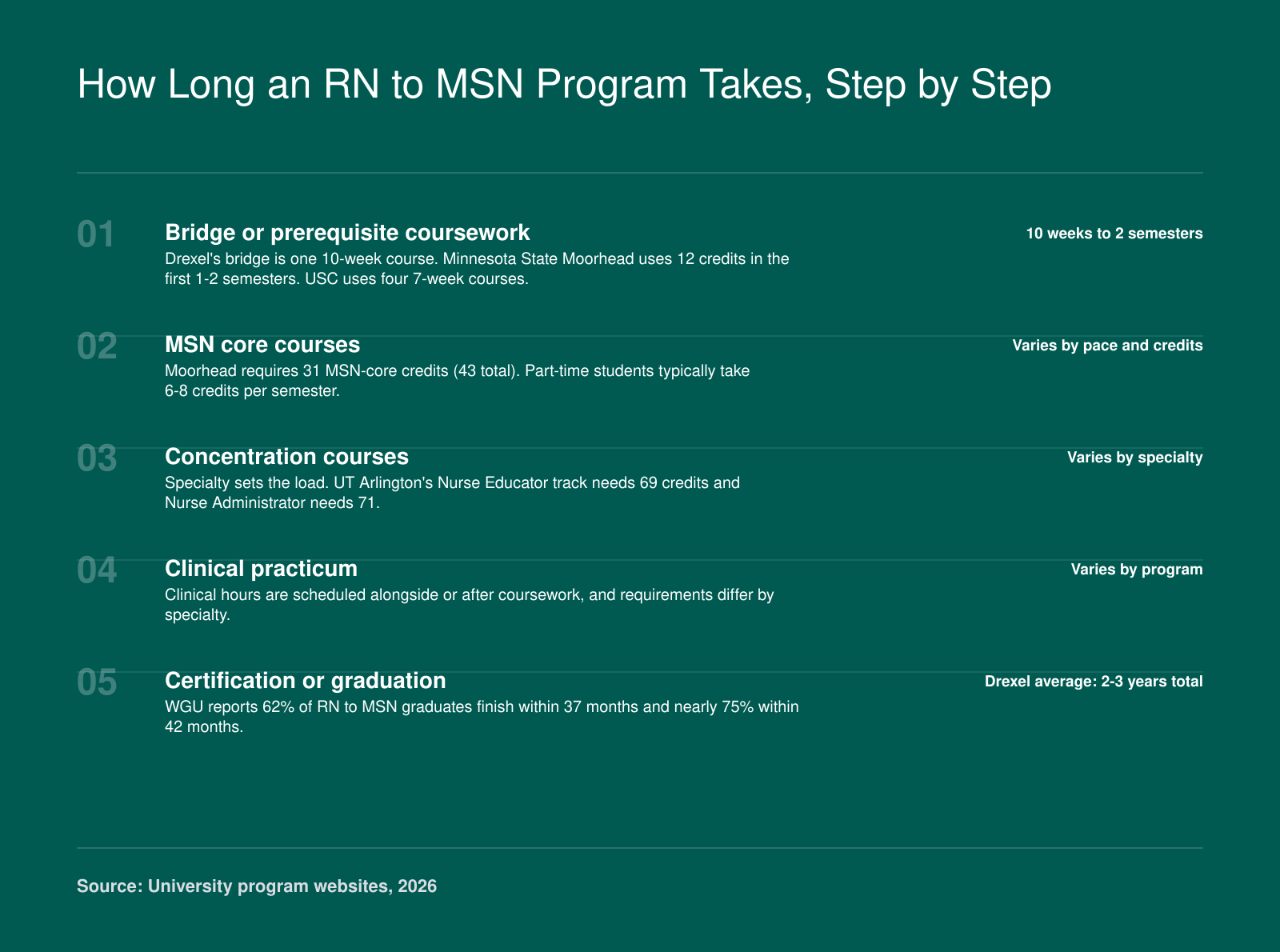
How Long an RN to MSN Program Takes, Step by Step
Full-time RN to MSN bridge programs commonly run 19-31 months, though some sources put it near 3 years; part-time often stretches to 4+ years. The shortest advertised option here is Southern Utah University at 20 months for 60 credits (BSN plus MSN), followed by UT Arlington at 36 months. ADN holders usually add BSN-level coursework, which the credit totals above reflect, while non-nursing bachelor's holders should ask each program for its own timeline.
What an RN to MSN Program Really Costs: Tuition, Fees, and Debt
Published per-credit tuition can understate the total cost once bridge courses, clinical or practicum fees, technology charges, and compliance costs are added. For example, Chamberlain University lists $750 per credit with 45 credits for a $36,735 total, while Wilkes University at $786 per credit reaches $42,444 and Utah Tech University at $375 per credit with 36 credits totals $13,500. The most affordable published graduate tuition in the table below is Georgia State at $8,664 in-state; for schools that report program-level debt, median balances range from about $32,400 to $45,600, with 10-year monthly payments from roughly $370 to $520. Net price is an institution-wide average after aid, not an exact RN to MSN quote.
| School | Graduate tuition, in-state | Graduate tuition, out-of-state | Median debt after graduation | Estimated 10-year monthly payment |
|---|---|---|---|---|
| University of Michigan-Flint | $14,473 | $21,390 | $45,578 | $518 |
| Ball State University | $12,342 | $30,052 | $33,250 | $378 |
| Georgia State University | $8,664 | $25,116 | $32,500 | $370 |
| Gardner-Webb University | $12,125 | $12,125 | $41,319 | $470 |
| Grand Canyon University | $10,015 | $10,015 | $32,443 | $369 |
Related Articles
Online, Hybrid, or Campus: Formats, Accreditation, and State Authorization
"Online" and "in person" are not the clean opposites they sound like. Most of the RN to MSN programs ranked here are delivered online, which suits working nurses who cannot leave a floor schedule. A smaller number run on campus or in hybrid form: Elmhurst University's RN to MSN option is campus-based, while Carroll University pairs eight-week hybrid courses with weekly in-person meetings and simulation lab work. Even among the fully online options, several build in required face time. MCPHS University includes two on-campus residencies in its AD to MSN family nurse practitioner bridge, and Sacred Heart University requires an on-campus residency for its FNP and PMHNP concentrations.
CCNE vs ACEN Accreditation
Two bodies accredit nursing programs: the Commission on Collegiate Nursing Education (CCNE) and the Accreditation Commission for Education in Nursing (ACEN). Both are legitimate, and neither is a tier above the other. CCNE accredits baccalaureate and graduate programs, and it covers programs including Chamberlain University, American Public University System, Stevenson University, Ball State University, and Walden University. ACEN accredits across all levels, including Arkansas State University's five MSN tracks. What matters is that your program carries one of them. Nurse Practitioner certification boards require graduation from an accredited program, and DNP admissions committees will look for it too.
State Authorization Can Block You
Accreditation and state authorization are separate questions, and the second one trips up more applicants. NC-SARA is a reciprocity agreement covering 49 states, DC, Puerto Rico, and the U.S. Virgin Islands; California is not a member.2 Reciprocity does not override state nursing board rules, and NP tracks are restricted most often. Walden's MSN-FNP excludes residents of Louisiana, Nevada, New York, Oklahoma, Oregon, and Utah. Western Governors University's FNP excludes California, DC, Louisiana, New York, North Dakota, and Washington. Drexel cannot admit Alabama residents to its NP programs or Minnesota residents to its RN-to-MSN bridge, and New York residents can enroll in its NP track but cannot complete clinical hours in state.3 Arkansas State's NP tracks enroll only from Arkansas, Missouri, Tennessee, and Mississippi.1 Check your state and your clinical placement state before you apply.
AACN's 2025-2026 Enrollment and Graduations Survey counted 146,718 students enrolled in nursing master's programs nationwide, up 6.8% (9,276 students) from the year before. More nurses are choosing graduate study, so you'll be competing with a growing pool of applicants for the best-value programs.
RN to MSN programs by state
Frequently Asked Questions About RN to MSN Programs
These answers cover the questions prospective students ask most often. Requirements, timelines, and prices vary by school and specialty, so confirm current details with each program before you apply.
Which RN to MSN programs accept a non-nursing bachelor's degree?
How long does an RN to MSN program take without a BSN?
Are RN to MSN programs available fully online?
Do RN to MSN schools arrange clinical placements?
What is the total cost of an RN to MSN program?
Compare RN to MSN programs on the data that matters
Explore more Nursing specializations or browse every graduate field.
All Nursing programs