Best RN to MSN Programs in Arizona
Compare 10 accredited RN to MSN programs in Arizona at 3 schools, with graduate earnings, cost, debt, and completion data from IPEDS and the U.S. College Scorecard.

A 30-credit bridge can run about $11,500 in Arizona, while longer practice-focused tracks push published totals near $38,000. That spread frames the real decision for working RNs, especially ADN graduates or nurses whose first bachelor's was in another field. Grand Canyon University's lean 24-credit bridge and Arizona State University's 30-credit online RN-to-MSN bridge sit at opposite ends of that tradeoff. Cost, clinical load, and advanced-practice eligibility matter more than name recognition across masters programs in Arizona, and admissions policies vary on entrance exams. The Most Affordable RN to MSN Programs show how much that calculation can differ.
Key Points
- Arizona State University's RN to MSN bridge is fully online, asynchronous, and requires no campus residency.
- Published totals run from roughly $11,500 to nearly $38,000, depending on school and track.
- Nurse practitioner tracks typically require 500 to 1,000 or more supervised clinical hours.
Best RN to MSN Schools in Arizona: 2027 Rankings
Our data covers two Arizona schools with RN to MSN pathways, so treat this as a shortlist, not a complete list of every program in the state. Each school can appear with several concentration or format listings, which we group under one entry. Check each program's accreditation and admission rules with the school before you apply.
Grand Canyon University
#1Phoenix, AZ · ~$10,000/yr (est.)
Best for: RNs holding non-nursing bachelor's degrees
Grand Canyon University in Phoenix offers RN to MSN bridge pathways built for registered nurses whose bachelor's degree is in a field other than nursing. Coursework is online, and clinical and practicum hours are completed locally. The school's overall graduation rate is about 43%, and net price is an approximate average of roughly $22,500, so confirm current costs with the school. The university is accredited by the Higher Learning Commission. One bridge listing is recorded with CCNE accreditation in federal accreditation records, but program-level accreditation should be verified. Admission for ADN-only RNs with no bachelor's degree is not established.
- 24 credits at $345 per credit
- Designed for RNs with a non-nursing bachelor's degree
- 40 clinical hours completed locally
- Fully online option, with 5-week online courses
- Up to 90 transfer credits accepted
- 5% tuition scholarship for qualifying new online students
- Completing the bridge qualifies students to apply to the MSN in Healthcare Quality and Patient Safety
- Nursing Leadership in Health Care Systems emphasis
- Listed as CCNE accredited in federal accreditation records
- 24 credits at $345 per credit
- 40 clinical hours with a preceptor
- Online delivery through an e-learning platform
- Pathway for RNs with non-nursing bachelor's degrees
Arizona State University
#2Scottsdale, AZ · ~$11,000/yr (est.)
Best for: ADN-prepared nurses moving into leadership
Arizona State University's online RN to MS in Nursing is designed for associate-degree-prepared nurses and runs 36 credits across 13 courses in 7.5-week terms. It is offered through the Edson College of Nursing and Health Innovation, which is ranked #41 for online master's in nursing programs by U.S. News & World Report. ASU's nursing programs hold CCNE accreditation. Reported tuition is about $11,478 for Arizona residents and $13,776 for nonresidents, but confirm both figures with ASU. Admission for RNs whose bachelor's is in a non-nursing field is not established.
- 36 credits across 13 courses
- 7.5-week course terms
- Fully online, with an in-person option also listed
- Full-time and part-time options
- 3.0 GPA minimum and prerequisite courses required
- 72 transferable credits and an unencumbered RN license required
- Faculty interview required, no entrance exam
- Curriculum focuses on leadership, innovation and evidence-based practice
Cost & outcomes by school
Federal data for the highest-earning RN to MSN programs, independent of the ranking above. Earnings are this field's master's graduates four years after completing, where the Scorecard reports them.
| School | Earnings | Tuition / yr | Debt | Grads/yr | Format |
|---|---|---|---|---|---|
| Grand Canyon University AZ | $123,688 | $10,015 | $32,443 | 1,394 | Hybrid |
| Arizona State University AZ | — | $10,843 | — | 51 | Online |
| Arizona State University AZ | — | $13,587 | — | 64 | Hybrid |
Sources: U.S. Department of Education. Tuition and graduates: IPEDS. Earnings and debt: College Scorecard, this field's master's graduates; a dash means no figure is reported.
Cost, debt & payoff
Median earnings of this field's master's graduates (4 yrs after completing) vs. their median federal loan debt · U.S. College Scorecard
Across these programs the median graduate earns about $123,688 and finishes with roughly $32,443 in debt — a ratio that clears a common rule of thumb (keep debt below first-year salary). Tuition and debt vary widely school to school, so check the per-school figures in the table above before you shortlist.
Online and Hybrid RN to MSN Programs in Arizona
Fully online coursework and hybrid nurse practitioner training split the best online RN to MSN programs in Arizona into two practical camps. Arizona State University's RN-to-MSN bridge is fully online and asynchronous, with no campus residency. Grand Canyon University's non-NP RN-to-MSN bridge is also fully online, delivered asynchronously through five-week terms with clinicals arranged locally where required.
Hybrid paths concentrate in advanced practice, especially nurse practitioner programs in Arizona. ASU's NP MSN combines online didactic work with roughly three on-campus skill intensives. GCU's NP MSN is primarily online but adds two on-campus experiences of one to three days for hands-on training and certification preparation, plus local clinical hours.
For out-of-state students, check state authorization before applying: online enrollment is not available everywhere, and clinicals or practicums are always completed in person at approved sites near you.
Because Arizona State and Grand Canyon online didactic courses are largely asynchronous, they fit rotating 12-hour shifts better than fixed-session cohort formats. Before choosing, confirm any scheduled Zoom meetings or intensive dates so they do not collide with your work schedule.
Do Arizona RN to MSN Programs Require the GRE? Admission Requirements Compared
Arizona State University states that its graduate programs do not require entrance exams, so the GRE is not a barrier for its postlicensure master's in nursing options. The admissions information available for this page does not say whether a non-nursing bachelor's degree is accepted, and it does not describe bridge courses for ADN holders. Applicants in either group should ask the admissions office before applying. We did not find enough admissions detail for Grand Canyon University to report its policy here.
| School | GRE Policy | Minimum GPA | Key Prerequisites |
|---|---|---|---|
| Arizona State University, Online MSN | Not required (graduate programs do not require entrance exams) | 3.00 in the last 60 hours of the first bachelor's degree, or 3.00 in an applicable master's program (4.00 scale) | Statistics (may be admitted with a deficiency and complete it by the end of the first semester); valid, unencumbered U.S. RN license, or ability to obtain one in the first semester |
| Arizona State University, postlicensure MSN programs | Not required (graduate programs do not require entrance exams) | N/A | N/A |
Related Articles
Cost of a Master's in Nursing in Arizona: Tuition and Net Price
How much does an RN-to-MSN actually cost in Arizona? Between the two schools here, published totals run from roughly $11,500 to nearly $38,000, depending on track.
Tuition and Fees
Grand Canyon University lists its 24-credit bridge at $345 per credit, and Scorecard shows $10,015 in tuition for in-state and out-of-state students alike. Its non-NP MSN bridges are estimated at $20,340 (36 credits) and $22,600 for the 40-credit Health Informatics track. Among nurse practitioner programs in Arizona, GCU's 77-credit NP pathway is estimated at $37,895, so confirm what that figure includes. GCU's institution-wide average net price after aid is $22,472, a campus-wide number, not a nursing-specific one.
Arizona State University's 30-credit online RN-to-MSN reports $11,478 for residents and $13,776 for out-of-state students (2026). Its per-credit rate of $605 (2026-27) plus a $15 per-credit fee (2025-26) implies a higher total, and the sources don't reconcile, so ask the bursar for a current estimate.
Debt and Funding
GCU graduates in this field carry median debt of $32,443, with a 10-year payment near $369 a month. ASU has no comparable figure.
Working RNs can lower the bill through employer tuition reimbursement, GCU's 5% tuition scholarship, Arizona nurse workforce programs, and federal loans. Ask HR what your employer covers before borrowing.
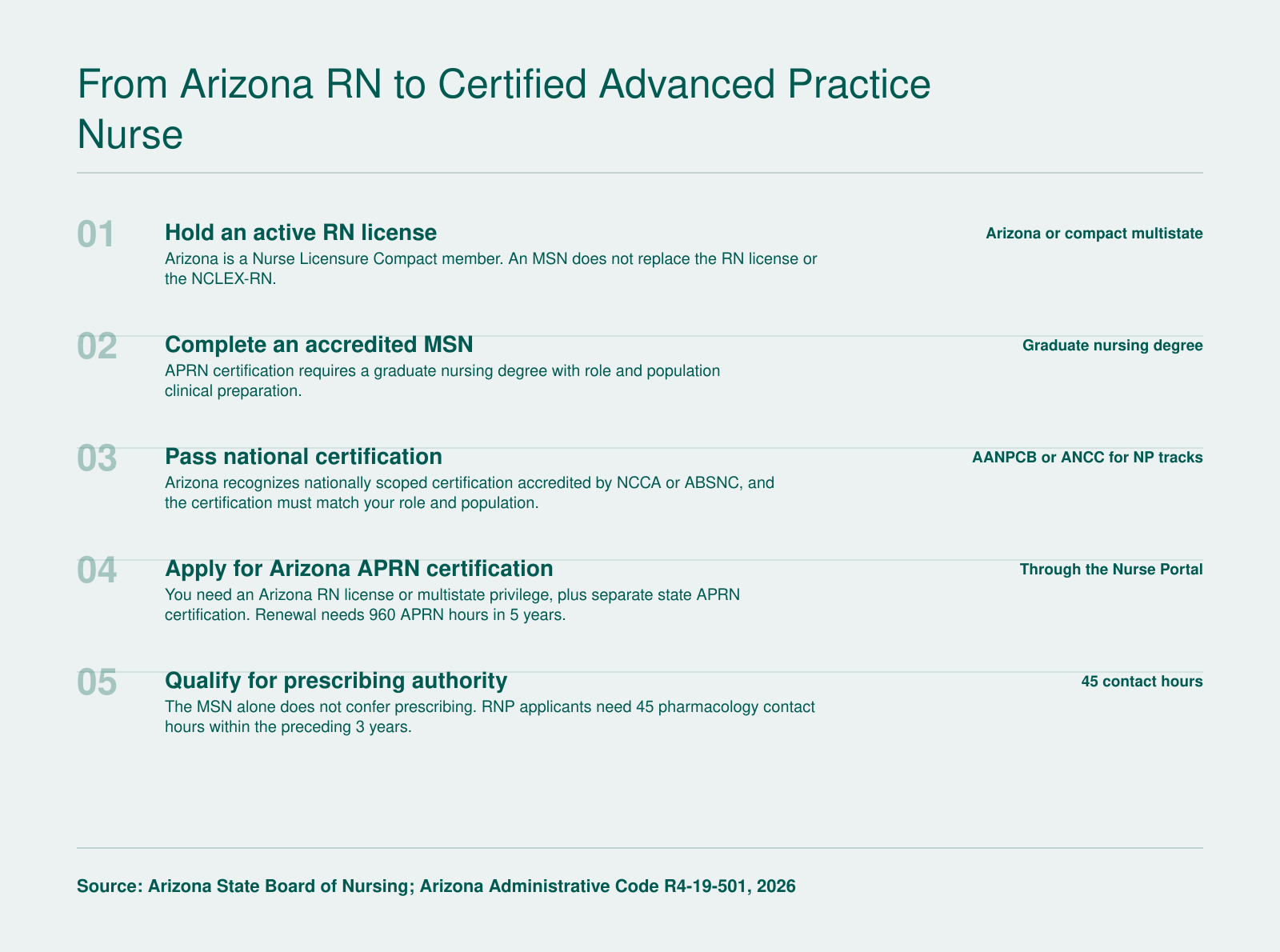
From Arizona RN to Certified Advanced Practice Nurse
The path to advanced practice in Arizona runs in a fixed order, and the MSN is only one step. Education or leadership tracks lead to optional certifications rather than APRN status, so this sequence applies to nurse practitioner and other APRN tracks.
Clinical Hour Requirements and Placement Support
Nurse practitioner tracks and education or leadership tracks sit at opposite ends of the clinical workload. NP programs generally require 500 to 1,000 or more supervised patient-care hours. Education tracks and Nurse Administrator MSN Programs in Arizona usually require shorter practicums, though totals vary by school and should be confirmed.
Grand Canyon University
GCU lists 675 clinical practicum hours for its family nurse practitioner MSN program in Arizona and 750 each for the PMHNP and AGACNP tracks. The FNP and AGACNP tracks are 53 credits and include two on-campus experiences. GCU requires a local, in-person preceptor. Published information does not make clear whether the university arranges sites centrally, so ask admissions directly.
Arizona State University
ASU arranges placements for students in Maricopa County. Students outside the county must find their own sites and preceptors, subject to ASU approval, and placement is not guaranteed. Hour totals for ASU's specialty tracks were not available, so check the current program handbook.
Rural placement risk
Preceptors are scarce in rural Arizona, and a missing preceptor can delay graduation. Before enrolling, ask admissions whether placement is guaranteed, who finds the site, and what happens if no local preceptor is available.
Did you know? The American Association of Nurse Practitioners Certification Board (AANPCB) reported that 81% of first-time FNP-C test takers passed in 2025, based on 15,395 initial exams. Neither it nor ANCC publishes school-by-school pass rates, so ask any Arizona program for its own certification results.
Frequently Asked Questions About RN to MSN Programs in Arizona
What is the difference between an RN to MSN and an ADN to MSN program?
How long does an RN to MSN program take in Arizona?
What MSN specializations are available through Arizona RN to MSN programs?
When are application deadlines and start dates, and how much transfer credit is accepted?
Compare RN to MSN programs on the data that matters
Explore more Nursing specializations or browse every graduate field.
All Nursing programs