Best Family Nurse Practitioner (FNP) MSN Programs in Arizona
Compare 4 accredited Family Nurse Practitioner (FNP) programs in Arizona at 3 schools, with graduate earnings, cost, debt, and completion data from IPEDS and the U.S. College Scorecard.

An Arizona RN weighing an FNP master's has to settle three things at once: whether the program holds the accreditation needed to sit for national certification, what it costs, and whether it can be finished while still working shifts. Published graduate tuition across the schools here differs by thousands of dollars, and the schedules differ just as much.
The field is small. With only a handful of ranked Arizona programs, details like who secures clinical preceptors and how often students must come to campus count for more than brand recognition.
In a market this thin, a program's placement support often decides whether a student finishes on time.
Key Points
- Grand Canyon University's published graduate tuition of $10,015 is the lowest among the schools ranked here.
- Northern Arizona University requires 780 clinical hours, and some programs leave preceptor searches to students.
- National first-time pass rates in 2025 were 81% for AANPCB and 82% for ANCC FNP exams.
Arizona's Top Master's FNP Programs, Ranked and Compared
Three Arizona schools returned in our federal data for this master's track, and the order below reflects how cost, institution-wide completion, and delivery flexibility line up for each. Graduation rates and net prices are averages for the whole institution, not FNP-only figures, so read them as context. Confirm current application status and accreditation directly with each school before you apply.
Northern Arizona University
#1Flagstaff, AZ · ~$13,000/yr (est.)
Best for: Rural-minded Arizona RNs
Northern Arizona University is the only public option in this set, and it posts the strongest institution-wide graduation rate of the three, at about 61 percent. Its advanced-practice master's in nursing offers a Family Nurse Practitioner track with a rural primary care focus and eligibility for Arizona prescribing privileges. The program is listed as CCNE accredited, and applicants need a current Arizona RN license. Coursework is online with required supervised fieldwork, and the school's net price averages about $14,158 institution-wide.
- Listed as CCNE accredited
- 48 to 51 total units, with 25 units in the FNP emphasis
- Rural primary care focus
- Prepares graduates for national FNP certification
- Arizona prescribing privileges eligibility
- 3.0 GPA minimum and prerequisite courses required
- Current Arizona RN license required
- Required fieldwork experience
Grand Canyon University
#2Phoenix, AZ · ~$10,000/yr (est.)
Best for: Working nurses wanting online coursework
Grand Canyon University, based in Phoenix, delivers its MSN Family Nurse Practitioner fully online, with two on-campus experiences for hands-on skills work. Tuition is published at $750 per credit across 53 credits, and the institution-wide graduation rate is about 43 percent, with a net price near $22,472. The program is approved by the Arizona State Board of Nursing, and federal accreditor data lists CCNE accreditation, which you should verify with the school. Students generally find their own clinical site and preceptor, with university staff approving and coordinating rather than guaranteeing placement.
- Online format with two on-campus experiences
- 53 total credits at $750 per credit
- 675 clinical practicum hours
- Admission requires a BSN with a 3.0 GPA
- Up to 12 transfer credits accepted
- 16-week online courses
- Approved by the Arizona State Board of Nursing
- Post-MSN certificate option available
University of Phoenix-Arizona
#3Phoenix, AZ · $15,000 – $20,000/yr (est.)
Best for: Phoenix-area nurses wanting a hybrid format
University of Phoenix-Arizona pairs online learning with a required five-day in-person residency in Phoenix, and the program can be completed in as little as 29 months. It lists the lowest published tuition in this group, $2,355 per course across 48 credits, and no GMAT or essay is required. The trade-off is completion: the institution-wide graduation rate is about 21 percent, well below the other two schools. The program is CCNE accredited, and students arrange their own clinical site and preceptor subject to school approval.
- Hybrid format with a five-day in-person residency
- As little as 29 months to complete
- 48 credits at $2,355 per course
- CCNE accredited
- No GMAT or essay required
- Active RN license and bachelor's degree required
- Eligible for ANCC FNP-BC or AANP FNP-C certification
- Students arrange their own preceptor, subject to approval
Cost & outcomes by school
Federal data for the highest-earning Family Nurse Practitioner (FNP) programs, independent of the ranking above. Earnings are this field's master's graduates four years after completing, where the Scorecard reports them.
| School | Earnings | Tuition / yr | Debt | Grads/yr | Format |
|---|---|---|---|---|---|
| University of Phoenix-Arizona AZ | $131,365 | $15,208 | $31,196 | 366 | Hybrid |
| Grand Canyon University AZ | $123,688 | $10,015 | $32,443 | 1,394 | Online |
| Northern Arizona University AZ | $117,110 | $13,023 | $42,539 | 43 | Hybrid |
Sources: U.S. Department of Education. Tuition and graduates: IPEDS. Earnings and debt: College Scorecard, this field's master's graduates; a dash means no figure is reported.
Cost, debt & payoff
Median earnings of this field's master's graduates (4 yrs after completing) vs. their median federal loan debt · U.S. College Scorecard
Across these programs the median graduate earns about $120,399 and finishes with roughly $37,491 in debt — a ratio that clears a common rule of thumb (keep debt below first-year salary). Tuition and debt vary widely school to school, so check the per-school figures in the table above before you shortlist.
Master's FNP Costs in Arizona and the Price of Getting Licensed
What will an FNP master's actually cost in Arizona? For a national cost comparison, see the Most Affordable Family Nurse Practitioner MSN Programs; in Arizona, the published graduate tuition figures run cheapest to priciest like this: Grand Canyon University at $10,015, Northern Arizona University at $13,023 in-state, University of Phoenix-Arizona at $15,208, and NAU at $19,306 for out-of-state students. NAU is the public option, and its residents get the clearest discount. Net price is a school-wide average, not an FNP figure: about $13,520 at Phoenix, $14,158 at NAU, and $22,472 at GCU.
Per-credit rates and program totals
Official pages often bury the full price. GCU lists $750 per credit across 53 credits, which works out to roughly $39,750 before fees and transfer credits (up to 12 are accepted). University of Phoenix lists $2,355 per course over 48 credits, so your total depends on how its courses are credited. NAU's per-credit rate for this track isn't confirmed, so ask admissions for a written estimate.
Debt and licensing costs
Median program debt is $31,196 at Phoenix ($355 a month over 10 years), $32,443 at GCU ($369), and $42,539 at NAU ($484).
After graduating, budget for the national certification exam from AANPCB or ANCC. Check each body's current fee schedule, since 2026 amounts weren't confirmed here. The Arizona State Board of Nursing charges $150 for the APRN certification application, plus an optional $35 for temporary certification.
Related Articles
Online FNP MSN Programs in Arizona: Where Campus Visits Still Apply
An online FNP MSN delivers coursework over the internet while you complete supervised clinical hours near home, but most nurse practitioner programs in Arizona still require at least some time on campus. Grand Canyon University runs its MSN FNP online. Among MSN programs in Arizona, Northern Arizona University and University of Phoenix-Arizona use hybrid formats.
- Grand Canyon University: Courses run in 16-week online blocks, with two on-campus experiences and hands-on skills labs.
- University of Phoenix-Arizona: Plan for one five-day residency in Phoenix. The 600 clinical hours, 500 of them in primary care, are completed locally.
- Northern Arizona University: Coursework is online, but the hybrid label signals in-person components, so confirm visit dates with the Flagstaff nursing school before applying.
Out-of-state applicants should check authorization first. University of Phoenix publishes the states where it currently enrolls, including Arizona, Colorado, New Mexico and Texas, and that list can change; Samuel Merritt University lists Arizona among its approved states.1 Grand Canyon says only that it enrolls in multiple states.
Rural RNs lose the fewest shifts with Grand Canyon's online model or Phoenix's single residency. Phoenix and Tucson residents can reach the Phoenix campuses within a day's drive, while northern Arizona nurses sit closest to NAU.
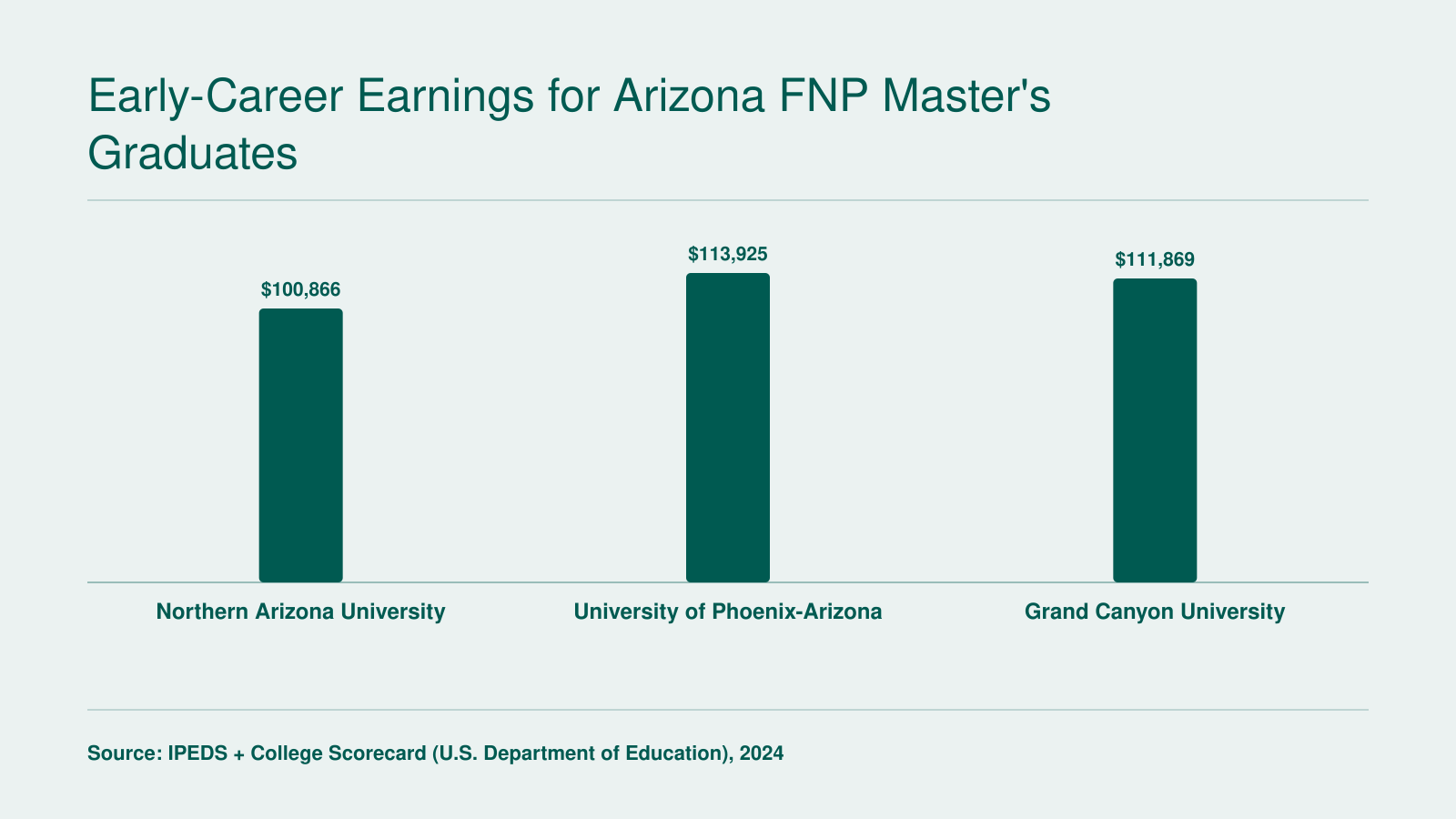
Early-Career Earnings for Arizona FNP Master's Graduates
These figures are program-level median earnings for nursing master's graduates, measured one year after completion. They come from federal College Scorecard data for the Family Nurse Practitioner field of study, not institution-wide averages.
FNP Clinical Placement in Arizona: Required Hours and Preceptor Support by School
Studying close to home sounds flexible, but in MSN programs in Arizona where students arrange their own clinical sites, finding a preceptor becomes part of the workload.
Required hours and who finds the preceptor
- Northern Arizona University: 780 hours over three semesters (180, 300 and 300), including at least 500 faculty-supervised hours in the population focus. Students identify their own preceptors, and the FNP Program Coordinator must approve each one. Preceptors need at least one year of experience and a current license, and nurse preceptors need national certification. These figures come from the 2021-2022 handbook, so confirm current requirements.
- University of Phoenix-Arizona: A 600-hour supervised minimum is reported. Students arrange the site and preceptor, and the university approves each, generally through a CV and signed agreement.
- Grand Canyon University: Clinical hours and placement policy could not be confirmed from official pages, so ask admissions for the written policy.
Arizona realities
Preceptors in Phoenix and Tucson are in demand, and students from several Master's Programs in Arizona compete for the same practices. Rural sites are worth exploring for broad primary care experience, though they may mean longer drives. NAU allows telehealth when it is necessary for the patient.
One question to ask
Ask admissions how many students in the last cohort were placed late, and how late. That answer tells you more than any promise of support.
In 2025, the national first-time pass rate was 81% for the AANPCB FNP-C exam and 82% for the ANCC FNP-BC exam, down from recent highs. Neither certifying body publishes a searchable, school-by-school FNP pass-rate database, so compare programs' own reported figures carefully.
Quick Answers for Arizona FNP Master's Applicants
These short answers cover the questions applicants ask most often. Each points to the section below with the details, and program-specific rules should always be confirmed on the school's own admissions page.
How long does FNP school take in Arizona for full-time versus part-time master's students?
What do Arizona master's FNP programs require for admission besides an active RN license?
What should you verify before trusting reviews of the University of Phoenix-Arizona master's FNP program?
Which certification exam do Arizona FNP graduates take before applying for APRN licensure?
Can students living outside Arizona enroll in an Arizona-based online FNP master's?
Do you need an Arizona or compact RN license before starting clinical rotations in Arizona?
Compare Family Nurse Practitioner (FNP) programs on the data that matters
Explore more Nursing specializations or browse every graduate field.
All Nursing programs