Most Affordable Family Nurse Practitioner (FNP) MSN Programs
Compare 460+ accredited most affordable Family Nurse Practitioner (FNP) programs at 400+ schools, with graduate earnings, cost, debt, and completion data from IPEDS and the U.S. College Scorecard.
An affordable FNP MSN is a master's-level nursing degree that qualifies a registered nurse to sit for national family nurse practitioner certification without a bill that outruns the pay increase. Sticker price tells only part of that story. Annual in-state graduate tuition across the schools ranked here runs from $6,543 to $11,570, yet per-term fees, clinical course charges, and travel to on-campus visits can add thousands on top.
FNP demand is high, so nurse practitioner programs have little pressure to discount placement help or waive fees. The lowest tuition line and the lowest total cost are often not the same program.
Key Points
- Average net price, not advertised per-credit tuition, sets the affordability ranking.
- Some public FNP programs charge online students the same tuition as residents.
- Duquesne's FNP program requires a BSN and a 3.0 GPA.
The 10 Most Affordable Family Nurse Practitioner MSN Programs
This list is not a scan of advertised per-credit rates. It is built around what working RNs actually pay after federal aid, starting with net price and then lining up residency tuition, fees, and program structure at all ten schools. The schools below are the most affordable family nurse practitioner MSN programs in the current data.
Texas A & M International University
#1Laredo, TX · ~$7,000/yr (est.)
Best for: Texas RNs wanting an online FNP
Texas A&M International University offers a notably low in-state total of $17,616 for its online MSN-FNP, built for working Texas RNs. The 48-credit program runs $367 per credit and requires two on-campus visits per course while carrying an average net price after aid of about $3,600. A 100% first-time certification pass rate adds confidence to the value.
- 48 credit hours, $367 per credit in-state
- Total in-state tuition is $17,616
- Online coursework with two on-campus visits per course
- 100% first-time certification pass rate
- Requires Texas RN license and one year inpatient experience
- ACEN accredited with fall and spring starts
The University of Texas Rio Grande Valley
#2Edinburg, TX · $5,000 – $10,000/yr (est.)
Best for: Rio Grande Valley nurses focused on border care
The University of Texas Rio Grande Valley keeps costs modest for South Texas residents while emphasizing care for Rio Grande Valley and border communities. Its campus-based MSN-FNP carries an average net price around $4,800, and the Graduate Select Scholarship adds up to $1,000 for eligible students. The program focus on multicultural practice gives it a strong regional identity for FNP candidates.
- Emphasizes multicultural communities in Rio Grande Valley
- UTRGV Graduate Select Scholarship of up to $1,000
- CCNE accredited campus-based program
- Prepares for advanced practice nursing with holistic care
CUNY Lehman College
#3Bronx, NY · ~$12,000/yr (est.)
Best for: Bronx RNs needing one weekly class day
CUNY Lehman College offers a New York City option with an average net price near $3,100, among the list's lowest. The full-time, 45-credit MSN has a Family Nurse Practitioner concentration and meets one day per week on the Bronx campus, which suits working nurses who can attend in person. CCNE accreditation and New York State licensure preparation round out the value.
- 45 credit hours in a full-time cohort
- On-campus classes one day per week
- CCNE accredited and prepares for NYS licensure
- Family Nurse Practitioner and Pediatric Nurse Practitioner concentrations
- Clinical training and didactic instruction included
United States University
#4Sandy Springs, CA · ~$7,000/yr (est.)
United States University delivers a hybrid MSN-FNP with local clinical practicums and optional four-day campus immersions in California, Arizona, or Florida. The published total tuition of $42,734 includes all fees, and a monthly payment plan spreads the cost for working RNs. The curriculum emphasizes evidence-based practice and prepares students for California NP licensure.
- Hybrid format with in-person immersion experiences
- Total tuition of $42,734 includes all fees
- Monthly payment plan available
- Prepares for California NP licensure and national certification
- Includes clinical practicum hours in primary care settings
- CCNE accredited
California State University-Fresno
#5Fresno, CA · ~$9,000/yr (est.)
California State University, Fresno offers a CCNE-accredited MSN with a primary care family nurse practitioner emphasis and 750 clinical practicum hours. The school's average net price is about $7,000 after aid, and California residents benefit from CSU's in-state graduate tuition. Admission requires a California RN license and a 3.0 GPA, with applications running October 1 to May 1.
- Minimum 43 units including 16 core and 24 specialization
- 750 clinical practicum hours required
- CCNE accredited and California BRN approved
- Requires California RN license and 3.0 GPA
- Thesis or culminating project required
- Application period October 1 to May 1
California State University-Stanislaus
#6Turlock, CA · ~$10,000/yr (est.)
Stanislaus State combines a two-year hybrid FNP curriculum with a relatively low California in-state price and an average net price near $6,100. The 56-unit program includes online didactics plus on-campus simulation meetings and 750 clinical hours in California outpatient settings. It requires one year of RN experience, making it suited to early-career nurses who meet that threshold.
- 56 semester units over 2 years
- Hybrid online didactics with on-campus simulation meetings
- 750 clinical hours in California outpatient settings
- Requires one year RN experience and California RN license
- CCNE accredited and California BRN approved
- $70 application fee with rolling admissions
California State University-Bakersfield
#7Bakersfield, CA · $5,000 – $10,000/yr (est.)
California State University, Bakersfield provides a 47-unit campus-based FNP with a clear path to California FNP certification. The average net price is around $5,700, and admission requires two years of full-time RN experience plus a California RN license. The program includes advanced health assessment, pharmacology, and clinical courses, with a culminating comprehensive exam.
- 47 total units with advanced health assessment and pharmacology
- Requires two years of full-time RN experience
- CCNE accredited and California BRN approved
- Culminating comprehensive examination required
- Only FNP track available
- Background check, drug screen, and BLS certification required
California State University-Long Beach
#8Long Beach, CA · $9,000 – $19,000/yr (est.)
Cal State Long Beach offers a campus-based MSN with a Family Nurse Practitioner specialty and a strong overall graduation rate of about 69 percent. The program can run as compact as 30 units or up to 48, depending on prior coursework, and requires a California RN license with prerequisite courses in statistics, physical assessment, and pathophysiology. Its average net price is higher at roughly $10,400, but the school's clinical sites across diverse primary care settings support hands-on FNP education.
- 30 to 48 units with family-focused theory and clinical components
- CCNE accredited and California BRN approved
- Requires California RN license and 3.0 undergraduate GPA
- Prerequisites in statistics, physical assessment, and pathophysiology
- Culminating project or thesis required
- Campus-based with primary care clinical experiences
Florida International University
#9Miami, FL · ~$11,000/yr (est.)
Florida International University combines a hybrid MSN-FNP with a strong institutional graduation rate of about 74 percent. The 49 to 52 credit program carries an average net price near $9,300 and requires a Florida RN license plus a CCNE- or ACEN-accredited BSN. Its core includes advanced practice nursing and 19 credits of advanced family health nursing, with clinical experiences and a thesis or research project.
- 49 to 52 semester credits with advanced family health nursing
- Hybrid delivery with graduate nursing core and advanced practice core
- Requires Florida RN license and a CCNE or ACEN accredited BSN
- 3.0 GPA and three professional nursing references required
- Clinical experience plus thesis, paper, or research project
- NursingCAS application and $30 supplemental fee
Florida Atlantic University
#10Boca Raton, FL · $7,000 – $18,000/yr (est.)
Florida Atlantic University offers a part-time, hybrid FNP that can be completed in about 2.5 years with 780 clinical hours. In-state tuition is $371.81 per credit hour, and the school's average net price is around $8,800. No GRE or MAT is required, and graduates are eligible for ANCC or AANP certification exams.
- 52 credit hours with 780 clinical hours
- Part-time hybrid format over about 2.5 years
- In-state tuition of $371.81 per credit hour
- No GRE or MAT required
- Fall admission only with South Florida clinical sites
- Eligible for ANCC or AANP certification exams
- CCNE accredited
Cost & outcomes by school
Federal data for the highest-earning Family Nurse Practitioner (FNP) programs, independent of the ranking above. Earnings are this field's master's graduates four years after completing, where the Scorecard reports them.
| School | Earnings | Tuition / yr | Debt | Grads/yr | Format |
|---|---|---|---|---|---|
| University of North Dakota ND | $244,209 | $13,677 | $51,250 | 130 | Hybrid |
| Mount Marty University SD | $221,221 | $16,499 | $88,791 | 6 | Hybrid |
| Texas Wesleyan University TX | $219,488 | $19,499 | $147,822 | 3 | Hybrid |
| AdventHealth University FL | $214,531 | $30,280 | $134,000 | 46 | Online |
| Gannon University PA | $197,954 | $23,840 | $110,884 | 16 | Hybrid |
| Medical University of South Carolina SC | $187,865 | $17,574 | $103,353 | 74 | Hybrid |
| York College of Pennsylvania PA | $159,209 | $8,340 | $59,250 | 7 | Online |
| Fresno Pacific University CA | $155,201 | $13,780 | $41,000 | 22 | Campus |
| California State University-Dominguez Hills CA | $151,224 | $8,978 | $23,500 | 54 | Hybrid |
| Youngstown State University OH | $147,080 | $6,848 | $48,456 | 93 | Online |
| CUNY Lehman College NY | $144,722 | $11,570 | $22,052 | 18 | Campus |
| Sonoma State University CA | $144,371 | $10,148 | $41,000 | 32 | Hybrid |
Sources: U.S. Department of Education. Tuition and graduates: IPEDS. Earnings and debt: College Scorecard, this field's master's graduates; a dash means no figure is reported.
Cost, debt & payoff
Median earnings of this field's master's graduates (4 yrs after completing) vs. their median federal loan debt · U.S. College Scorecard
Across these programs the median graduate earns about $120,857 and finishes with roughly $44,104 in debt — a ratio that clears a common rule of thumb (keep debt below first-year salary). Tuition and debt vary widely school to school, so check the per-school figures in the table above before you shortlist.
How Affordable FNP MSN Schools Earned a Spot on This List
A low price only matters if the degree leads to a credential you can use. Every school in this list of Family Nurse Practitioner (FNP) programs had to clear both tests: affordable to attend, and accredited well enough to qualify you for national certification.
What We Compared
The cost side starts with graduate tuition and fees as reported to IPEDS. We paired that with the College Scorecard average net price and the school's graduation rate. Where a program-level figure was published, we also looked at completions and graduate earnings.
Net price averages what students pay after grants and scholarships, across the whole institution. Treat it as a rough guide, not a quote. Your own cost depends on residency, credits taken, and the aid you receive.
Accreditation Is a Hard Requirement
We checked every ranked program for CCNE or ACEN accreditation. The reason is practical. The AANPCB (FNP-C) and ANCC (FNP-BC) exams require you to have graduated from an accredited graduate nursing program. Without that, a cheap degree can leave you unable to sit for the exam, which means no certification and no practice as an FNP.
Accreditation applies to specific programs, not whole universities. A school can hold CCNE status for one nursing degree and not another, so confirm the exact MSN-FNP track with the accreditor before you apply.
What This Ranking Leaves Out
This comparison does not measure how well a school supports clinical placement, and it does not include certification pass rates. Both can change what a program really costs you. The clinical placement section below covers placement support and the FNP clinical hours requirements you'll need to budget for, and you should ask each program for its recent first-time pass rates directly.
FNP MSN Total Cost With Fees: Tuition Is Only the Starting Line
Per-credit tuition rates for affordable master's degrees have never been easier to find, while the fee schedules stacked on top of them stay buried in bursar pages and course catalogs. That gap is where affordable nurse practitioner MSN programs quietly stop being cheap.
Start with credits times rate
Texas A&M International University lists 48 credit hours at $367 per credit for in-state students, which works out to about $17,616 in tuition. Florida Atlantic University posts an in-state rate of $371.81 per credit and 49 credits to graduate, roughly $18,200. Credit totals swing more than per-credit rates do: Indiana University Kokomo requires 44 credit hours, CUNY Lehman College 45, Clayton State University 47, Cal State Dominguez Hills 48 units, and Cal State Stanislaus 56. A $20 difference in the per-credit rate matters far less than an eight-credit difference in program length.
The fees sticker comparisons skip
Distance learning and technology fees are the most common surcharge on an online FNP track. George Mason University, for example, has published a $35-per-credit distance learning fee in its recent rate schedules, which compounds across a 49-credit program if it applies to every credit. Comprehensive fees can be larger still: the University of Virginia lists a resident total program cost of $26,566 and shows a $3,870 comprehensive fee separately, plus a small nursing activity fee. Nursing course fees, simulation lab charges, and graduation fees vary widely by school, and many institutions do not itemize them anywhere near the tuition page.
Costs that never show up on a tuition page
- Books and review materials: Budget per term, and separately for a certification review course.
- Clinical tracking software: Typhon or Exxat is typically billed per student per term.
- Background checks and drug screens: Indiana University Kokomo requires both, and clinical sites may demand repeats.
- On-campus intensives: Texas A&M International schedules two on-campus visits per course, and Cal State Stanislaus holds on-campus simulation meetings. Travel and lodging are yours.
- Certification exam: AANPCB charges $240 for members and $315 for nonmembers ($365 by paper application, $315 to retake). ANCC runs $295 for ANA members up to $395 for nonmembers.
The arithmetic worth running
Multiply the per-credit rate by total required credits, then add roughly 10 to 15 percent for mandatory fees, which is close to what the comprehensive fee alone represents at the schools that publish one. Add several hundred more for screening, tracking software, and the exam. Then ask the program for a sample per-term bill and check the estimate against it.
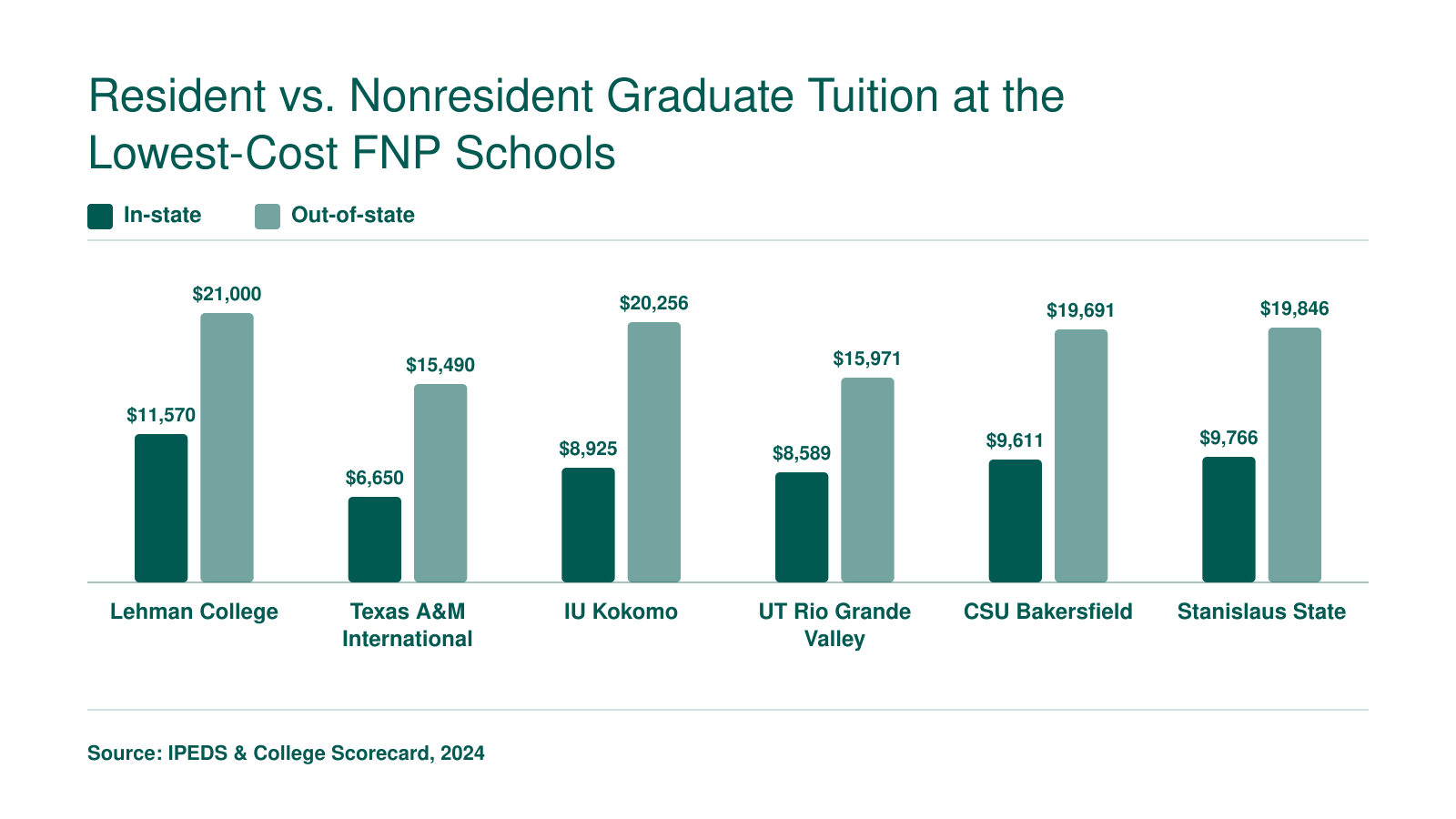
Resident vs. Nonresident Graduate Tuition at the Lowest-Cost FNP Schools
These side-by-side bars compare annual graduate tuition and fees for residents and nonresidents at six low-cost family nurse practitioner programs. A narrow gap between the bars often signals flat-rate or online-friendly pricing, which can save out-of-state students thousands.
Do Online FNP Students Pay In-State Rates? Residency Rules Explained
The phrase "in-state tuition" can mean very different things once a program moves online, and the difference quietly decides whether an advertised sticker price applies to you.
Three Pricing Models to Watch For
Public nursing schools tend to handle out-of-state students in one of three ways:
- Flat e-tuition for everyone: One per-credit rate regardless of where you live. Arkansas State University runs its online FNP this way, with a total program cost around $15,580, though enrollment is limited to residents of Arkansas, Mississippi, Missouri, and Tennessee.
- In-state rates for residents only: Nonresidents pay a surcharge. At many schools that gap is thousands of dollars, though a few keep it slim. Youngstown State University's 2026 figures put residents at about $559 per credit and nonresidents at roughly $564, a total-program difference near $230. Cleveland State University shows a similarly narrow spread.
- Regional reciprocity: Programs such as WICHE's WRGP or the SREB Academic Common Market can extend in-state rates across member states, but these compacts do not automatically cover graduate nursing or online enrollment. Confirm that a specific FNP track participates before assuming you qualify.
A word of caution: some published rate structures are unusual. Old Dominion University's Fall 2026 sheet, for instance, lists a nonresident per-credit figure slightly below the resident one, an inversion the source does not explain. Treat any odd gap as a question to raise, not a bargain to bank on.
State Authorization Can Lock You Out Entirely
Price is irrelevant if the program cannot legally enroll you. The University of Cincinnati's online graduate nursing offerings, including its FNP track, are unavailable to applicants located in Arizona, Louisiana, Massachusetts, New York, Oregon, Rhode Island, and Tennessee. Restrictions like this vary by school and can touch admission, enrollment, or clinical placement, so verify your state is served before comparing costs.
The takeaway: among affordable MSN programs, the residency gap can swamp every other cost difference. Get the exact rate that applies to your state, and your clinical site's state, in writing before you commit.
Related Articles
Clinical Placement Guarantees and the Real FNP Clinical Hours Cost
Clinical placement support, not sticker tuition, is often the true cost driver in an online FNP program. A degree that looks cheap on paper can quietly add thousands of dollars in placement fees, preceptor-matching services, travel, and unpaid leave.
Where Schools Land on Placement Support
A common baseline for FNP clinical training is at least 500 direct patient care hours, but schools set their own totals. Among the programs named here, published totals reach higher, with Walsh University listing 700 hours and Simmons University listing 756. Texas A&M International University lists 135 to 180 practicum hours per course, but its published total is not a single clear figure.
Placement policies vary more than tuition. University of Texas at Arlington expects students to locate their own preceptors, with department help only when a student has difficulty, so support is assisted rather than guaranteed. Felician University coordinates sites and preceptors near the student's community, and Walsh University's coordinator helps secure rotations, but neither school describes an unconditional written guarantee. Simmons University uses a collaborative model: students suggest local sites and the university vets sites, handles contracts, and confirms the 756-hour requirement, yet a delay is possible if no site is secured in time.
The Price of Finding Your Own Preceptor
If a school does not arrange placement, students may pay a third-party matching service anywhere from $500 to $2,000 or more per rotation, and some reports put preceptor-finding fees at $1,000 to $5,000 added to the nurse practitioner program cost. School-arranged placement fees, where charged, often run $500 to $1,500 or more per rotation. Franklin University adds a $334 clinical course fee per course in 2026-2027 plus background screening fees, a reminder that clinical costs sit outside tuition. Travel and lodging for distant sites, and unpaid time away from your nursing job, can push the true total higher than the per-credit price suggests.
Three Questions for Admissions
Before you enroll, ask admissions to answer these in writing: - Placement guarantee: Do you guarantee a compliant preceptor and site by a specific rotation start date, or do you only assist? - Total placement cost: What is the exact placement or coordination fee per rotation, and are third-party matching costs separate? - Delay policy: If I cannot secure a site near my home by the deadline, will my rotation or graduation be delayed, and who pays for that delay?
A program that coordinates placement near your community can be worth more than a slightly lower per-credit price if it prevents a semester-long stall.
From ADN to FNP: Bridge Entry, Transfer Credit, and Accelerated FNP Programs Online
An associate degree alone will not get you into most low-cost online FNP programs, and the public schools we can verify mostly ask for a BSN first. Duquesne, for example, requires a BSN, a 3.0 GPA, and at least one year of full-time RN experience before clinical courses begin.1 For the other schools here, including Winston-Salem State and the University of North Alabama, ADN admission is not clearly established in their published materials. Ask admissions directly whether affordable RN-to-MSN programs exist, because a bridge adds prerequisite or bachelor's-level credits on top of the 41 to 46 credits these FNP tracks require.52 The exact number varies by school.
Transfer Credit Can Trim the Bill, But Only a Little
Published graduate transfer limits vary and none is guaranteed. The University of North Alabama allows 6 credits with approval.5 Mount Union and Duquesne cap it at 9,21 Winston-Salem State at 10 (grade of B or better, within 5 years),4 and Texas Wesleyan at 12.3 Texas State evaluates 6 to 12 credits but may deny them if practice relevance or practicum rules are not met. Prior graduate coursework can lower your cost, but Mount Union requires all track didactic and clinical courses to be taken there, so expect to save a course or two at most.2
Part-Time Versus Full-Time Pacing
Total tuition is often similar either way, since you pay for the same credits. Part-time students, though, pay per-term fees across more terms. Mount Union publishes a fixed $36,800 for its 46-credit program ($800 per credit) with no part-time surcharge shown, but fee structures differ elsewhere, so request a term-by-term estimate.2
Accelerated Tracks: Fast, With Trade-Offs
The shortest published timeline here is West Coast University's accelerated online FNP program: 20 months, five trimesters, 53 credits, and 540 precepted clinical hours.6 Its working-professional pace takes 32 months. Tuition is $43,502 from Fall 2026, and the program includes two on-site intensives.6 West Coast is a private school, so it sits above the public options on price. The compressed schedule also leaves little room for full-time shifts, so most working nurses will find the longer pace more realistic.
Per-credit tuition is the number schools advertise, but the bill that matters adds fees, clinical course charges, and the cost of finding your own preceptor. Cheap tuition with no placement support is rarely cheap.
Early-Career Earnings for FNP Program Completers
Family Nurse Practitioner (FNP) programs by state
Compare Family Nurse Practitioner (FNP) programs on the data that matters
Explore more Nursing specializations or browse every graduate field.
All Nursing programs