Accelerated Family Nurse Practitioner (FNP) MSN Programs
Compare 460+ accredited fastest Family Nurse Practitioner (FNP) programs at 400+ schools, with graduate earnings, cost, debt, and completion data from IPEDS and the U.S. College Scorecard.
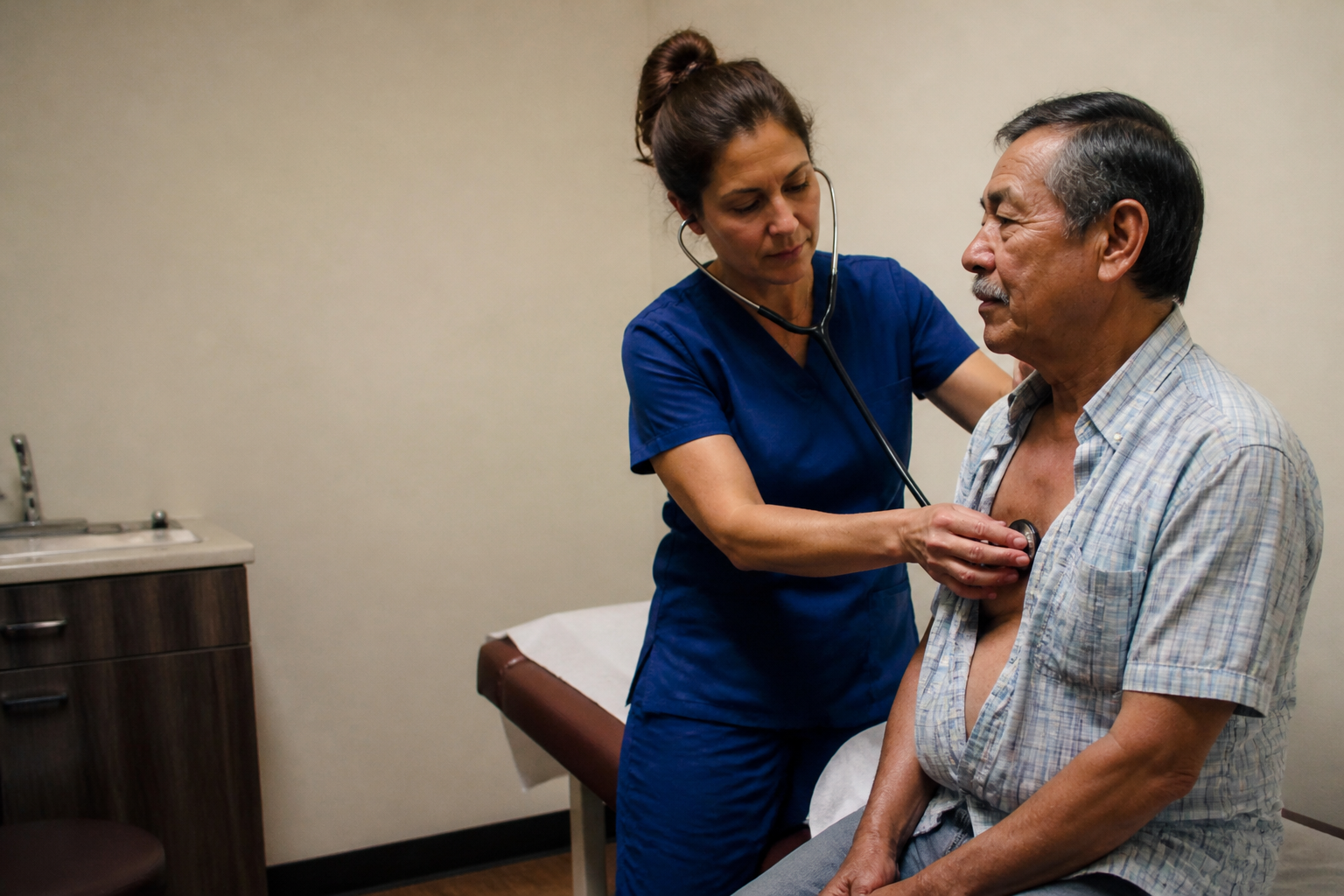
Every working RN chasing FNP credentials sooner hits the same arithmetic: the calendar can shrink, but clinical hours and certification eligibility cannot. The University of Miami's full-time track finishes 38 credits in about a year, yet it still requires at least 616 supervised clinical hours, the same minimum as its two-year option.
Accelerated means compressed scheduling, not trimmed content. The online MSN programs ranked here lead with speed. Each is then weighed on cost, placement support, accreditation, format, and entry routes for BSN holders, RNs without a BSN, and non-nurses.
The bottleneck is rarely coursework. It is lining up preceptors fast enough to log hours on a compressed timeline.
Key Points
- In 2027, York College's in-state tuition is $8,340 while Vanderbilt's is $57,868.
- AACN Essentials push FNP clinical training toward 750 direct-care hours.
- Get clinical placement promises in writing before you deposit.
Best Accelerated FNP MSN Schools: 2027 Ranking
Speed put these programs on the list, and affordability, earnings, and debt set the order within it. Net price is an institution-wide average after aid, not an exact personal quote. The ten entries below pair fast FNP training with the financial and career outcomes that matter most.
University of California-Los Angeles
#1Los Angeles, CA · ~$14,000/yr (est.)
Best for: California RNs seeking advanced practice training
UCLA's advanced practice nursing track is campus-based and prepares registered nurses for nurse practitioner roles, with Family Nurse Practitioner among four specialty options. In-state graduate tuition is $15,203 and out-of-state is $49,403; the institution-wide average net price after aid is $12,548. Schools offering this program graduate about 92.6% of students, and program-level median earnings one year after completion are $112,065.
- One of four nurse practitioner specialty options in the program
- Requires California RN license and a 3.0 minimum GPA
- Requires three letters of recommendation and a statement of purpose
- TOEFL or IELTS required for international applicants
Northeastern University
#2Boston, MA · ~$29,000/yr (est.)
Best for: Working RNs needing hybrid online format
Northeastern's Family Nurse Practitioner MSN uses a hybrid format with online coursework and in-person clinical placements. In-state and out-of-state graduate tuition are both $66,162, and the institution-wide average net price after aid is $30,915. Schools offering this program graduate about 90.5% of students, and graduates' median earnings one year after completion are $125,480.
- 47 credits and 750 clinical hours required
- Hybrid online coursework with in-person clinical experiences
- No GRE required; BSN, 3.0 GPA, and one year of RN experience required
- Fall and spring start dates; full-time or part-time options
- Clinical placements within 100 miles; students find their own preceptors
University of Virginia
#3Charlottesville, VA · ~$24,000/yr (est.)
Best for: Virginia RNs wanting full-time or part-time tracks
University of Virginia's Family Nurse Practitioner MSN is hybrid, with classes on campus plus clinical practica. Virginia residents pay $21,803 in graduate tuition and nonresidents pay $59,512; the average net price after aid is $21,565. Schools offering this program graduate about 95.6% of students, and graduates' median earnings one year after completion are $89,572.
- Full-time two-year or part-time three-year completion
- 23-24 core credits, 12 specialty credits, and 11 practicum credits
- Requires 3.0 GPA, one year of RN experience, and three recommendations
- Classes on Thursdays and Fridays; clinical practica Monday through Friday
- No GRE required; $85 application fee
Vanderbilt University
#4Nashville, TN · ~$58,000/yr (est.)
Vanderbilt's dual Nurse-Midwifery/Family Nurse Practitioner specialty is hybrid, combining online learning with in-person clinicals and more than 1,400 clinical hours. Graduate tuition is $67,498 for both in-state and out-of-state students, while the average net price after aid is $15,846. Schools offering this program graduate about 93.5% of students, and median earnings one year after completion are $109,840.
- Dual nurse-midwifery and family nurse practitioner specialty
- Hybrid online and in-person learning with over 1,400 clinical hours
- Eight full-time semesters required
- MSN, MN prespecialty, and post-master's certificate options available
- Graduates eligible for certification exams from multiple national boards
University of Miami
#5Coral Gables, FL · ~$47,000/yr (est.)
Miami's campus-based Family Nurse Practitioner MSN can be completed in one year full-time or two years part-time, with a lock-step cohort model. Graduate tuition is $62,616 for in-state and out-of-state students, and the institution-wide average net price after aid is $37,244. Schools offering this program graduate about 83.7% of students, and graduates' median earnings one year after completion are $107,332.
- 38 total credits and 616 minimum clinical hours
- One-year full-time or two-year part-time study
- Lock-step cohort model with fall full-time or spring part-time starts
- CCNE accredited and prepares students for AANP or ANCC certification
- Financial assistance opportunities available
University of Rhode Island
#6Kingston, RI · ~$18,000/yr (est.)
URI's campus-based Family Nurse Practitioner MSN is a 42-credit program that can be completed full-time or part-time. Rhode Island graduate tuition is $16,942 in-state and $37,146 out-of-state, while the average net price after aid is $21,440. Schools offering this program graduate about 73.3% of students, and graduates' median earnings one year after completion are $109,305.
- 42 semester credit hours and 750 clinical hours
- Requires BSN, 3.0 GPA, Rhode Island RN licensure eligibility, and one year of clinical experience
- Full-time or part-time study over 2.5 to 5 years
- Fall start with February 15 application deadline
- ANCC or AANPCB Family Nurse Practitioner certification eligibility
University of Cincinnati
#7Cincinnati, OH · ~$15,000/yr (est.)
Cincinnati's Family Nurse Practitioner MSN is fully online with asynchronous coursework, no required site visits, and spring, summer, or fall starts. Ohio graduate tuition is $13,976 in-state and $29,310 out-of-state, and the average net price after aid is $25,648. Schools offering this program graduate about 75.0% of students, and program-level median earnings one year after completion are $102,735.
- Fully online with asynchronous coursework and no required site visits
- Spring, summer, and fall semester starts
- BSN and at least one year of RN work experience required
- Federal financial aid and transfer credit options available
- Enrollment advisor and clinical planning support teams
- Reports certification pass rates above 95%
Stony Brook University
#8Stony Brook, NY · ~$14,000/yr (est.)
Stony Brook's Family Nurse Practitioner M.S. is a hybrid program that blends online coursework with campus-based study. In-state graduate tuition is $10,931 and out-of-state is $32,741; the institution-wide average net price after aid is $18,784. Schools offering this program graduate about 75.6% of students, and graduates' median earnings one year after completion are $126,792.
- Hybrid format with clinical prevention and population health focus
- Leadership development and technology integration built into the curriculum
- Prepares graduates for culturally relevant primary care across diverse populations
- CCNE accredited
Quinnipiac University
#9Hamden, CT · ~$19,000/yr (est.)
Quinnipiac's Family Nurse Practitioner MSN is hybrid, mixing online coursework with three on-campus immersions and full-time or part-time pacing. Graduate tuition is $55,480 for in-state and out-of-state students, and the institution-wide average net price after aid is $40,675. Schools offering this program graduate about 75.7% of students.
- Hybrid online coursework with three on-campus immersions
- Full-time or part-time completion options
- Requires BSN with 3.0 GPA and at least one year of RN experience
- Rolling admissions for residents of several northeastern states
- Prepares graduates for the national family nurse practitioner certification exam
Duquesne University
#10Pittsburgh, PA · $25,000 – $30,000/yr (est.)
Duquesne's Family Nurse Practitioner MSN is fully online and is described as a three-year program requiring 44 credits and 775 clinical hours. Graduate tuition is $48,986 for in-state and out-of-state students, while the average net price after aid is $37,730. Schools offering this program graduate about 77.5% of students, and graduates' median earnings one year after completion are $94,344.
- Fully online three-year MSN-FNP program
- 44 credit hours and 775 clinical hours required
- Requires BSN with 3.0 GPA, one year RN experience, and unencumbered RN license
- Three concentrations: Forensic Nursing, Nursing Education, or Transcultural Nursing
- Up to 9 transfer credits accepted
- On-campus residency required
None of the ranked Family Nurse Practitioner (FNP) programs match the fastest lens yet. The full ranking is at the link above.
Cost, debt & payoff
Median earnings of this field's master's graduates (4 yrs after completing) vs. their median federal loan debt · U.S. College Scorecard
Across these programs the median graduate earns about $120,857 and finishes with roughly $44,104 in debt — a ratio that clears a common rule of thumb (keep debt below first-year salary). Tuition and debt vary widely school to school, so check the per-school figures in the table above before you shortlist.
Cost and Value: What Accelerated FNP Schools Really Charge
In-state graduate tuition in the programs ranked here runs from $8,340 at York College of Pennsylvania to $57,868 at Vanderbilt, and out-of-state rates at public universities push the lower end much higher.
Where Out-of-State Tuition Changes the Math
Texas State's out-of-state rate is $16,377, nearly double its $8,997 in-state price. Southern Utah charges $25,273 out of state compared with $8,577 in state, and UT Arlington lists $26,073 for nonresidents versus $11,249 for residents.
Fees Tuition Leaves Out
- West Coast: $2,500 technology fee and $4,515 clinical program fee.
- Chamberlain: $6,750 APRN fee plus $150 background, fingerprint, and drug screen.
- Franklin: $334 per clinical course and $100 per semester resource fee.
- Mount Union: $3,550 in total technology and program fees across six terms.3
Florida Southern adds a $550 per-semester program fee and a technology fee of $25 to $100 depending on enrollment1, while George Mason charges $35 per credit as a distance learning fee.2
On-campus intensives can add travel and lodging that no published fee schedule captures. Clinical tracking subscriptions, background checks, books, and board review often appear as separate line items or vary by campus.
A Realistic All-In Check
Plan for books, board review, and clinical tracking software. All-in program costs before living expenses can reasonably land between $12,000 and $65,000 depending on school and residency status. Request a full cost-of-attendance sheet from each program, and ask explicitly which fees are per term, per course, or one-time. Also ask about clinical placement or preceptor fees, which can vary, and whether a board review course is bundled into tuition or billed separately.
Why Shorter Can Be Cheaper
An accelerated track can cut total cost by reducing the number of terms you pay technology, resource, and clinical fees, and by shortening the window in which you may need to reduce work hours for clinical rotations.
Three Fast-Track FNP Schools Where Earnings Outpace Debt
The table below uses federal outcome data to show schools in this ranking with the strongest earnings-to-debt balance. Earnings are median earnings for federally aided students 10 years after they entered each school, and debt is median federal graduate debt. The ROI ratio divides median earnings by median graduate debt; higher values mean more earnings per dollar borrowed. These are school-level outcomes, not program-specific results for the FNP track.
| School | Median Earnings (10 Years After Entry) | Median Graduate Debt | Earnings-to-Debt Ratio |
|---|---|---|---|
| Vanderbilt University | $91,565 | $14,000 | 6.54 |
| University of California-Los Angeles | $82,511 | $14,000 | 5.89 |
| University of Virginia | $86,863 | $17,500 | 4.96 |
Related Articles
Clinical Hours and Placement Support in Accelerated FNP Tracks
The AACN Essentials set a floor of 500 advanced-level practice hours, which can include direct and indirect experience, while the National Task Force (NTF) specifies 750 hours of direct patient care for nurse practitioner students. That floor is a minimum tied to population needs, not a cap. In practice, many schools set their own minimums above that floor. Among accelerated programs here, required totals run from 600 to 750 hours: Franklin University requires 600, George Mason 600, Felician University 750, and UT Arlington 720.
Why Clinical Hours Don't Shrink with the Timeline
Accelerated tracks can compress didactic coursework, but precepted hours still have to be logged one patient encounter at a time. A program cannot shorten the direct-care log by moving faster through online modules. Speed comes from condensing theory, not from counting fewer clinical hours. Franklin University spreads its 600 required clinical hours as 150 hours per semester across four semesters, which keeps the pace demanding without skipping supervised practice.
Placement Models: Three Real-World Setups
- School-arranged, close to it: Felician University uses a dedicated placement team to match students with preceptors within a reasonable driving distance. The wording is assistance and matching, not an unconditional guarantee.
- School-assisted: Cleveland State University has a team that helps identify a site and coordinates preceptor details. George Mason's online MSN-FNP program notes that clinical requirements and site availability vary by state, with an engagement specialist explaining local support.
- Student-found: University of Texas at Arlington requires students to locate a preceptor who meets program requirements, and offers help only if a student has difficulty.
The Preceptor Bottleneck and Hidden Fees
A missing preceptor is the most common reason an accelerated FNP student's graduation date slips. Schools do not control local clinic capacity, and some limit placements by state. Franklin University, for example, lists variable clinical and preceptor fees on top of fixed background-check and clinical-course fees. Other programs in this list do not publish a separate placement fee, but "tuition plus fees" language leaves room for added charges. Before committing, ask for a written policy covering placement support, state restrictions, and any placement-related charges.
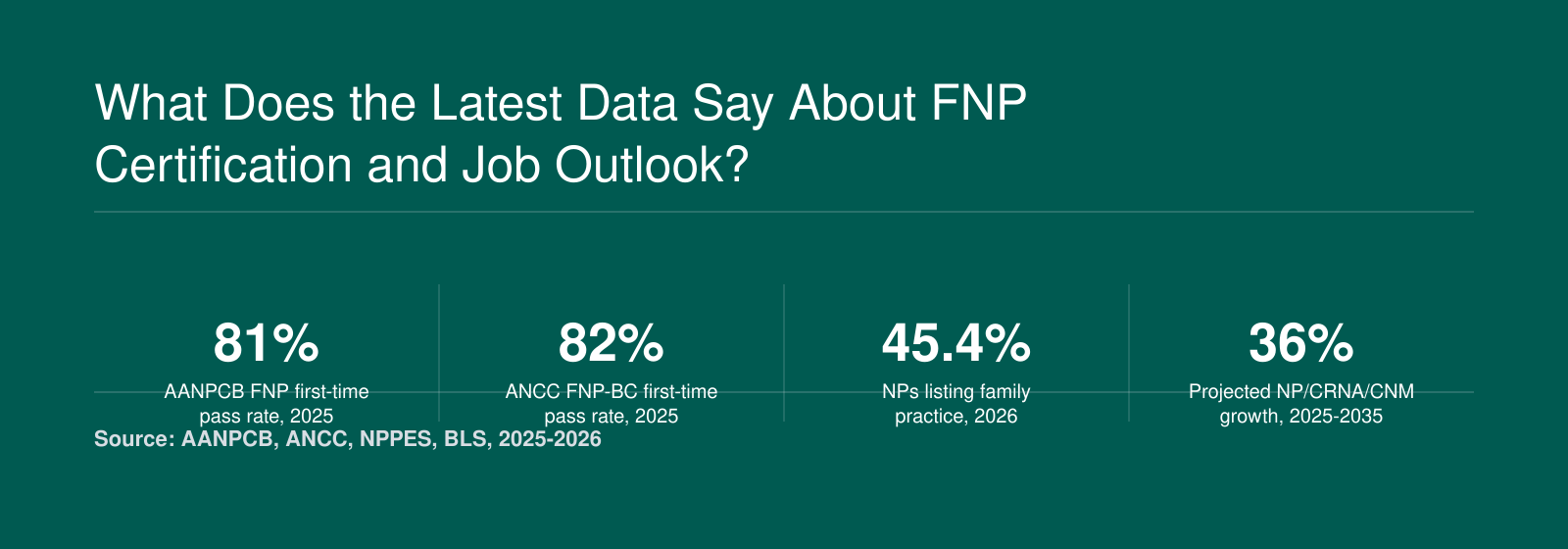
What Does the Latest Data Say About FNP Certification and Job Outlook?
National certification pass rates are averages across all candidates. The figures below reflect the latest published results for the two main FNP certifying exams, the family practice share of NPs, and projected job growth for advanced practice registered nurses. Before you commit, ask each school for its own first-time pass rate over the past three years.
The clinical hours, not the coursework, set the real pace of an accelerated FNP: no program can make you finish those required patient-care experiences faster.
Admission Pathways: BSN, RN, and Non-Nurse Options
Choosing among BSN-to-MSN FNP, RN-to-MSN FNP, and direct-entry MSN routes hinges on your current nursing credential and license. BSN and RN-to-MSN routes admit experienced nurses and move directly into FNP coursework. Direct-entry programs for non-nurses typically prepare generalist RNs first, so a separate post-master's FNP certificate is often required later.
| Dimension | BSN-to-MSN FNP | RN-to-MSN FNP | Direct-entry MSN (non-nurses) |
|---|---|---|---|
| Who qualifies | BSN graduates from an accredited nursing program with an active RN license. | ADN or nursing diploma holders; some programs also accept non-nursing bachelor's degree holders with an RN license. | Bachelor's degree in another field; no nursing degree or RN license required to start. |
| Key prerequisites | Current RN license; some programs require 1 year of RN experience, statistics, and a 3.0 GPA. | Current RN license; bridge courses (e.g., Bradley requires NUR 300, 303, 404, 407); 2.75 to 3.0 GPA; statistics for some. | Science prerequisites and a bachelor's degree; RN license is earned during the prelicensure phase, not required for admission. |
| Typical length | Bradley BSN-to-MSN FNP: 2.7 years, 50 credit hours; George Mason and Cincinnati require RN experience before NP coursework. | Bradley RN-to-MSN FNP: 3.3 years, 10 semesters, 59 credit hours; DePaul ADN-entry option length varies. | Not established in available research; direct-entry generalist MSN typically includes a prelicensure year before NP content. |
| RN license timing | RN license required at admission; NP coursework follows. | RN license required at admission or before clinical practicum (DePaul, Touro). | RN license obtained during the program, before any NP coursework; direct-entry rarely leads straight to FNP. |
| Named program example | George Mason University Nursing (MSN-FNP) or University of Cincinnati MSN Family Nurse Practitioner. | Bradley University Family Nurse Practitioner Program (ADN, diploma, or non-nursing bachelor's entry) or DePaul University RN to MS in Nursing. | No direct-entry non-nurse MSN-FNP program identified in the available research; check generalist direct-entry MSN programs separately. |
Family Nurse Practitioner (FNP) programs by state
Accelerated FNP Programs: Straight Answers Before You Commit
Accelerated FNP programs can shorten your path to advanced practice, but only if the clinical, cost, and scheduling realities fit your life. Here are straight answers to the questions students ask most often before enrolling.
How fast can I complete an accelerated FNP program?
Can I become a family nurse practitioner without a BSN?
Do accelerated FNP programs require clinical hours?
Are accelerated online FNP programs accredited?
Do schools arrange clinical placements for FNP students?
What does an accelerated FNP program cost?
Is it realistic to keep an RN job during an accelerated FNP track?
Compare Family Nurse Practitioner (FNP) programs on the data that matters
Explore more Nursing specializations or browse every graduate field.
All Nursing programs