Best Direct-Entry MSN Programs in California
Compare 13 accredited Direct Entry MSN (MENP) programs in California, with graduate earnings, cost, debt, and completion data from IPEDS and the U.S. College Scorecard.

A direct-entry master's in nursing takes someone with a non-nursing bachelor's from prerequisites to RN licensure and a graduate degree in one sequence, as fast as 18 months at UC Davis or as long as three years at Samuel Merritt. California programs cover both campus and hybrid formats, and application cycles were checked in October 2026.
The tradeoff is money against speed. Published tuition runs from under $10,000 a year at San Francisco State to roughly $60,000 at private schools, and every graduate still faces the same NCLEX-RN.
Key Points
- Online direct-entry master's in nursing almost always means hybrid, since skills labs and clinicals stay in person.
- Where schools publish a GRE policy, none ask for it, though several publish nothing.
- UC Irvine's MSN posted 100% first-time NCLEX-RN passing in 2024-2025, ahead of UCLA at 85.07%.
Top Direct-Entry MSN Schools in California for Non-Nursing Majors
A career changer choosing a direct-entry master's in nursing weighs what the degree costs after aid, whether the format fits a working life, and how many students at the school actually finish. Graduation rates below are institution-wide, not specific to the nursing program. Admission status and deadlines change by cycle and were not confirmed on every official page for 2026, so check each program's admissions page before you plan around a date.
University of California-Los Angeles
#1Los Angeles, CA · ~$14,000/yr (est.)
Best for: Applicants wanting a public health nursing credential
UCLA's Master of Science-Entry is a two-year, campus-based path for people with a bachelor's degree in another field. It leads to an MSN and NCLEX-RN eligibility, and students can add a Public Health Nursing Certificate. The school-wide graduation rate is about 93%. One 2026 ranking reports a Nov. 1 deadline and more than 500 applicants for roughly 70 seats per cohort. Current open or paused status was not confirmed, so verify it with the school.
- Two-year, campus-based program leading to an MSN
- Eligible to sit for the NCLEX-RN exam
- Optional Public Health Nursing Certificate
- B average and prerequisite courses required
- Three recommendation letters needed
- TOEFL or IELTS for international applicants
- Military experience credit available
- Summer enrollment is included
University of California-Davis
#2Davis, CA · $15,000 – $20,000/yr (est.)
UC Davis runs an 18-month, full-time Master's Entry Program in Nursing for people who already hold a bachelor's degree. It is campus-based, with weekday classes plus some evening and weekend sessions, and has no part-time option. The school-wide graduation rate is about 86%. One 2026 ranking lists a Nov. 1 deadline, but official-page status for 2026 was not confirmed, so check before planning.
- 18-month, full-time, campus-based program
- 91 total units required
- Prepares for the NCLEX-RN exam
- Eligible for Public Health Nurse certification
- Capstone portfolio project, no thesis
- Prerequisite courses required
- Evening and weekend sessions in addition to weekdays
University of California-Irvine
#3Irvine, CA · ~$15,000/yr (est.)
Best for: Aspiring community health nurses who prefer small cohorts
UC Irvine's Master's Entry Program in Nursing is a two-year, full-time, cohort-based MSN for non-nursing bachelor's holders. Clinical rotations run through UCI Health, and a Community and Population Health Nursing concentration is a distinguishing feature. The school-wide graduation rate is about 87%. The program lists a fall start and a Nov. 30, 2026 application deadline, though official-page status was not confirmed.
- Two-year, full-time, cohort-based MSN
- Fall start; listed application deadline of Nov. 30, 2026
- Designed for non-nursing bachelor's degree holders
- Clinical rotations at UCI Health
- High-tech clinical simulation experiences
- Community and Population Health Nursing concentration
- Eligible for California public health nurse certification
- Prepares for the NCLEX
Samuel Merritt University
#4Oakland, CA · ~$50,000/yr (est.)
Samuel Merritt University in Oakland offers two campus-based entry-level MSN routes: a Family Nurse Practitioner track and a Case Management track. A formal pathway with San Francisco State's post-baccalaureate pre-health certificate reserves seats for eligible SFSU students. A school-wide graduation rate is not reported in the federal data. Check the official page for current admission status and deadlines.
- Three-year, campus-based program
- Family Nurse Practitioner concentration
- RN licensure eligibility after four semesters
- Recommended 3.0 GPA, two reference letters, and an interview
- $80 application fee
- Available in Oakland and Sacramento
- 27-month, on-campus program
- Case Management concentration
- Recommended 3.0 GPA and two reference letters
- Prerequisite courses required
- BSN equivalency letter available
- Eligible for the NCLEX exam
Azusa Pacific University
#5Azusa, CA · ~$17,000/yr (est.)
Azusa Pacific's Entry-Level MSN is an accelerated graduate program for bachelor's holders in other fields. It lists $895 per unit, with total estimated expenses of $94,870 to $111,875. Its regional delivery locations include Monrovia, San Bernardino, and San Diego, which helps Southern California applicants avoid relocating. The school-wide graduation rate is about 62%. Spring, summer, and fall starts are listed, but confirm the next open cycle with the school.
- Accelerated, campus-based graduate program
- 106 to 125 program units
- $895 per unit; estimated total $94,870 to $111,875
- 3.0 GPA and science and behavioral prerequisites required
- Spring, summer, and fall starts listed
- Approved by the California BRN
- Specialty tracks and nurse practitioner options after licensure
University of the Pacific
#6Stockton, CA · ~$55,000/yr (est.)
University of the Pacific's Entry Level MSN is an accelerated 24-month campus program for graduates with a non-nursing bachelor's degree. It runs 90 units over six consecutive semesters and includes a 225-hour clinical immersion. The school-wide graduation rate is about 69%. We did not establish a 2026 deadline, start term, or admission status, so check the official page.
- 24-month, campus-based accelerated program
- 90 units over six consecutive semesters
- 225-hour clinical immersion
- Non-nursing bachelor's degree and prerequisites required
- Graduate core courses included
- Scholarship opportunities available
- Emphasis on leadership, evidence-based practice, and community health
San Francisco State University
#7San Francisco, CA · $5,000 – $10,000/yr (est.)
San Francisco State's Entry Level MSN awards both BSN and MSN degrees to students who start with a non-nursing bachelor's degree. It is a full-time, cohort-based program of about 24 months, with NCLEX-RN eligibility after four semesters. The school-wide graduation rate is about 50%, the lowest on this list. Applications go through Cal State Apply and NursingCAS, with an August 1 to 31 window. That window has closed for 2026, so plan for the next cycle and confirm the dates.
- Full-time, cohort-based program of about 24 months
- Six semesters; NCLEX-RN eligibility after four
- Awards both BSN and MSN degrees
- Five concentration options
- Thesis or capstone option
- 3.0 GPA minimum and prerequisite courses required
- Two-step application via Cal State Apply and NursingCAS
- Eligible for California Public Health Nurse certification
University of San Francisco
#8San Francisco, CA · ~$30,000/yr (est.)
University of San Francisco's Master's Entry MSN in Clinical Nurse Leader is a two-year campus program for non-nursing bachelor's graduates. It includes more than 1,000 clinical and internship hours at Bay Area partners such as Kaiser Permanente. Fall and spring starts are listed. The school-wide graduation rate is about 70%. A specific 2026 deadline and admission status were not confirmed.
- Two-year, campus-based program
- 68 total credit hours
- Fall and spring starts listed
- More than 1,000 clinical and internship hours
- NCLEX taken during the fifth semester
- Clinical sites include Kaiser Permanente
- Prepares for RN licensure in California
Loma Linda University
#9Loma Linda, CA · ~$34,000/yr (est.)
Loma Linda University's Entry-Level MS in Nursing is a 24-month hybrid program for non-nursing bachelor's holders, with a population health focus in the second year. Clinicals take place across Southern California, including at LLU Medical Center. The program lists applications open for Winter 2027, which makes it the one program here with a clearly stated upcoming cycle. A school-wide graduation rate is not reported in the federal data.
- 24-month hybrid program with a winter start
- Applications listed as open for Winter 2027
- 3.3 GPA minimum
- TEAS entrance exam required
- Three recommendation letters minimum
- Prerequisite courses required
- Population health focus in the second year
- Clinicals at LLU Medical Center and across Southern California
California Baptist University
#10Riverside, CA · $15,000 – $20,000/yr (est.)
California Baptist University's Entry-Level Nursing MSN is listed as an online program for bachelor's holders outside nursing, priced at $815 per unit plus fees. It requires 102 to 108 units over 10 semesters and includes clinical practicums, so confirm what must be done in person. The school-wide graduation rate is about 62%. Confirm the current deadline and open status with the school.
- Listed as an online program
- 102 to 108 total units over 10 semesters
- $815 per unit plus fees
- Prerequisites with a C or better required
- Concentrations: Nurse Educator, Nursing Informatics, Nursing Organizational Leadership
- Clinical practicum hours required
- Faith-based curriculum with a biblical worldview
Cost & outcomes by school
Federal data for the highest-earning Direct Entry MSN (MENP) programs, independent of the ranking above. Earnings are this field's master's graduates four years after completing, where the Scorecard reports them.
| School | Earnings | Tuition / yr | Debt | Grads/yr | Format |
|---|---|---|---|---|---|
| Loma Linda University CA | $177,247 | $34,460 | $116,245 | 3 | Hybrid |
| University of California-Davis CA | $163,702 | $15,141 | $50,303 | 2 | Campus |
| Samuel Merritt University CA | $155,587 | $49,786 | $139,395 | 193 | Campus |
| San Francisco State University CA | $152,207 | $9,370 | — | 26 | Campus |
| University of San Francisco CA | $147,482 | $29,960 | $96,735 | 140 | Campus |
| Charles R Drew University of Medicine and Science CA | $146,374 | $38,973 | $94,100 | 157 | Campus |
| Azusa Pacific University CA | $143,392 | $17,015 | $61,500 | 198 | Campus |
| University of California-Los Angeles CA | $136,869 | $14,476 | $50,511 | 151 | Campus |
| California Baptist University CA | $134,166 | $15,562 | $93,083 | 31 | Online |
| Western University of Health Sciences CA | $132,638 | $36,400 | $117,811 | 95 | Campus |
| University of California-Irvine CA | $128,924 | $14,827 | $85,000 | 21 | Campus |
| Pepperdine University CA | — | $44,056 | — | — | Campus |
Sources: U.S. Department of Education. Tuition and graduates: IPEDS. Earnings and debt: College Scorecard, this field's master's graduates; a dash means no figure is reported.
Cost, debt & payoff
Median earnings of this field's master's graduates (4 yrs after completing) vs. their median federal loan debt · U.S. College Scorecard
Across these programs the median graduate earns about $146,374 and finishes with roughly $93,592 in debt — a ratio that clears a common rule of thumb (keep debt below first-year salary). Tuition and debt vary widely school to school, so check the per-school figures in the table above before you shortlist.
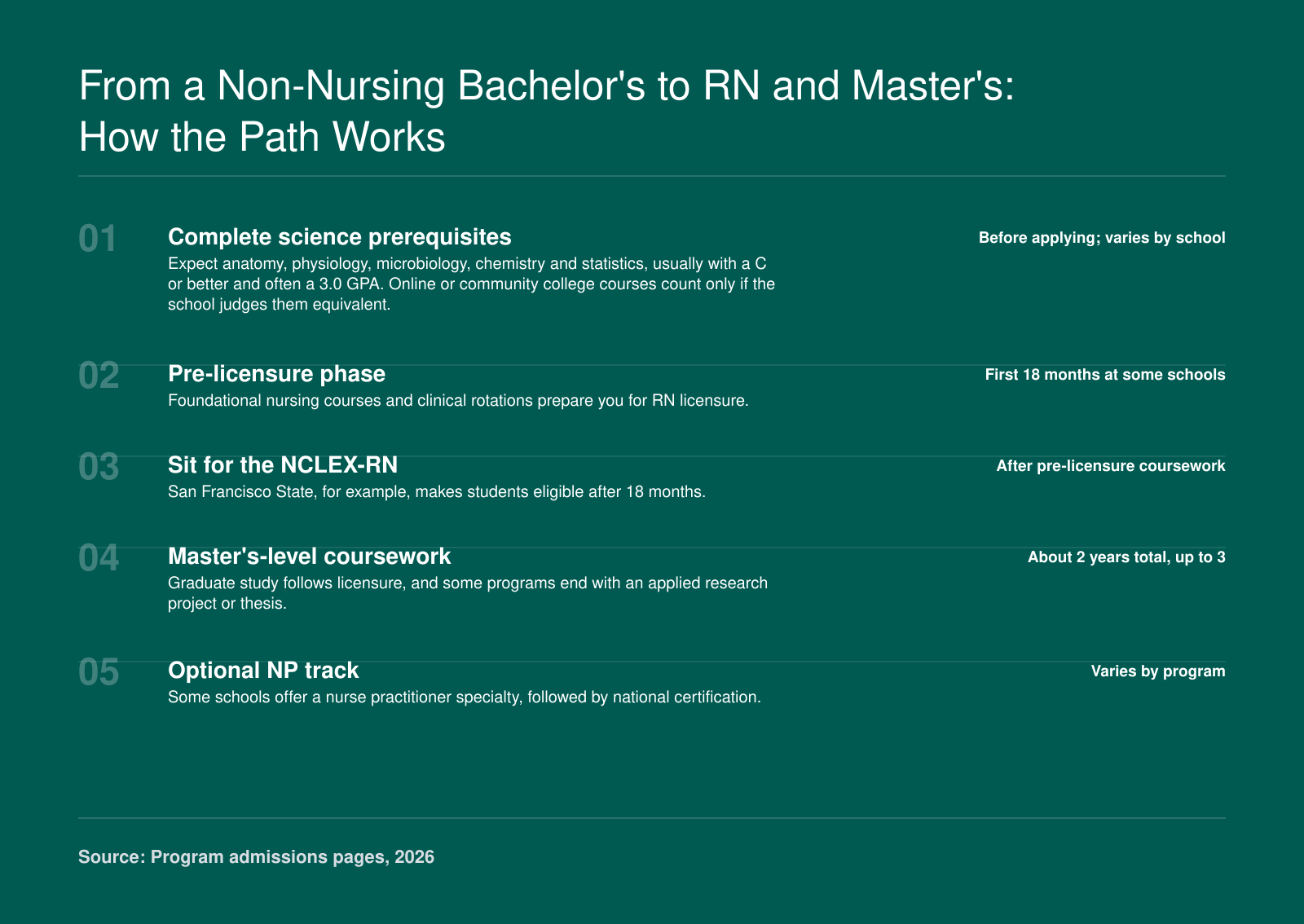
From a Non-Nursing Bachelor's to RN and Master's: How the Path Works
A direct-entry master's in nursing is a graduate-entry degree for career changers who already hold a non-nursing bachelor's. It is not a BSN. You complete pre-licensure training first, sit for the NCLEX-RN to become a registered nurse, then finish master's-level coursework. Most programs here run about two years full-time, and flexible formats can stretch to three. Prerequisite time comes on top of that. Details differ by school, so confirm each program's requirements before you apply.
Which Ranked Master's in Nursing Programs Waive or Drop the GRE
Do California direct-entry MSN programs require the GRE? Among ranked schools that publish a policy, none requires the exam. Several publish nothing.
GRE not required
- California Baptist University: No GRE or MAT, but a 64% composite TEAS is required. Expect a 3.0 cumulative GPA and a 2.8 across four science prerequisites.
- University of San Francisco: No GRE or TEAS. A 3.0 is preferred,1 and applicants need at least 2.75 to be considered.2
- UC Davis: No GRE. It wants a 3.0 bachelor's GPA and a 3.0 in prerequisites, and meeting those only establishes eligibility.3
Optional, waivable, or required
Within these ranked direct-entry MSN programs, no school publishes a waiver with criteria such as a GPA threshold, and none with a stated policy requires the GRE.
No published GRE policy
- Azusa Pacific University: It asks for a 3.0 cumulative GPA for regular admission, with provisional admission possible below that, but its page states no GRE policy.4
- UCLA: The 2027-2028 Graduate Division page gives no program-specific GRE rule or minimum GPA.5
- Mount Saint Mary's University: The no-GRE, 3.0 page covers BSN/RN applicants, so it does not settle the direct-entry question.6
GRE rules shift between cycles, so confirm the policy for your specific entry term with the admissions office before you register for the exam.
Cost of a Direct-Entry Master's in Nursing in California, Fees Included
The table shows each school's published in-state and out-of-state tuition and fees, plus net price, an approximate institution-wide average after grants and scholarships rather than a program-specific figure. Published program totals are tuition-heavy and vary widely: Westcliff University lists $84,175, Azusa Pacific University $94,870 to $111,875, and the University of San Francisco $124,560. Those totals leave out most extras, so add health insurance, uniforms and equipment, clinical and lab fees, background checks, and NCLEX and California licensure fees. Westcliff itemizes some, including $600 per semester in lab fees, $660 per semester for ATI testing, $500 per year for uniforms, and a $400 exam fee. Few schools publish a full fee-inclusive total, so plan on several thousand dollars above tuition and confirm with each program. The lowest net prices here belong to the public campuses (San Francisco State, UCLA, UC Irvine, UC Davis), because state funding subsidizes tuition while private schools rely mostly on tuition revenue. Federal graduate loans and California nursing scholarships can reduce the gap, so check each financial aid office for current award amounts.
| School | In-State Tuition and Fees | Out-of-State Tuition and Fees | Average Net Price |
|---|---|---|---|
| San Francisco State University | $7,950 | $20,550 | $12,278 |
| University of California-Los Angeles | $15,203 | $49,403 | $12,548 |
| University of California-Irvine | $15,722 | $49,922 | $14,251 |
| University of California-Davis | $16,774 | $50,974 | $14,741 |
| Azusa Pacific University | $44,458 | $44,458 | $22,212 |
| University of the Pacific | $57,080 | $57,080 | $25,447 |
| California Baptist University | $41,228 | $41,228 | $26,285 |
| Charles R Drew University of Medicine and Science | $23,000 | $23,000 | $35,558 |
| University of San Francisco | $60,492 | $60,492 | $41,431 |
Related Articles
Online and Hybrid Direct-Entry Master's Options in California
Can you earn a direct-entry nursing master's program fully online in California? No. Pre-licensure students need hands-on skills labs and supervised clinicals, so "online" almost always means hybrid, with didactic courses delivered remotely and the rest in person.
Three programs here are listed outside the campus-only category. Loma Linda University's Entry-Level MS in Nursing (Population Health) is classed as hybrid, with clinicals at LLU Medical Center and across Southern California. California Baptist University's entry-level MSN is listed as online, with clinical practicum hours and varied rotation sites. Azusa Pacific University lists online and San Diego locations, but it does not clearly say how much work happens on campus.
On placements, none of these schools' published pages clearly say whether the school guarantees sites or students find their own. Ask each admissions office directly, in writing, before you apply.
Clinical hours are also inconsistently published. The University of San Francisco reports more than 1,000 clinical and internship hours, but it is campus-based. For the rest, total hours were not found. California's Board of Registered Nursing regulates pre-licensure clinical content mainly through unit requirements and program approval, so confirm each school's approved hours with the school.
California Board of Registered Nursing
NCLEX Pass Rates and NP Pathways at Ranked Programs
First-Time NCLEX-RN Results
The latest school-level figures from the California BRN cover 2024-2025 first-time test takers across the ranked Master's Programs in California. UC Irvine's MSN posted 100% (21 candidates), UCLA's MSN 85.07% (67), and the University of San Francisco's MSN 82.88% (111). The statewide rate for California-educated candidates was 89.73% in 2025-2026 (17,024 candidates), so UC Irvine sits above it while UCLA and USF sit below, though the years differ. The BRN labels these rows "MSN" without confirming each is entry-level. Pepperdine, Samuel Merritt, and Azusa Pacific have no separately published rate in the sources I reviewed.
Generalist MSN or NP Track?
- Generalist degree: USF's entry-level pathway is a 68-unit Clinical Nurse Leader MSN, and Pepperdine's entry-level MSN also prepares graduates for CNL certification. Neither qualifies you for NP certification.
- NP-oriented: Azusa Pacific’s post-licensure pathways include family, school, and pediatric-focused NP options. Samuel Merritt offers a Family Nurse Practitioner specialization alongside Case Management.
If you want an NP role, a generalist degree means a post-master's certificate or DNP afterward, which can add a year or more of time and tuition.
Before applying, confirm the current pass rate and which tracks lead to NP eligibility on each school's admissions page.
Compare Direct Entry MSN (MENP) programs on the data that matters
Explore more Nursing specializations or browse every graduate field.
All Nursing programs