Best RN to MSN Programs in Maryland
Compare 7 accredited RN to MSN programs in Maryland at 3 schools, with graduate earnings, cost, debt, and completion data from IPEDS and the U.S. College Scorecard.

Stevenson University's RN to MS Nursing requires 120 total credit hours, and Washington Adventist University's RN-MS pathway runs 136. Those totals show the real tradeoff for a Maryland RN with an associate degree or a bachelor's in another field: a bridge program folds undergraduate nursing coursework into the master's, so the credit load and the bill are both larger than a standard MSN.
Yes, you can earn an MSN without a nursing bachelor's through these bridge routes, but eligibility, GPA minimums, and prerequisites differ by school. Maryland's field is small, and few pathways lead to nurse practitioner licensure.
Key Points
- Stevenson University offers its RN to MS Nursing fully online with 45 clinical hours.
- University of Maryland, Baltimore charges residents $963 per credit and nonresidents $1,708 per credit.
- Private schools like Washington Adventist University charge residents and nonresidents the same graduate rate.
Maryland's Top RN to MSN Master's Programs, Ranked for 2027
A working nurse usually weighs three things first: what the program costs after aid, how students fare at the school overall, and whether the format fits a shift schedule. Maryland has a small field of true RN to MSN pathways, so the three programs below differ mostly in format, price, and how much accreditation detail we could confirm. Net price figures are approximate school-wide averages, not quotes, and graduation rates describe the whole institution.
University of Maryland, Baltimore
#1Baltimore, MD · ~$18,000/yr (est.)
Best for: Hospital-employed RNs wanting employer support
The University of Maryland School of Nursing in Baltimore offers an RN to MSN that awards both a BSN and an MSN, with 69 to 71 credits and a path of as little as two years. Tuition is $963 per credit in state and $1,708 out of state. The master's program is CCNE accredited, and the school says that covers this pathway. Classes meet in Baltimore and at the Universities at Shady Grove, and the Leadership and Management and Informatics specialties can run online. Partnerships with Maryland hospitals add on-site advising and help arranging practicum placements for employed nurses. We found no institution-wide graduation rate or net price figure for this school.
- Earns a BSN and an MSN together; 69 to 71 total credits
- Six credits count toward both degrees; six-year completion limit
- Specialties: Community/Public Health, Leadership and Management, Nursing Informatics
- Leadership track adds a focus in Leadership and Management, Education, or Business
- Full-time and part-time study; spring and fall starts
- Admission: 2.5 GPA, 2.75 science GPA, prerequisites, one recommendation, $75 fee
- Merit scholarships of $1,500 to $3,000 per semester; assistantships with tuition remission
- Apply by December 15, 2026 for scholarship consideration
Stevenson University
#2Owings Mills, MD · ~$8,000/yr (est.)
Best for: Working nurses needing fully online study
Stevenson University in Owings Mills delivers its RN to MS in Nursing fully online, built for working Maryland nurses. At $505 per credit with no added fees, the first graduate nursing course is billed at the undergraduate rate. CCNE accreditation is confirmed through the federal accreditation database. The school's overall graduation rate is about 68%, and its approximate average net price is roughly $26,500 a year (an undergraduate-based estimate, not a quote for this program). Six start dates a year and eight-week sessions suit shift schedules.
- CCNE accredited; fully online option available
- 120 total credits; earns both a BSN and an MSN
- $505 per credit with no tuition fees
- Concentrations: Nursing Education, Leadership/Management, Forensic Nursing, Population Health
- Six start dates per year; mostly eight-week courses
- Admission: current RN license, 3.0 GPA, transcripts, personal statement
- 45 clinical hours in outpatient care
- No entrance exam required
Washington Adventist University
#3Takoma Park, MD · $10,000 – $15,000/yr (est.)
Best for: Associate-degree nurses preferring cohort learning
Washington Adventist University in Takoma Park offers an M.S. in Nursing through an RN-M.S. pathway for nurses who hold an associate degree. The full pathway runs 136 credits, including 45 graduate credits, with a choice of nursing education or nursing and business leadership. It is cohort based and also available online. The school's overall graduation rate is about 29%, and its approximate average net price is near $18,500 a year (an undergraduate-based estimate). We could not confirm current CCNE or ACEN status for the nursing master's, so check this directly with the school before applying.
- Requires an associate degree in nursing and an RN license
- 136 total credits, including 27 bridge credits and 45 graduate credits
- Two concentrations: nursing education, or nursing and business leadership
- Cohort-based; minimum of seven students per cohort
- Admission: 3.0 GPA, statement of intent, resume; probationary admission below 3.0
- Prerequisites include anatomy, microbiology, chemistry, statistics, nursing research
- Health requirements and background check before clinical practicum
- Also available online
Cost & outcomes by school
Federal data for the highest-earning RN to MSN programs, independent of the ranking above. Earnings are this field's master's graduates four years after completing, where the Scorecard reports them.
| School | Earnings | Tuition / yr | Debt | Grads/yr | Format |
|---|---|---|---|---|---|
| Stevenson University MD | $111,980 | $8,460 | $31,017 | 36 | Online |
| University of Maryland, Baltimore MD | $100,525 | $17,827 | $76,133 | 178 | Hybrid |
| Washington Adventist University MD | — | $11,525 | — | 1 | Hybrid |
Sources: U.S. Department of Education. Tuition and graduates: IPEDS. Earnings and debt: College Scorecard, this field's master's graduates; a dash means no figure is reported.
Cost, debt & payoff
Median earnings of this field's master's graduates (4 yrs after completing) vs. their median federal loan debt · U.S. College Scorecard
Across these programs the median graduate earns about $111,980 and finishes with roughly $31,017 in debt — a ratio that clears a common rule of thumb (keep debt below first-year salary). Tuition and debt vary widely school to school, so check the per-school figures in the table above before you shortlist.
Can You Get an MSN With a Non-Nursing Bachelor's Degree? Eligibility at Maryland Schools
Can you earn a master's in nursing if your bachelor's is in something else? Yes. In Maryland, licensed RNs with a non-nursing bachelor's and RNs holding an associate degree can both move into an MSN through RN to MSN bridge programs. Both differ from direct entry MSN programs in Maryland, which admit non-nurses who hold no RN license.
Who Each School Admits
- University of Maryland, Baltimore: Its RN-to-MSN accepts RNs with a non-nursing bachelor's and RNs without a bachelor's, including associate-degree nurses. Applicants without a bachelor's complete all 59 prerequisite credits and earn the BSN and MSN together.
- Stevenson University: Admits RNs working toward both the BSN and MSN; a current RN license is required.
- Washington Adventist University: Requires an associate degree in nursing and active Maryland RN licensure before admission.
Typical Bridge Requirements
Expect prerequisite coursework such as anatomy and physiology with lab, microbiology, statistics, nutrition, or human growth and development. At University of Maryland, the floor is a 2.5 cumulative and 2.75 science GPA; Stevenson and Washington Adventist publish a 3.0 minimum. University of Maryland asks for proof of a valid Maryland or compact-state RN license by the end of your first semester.
Online and Hybrid RN to MSN Options in Maryland
Online coursework buys flexibility, but the practicum is where a working nurse's schedule gets tested. Stevenson University runs its RN to MS Nursing fully online, with 45 clinical hours. University of Maryland, Baltimore offers its RN-to-MSN as a hybrid, with its online MSN programs in Maryland limited to Health Services Leadership and Management and Nursing Informatics. Classes meet in Baltimore or at Shady Grove. Washington Adventist University's cohort-based RN-MS pathway is also hybrid, with an online option, and requires a Maryland RN license.
Practicum loads differ sharply. UMB's online informatics and leadership master's tracks each require 500 practicum hours (the informatics figure applies to students entering fall 2024 or later). By contrast, MSN nurse practitioner programs in Maryland carry a much heavier direct patient care requirement.
Placement is the biggest feasibility factor. UMB says it arranges clinical experiences for RN-to-MSN students. In its online tracks, faculty or advisors help, but you settle on the site with them, and leadership placements aim beyond your current employer. Ask each school who finds the preceptor before you enroll.
Related Articles
Which Maryland Master's in Nursing Programs Waive the GRE?
For nurses who have been out of school a decade, whether a program qualifies as one of the master's programs with no GRE required can matter more than tuition. Here is what each of the Master's Programs in Maryland publishes.
- University of Maryland, Baltimore: The GRE is conditional, not waived outright. Scores are required only when the most recently earned degree GPA falls below 3.25 on a 4.0 scale (or 4.01 on a 5.0 scale), and when required, they must be no more than five years old. The RN to MSN pathway itself lists a 2.5 GPA minimum and at least one recommendation letter.
- Stevenson University: No GRE policy is published for the RN to MS pathway. Admission centers on a 3.0 GPA, a current RN license, a personal statement, and transcripts.
- Washington Adventist University: The catalogue does not publish a GRE policy. It requires a 3.0 GPA, a written statement of intent, and a current professional resume.
What a Maryland RN to MSN Costs, Plus Licensure and Certification After You Graduate
What does a Maryland RN to MSN actually cost, and what happens with licensure after you graduate? At the University of Maryland, Baltimore, school-published graduate tuition is $963 per credit for Maryland residents and $1,708 per credit for nonresidents. A 38-credit pathway totals about $36,594 resident or $64,904 nonresident before mandatory fees; a 40-credit pathway totals about $38,520 resident or $68,320. Stevenson's published online graduate nursing rate is $647 per credit with a 36-credit estimate near $23,292 and no separate online fee, so students in online RN to MSN programs avoid a nonresident surcharge; its RN-to-MSN credit total should be confirmed. Washington Adventist lists an $11,525 graduate tuition for both residents and nonresidents, with an RN-to-MSN pathway of 136 credits. After finishing, keep your Maryland RN license through the Board of Nursing. Graduates of Maryland nurse practitioner MSN programs must pass ANCC or AANP national certification, then apply to the Board for APRN certification with an official transcript and a $50 fee. Employer tuition reimbursement commonly offsets these costs.
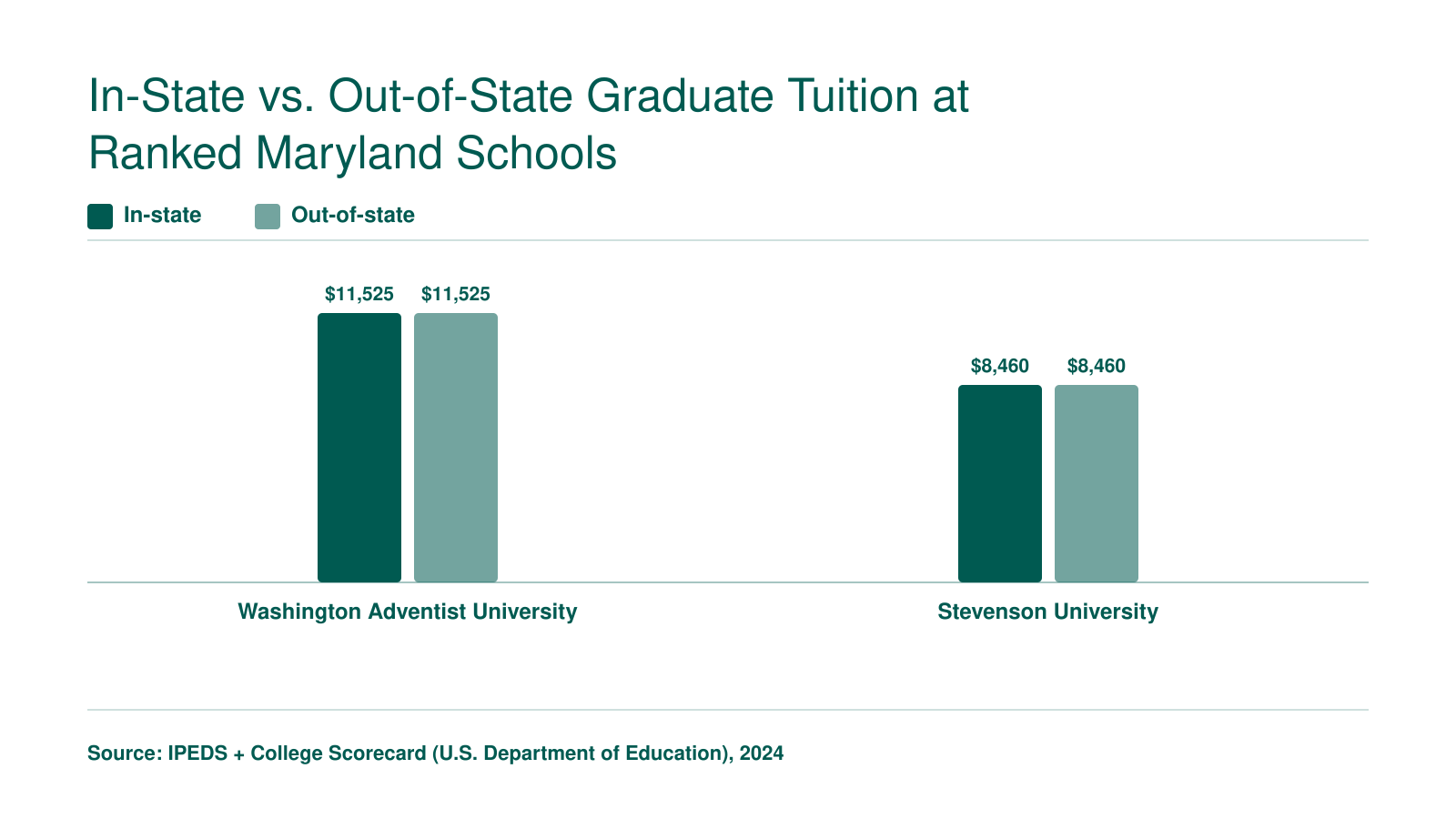
In-State vs. Out-of-State Graduate Tuition at Ranked Maryland Schools
Washington Adventist University and Stevenson University are private, so each charges residents and non-residents the same graduate rate. Figures are annual published graduate tuition and fees, not the total cost of a program. Your net price after aid will differ, and total cost depends on how many credits you complete.
Specializations and Career Paths for Maryland RN to MSN Graduates
Many RN to MSN pathways in Maryland steer toward leadership, informatics, and education, and away from nurse practitioner tracks. University of Maryland, Baltimore lists Nursing Leadership and Management, Nursing Informatics, and Community/Public Health Nursing; no NP track appears for RN-to-MSN students. Leadership and informatics are fully online, which makes them the lightest clinical load for full-time nurses. Public health nursing is blended, with 315 clinical hours.
Stevenson University offers Nursing Education, Nursing Leadership/Management, Forensic Nursing, and Population-Based Care Coordination, with online coursework and clinicals near home. Washington Adventist University's pathway is built around nursing education.
- Leadership: nurse manager or unit director roles.
- Informatics: informatics specialist positions.
- Education: clinical educator or faculty roles.
- Public health: community and population health work.
Confirm current tracks with each school, since offerings change.
Earnings After a Maryland Nursing Master's
Among the schools here, University of Maryland, Baltimore reports the highest program-level earnings.
How to Pick the Right Maryland RN to MSN Program for Your Background
Start with eligibility: confirm the school accepts your degree type, whether that's an ADN or a non-nursing bachelor's, before comparing Accelerated RN to MSN Programs. Then verify programmatic accreditation. CCNE or ACEN approval matters for national NP certification and many employer tuition benefits. Next, weigh clinical placement support and format against your work schedule. For NP tracks, a school that arranges preceptors can matter more than being among the Most Affordable RN to MSN Programs. At University of Maryland, Baltimore and Stevenson University, for example, check whether the delivery format fits your current hours. Finally, request a transcript evaluation from your top two schools to see exactly how many bridge credits you need.
RN to MSN in Maryland: Questions Nurses Ask Most
How long does an RN to MSN program take in Maryland?
Are there CCNE accredited RN to MSN programs in Maryland?
When do Maryland RN to MSN programs accept applications?
Is an ADN-to-MSN path longer than the path for an RN with a non-nursing bachelor's?
Compare RN to MSN programs on the data that matters
Explore more Nursing specializations or browse every graduate field.
All Nursing programs