Best Direct-Entry MSN Programs in Maryland
Compare 3 accredited Direct Entry MSN (MENP) programs in Maryland, with graduate earnings, cost, debt, and completion data from IPEDS and the U.S. College Scorecard.
A direct-entry master's in nursing turns a bachelor's in another field into RN eligibility and an MSN, with no BSN first. Maryland's accelerated direct-entry MSN programs take about two years: Johns Hopkins runs five semesters, and the University of Maryland, Baltimore requires 65 credits.
Maryland has only a small number of these options, and among the Most Affordable Direct-Entry MSN Programs, cost, format, prerequisites, and clinical training separate them sharply. Johns Hopkins lists $1,995 per credit, Baltimore $963.
All are full-time and campus-based, leaving little room for outside work. Career-changers tend to underestimate that constraint.
Key Points
- UMB's entry MSN requires 855 clinical hours within a 65-credit curriculum.
- No Maryland direct-entry master's here works as a fully online option for non-nurses.
- Johns Hopkins accepts GRE scores for its MSN Entry into Nursing but doesn't require them.
2027 Rankings: Best Direct-Entry MSN Schools in Maryland
A top spot here goes to the program that gives a career-changer the strongest value and the best odds of finishing. All three Maryland programs below are full-time and campus-based, so the real differences are cost, pacing, and how much research or doctoral exposure you want.
Johns Hopkins University
#1Baltimore, MD · ~$65,000/yr (est.)
Best for: Career changers drawn to global health
Johns Hopkins in Baltimore runs a five-semester, full-time, on-campus entry master's in nursing for applicants with a bachelor's in another field. Schools offering this program graduate about 94% of students institution-wide. Program-level federal data shows median earnings of $84,697 one year after completion and $111,325 four years after, though completers also carry the heaviest median debt of the three, about $106,371. It suits applicants who value leadership and global health training and can afford the highest price.
- Five semesters, full-time on-campus format
- Published rate of $1,995 per credit
- 3.0 minimum GPA and science prerequisites such as anatomy and statistics
- Essay, interview, and three recommendation letters required
- No GRE required
- Prepares graduates to sit for the NCLEX
- Leadership, evidence-based practice, and global health emphasis
- Pathways to advanced roles or doctoral study
Towson University
#2Towson, MD · ~$13,000/yr (est.)
Best for: Budget-focused Maryland residents
Towson University offers a campus-based entry-level master's in nursing in the Towson area, with year-round enrollment across five terms. Schools offering this program graduate roughly 69% of students institution-wide. The program reports a 100% recent NCLEX pass rate. Its federal earnings data covers only a handful of completers, so treat the figure of about $103,756 five years after graduation as a rough signal. It fits budget-focused Maryland residents who want a state university price and clinical rotations at Maryland facilities.
- Five terms with year-round enrollment
- 65 total units
- Six clinical rotations plus a 4-credit practicum
- Clinical partnerships with Maryland healthcare facilities
- State-of-the-art simulation lab
- Evidence-based practice and population health curriculum
- Eligible for the NCLEX-RN exam
- CCNE accredited
University of Maryland, Baltimore
#3Baltimore, MD · ~$18,000/yr (est.)
Best for: Future DNP or PhD candidates
The University of Maryland School of Nursing in Baltimore pairs a 65-credit entry curriculum with 855 clinical hours, and it arranges all clinical placements for you. Federal program-level data shows median earnings of $85,488 one year after completion and $100,525 four years after, with median debt around $76,133, well below Johns Hopkins. Study is full-time only, with a choice of five or six semesters. It is a strong value for applicants who may later pursue a DNP or PhD.
- 65 credit hours over two years, full-time study only
- 855 clinical hours with placements arranged by the school
- Clinical sites in Maryland and DC
- Choice of 5- or 6-semester plan
- Fall and spring start dates
- 3.0 minimum GPA and prerequisite courses required
- Competency-based approach
- Pathways into DNP or PhD study
Cost & outcomes by school
Federal data for the highest-earning Direct Entry MSN (MENP) programs, independent of the ranking above. Earnings are this field's master's graduates four years after completing, where the Scorecard reports them.
| School | Earnings | Tuition / yr | Debt | Grads/yr | Format |
|---|---|---|---|---|---|
| Johns Hopkins University MD | $111,325 | $64,730 | $106,371 | 280 | Campus |
| University of Maryland, Baltimore MD | $100,525 | $17,827 | $76,133 | 178 | Campus |
| Towson University MD | — | $12,636 | — | 14 | Campus |
Sources: U.S. Department of Education. Tuition and graduates: IPEDS. Earnings and debt: College Scorecard, this field's master's graduates; a dash means no figure is reported.
How We Rank Direct-Entry Master's in Nursing Schools in Maryland
Sticker price and real cost are two different numbers, and a career-changer needs both. The question that matters is what you actually get from direct entry MSN programs for the money and how likely you are to finish. So the rankings weigh degree-aware graduate tuition and fees (in-state and out-of-state), net price after aid, institution-wide graduation rate, and delivery format.
One caveat: those cost and completion figures describe the whole institution, not the direct-entry cohort specifically. Treat them as context, not a promise about your own class.
NCLEX pass rates, clinical hours, and prerequisites are not part of the ranking data. They are reported separately below, drawn from school and Maryland Board of Nursing sources.
Direct-Entry MSN Prerequisites in Maryland: UMB, Johns Hopkins, and Towson
Use this matrix to see which science courses you still need before applying. Towson does not run a true direct-entry master's, so its row describes a second-degree pathway into the nursing major. Practical tip: map missing prerequisites early, because lab sciences often need a full semester each.
| School | Program | Required Prerequisite Courses | Minimum GPA | Recency / Transfer Policy |
|---|---|---|---|---|
| University of Maryland, Baltimore | MSN Clinical Nurse Leader | Course list not confirmed here; check the School of Nursing's current prerequisite page | N/A | Specified courses must have been taken within the past 10 years. Transfer-credit policy for this MSN is not stated. |
| Johns Hopkins University | MSN, Entry into Nursing | Six prerequisites totaling 17 to 21 credits, each with a B- or better: Nutrition; Human Growth and Development Through the Lifespan; Biostatistics; Biochemistry with Lab; plus two more listed in the program requirements | 3.0 or higher (4.0 scale) | No recency limit stated. Prerequisites and final transcripts must be complete before the program begins. The Admissions Office evaluates transfer courses from transcripts and course descriptions. |
| Towson University | Second-degree pathway into the nursing major (not a true direct-entry MSN) | English composition (ENGL 102); College Algebra or Pre-calculus; Intro Biology with lab (or Intro Cell Biology and Genetics with lab); Human Anatomy and Physiology I and II with labs; Foundations of Microbiology | 3.0 or higher cumulative, across all colleges attended | Science and math prerequisites must be completed within 10 years of applying. Transfer credit can satisfy prerequisites. |
Online and Hybrid Direct-Entry Master's Options in Maryland
UMSON's entry MSN asks for about 60 hours a week across five to six semesters, and, unlike the Best Online Direct-Entry MSN Programs, no direct-entry master's here works as a fully online option for non-nurses. Skills labs and clinical rotations have to happen in person.
University of Maryland, Baltimore lists on-campus delivery, full-time enrollment only, and school-arranged clinical placements. Its six-semester plan adds breathing room, not part-time status. Johns Hopkins is on campus and full-time, with clinicals in community health centers and senior living facilities rather than hospitals. Its published information does not say whether the school or the student arranges those placements. Towson's ELMS is campus-based and full-time, with five year-round terms and six or more clinical rotations. Its placement policy is not clearly stated, so ask admissions directly.
Plan on not working full-time at any of them. Even a part-time job will be hard to fit around labs, rotations, and study.
Related Articles
Which Maryland Direct-Entry Master's Programs Waive the GRE?
Standardized tests have largely faded from direct-entry nursing admissions, part of a broader shift toward master's programs with no GRE required, and master's programs in Maryland reflect that trend. Johns Hopkins accepts GRE scores for its MSN Entry into Nursing but does not require them. It admits fall and spring cohorts. Fall deadlines are November 1 and January 15, and spring deadlines are July 1 and October 1.
Towson's Entry-Level Nursing (ELMS) pathway requires neither the GRE nor the TEAS.1 Its priority deadline is January 15 and its final deadline is April 1.1 Decisions typically arrive within a month, provided all materials are in within five business days of the deadline.1 Confirm Towson's start date directly, since outstanding prerequisites must be finished before the program begins.
For the University of Maryland, Baltimore's Master's Entry-Into-Nursing, the materials we reviewed list no GRE policy or deadlines, so contact admissions directly. With tests sidelined, prerequisite grades, essays, healthcare exposure, and interviews tend to carry more weight.
Clinical Hours Required at Maryland Direct-Entry MSN Schools
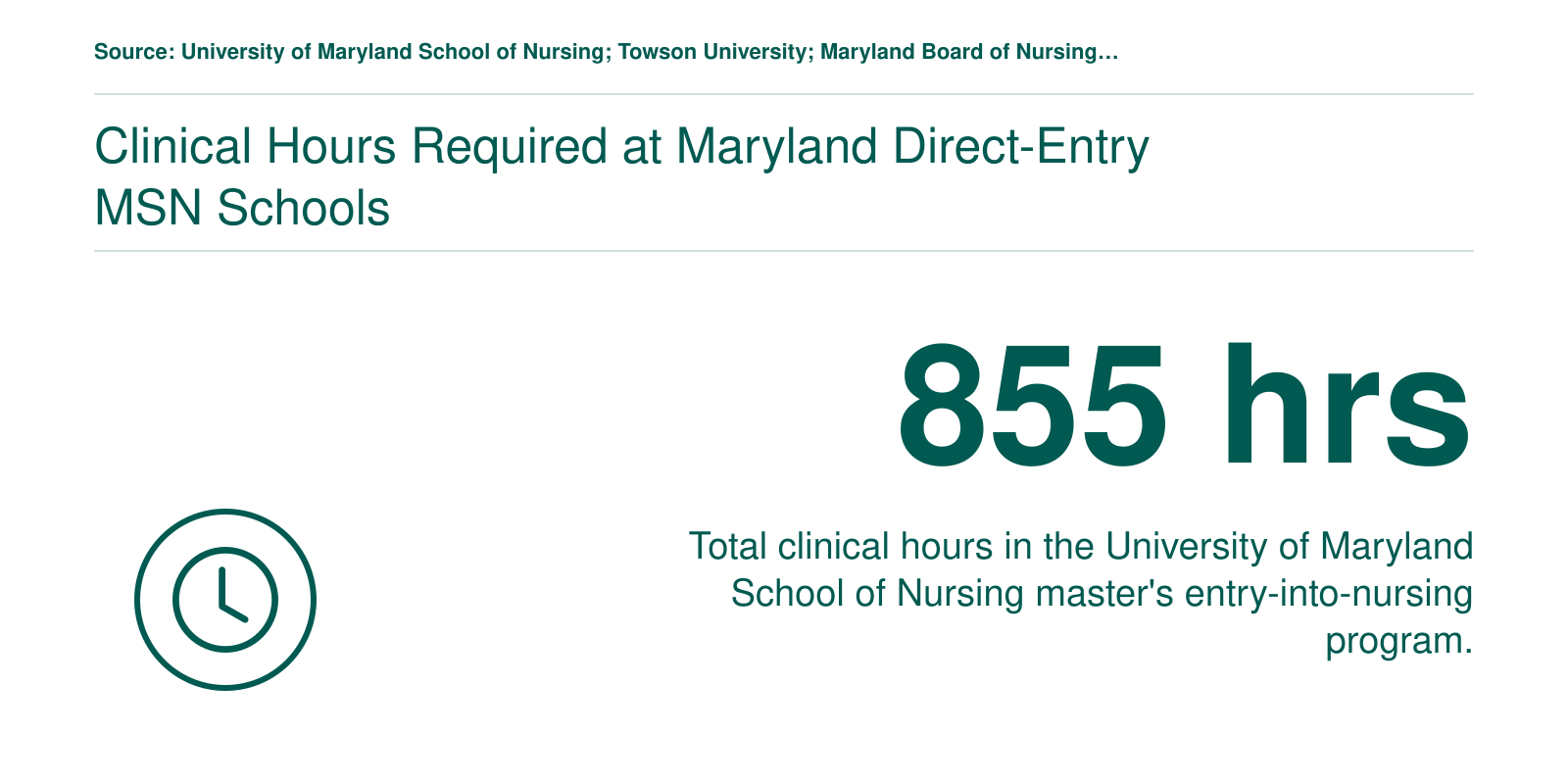
The University of Maryland, Baltimore requires 855 clinical hours within a 65-credit curriculum. That is the only verified total here, so Johns Hopkins is left off the comparison and not estimated, and Towson, which describes at least six clinical rotations and a 4-credit practicum, is left off too. Towson's M.S. entry-level pathway reported 100% first-time NCLEX-RN pass rates in FY2025 and FY2024, and its basic pre-licensure pathway reported 91.03% in FY2025 against a Maryland average of 89.74%. Maryland's nursing school figures show no current first-time rate for Baltimore, only an 80% benchmark in its 2024 self-study, and no school here discloses a current completion or attrition figure.
For a career-changer, what separates Maryland's direct-entry programs is not the name on the diploma but the trade-off between what you pay and how dependable your clinical placements are.
Maryland Direct-Entry Master's Cost, Financial Aid, and Licensure
Public pricing versus private pricing drives the widest cost gap in Maryland direct-entry MSN programs, though fees and aid can shift the final bill.
Sticker Price
Towson University lists the lowest published direct-entry tuition among the schools profiled here: $12,636 resident and $22,860 nonresident. Johns Hopkins School of Nursing catalog figures run $71,820 to $84,000 for full-time entry. University of Maryland, Baltimore charges $963 per credit resident and $1,708 nonresident, so total varies with credit load. Institution-wide average net price is $17,413 at Towson and $18,809 at Johns Hopkins.
Financial Aid
University of Maryland, Baltimore offers merit awards of $1,500 to $3,000 per semester and donor scholarships of $500 to $2,000; Conway covers half of in-state tuition, fees, and books. Johns Hopkins reports 90% of MSN Entry students receive school scholarships, including AmeriCorps ($12,500), Baltimore Talent (full tuition), Returned Peace Corps ($30,000), and Gurtler ($60,000). Check the Maryland Higher Education Commission for state nursing grants and repayment help, and ask hospital employers about tuition partnerships.
Licensure Path
To become an RN, finish a program meeting Maryland Board of Nursing prelicensure standards, apply for licensure by examination, and pass NCLEX-RN. Maryland is in the Nurse Licensure Compact, so a Maryland license transfers to other compact states. Compare total cost against clinical placement support before applying; a cheap program without placement support adds hidden friction later.
Direct-Entry MSN Maryland: Questions Applicants Ask
These answers draw on the admissions and catalogue information published by the schools ranked here. Policies can change, so confirm details with each admissions office before you apply.
Which Maryland direct-entry MSN program is best for a Clinical Nurse Leader role?
Are clinical placements guaranteed, or do students arrange their own?
Can I start a direct-entry master's in nursing in Maryland with no prerequisites completed?
Compare Direct Entry MSN (MENP) programs on the data that matters
Explore more Nursing specializations or browse every graduate field.
All Nursing programs