Most Affordable Direct-Entry MSN Programs
Compare 130+ accredited most affordable Direct Entry MSN (MENP) programs at 120+ schools, with graduate earnings, cost, debt, and completion data from IPEDS and the U.S. College Scorecard.
Public campuses and private online programs take opposite approaches to direct-entry MSN pricing. A non-nursing bachelor's can lead to RN licensure and an MSN in one program, yet published graduate tuition across these ranked programs runs from about $6,900 to $15,100 a year, while average net price after aid ranges from roughly $10,300 to $20,500. That spread means the lowest sticker is not always the best deal; fees, clinical placements, accreditation, and first-time NCLEX results determine the real cost.
Key Points
- Pacific Lutheran lists tuition at $94,960 for 92 credits in 2027.
- University of Nevada, Las Vegas charges out-of-state students about $18,100 more.
- National first-time NCLEX-RN pass rate was 86.7% in 2025.
The 10 Most Affordable Direct-Entry MSN Programs for 2027
Price came first: programs rise on this list when graduate tuition and average net price stay low, then outcomes break the ties. The schools below pair that affordability with NCLEX preparation and program accreditation where it is confirmed.
University of California-Davis
#1Davis, CA · $15,000 – $20,000/yr (est.)
Best for: California residents wanting accelerated campus entry
UC Davis runs an 18-month, full-time Master's Entry Program in Nursing on its Sacramento-area campus for students who already hold a bachelor's degree outside nursing. The curriculum is case-based and clinical, with a capstone portfolio and preparation for both the NCLEX-RN and California Public Health Nurse certification. It is a demanding full-time path best suited to students who can commit to daytime and evening sessions without stopping out.
- 18-month full-time campus program
- 91 total units with no thesis required
- Prepares for NCLEX-RN and Public Health Nurse certification
- Case-based integrative learning with clinical experiences
- Capstone portfolio project and comprehensive final exam
- Prior bachelor's degree and prerequisite courses required
- Classes Monday through Friday with some evening or weekend sessions
University of California-Irvine
#2Irvine, CA · ~$15,000/yr (est.)
Best for: Non-nursing majors pursuing public health certification
UC Irvine's two-year Master's Entry Program in Nursing is a CCNE-accredited, full-time campus experience with small cohorts and clinical rotations at UCI Health. Students get high-tech simulation plus a Community and Population Health Nursing concentration, and they leave eligible for the NCLEX and California public health nurse certification. The program is designed for non-nursing bachelor's degree holders who want a master's-level credential instead of a second bachelor's.
- Two-year full-time CCNE-accredited program
- Clinical rotations at UCI Health with simulation training
- Community and Population Health Nursing concentration
- Designed for non-nursing bachelor's degree holders
- Small cohorts with interprofessional learning communities
- Prepares for NCLEX and public health nurse certification
- Application deadline November 30, 2026
San Francisco State University
#3San Francisco, CA · $5,000 – $10,000/yr (est.)
Best for: Students wanting five nursing concentrations
San Francisco State's Entry Level Master of Science in Nursing is a six-semester, campus-based route that awards both BSN and MSN degrees. Students can choose among five concentrations, including Clinical Nurse Specialist, Nursing Administration, Women's Health, Public/Community Health, and Psychiatric Mental Health. After four semesters, eligible students can sit for the NCLEX-RN, and the program is CCNE accredited.
- Six-semester campus program awarding BSN and MSN
- Five concentrations including CNS, Nursing Administration, and Women's Health
- NCLEX-RN eligibility after fourth semester
- 3.0 GPA minimum and three recommendation letters
- CCNE accredited and Public Health Nurse certification eligible
- Open to non-nursing bachelor's degree holders
- Two-step application process
Herzing University-Tampa
#4Tampa, FL · ~$9,000/yr (est.)
Herzing University-Tampa's online MSN Direct Entry is built for Florida residents with a non-nursing bachelor's degree. The 60 to 77 credit program runs 20 to 24 months, combines online didactic work with Florida clinicals and three in-person intensives, and requires a 3.0 GPA and a TEAS score of 66. It is CCNE accredited and does not require the GRE.
- 20 to 24 month program length
- 60 to 77 credit hours
- 100 percent online didactic coursework
- Clinical placements in Florida with three in-person intensives
- 3.0 GPA and TEAS score of 66 required
- CCNE accredited and no GRE required
- Non-nursing bachelor's degree prerequisite
University of Nevada-Las Vegas
#5Las Vegas, NV · ~$7,000/yr (est.)
UNLV's Direct Entry Generalist MSN is a hybrid, fast track to RN licensure for students with a bachelor's degree in another field. The program is ACEN accredited and prepares graduates for the NCLEX while awarding a generalist master's degree. It is a practical fit for career changers who want to move into nursing practice at the graduate level.
- Hybrid program with fast track to RN licensure
- For non-traditional students with a bachelor's degree
- Prepares for NCLEX and master's-level entry practice
- ACEN accredited
- Bachelor's degree required
University of North Carolina at Pembroke
#6Pembroke, NC · ~$7,000/yr (est.)
UNC Pembroke offers hybrid MSN concentrations in Nursing Education, Clinical Nurse Leader, and Rural Case Management. Each 39-credit track is CCNE accredited and includes practicum experiences, with admission requiring a BSN, current RN license, and a 3.0 GPA. The rural case manager option is a distinctive fit for nurses who want to practice in underserved communities.
- Hybrid format with 39 credit hours
- BSN, RN license, and 3.0 GPA required
- One year of nursing experience recommended
- $55 application fee
- CCNE accredited with practicum courses
- Hybrid online and campus format
- 39 credit hours with practicum experiences
- BSN, RN license, and 3.0 GPA required
- Focus on Clinical Nurse Leader role
- CCNE accredited
- Hybrid program with rural health emphasis
- 39 credit hours
- Advanced pathophysiology, pharmacology, and health assessment
- BSN, RN license, and 3.0 GPA required
- CCNE accredited
University of North Carolina at Greensboro
#7Greensboro, NC · ~$9,000/yr (est.)
UNCG's Prelicensure Entry-Level MSN is a 24-month, full-time blended program for students who already hold a non-nursing bachelor's degree. It combines mostly on-campus coursework with clinical rotations at Cone Health and Novant Health, and graduates are eligible for the NCLEX-RN. The program is ACEN and CCNE accredited and requires a 2.7 GPA.
- 24-month full-time blended program
- Mostly on campus with some online courses
- Clinical partners: Cone Health and Novant Health
- 2.7 GPA minimum and prerequisite courses required
- Prepares for NCLEX-RN
- ACEN and CCNE accredited
- Two start dates per year
Herzing University-Nashville
#8Nashville, TN · ~$9,000/yr (est.)
Herzing University-Nashville's online MSN Direct Entry follows the same 20 to 24 month, 60 to 77 credit model as the Tampa location, but clinicals take place in Tennessee. Tennessee residents with a non-nursing bachelor's degree need a 3.0 GPA and a TEAS score of 66, and the program is CCNE accredited. Online didactic work is paired with in-person intensives.
- 20 to 24 month program length
- 60 to 77 credit hours
- Online didactic classes with clinicals in Tennessee
- In-person intensives required
- 3.0 GPA and TEAS exam required
- CCNE accredited
- Waived enrollment fee
Arizona State University
#9Tempe, AZ · ~$14,000/yr (est.)
Arizona State's MS in Nursing with a concentration in Entry to Nursing Practice is designed for career changers who hold a bachelor's degree outside nursing. The full-time campus program uses the Clinical Teams Model and Grace Center simulation, and graduates are prepared for the NCLEX-RN. Students complete 53 credits and should plan for 40-plus hours weekly.
- 53 total credit hours
- TEAS exam required with rolling admissions
- 3.0 GPA minimum and prerequisite courses required
- Capstone required and NCLEX-RN preparation
- Clinical Teams Model mentorship
- Full-time, 40-plus hours weekly
- Simulation at Grace Center for Innovation
- Path to advanced practice nursing
Western Carolina University
#10Cullowhee, NC · ~$8,000/yr (est.)
Western Carolina's Master's Entry Prelicensure Nursing program is a 15-month, campus-based accelerated route with a Rural Health concentration. It requires 56 credits and 660 clinical hours, and it is CCNE accredited. Admission needs a 2.8 GPA, prerequisites, and a personal statement, making it a focused option for students who want rural generalist nursing.
- 15-month accelerated campus program
- Rural Health concentration
- 56 credits and 660 clinical hours
- 2.8 GPA, prerequisites, personal statement required
- Interview by invitation
- CCNE accredited
- Telehealth training and practice change project
Cost & outcomes by school
Federal data for the highest-earning Direct Entry MSN (MENP) programs, independent of the ranking above. Earnings are this field's master's graduates four years after completing, where the Scorecard reports them.
| School | Earnings | Tuition / yr | Debt | Grads/yr | Format |
|---|---|---|---|---|---|
| Saint Vincent College PA | $229,621 | $16,168 | $117,526 | — | Campus |
| Rosalind Franklin University of Medicine and Science IL | $218,719 | $36,769 | — | — | Campus |
| University of California-Davis CA | $163,702 | $15,141 | $50,303 | 2 | Campus |
| San Francisco State University CA | $152,207 | $9,370 | — | 26 | Campus |
| Fairleigh Dickinson University-Metropolitan Campus NJ | $145,105 | $19,068 | $40,432 | 57 | Hybrid |
| Fairleigh Dickinson University NJ | $145,105 | $25,628 | $40,432 | 8 | Hybrid |
| Azusa Pacific University CA | $143,392 | $17,015 | $61,500 | 198 | Campus |
| University of Nevada-Las Vegas NV | $141,227 | $7,413 | $34,991 | 62 | Hybrid |
| University of California-Los Angeles CA | $136,869 | $14,476 | $50,511 | 151 | Campus |
| The University of Texas Health Science Center at San Antonio TX | $129,695 | $4,648 | $41,000 | — | Hybrid |
| Colorado State University Pueblo CO | $126,927 | $10,064 | $41,000 | 21 | Campus |
| Florida International University FL | $125,543 | $11,334 | $42,812 | 94 | Campus |
Sources: U.S. Department of Education. Tuition and graduates: IPEDS. Earnings and debt: College Scorecard, this field's master's graduates; a dash means no figure is reported.
Cost, debt & payoff
Median earnings of this field's master's graduates (4 yrs after completing) vs. their median federal loan debt · U.S. College Scorecard
Across these programs the median graduate earns about $120,338 and finishes with roughly $55,606 in debt — a ratio that clears a common rule of thumb (keep debt below first-year salary). Tuition and debt vary widely school to school, so check the per-school figures in the table above before you shortlist.
What the Per-Credit Rate Hides: Fees, Clinical Costs, and the Real Total
A per-credit rate is the least reliable number on a direct-entry MSN cost page. Fees, screenings, uniforms, equipment, NCLEX registration, and clinical travel all sit outside it.
Pacific Lutheran's 2026-2027 sheet puts tuition at $94,960 for 92 credits (56 at $950, 36 at $1,160). Nursing fees of $1,975 per pre-licensure term, annual technology and wellness fees, and one-time charges come on top.1 Marquette lists $69,000 in tuition and $71,755 once CPR, screening, uniforms, assessment equipment, and NCLEX review are added, before per-semester student fees.2 Xavier publishes $739 per credit plus per-semester liability insurance and an annual nursing fee, but no total credit count, so you must request that figure.3
None of these pages states program length in months. Ask admissions, then divide the full total by the months enrolled. That is the fair way to compare a 15-month accelerated direct-entry MSN program with a 24-month one. Then add rent and food, since most programs discourage outside work.
For public schools, check in-state versus out-of-state rates. Some hybrid and online direct-entry MSN programs still bill out-of-state tuition to students who live elsewhere.
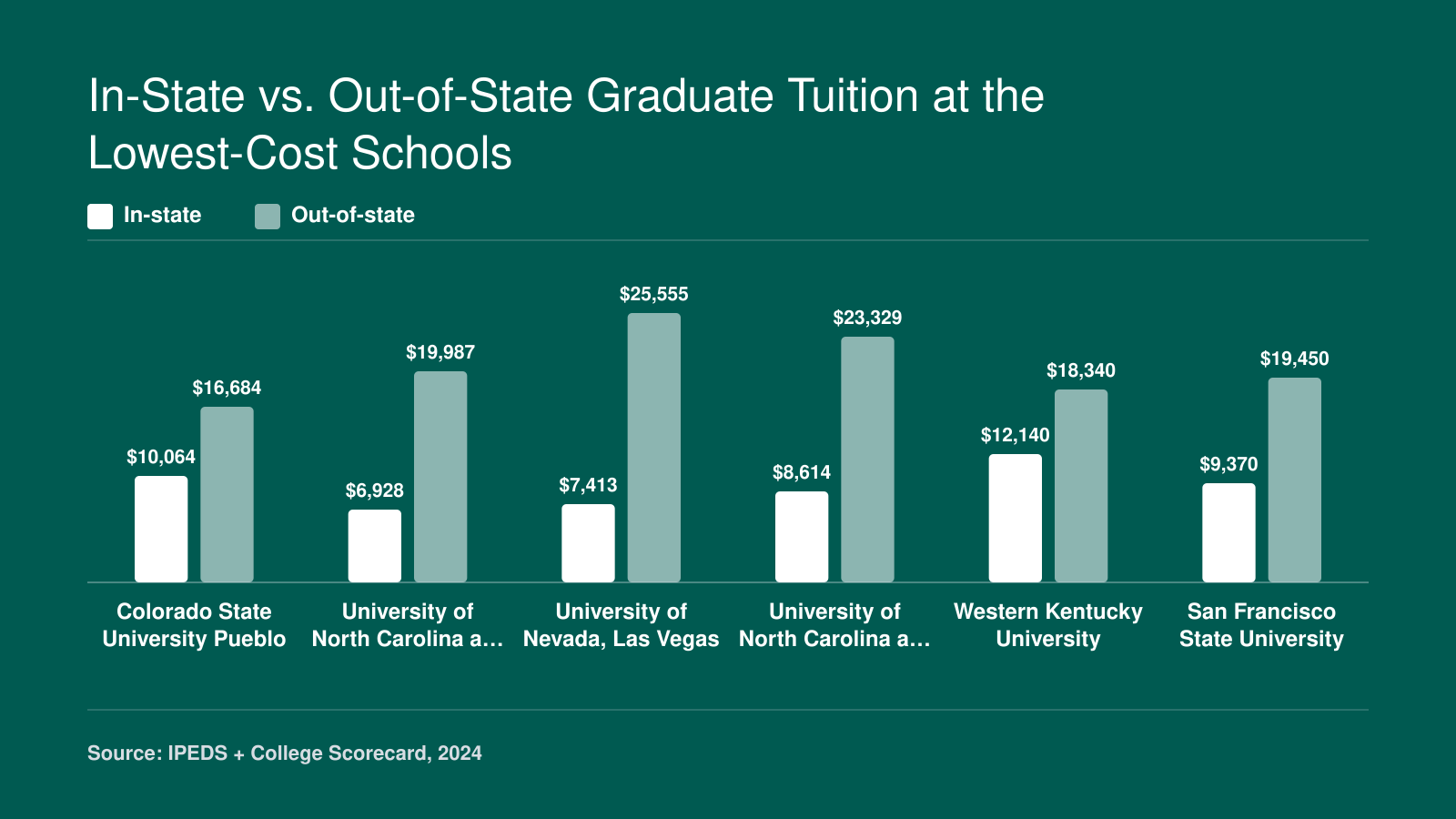
In-State vs. Out-of-State Graduate Tuition at the Lowest-Cost Schools
All of these lowest-cost direct-entry MSN programs are public universities, so each one publishes separate in-state and out-of-state graduate tuition and fees. The largest residency gap is at University of Nevada, Las Vegas, where out-of-state students pay about $18,100 more per year; the smallest gap is roughly $6,200 at Western Kentucky University. Because no private schools appear among these programs, there is no single-rate option in this chart; every school shown charges two rates.
Checking Quality Before Price: CCNE Accreditation and First-Time NCLEX Results
Accreditation does more than signal prestige. CCNE or ACEN status can affect federal aid eligibility, later admission to DNP and PhD programs, and hiring at some hospital systems and military nursing corps. Several programs here advertise CCNE accreditation, including Arizona State, UNC Pembroke, and Herzing, but confirm current status yourself in the CCNE or ACEN directory before you pay a deposit.
State boards publish first-time NCLEX-RN results by program, and the picture varies. For 2024, Texas reported 96.55% for Texas Lutheran's direct-entry MSN program cohort (29 candidates) and 100% at UT Austin's alternate-entry MSN (53 candidates), with entry-level MSN programs statewide at 98.78%.1 Ohio listed Lourdes at 80.95% across 21 candidates.2 California's 2024-2025 figures show 86.67% at Charles Drew and 85.00% at Samuel Merritt, though those counts may include MSN test takers beyond the direct-entry track.3
Measure any program against the national first-time rate for U.S.-educated candidates, which was 86.7 percent in 2025. Cohorts this small swing hard year to year, so read three or four years of history on your state board's site. Cheap tuition never offsets weak licensure results.
In 2025, U.S.-educated first-time NCLEX-RN candidates passed at 86.7% nationally, according to NCSBN (167,272 of 192,916). Use that benchmark when weighing the pass rates listed for the programs below: anything well under it deserves a closer look.
Related Articles
Who Qualifies: Entry Requirements for Career Changers With a Non-Nursing Degree
Admission requirements vary by school, so confirm the details before applying. Published policies at direct-entry MSN programs show a shared baseline with important differences.
- Bachelor’s degree and GPAYou’ll need a bachelor’s degree in a non-nursing field, usually from a regionally accredited school. Minimum GPAs vary, some programs set 3.0 overall, Brenau calculates the last 60 credits, and Saint Leo lists 2.75.
- Science prerequisitesCommon prerequisites include anatomy and physiology, microbiology, chemistry, and statistics, sometimes with nutrition or behavioral science. Several programs require a B or better in these courses, with a 7-year recency limit at schools such as Kansas and Saint Leo.
- Tests and experienceGRE is often not required, Marquette and Herzing waive it. Some programs require HESI or TEAS, and applications may also ask for essays or interviews. Prior nursing coursework or clinical experience is not required by schools that state a policy.
- Clinical clearanceExpect to document immunizations, pass a background check, and hold current CPR/BLS certification before clinical placements.
Online, Hybrid, or on Campus: Where the Coursework Ends and Clinicals Begin
Can you earn a direct-entry MSN without ever setting foot on a campus or in a hospital? No. Lecture content can be delivered online, but skills labs, simulation, and hundreds of supervised clinical hours are always in person. Herzing's direct-entry MSN, listed here as an online program, requires 585 clinical hours plus in-person intensives, with clinicals completed in the state where you enroll.
Most of the schools ranked here are campus-based, with a few hybrid options such as UNLV and Western Carolina blending online coursework with on-site labs and rotations. Read "online" as "online didactics."
Who Finds Your Clinical Site
Placement models vary widely. Herzing uses a dedicated placement team. Texas State students contact sites themselves, with a coordinator facilitating and the department approving. Sacred Heart has students identify a site before the coordinator secures it. Texas A&M places students who lack a preceptor, though travel and lodging may be at your expense. Duke warns students may travel up to 120 miles.
State Authorization
Distance programs cannot enroll everywhere. Texas State reported Texas-only approval in 2025, and Texas A&M requires Texas residency. Sacred Heart bars clinical placements in New York. Confirm your state before applying, and check how residency affects tuition.
Direct Entry MSN (MENP) programs by state
Questions Career Changers Ask About Low-Cost Direct-Entry MSN Programs
Which direct-entry MSN program costs the least right now?
What's the typical all-in price of a direct-entry MSN once fees and clinicals are included?
Is a direct-entry MSN worth the money for someone switching careers?
Is there a direct-entry MSN you can finish mostly online?
Direct-entry MSN or accelerated BSN: which is the better route for a non-nurse?
How do the 2026 federal graduate loan changes affect paying for a direct-entry MSN?
Does finishing a direct-entry MSN make you a nurse practitioner?
Can you sit for the NCLEX and work as an RN before completing the master's portion?
Compare Direct Entry MSN (MENP) programs on the data that matters
Explore more Nursing specializations or browse every graduate field.
All Nursing programs