Best Direct-Entry MSN Programs in Texas
Compare 3 accredited Direct Entry MSN (MENP) programs in Texas, with graduate earnings, cost, debt, and completion data from IPEDS and the U.S. College Scorecard.
A non-nursing bachelor's degree does not have to mean starting over. Texas direct-entry MSN programs move career changers to RN licensure and a master's in nursing in 20 months to three years, with no second bachelor's required.
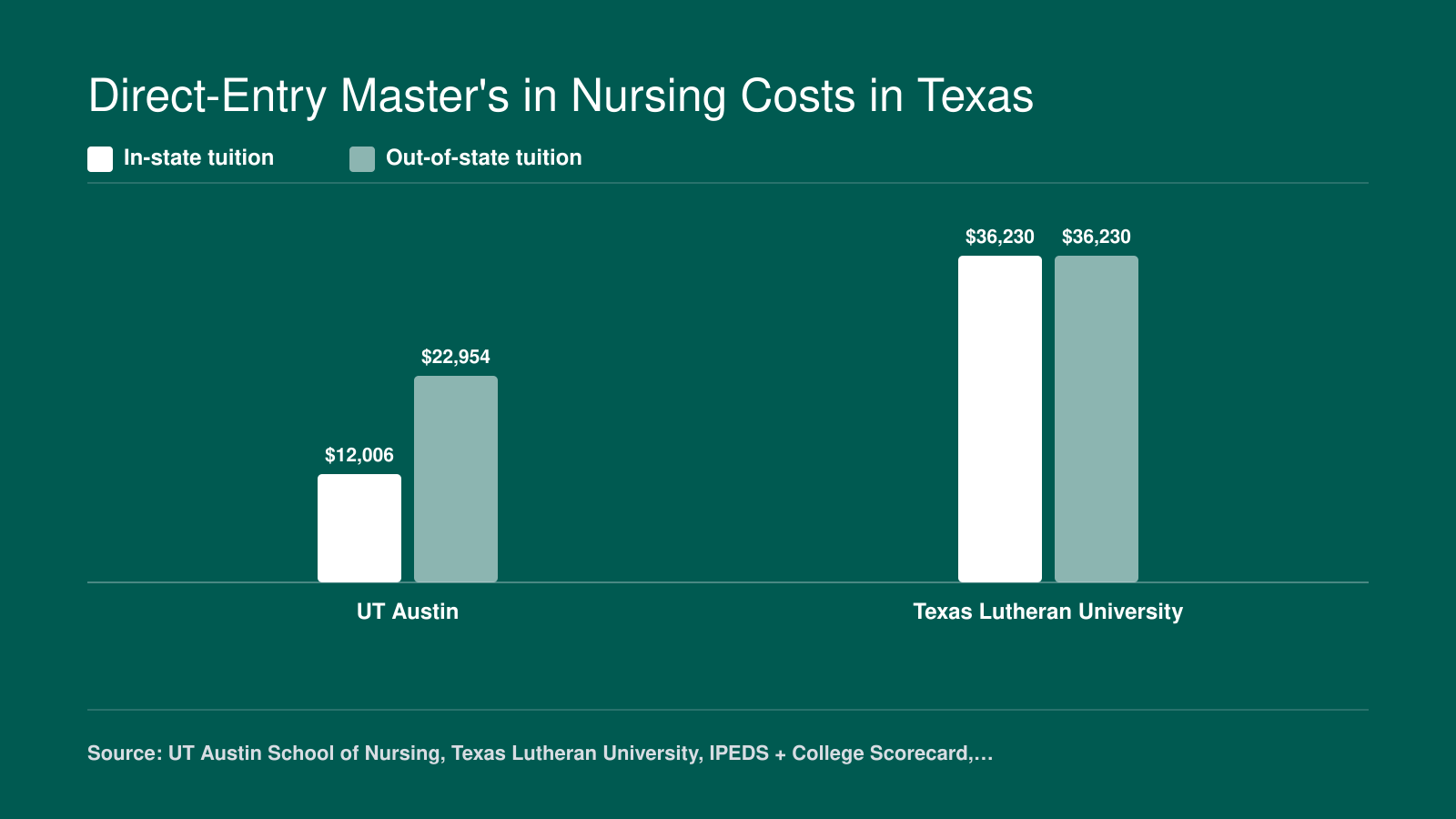
Cost is where the choice gets hard. Annual in-state graduate tuition at the programs below runs from about $4,600 at UT Health San Antonio to roughly $36,200 at Texas Lutheran, and none is fully online.
Whatever the price, the license still hinges on one exam: the NCLEX-RN.
Key Points
- No ranked Texas program is fully online, since RN licensure requires in-person clinical training.
- UT Austin lists $37,281 in-state tuition over three years versus $68,139 out-of-state.
- Ask each school for a total cost sheet, because clinical and lab fees add thousands.
Ranked: Texas Direct-Entry Master's in Nursing Programs Worth Your Shortlist
Each school below earned its place through a mix of what it costs, how many students finish, and what graduates go on to earn. Graduation rates shown are institution-wide, not specific to the nursing program. Net price figures are approximate institution-wide averages, not quotes for this program, so confirm real costs with each school. Always check the Texas Board of Nursing approved-programs list before you enroll.
The University of Texas at Austin
#1Austin, TX · ~$12,000/yr (est.)
Best for: Aspiring nurse leaders committing to full-time campus study
UT Austin's Alternate Entry MSN is a structured, three-year, full-time, on-campus path for bachelor's degree holders outside nursing, with a Leadership in Diverse Settings focus. The first year builds clinical foundations, then master's coursework in advanced practice, advocacy, and organizational change follows, ending in a capstone. The institution-wide graduation rate is about 89%, and the approximate institution-wide average net price is near $19,857 (not a quote). We could not confirm CCNE or ACEN accreditation or Texas Board of Nursing approval for this program from the sources we reviewed, so verify both before applying.
- Three-year, full-time, on-campus program
- One start per year, in summer
- Requires a non-nursing bachelor's degree
- 3.0 GPA minimum in upper-division and graduate coursework
- 24 prerequisite credits, each with at least a C-
- Three letters of recommendation (minimum)
- Capstone project required
- Prepares for NCLEX-RN and RN licensure
The University of Texas Health Science Center at San Antonio
#2San Antonio, TX · ~$5,000/yr (est.)
Best for: San Antonio area students needing hybrid flexibility
UT Health San Antonio offers a hybrid Direct Entry MSN that pairs online coursework with in-person clinical practice, built for students with non-nursing bachelor's degrees. Its location in the South Texas Medical Center supports local clinical connections, including University Health and the South Texas Veterans Health Care System. The program is listed as CCNE accredited. A single consolidated set of deadlines and direct-entry prerequisites was not easy to find, so check the school's catalog page directly. Texas Board of Nursing approval status was not confirmed in the sources we reviewed.
- Hybrid format: online coursework plus in-person clinical preceptorships
- CCNE accredited
- For bachelor's degree holders in other fields
- Prerequisite courses required before entry
- Covers pre-licensure competencies and advanced nursing skills
- Emphasis on health promotion across diverse patient populations
Texas Lutheran University
#3Seguin, TX · $35,000 – $40,000/yr (est.)
Best for: Dallas and Houston area career changers
Texas Lutheran University's Direct-Entry MSN is a hybrid, 75-credit program for career changers from any major, taking as few as 20 months of full-time study. It is offered through New Braunfels, Dallas, and Houston, and includes 990 clinical hours and small class sizes. The Texas Board of Nursing's January 12, 2026 approved-programs list shows the program with full approval, and CCNE accreditation dating to 2021. The Dallas site was listed as pending Board approval, so confirm which location is approved before applying. The institution-wide graduation rate is about 54%, and the approximate institution-wide average net price is near $24,654 (not a quote).
- 75 credit hours, as few as 20 months full time
- 990 hours of clinical experience
- Earn both a BSN and an MSN
- Hybrid delivery: New Braunfels, Dallas, Houston
- CCNE accredited, Texas Board of Nursing approval listed as full
- Dallas applicants: ATI TEAS of at least 70 overall and in science
- Dallas prerequisites must be completed within seven years
- Prepares for NCLEX-RN and later DNP or Ph.D. study
Cost & outcomes by school
Federal data for the highest-earning Direct Entry MSN (MENP) programs, independent of the ranking above. Earnings are this field's master's graduates four years after completing, where the Scorecard reports them.
| School | Earnings | Tuition / yr | Debt | Grads/yr | Format |
|---|---|---|---|---|---|
| The University of Texas Health Science Center at San Antonio TX | $129,695 | $4,648 | $41,000 | — | Hybrid |
| The University of Texas at Austin TX | $104,458 | $12,006 | $59,051 | 78 | Campus |
| Texas Lutheran University TX | — | $36,230 | — | 23 | Campus |
Sources: U.S. Department of Education. Tuition and graduates: IPEDS. Earnings and debt: College Scorecard, this field's master's graduates; a dash means no figure is reported.
How Direct-Entry Master's in Nursing Programs Work
As nursing schools court career changers, the Direct Entry MSN has become the fastest route from a non-nursing degree to both a license and a graduate credential. A direct-entry (sometimes called alternate-entry) MSN is a pre-licensure graduate pathway for people who already hold a bachelor's in another field. It combines prelicensure nursing coursework, clinicals, and NCLEX-RN preparation with graduate-level study, ending in an MSN plus eligibility for RN licensure.
That makes it different from RN-to-MSN and BSN-to-MSN tracks, which assume you already hold a nursing license and build on it. Direct-entry assumes you are starting from zero clinical background.
Full-time length typically runs about 20 to 24 months, though curriculum and outstanding prerequisites can stretch it. The usual sequence moves from foundational prelicensure courses and clinicals to the NCLEX-RN, then graduate coursework. At Texas Lutheran University and Herzing University, two Master's Programs in Texas, NCLEX eligibility comes near the end; at UT Austin's alternate-entry program, it can fall mid-program.
One expectation to set early: graduates enter as MSN-prepared registered nurses or clinical nurse leaders, not as nurse practitioners.
Prerequisites and Deadlines to Check Before You Apply
Requirements vary by school and change often, so confirm every item below on the program's admissions page before you plan your coursework.
- Bachelor's degreeUT Austin requires a non-nursing bachelor's or graduate degree. Texas Lutheran University welcomes career changers from any major.
- Minimum GPAUT Austin and Herzing University both list a 3.0.
- Core prerequisitesHerzing lists 17 credits: statistics, anatomy and physiology I and II, chemistry and microbiology. UT Austin requires 3 credits of statistics before enrollment. Ask each school whether human development or nutrition is also required.
- Grade minimumsHerzing requires a B or better in both anatomy and physiology courses.
- Science recencyThe UT Austin and Herzing pages we reviewed do not state a recency limit. Ask an advisor before retaking any courses.
- Healthcare experience or CNANone of the admissions pages we reviewed lists either as a requirement.
- UT Austin deadlineThe admissions page shows an application window of September 1 to November 1, while another source says October 1. Treat October 1 as the safe date.
- UT Austin start termThe admissions page says fall, though one source says summer. Confirm before you plan.
- Herzing deadline and startThe admissions information we reviewed does not state either one, so contact admissions.
Online and Hybrid Direct-Entry MSN Options in Texas
Can you earn a direct-entry MSN in Texas entirely online? Not at any school ranked here. Because the degree leads to RN licensure, every program requires hands-on training in person.
- Hybrid: UT Health San Antonio (San Antonio) pairs online coursework with in-person clinical practice and a simulation lab for fundamental skills.
- Campus-based: UT Austin (Austin) is on campus, with a three-year plan. Texas Lutheran (Seguin) lists a 20-month format with simulation labs and 990 clinical hours.
Houston readers should look at Texas Lutheran, which offers instruction there. Its materials also mention Dallas, so confirm which site is enrolling your cohort. No other ranked program is based in either metro.
None of these schools publishes a separate residency requirement that we could verify, and total simulation hours are not clearly stated. Ask admissions for lab schedules and campus-visit expectations before you plan work or childcare around them.
Related Articles
Direct-Entry Master's in Nursing Costs in Texas
Bars show annual graduate tuition from federal data. UT Austin's program page publishes $12,427 (in-state) and $22,713 (out-of-state) per year, or $37,281 and $68,139 over three years. Texas Lutheran charges $825 per credit, and its program lists 75 credit hours, so tuition alone would be roughly $61,875. Mandatory fees are not published for either program in the sources reviewed. Institution-wide net price after aid averages about $19,857 at UT Austin and $24,654 at Texas Lutheran, and these are approximations, not program quotes. Aid levers include federal loans (Grad PLUS rules changed in 2026, so confirm current limits), Texas nursing scholarships, and HRSA nurse loan repayment.
Quick Answers for Career Changers
How long does a direct-entry MSN program take in Texas?
Can you keep a job while enrolled in an accelerated direct-entry MSN?
Are there direct-entry MSN programs in Houston or Dallas?
Does a direct-entry MSN qualify you to become a nurse practitioner in Texas?
Compare Direct Entry MSN (MENP) programs on the data that matters
Explore more Nursing specializations or browse every graduate field.
All Nursing programs