Best Direct-Entry MSN Programs in Minnesota
Compare 6 accredited Direct Entry MSN (MENP) programs in Minnesota, with graduate earnings, cost, debt, and completion data from IPEDS and the U.S. College Scorecard.
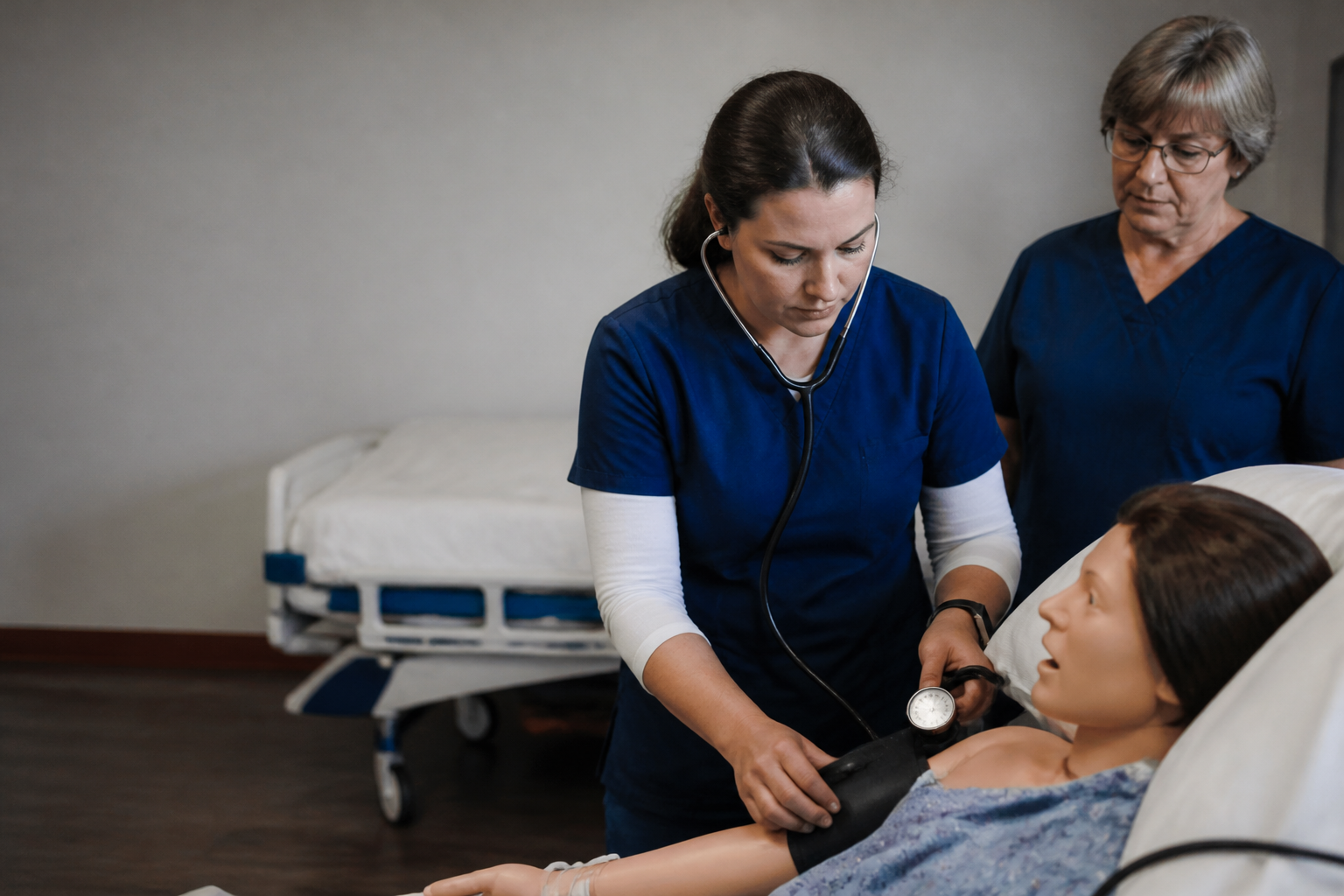
In Minnesota, someone with a bachelor's in history or biology can earn an RN license and a master's in nursing in as little as 16 months, without a second bachelor's degree.
Direct-entry (or entry-level) MSN programs pair pre-licensure coursework with graduate nursing study for people whose first degree is outside nursing. Programs run roughly 16 to 24 months, and the Most Affordable Direct-Entry MSN Programs list shows how sharply tuition varies by school.
The NCLEX-RN still decides licensure, whatever the degree.
Key Points
- No Minnesota direct-entry master's can be completed fully online, since clinicals and labs are in person.
- Most programs here ask for a prior bachelor's degree and GPA, not GRE scores.
- Pass the NCLEX-RN and apply to the Minnesota Board of Nursing for RN licensure.
Top Direct-Entry Master's in Nursing Programs in Minnesota, Ranked
A program earns its spot by what its graduates pay, how many students finish at the school, and what they earn and owe afterward. Graduation rates below describe the whole institution, not the nursing program. Earnings and debt figures are program-level and carry their time window, and NCLEX results are noted with their year when one is published.
University of Minnesota-Twin Cities
#1Minneapolis, MN · ~$22,000/yr (est.)
Best for: Full-time career changers at a public flagship
The University of Minnesota Twin Cities offers a 16-month, full-time, on-campus Master of Nursing for career changers with a non-nursing bachelor's degree. The institution-wide graduation rate is 85%. Program-level median earnings one year after completion were $72,217, and median graduate debt was $54,931. The program lists CCNE accreditation and a 98% licensure pass rate on its own page without a reporting year in our data, so confirm the current first-time NCLEX figure with the school.
- 16-month, full-time, campus-based program with a fall start only
- Roughly 500 practicum hours in hospitals, clinics and community sites
- 3.5 GPA minimum listed; prerequisite courses required
- Simulation labs use VR, manikins and standardized patients
- Practicum shifts can include evenings and weekends
- Eligible for public health nursing certification in Minnesota
- Recent cohort of 63 students; early admission for UMN system students
University of St Thomas
#2Saint Paul, MN · ~$21,000/yr (est.)
Best for: Cohort-minded learners preferring private campus study
The University of St. Thomas runs a 21-month, 56-credit campus MSN in Saint Paul designed for people with no nursing experience. The program is CCNE accredited and approved by the Minnesota Board of Nursing. The institution-wide graduation rate is 76%. Program-level earnings and debt aren't available for this program, and a current first-time NCLEX pass rate wasn't confirmed, so check the school's published results.
- 21-month, 56-credit campus program
- No nursing experience needed; bachelor's degree required
- 3.0 GPA preferred and six prerequisite courses
- Basic Life Support certification required
- Cohort model with emphasis on health equity and interprofessional care
- CCNE accredited; Minnesota Board approved
St Catherine University
#3Saint Paul, MN · $15,000 – $20,000/yr (est.)
Best for: Spring-start applicants valuing placement support
St. Catherine University's Entry-Level MSN is a 23-month, 49-credit campus program in Saint Paul, with a dedicated coordinator who secures a clinical placement for every student. The institution-wide graduation rate is 61%. Program-level median earnings one year after completion were $81,054, the highest among ranked programs reporting that figure, and median graduate debt was $61,500. A secondary compilation reports a 77.8% first-time NCLEX-RN pass rate without a reporting year, and current CCNE or ACEN status wasn't confirmed, so verify both directly.
- 23-month, 49-credit program; spring start
- $995 per credit, $48,755 total program tuition
- Dedicated clinical placement coordinator for every student
- Clinical placements in local and global settings
- Eligible for the Clinical Nurse Leader exam
- Scholarships and financial aid available
Metropolitan State University
#4Saint Paul, MN · ~$11,000/yr (est.)
Metropolitan State University offers a seven-semester hybrid Entry Level MSN in Saint Paul. The program is CCNE accredited and includes a path to public health nurse registration. The institution-wide graduation rate is 44%, lower than the private schools here, but the public price point is the draw. Program-level median earnings one year after completion were $75,682, and median graduate debt was $50,693, the lowest listed. A 2026 secondary compilation reports an 85.7% first-time NCLEX-RN pass rate with no year or candidate count shown.
- Seven-semester hybrid format with online and campus components
- 62 credits of nursing coursework
- 3.0 minimum GPA; non-nursing bachelor's degree required
- Applications go through NursingCAS; priority deadline January 15, 2027
- One fall cohort per year; next listed start is Fall 2027
- Remaining prerequisites may be finished after admission with a C or better
- CCNE accredited; $80 application fee with waivers for eligible applicants
Herzing University-Minneapolis
#5St. Louis Park, MN · $5,000 – $10,000/yr (est.)
Herzing University's Minneapolis campus in St. Louis Park offers the only fully online format on this list, with clinical placements in Minnesota and intensives at campuses. Herzing states the program is CCNE accredited and reports a 2025 NCLEX-RN pass rate of 87.61% (99 of 113 first-time candidates). It's unclear whether that figure is specific to Minnesota or covers all campuses. The institution-wide graduation rate is 47%, and program-level earnings and debt aren't available.
- Online format with 20 to 24 months to complete
- 60 to 77 total credits
- Clinical placements in Minnesota; intensives at campuses
- 3.0 GPA and an aggregate TEAS score of 66 required
- No GRE required
- B or better needed in prerequisite courses
- CCNE accredited per Herzing
University of Minnesota-Duluth
#6Duluth, MN · $22,000 – $33,000/yr (est.)
The University of Minnesota Duluth lists a 16-month, full-time, on-campus Master of Nursing for non-nursing bachelor's degree holders. It requires five of nine prerequisites to apply and offers early options for University of Minnesota students. The institution-wide graduation rate is 65%. Program materials cite CCNE accreditation and a 98% pass rate with no reporting year, but our accreditation verification came back unconfirmed, and no program-level earnings or debt are available. Confirm details directly with the school.
- 16-month, full-time, on-campus program; fall start only
- 500 practicum hours across varied clinical settings
- Five of nine prerequisites needed to apply
- Early admission option for University of Minnesota students
- Eligible for public health nursing certification
- Working during the program is not recommended
Cost & outcomes by school
Federal data for the highest-earning Direct Entry MSN (MENP) programs, independent of the ranking above. Earnings are this field's master's graduates four years after completing, where the Scorecard reports them.
| School | Earnings | Tuition / yr | Debt | Grads/yr | Format |
|---|---|---|---|---|---|
| St Catherine University MN | $99,367 | $18,570 | $61,500 | 94 | Campus |
| Metropolitan State University MN | $79,007 | $11,323 | $50,693 | 44 | Hybrid |
| University of Minnesota-Twin Cities MN | $78,778 | $22,017 | $54,931 | 97 | Campus |
| Herzing University-Minneapolis MN | — | $9,370 | — | — | Online |
| University of St Thomas MN | — | $21,151 | — | 36 | Campus |
| University of Minnesota-Duluth MN | — | $21,630 | — | — | Campus |
Sources: U.S. Department of Education. Tuition and graduates: IPEDS. Earnings and debt: College Scorecard, this field's master's graduates; a dash means no figure is reported.
Cost, debt & payoff
Median earnings of this field's master's graduates (4 yrs after completing) vs. their median federal loan debt · U.S. College Scorecard
Across these programs the median graduate earns about $79,007 and finishes with roughly $54,931 in debt — a ratio that clears a common rule of thumb (keep debt below first-year salary). Tuition and debt vary widely school to school, so check the per-school figures in the table above before you shortlist.
Online and Hybrid Direct-Entry MSN Options in Minnesota
Can you complete a direct-entry master's in nursing in Minnesota fully online? No. Pre-licensure training requires hands-on practice, so every program labeled online is really hybrid, with required labs and in-person clinicals.
Format and clinical details
- Metro State University: Hybrid, online and on campus, over seven semesters and 62 credits, one of the MSN programs in Minnesota. Students complete 630 clinical hours, and a clinical coordinator arranges all placements. A fixed campus schedule isn't specified, so ask admissions how often you will attend.
- St. Catherine University: Primarily in person, with some hybrid and fully online courses, one of the Master's Programs in Minnesota. Classroom, lab, and simulation work is centered in Minnesota, and in-person clinical experiences are required. Confirm total clinical hours and how placements are handled.
- Herzing University: Didactic coursework is 100% online, but hands-on clinicals and on-campus intensives are required. Placements use faculty-led rotations or a precepted model at select Minnesota partner sites, and a dedicated team looks for sites near you. A placement at a specific site is not guaranteed before enrollment.
Before you apply
Ask each school how often you must be at a campus or lab site. Then confirm the commute to clinical sites in the Twin Cities metro versus Greater Minnesota, since a long drive several days a week can matter as much as tuition.
Related Articles
Which Minnesota Entry-Level Master's Programs Waive or Skip the GRE
The GRE is a standardized graduate admissions exam, and most Minnesota direct-entry nursing programs, like Accelerated Direct-Entry MSN Programs, ask for something else: a prior bachelor's degree and a solid GPA. Here is how the schools sort, based on their admissions pages.
- GRE not required: St. Catherine University states GRE scores are not required for its entry-level MSN1, and Herzing University's online direct-entry MSN does not require one either.
- No published policy: University of St. Thomas, University of Minnesota-Twin Cities, and Metropolitan State University do not state a current GRE policy in the sources we reviewed. We won't guess. The same goes for University of Minnesota-Duluth.
TEAS and HESI A2
Herzing asks for an aggregate TEAS score of at least 66 instead. St. Catherine lists no TEAS or HESI requirement1. No HESI A2 policy appears for any school here.
Testing rules have shifted often since 2020, so confirm the current policy with each admissions office before you plan test dates or pay for an exam.
What a Direct-Entry Master's in Nursing Costs in Minnesota
Annual tuition understates what a direct-entry master's costs, because these programs run well past one academic year and add fees, uniforms, and clinical or lab charges. Net price is an institution-wide average after aid, not a quote for this program. Graduates should also budget for the NCLEX-RN registration fee and the Minnesota Board of Nursing application fee, covered in the licensure box below.
| School | Annual grad tuition (in-state) | Annual grad tuition (out-of-state) | Average net price (institution-wide) | Published total program cost |
|---|---|---|---|---|
| Herzing University-Minneapolis | $9,370 | $9,370 | $16,670 | Not published |
| Metropolitan State University | $11,323 | $11,323 | $16,863 | $41,077.95 estimate with fees for 2026-2027 (62 credits); about $2,500 in other non-tuition costs also listed |
| St Catherine University | $18,570 | $18,570 | $19,764 | $48,755 in tuition (49 credits at $995 each), fees not included |
| University of St Thomas | $21,151 | $21,151 | $29,155 | Not published |
| University of Minnesota-Duluth | $21,630 | $32,862 | $18,743 | Not published |
| University of Minnesota-Twin Cities | $22,017 | $33,249 | $16,778 | Not published |
Minnesota RN Licensure and Public Health Nurse Registration
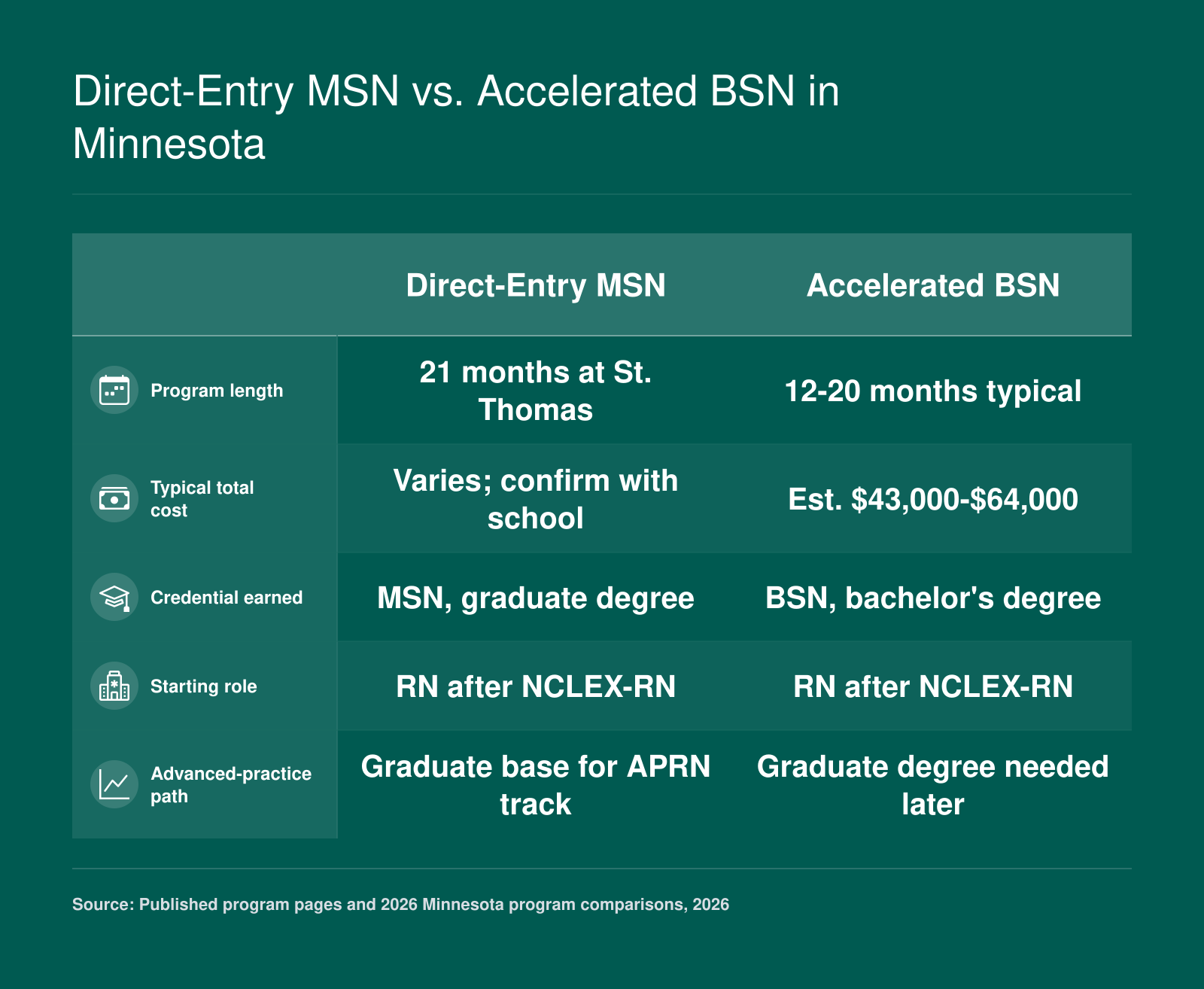
Direct-Entry MSN vs. Accelerated BSN in Minnesota
Both paths are built for career changers with a non-nursing bachelor's degree, and both prepare you to sit for the NCLEX-RN. The accelerated BSN is usually shorter and cheaper, while the direct-entry MSN adds a graduate credential that can shorten the path to leadership or an APRN role. Published costs vary and often leave out fees, so confirm totals with each school.
Admission Requirements for Minnesota Direct-Entry MSN Programs
Requirements vary by school, so confirm details on each admissions page. Every program here expects a non-nursing bachelor's degree, but GPA rules and prerequisite detail differ.
- Bachelor's degree and GPAA 3.0 is the common benchmark. St. Catherine University lets applicants at 2.80–2.99 petition through its application. University of St. Thomas calls 3.0 preferred. Metropolitan State University and Herzing University list 3.0.
- Science and other prerequisitesHerzing requires five courses (17 credits), with B or better in Anatomy & Physiology I and II. Metropolitan State requires eight, including chemistry, anatomy, physiology, microbiology and statistics, with a 3.0 across the science courses. Its only stated recency rule is statistics within four years. St. Catherine requires C or better with a 3.0 prerequisite GPA. St. Thomas requires six courses. The University of Minnesota-Twin Cities and University of Minnesota-Duluth requirements were not confirmed here.
- CNA and patient-care experienceNone of the schools above lists a CNA requirement, and Herzing says none is needed. St. Thomas does require AHA BLS Healthcare Provider certification before the first class.
- Deadlines and start termsMetropolitan State opens its cycle in August 2026 for a Fall 2027 cohort. St. Catherine opens applications April 1, 2027 for Spring 2028. Check the other schools directly for current dates.
- Statement, references and interviewHerzing requires a TEAS aggregate score of 66. Check each school for its statement, reference and interview expectations before you apply.
Quick Answers for Career Changers Considering a Minnesota Direct-Entry MSN
These answers cover the questions career changers ask most before applying. Details such as prerequisites and deadlines change by cycle, so confirm them on each school's admissions page.
Can I become an RN with a direct-entry MSN in Minnesota?
How long does a direct-entry MSN take in Minnesota?
Do Minnesota entry-level MSN programs require the GRE?
How much does a direct-entry master's in nursing cost in Minnesota?
Can I complete a direct-entry MSN entirely online?
Is the St. Thomas MSN program a direct-entry option for non-nurses?
Compare Direct Entry MSN (MENP) programs on the data that matters
Explore more Nursing specializations or browse every graduate field.
All Nursing programs