Best Direct-Entry MSN Programs in North Carolina
Compare 5 accredited Direct Entry MSN (MENP) programs in North Carolina at 3 schools, with graduate earnings, cost, debt, and completion data from IPEDS and the U.S. College Scorecard.

What's the fastest master's-level route into nursing if your bachelor's is in biology, business, or anything but nursing? In North Carolina, it's the direct-entry MSN: a prelicensure track that takes a non-nurse to NCLEX-RN eligibility in as little as 15 months at Western Carolina.
Few NC schools offer this pathway, which is why the list below is short and every option rewards close scrutiny. Tuition, GPA floors, and clinical demands vary enough that the lowest sticker price isn't always the better value.
Key Points
- Western Carolina's MEPN packs 56 credits and 660+ clinical hours into 15 months.
- No direct-entry MSN here is fully online; UNC Greensboro and Duke run hybrid formats.
- NCLEX-RN registration costs $200 in 2026, so budget for it beyond tuition.
North Carolina's Top Direct-Entry MSN Schools, Ranked
A career changer comparing these schools should weigh published graduate tuition, how many students finish at the institution overall, whether classes are on campus or blended, and first-time NCLEX-RN performance where a school publishes it. Verified first-time pass rates and program-specific Board of Nursing approval status were not fully available for every school below, so check each School of Nursing and the NC Board of Nursing approved-program list before you apply. Only the first two schools offer a true entry route for applicants without a nursing degree.
Western Carolina University
#1Cullowhee, NC · ~$8,000/yr (est.)
Best for: Career changers drawn to rural health
Western Carolina University in Cullowhee offers an accelerated, campus-based Master's Entry Prelicensure Nursing program with a Rural Health concentration for applicants holding a non-nursing bachelor's degree. Clinical rotations include rural hospitals in western North Carolina, and Mission Health supports adjunct clinical faculty for nursing students. The school's graduation rate is 60%. The program is CCNE accredited. A school-published first-time NCLEX-RN pass rate and program-specific NC Board of Nursing approval status could not be confirmed, so verify both directly with the School of Nursing.
- 15-month accelerated program awarding an MSN
- 56 credits, campus-based in Cullowhee
- 660 supervised clinical hours
- Rural Health concentration with telehealth training
- Minimum 2.8 GPA and prerequisite courses required
- Personal statement and two recommendation letters
- Interview by invitation; GRE may be requested if GPA is low
- CCNE accredited
University of North Carolina at Greensboro
#2Greensboro, NC · ~$9,000/yr (est.)
Best for: Career changers wanting a blended schedule
UNC Greensboro's Prelicensure Entry-Level MSN was the first entry-level MSN in the UNC System and is recognized by the NC Board of Nursing as a Direct Master's Entry route for non-nurses with a prior bachelor's degree. The blended, full-time format is mostly on campus, with clinical placements across regional systems such as Cone Health and Novant Health. The school's graduation rate is 56%. It carries CCNE accreditation, and federal records also list ACEN. UNCG says its NCLEX pass rate varies by year and points applicants to current School of Nursing statistics, so no single first-time figure is cited here.
- 24-month full-time program for applicants who are not RNs
- Two start dates per year
- Minimum 2.7 GPA and prerequisite courses required
- Final deadline for January 2027 entry is October 1, 2026
- Mostly on campus with some online courses
- Clinicals may include nights and weekends
- Clinical partners include Cone Health and Novant Health
- Recognized by the NC Board as Direct Master's Entry
University of North Carolina at Pembroke
#3Pembroke, NC · ~$7,000/yr (est.)
Best for: Working RNs advancing into education or leadership
UNC Pembroke offers hybrid MSN concentrations, but the available materials describe them as graduate study for registered nurses with a BSN, not as a first-licensure route for non-nursing majors. Treat it as a post-licensure option rather than a direct comparison to the first two schools. The school's graduation rate is 44%, and the programs are CCNE accredited. Because these concentrations do not lead to initial RN licensure, a first-time NCLEX-RN pass rate does not apply to them.
- Hybrid format with online and face-to-face classes
- 39 credit hours with practicum and capstone
- Requires BSN, current RN license and 3.0 GPA
- One year of nursing experience expected
- Covers curriculum design, clinical teaching and educational technology
- Clinical Nurse Leader concentration
- Hybrid online and campus format
- Focus on leadership, management and clinical decision-making
- Full-time and part-time options
- Rural Case Manager concentration
- Hybrid format with a rural health focus
- Advanced pathophysiology, pharmacology and health assessment courses
- Nursing experience recommended
Cost & outcomes by school
Federal data for the highest-earning Direct Entry MSN (MENP) programs, independent of the ranking above. Earnings are this field's master's graduates four years after completing, where the Scorecard reports them.
| School | Earnings | Tuition / yr | Debt | Grads/yr | Format |
|---|---|---|---|---|---|
| Western Carolina University NC | $122,811 | $7,876 | $36,847 | 35 | Campus |
| University of North Carolina at Greensboro NC | $105,380 | $8,614 | — | 14 | Campus |
| University of North Carolina at Pembroke NC | — | $6,928 | — | 2 | Hybrid |
Sources: U.S. Department of Education. Tuition and graduates: IPEDS. Earnings and debt: College Scorecard, this field's master's graduates; a dash means no figure is reported.
How Direct-Entry Master's in Nursing Programs Work for Non-Nursing Majors
Western Carolina's MEPN packs 56 credits and at least 660 clinical hours into 15 months, one of several masters programs in north carolina for non-nursing majors. That is the direct-entry model behind these direct entry MSN programs: you arrive with a non-nursing bachelor's and leave with a master's and eligibility for the NCLEX-RN. An accelerated BSN awards a second bachelor's instead, and a traditional MSN requires you to already hold an RN license.
Program length and clinical hours
Lengths vary across the schools here. Western Carolina runs 4 semesters. Duke's Master of Nursing is also 4 semesters. UNC Greensboro takes 24 months, summers included. Herzing runs roughly 20 to 24 months depending on your background and prerequisites. Only Western Carolina publishes a firm clinical total. UNC Greensboro lists 35 to 40 contact hours per week each semester, and Duke and Herzing do not publish totals on their program pages.
Where you rotate
UNC Greensboro places students around the Triad with partners such as Cone Health, Novant Health, and Atrium/Advocate Health. Western Carolina uses regional hospitals and rural sites, including Mission Health System and Harris Regional Hospital. Herzing pairs online coursework with local placements, so ask about travel.
These programs are full-time and clinically heavy, so outside work is usually unrealistic.
Online and Hybrid Direct-Entry MSN Options in North Carolina
No direct-entry MSN on this list is a fully online master's program. Both hybrid programs here, UNC Greensboro's Prelicensure Entry-Level MSN and Duke's Master of Nursing, require in-person work that no screen can replace.
What Happens Online vs. In Person
UNC Greensboro combines online coursework with in-person clinical experiences in the Piedmont Triad region over 24 months. Duke's four-semester pathway pairs online coursework with hands-on simulation and clinical training on campus. Neither program publishes a course-by-course breakdown of which lectures run remotely, so expect the didactic portion to be flexible while labs, simulation, and clinical hours stay face-to-face.
Licensure and Portability
Hybrid delivery does not change NCLEX-RN eligibility for MSN programs in NC. What matters is that the program holds board-approved pre-licensure status, which both do, not how coursework reaches you.
North Carolina belongs to the Nurse Licensure Compact, now enacted in 43 jurisdictions. Once licensed here as your primary residence, a multistate license can let you practice across compact states. Neither school publishes a clear out-of-state professional-licensure disclosure, so confirm placement rules directly if you live elsewhere.
Related Articles
GRE Policies at Ranked Direct-Entry MSN Schools
Each row reflects the school's current graduate nursing admissions page. A GRE waiver usually hinges on academic record: a prior graduate degree, completed graduate coursework with strong grades, or a minimum undergraduate GPA. Schools that do not require the test have no waiver criteria to publish, so confirm the policy for your specific track before you apply.
| School | GRE Policy | Waiver Criteria / Notes |
|---|---|---|
| Duke University School of Nursing (MSN) | Not required | The GRE is not part of MSN requirements, so no waiver criteria are stated. |
| University of North Carolina at Chapel Hill (MSN programs) | Not required | Listed for the Adult-Gerontology, Family, Pediatric Primary Care, and Psychiatric-Mental Health (Online) nurse practitioner tracks. No GPA-based waiver criteria are stated. |
| East Carolina University (MSN Nursing Education) | Not required | No GMAT or GRE is required, so no GPA-based waiver criteria are stated. |
| East Carolina University (MSN Nurse-Midwifery) | GRE or MAT may be waived | Waiver is considered case by case and must be requested from the concentration director. Eligible applicants have a prior graduate degree, 9 or more graduate semester hours with a B or higher in each course, or a minimum 3.2 GPA (4.0 scale) in an accredited baccalaureate nursing program. |
Prerequisites and Application Deadlines for Direct-Entry Master's Programs
Direct-entry master's programs in nursing are built for career changers, so most requirements center on your prior degree and science coursework. Only UNC Greensboro publishes full details for its non-nurse track. For Duke, UNC Chapel Hill, and UNC Charlotte, confirm requirements and deadlines directly with each school before you plan your application.
- Prior degreeUNC Greensboro's Prelicensure Entry-Level MSN requires a non-nursing bachelor's degree or higher, and applicants must not already be nurses. Confirm the regional accreditation of your degree-granting school with each program.
- Science prerequisitesUNC Greensboro requires prerequisite courses completed with a C or better, and allows up to two to remain in progress at the time you apply. Anatomy and physiology, microbiology, and statistics are typical in programs like this, but confirm the exact course list and any recency limits on each school's admissions page.
- GPA expectationsUNC Greensboro sets a 2.70 minimum GPA and gives priority to applicants at 3.0 or above. Other ranked schools do not clearly publish a GPA for a non-nurse track.
- Deadlines and start termsUNC Greensboro opened applications June 1, 2026. For January 2027 admission, the priority deadline for scholarship consideration is September 1, 2026 and the final deadline is October 1, 2026. For August 2027, the priority deadline is April 15, 2027 and the final deadline is May 15, 2027.
- Clinical complianceUNC Greensboro indicates AHA BLS certification is required. Expect background checks, drug screens, immunization records, and possibly insurance, but the complete checklist is not published here, so verify it with the program.
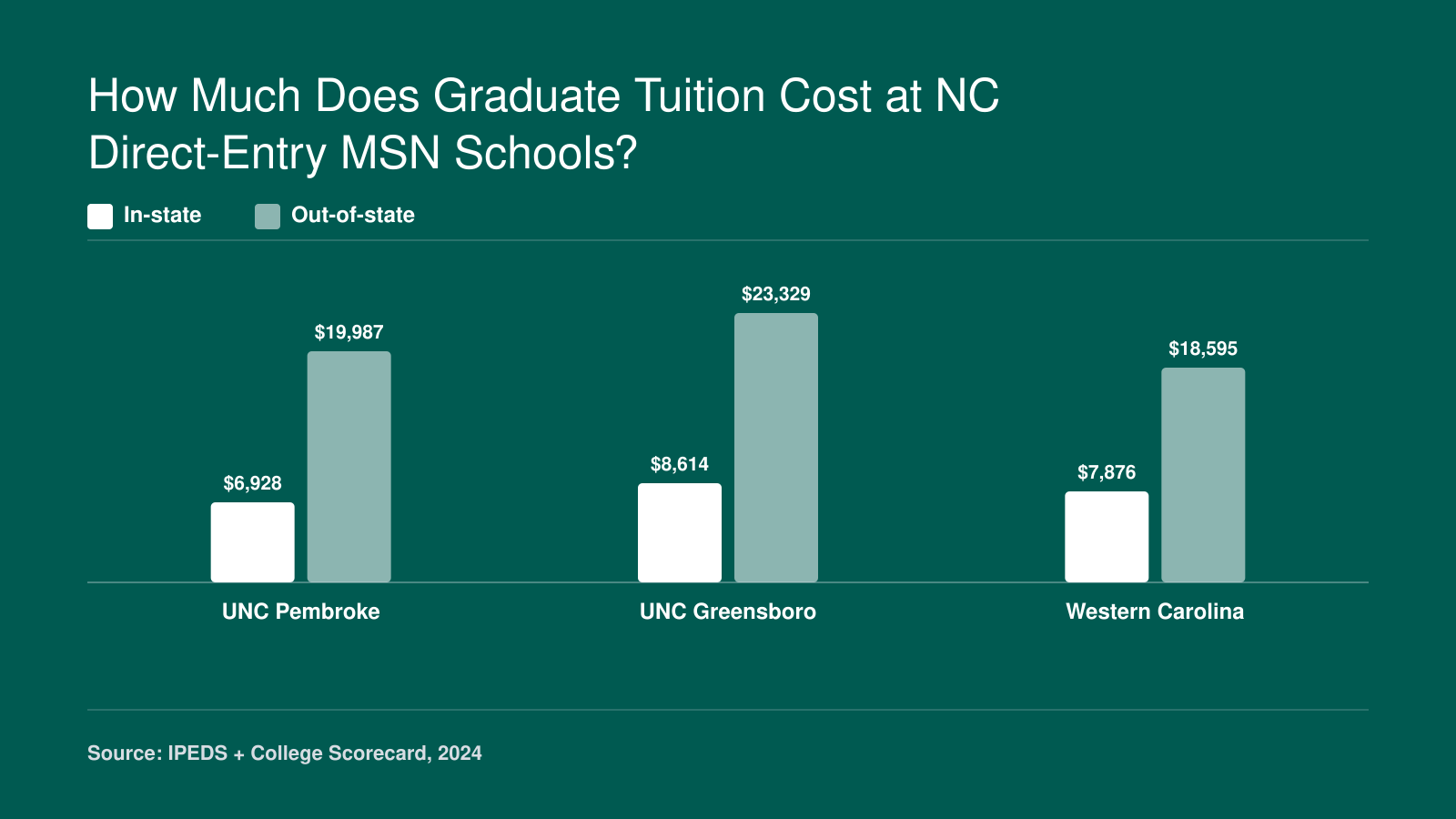
How Much Does Graduate Tuition Cost at NC Direct-Entry MSN Schools?
Published graduate tuition and fees vary widely across the North Carolina schools here, and the gap between in-state and out-of-state rates is largest at the University of North Carolina at Greensboro. Compare the annual rates below before you weigh total program cost.
Direct-Entry Master's in Nursing Costs and How to Pay for Them
The advertised per-credit rate is never the real price of a direct-entry nursing master's program. Build your own total: multiply the published rate by the program's credit load, then add mandatory nursing and clinical fees, which most North Carolina schools do not bundle into the headline number.
UNC Greensboro publishes graduate tuition at $443.83 per credit for residents and $1,294.78 for nonresidents across its 24-month prelicensure track, though the program's full credit total and required nursing fees are not posted, so a reliable all-in figure is not available. Herzing's direct-entry sequence runs 60 to 77 credits depending on whether your prior degree covered general education, a spread wide enough to move the final bill substantially. Where you see an institution-wide net price, treat it as an average after aid across all students, not a quote for this program.
Paying for it
Graduate students qualify for Direct Unsubsidized and Grad PLUS loans. Scholarship sources worth checking include NCNA, AACN, HRSA, FNSNA, and FA Davis; some schools award internally with no separate application. Budget separately for uniforms, a stethoscope and equipment, background checks, NCLEX registration, and state licensure fees.
Getting Your RN License in North Carolina
Early-Career Earnings and Debt for Direct-Entry MSN Graduates
Every direct-entry graduate has to pass the NCLEX-RN before earning a nurse's wage, so pay and debt both start after licensure. Program-level median earnings and borrowing figures are not published for Western Carolina University or the University of North Carolina at Greensboro. We won't put a number on these programs that the data doesn't support.
You can still run your own payment-versus-pay check. Add up tuition, fees, and living costs you plan to borrow. Estimate the monthly payment on a 10-year standard repayment plan. Then compare it with the starting RN salary offers posted by hospitals in the region where you want to work. A common rule of thumb is to keep that payment to a modest share of gross monthly pay, so lower-cost public options carry less risk.
Typical First Roles
Most new graduates start as staff RNs in acute care, often on medical-surgical or step-down units. Some pursue a clinical nurse leader track. After one to two years of bedside experience, many move toward advanced practice, such as a nurse practitioner or nurse educator pathway.
Compare Direct Entry MSN (MENP) programs on the data that matters
Explore more Nursing specializations or browse every graduate field.
All Nursing programs