Best Online Direct-Entry MSN Programs
Compare 50+ accredited online Direct Entry MSN (MENP) programs, with graduate earnings, cost, debt, and completion data from IPEDS and the U.S. College Scorecard.

Can you become a registered nurse and earn a master's without a four-year BSN? With a bachelor's in another field, yes. Direct-entry MSN programs combine RN preparation and graduate coursework in roughly 20 to 24 months at schools such as Herzing and Elmhurst.
"Online" covers the classroom, not the training. Coursework runs online, but clinical rotations happen in person at healthcare sites: 585 hours at Herzing and 810 at Elmhurst.
The rankings come first, followed by clinical placements, costs, state eligibility and admissions. The harder constraint is rarely coursework. It is securing clinical sites in your own state.
Key Points
- Only fully online direct-entry MSN coursework made this list.
- George Washington University won't accept online students from Alabama or Louisiana.
- California Baptist direct-entry MSN grads earn median $143,804 five years out.
Top 10 100% Online Direct-Entry MSN Programs Ranked
The programs below are limited to schools whose direct-entry MSN coursework is delivered fully online; programs labeled hybrid were excluded from consideration. Each entry pairs an institution's direct-entry MSN with cost context and a snapshot of what makes the school distinct. Use the cards to compare concentrations and fit, then check the clinical requirements section before applying.
California Baptist University
#1Riverside, CA · $15,000 – $20,000/yr (est.)
Best for: Career changers wanting faith-based curriculum
California Baptist University's direct-entry MSN is built for non-nursing bachelor's degree holders and carries CCNE accreditation. Students can choose from Nurse Educator, Nursing Informatics, and Nursing Organizational Leadership concentrations, with coursework online and clinical practicums in varied healthcare settings. The school's institution-wide graduation rate is 62%.
- CCNE accredited
- 102-108 total units
- 10 semesters program length
- Three concentrations: Nurse Educator, Nursing Informatics, Nursing Organizational Leadership
- Prepares for NCLEX-RN exam
- Clinical practicum hours required
- Faith-based curriculum
Elmhurst University
#2Elmhurst, IL · ~$34,000/yr (est.)
Best for: High-GPA candidates pursuing Clinical Nurse Leader
Elmhurst University's Master's Entry in Nursing Practice is a CCNE-accredited, 20-month program focused on the Clinical Nurse Leader concentration. Students complete 71 credits and 810 clinical hours through online coursework, in-person clinicals, and one on-campus residency. The school's institution-wide graduation rate is 70%.
- CCNE accredited
- 20-month program length
- Clinical Nurse Leader concentration
- 71 credit hours total
- 810 clinical hours required
- One on-campus residency
- 3.2 minimum GPA
- 22 prerequisite credits
Bay Path University
#3Longmeadow, MA · ~$15,000/yr (est.)
Best for: Working adults needing asynchronous online classes
Bay Path University's direct-entry MSN is an asynchronous online program designed for career changers and working adults. It offers two concentration options and spring and fall start dates, with residency courses for hands-on application. A pathway to the Doctor of Nursing Practice is available. The school's institution-wide graduation rate is 44%.
- CCNE accredited
- 2 concentration options
- Starts fall/spring
- Asynchronous online classes
- Residency courses provide hands-on application
- Pathway to Doctor of Nursing Practice
- Approved by Massachusetts Board of Nursing
Herzing University-Kenosha
#4Kenosha, WI · ~$9,000/yr (est.)
Herzing University-Kenosha's online direct-entry MSN is built for career changers with a non-nursing bachelor's degree. The CCNE-accredited program combines 100% online didactic classes with 585 clinical hours and three short on-campus intensives. The school's institution-wide graduation rate is 72%.
- CCNE accredited
- 20-24 month program length
- 585 clinical hours
- Three 2-4 day on-campus intensives
- $790 per credit
- Entrance exam required: TEAS
- 3.0 GPA minimum
- Prepares for NCLEX-RN
Herzing University-Tampa
#5Tampa, FL · ~$9,000/yr (est.)
Herzing University-Tampa offers an online direct-entry MSN for Florida residents with a non-nursing bachelor's degree. The 60-77 credit program takes 20-24 months and combines online didactic coursework with clinical placements in Florida and in-person intensives.
- 20-24 month program length
- 60-77 credit hours
- 100% online didactic classes
- Clinicals in Florida
- In-person intensives required
- 3.0 minimum GPA
- TEAS test score 66
- CCNE accredited
Herzing University-Minneapolis
#6St. Louis Park, MN · $5,000 – $10,000/yr (est.)
Herzing University-Minneapolis offers an online direct-entry MSN for Minnesota residents with a non-nursing bachelor's degree. The 60-77 credit program includes online coursework, clinical placements in Minnesota, and campus intensives. The school's institution-wide graduation rate is 47%.
- Online program format
- 20-24 months duration
- 60-77 total credits
- Clinicals in Minnesota
- 3.0 GPA requirement
- TEAS test required
- CCNE accredited
- NCLEX-RN preparation included
Aspen University
#7Phoenix, AZ · ~$6,000/yr (est.)
Aspen University's online MSN concentrations in Administration and Management, Forensic Nursing, and Informatics are CCNE-accredited and delivered in 8-week terms. The programs require a current RN license, a BSN, and one year of nursing experience, so they serve working nurses rather than first-time nursing students. The school's institution-wide graduation rate is 27%.
- Online program delivery
- 36 credit hours total
- 12 courses required
- Tuition cost $17,100
- Current RN license required
- BSN degree required
- 120 practicum hours total
- CCNE accredited program
- 2-year completion time
- $17,100 tuition
- 120-hour practicum course
- Current RN license needed
- Forensic Nursing concentration
- Evidence collection focus
- Local practicum placement
- Preceptor supervision needed
- $20,875 total cost
- Health informatics specialization
- Data analysis skills taught
- Legal and ethical issues covered
- Information security knowledge
- No application fee
- Local practicum required
Herzing University-Nashville
#8Nashville, TN · ~$9,000/yr (est.)
Herzing University-Nashville offers an online direct-entry MSN for Tennessee residents with a non-nursing bachelor's degree. The 60-77 credit program takes 20-24 months and combines online didactic coursework with clinical placements in Tennessee and in-person intensives.
- Online program format
- Program length 20-24 months
- 60-77 credits required
- Non-nursing bachelor's degree required
- Minimum 3.0 GPA required
- TEAS exam required
- Clinicals in Tennessee
- In-person intensives required
Herzing University-Orlando
#9Winter Park, FL · ~$9,000/yr (est.)
Herzing University-Orlando offers an online direct-entry MSN for non-nurses with a bachelor's degree. The 60-77 credit program takes 20-24 months and includes online didactic classes, 585 clinical hours, and in-person intensives. The school's institution-wide graduation rate is 37%.
- 20-24 month program length
- 60-77 total credits
- 100% online didactic classes
- In-person intensives required
- $790 per credit tuition
- 3.0 minimum GPA for admission
- TEAS test score of 66
- 585 clinical hours included
Herzing University-Madison
#10Madison, WI · ~$9,000/yr (est.)
Herzing University-Madison offers an online direct-entry MSN for non-nurses with a bachelor's degree. The CCNE-accredited program takes 20-24 months and combines online coursework with in-person clinicals and intensives. The school's institution-wide graduation rate is 28%.
- 20-24 month program length
- 60-77 total credits
- Online didactic coursework
- In-person clinicals and intensives
- $790 per credit tuition
- 3.0 minimum GPA
- TEAS test score of 66
- 585 clinical hours required
Cost & outcomes by school
Federal data for the highest-earning Direct Entry MSN (MENP) programs, independent of the ranking above. Earnings are this field's master's graduates four years after completing, where the Scorecard reports them.
| School | Earnings | Tuition / yr | Debt | Grads/yr | Format |
|---|---|---|---|---|---|
| Fairleigh Dickinson University-Metropolitan Campus NJ | $145,105 | $19,068 | $40,432 | 57 | Hybrid |
| Fairleigh Dickinson University NJ | $145,105 | $25,628 | $40,432 | 8 | Hybrid |
| University of Nevada-Las Vegas NV | $141,227 | $7,413 | $34,991 | 62 | Hybrid |
| The University of Texas Health Science Center at San Antonio TX | $129,695 | $4,648 | $41,000 | — | Hybrid |
| University of South Carolina SC | $123,101 | $14,134 | $44,143 | 148 | Hybrid |
| Concordia University-Wisconsin WI | $122,169 | $13,260 | $37,448 | 38 | Hybrid |
| Herzing University-Madison WI | $120,338 | $9,370 | $40,934 | 375 | Online |
| Troy University AL | $116,454 | $8,550 | $41,000 | 65 | Hybrid |
| Aspen University AZ | $106,024 | $5,910 | $26,087 | 517 | Online |
| Miami Regional University FL | $93,654 | — | $34,500 | 532 | Hybrid |
| Post University CT | — | $7,955 | — | 262 | Online |
| Herzing University-Tampa FL | — | $9,190 | — | — | Online |
Sources: U.S. Department of Education. Tuition and graduates: IPEDS. Earnings and debt: College Scorecard, this field's master's graduates; a dash means no figure is reported.
Cost, debt & payoff
Median earnings of this field's master's graduates (4 yrs after completing) vs. their median federal loan debt · U.S. College Scorecard
Across these programs the median graduate earns about $120,338 and finishes with roughly $55,606 in debt — a ratio that clears a common rule of thumb (keep debt below first-year salary). Tuition and debt vary widely school to school, so check the per-school figures in the table above before you shortlist.
Inside Our Scoring: Why Only 100% Online Programs Made the Cut
Delivery format was the gatekeeper here, and quality metrics set the order after that. A direct entry msn program had to run its coursework fully online to appear at all; anything labeled hybrid was removed before ranking began. That filter is why California Baptist University, Elmhurst University, and the Herzing campuses made the list; each delivers didactic instruction online even when clinicals and short intensives happen in person.
How the Order Gets Decided
Among the programs that cleared the format filter, placement came down to a composite of three things:
- Affordability: net price and published tuition, where California Baptist's roughly $26,000 effective net price sits well below its sticker cost.
- Student success: institution-wide graduation and retention rates, such as Herzing-Kenosha's 72 percent completion figure.
- Career payoff: federal earnings and median graduate debt where those numbers are published.
What the Score Leaves Out
Be clear-eyed about the limits. Graduation rate and net price are institution-wide figures, not specific to the nursing program. NCLEX-RN pass rates and clinical placement policies are not folded into the score at all, which is exactly why later sections treat them separately.
Use this list to shortlist affordable direct entry msn programs by format and cost first. Then, before you apply anywhere, confirm clinical placement support and your own state's eligibility rules, since those can rule out a program no ranking would flag.
Clinical Hours and Placement Support: Who Finds Your Clinical Site?
No direct-entry MSN can be completed without supervised, in-person clinical hours, even when all didactic coursework is delivered online. Published hour totals vary widely by program and track. Herzing lists 585 clinical hours for its direct-entry MSN, Saint Leo requires 672 hours, Arkansas State's MSN-FNP requires 750 hours, and Texas State's PMHNP track lists 840 total hours, with 750 direct and 90 indirect.
Three placement models to compare
Placement responsibility is where programs diverge sharply. Elmhurst University says its placement team arranges clinical sites, a university-arranged model that removes much of the legwork. Herzing University offers placement assistance and tries to place students within 100 miles, but states a particular institution cannot be guaranteed before enrollment. Texas State expects students to contact sites themselves, with a coordinator approving the arrangement rather than assigning preceptors; placement is not guaranteed. Saint Leo also offers support rather than a documented guarantee. Arkansas State uses a home-community preceptorship model.
Where clinicals can happen
Geography is another early filter. Elmhurst currently serves students in Illinois, Indiana, Iowa, Missouri, and Wisconsin. Marquette places students in Metro Milwaukee, southeastern Wisconsin, and northeastern Illinois. La Roche's clinical sites sit in the Pittsburgh area, and Alverno runs simulation and labs in Milwaukee or Mesa. Saint Leo requires Florida residency or relocation. Arkansas State enrolls from Arkansas, Missouri, Tennessee, and Mississippi and requires practicum hours in a state where it holds operating authority. If your home state is not covered, the program is not a fit, even if the coursework is fully online.
Plan for travel before you commit
Even programs described as online include required on-site components. Elmhurst requires an on-campus residency. Herzing includes three in-person intensives. Marquette requires weekly on-site labs and testing. Saint Leo requires on-campus labs. These are fixed obligations, so budget for travel, lodging, and time away from work before enrolling.
Ask an admissions advisor
- Who arranges my clinical site, and what happens if a preceptor falls through?
- Is my home county currently covered by a partner network or clinical agreement?
- Are there required on-campus intensives, residencies, or lab days, and on what dates?
Related Articles
What Direct-Entry MSN Programs Really Cost: The 3 Lowest Net Prices
Net price is an institution-wide average after grant or scholarship aid, not a quote for this specific MSN program. Use each school's published program tuition as the better budgeting anchor, then add the costs that do not appear in tuition: lab and simulation fees; clinical compliance costs such as background checks, drug screens, and immunizations; uniforms and equipment; any required immersion travel; and the NCLEX-RN registration fee. To build a realistic budget, multiply the published per-credit rate by the total required credits and add those fees.
| School | Program | Graduate Tuition (In State) | Graduate Tuition (Out of State) | Average Net Price After Aid |
|---|---|---|---|---|
| Bay Path University | Direct Entry MSN | $15,162 | $15,162 | $14,271 |
| Herzing University-Minneapolis | MSN Direct Entry Program | $9,370 | $9,370 | $16,670 |
| Herzing University-Orlando | Master of Science in Nursing - Direct Entry | $9,370 | $9,370 | $19,850 |
Will Your State Let You Enroll? Authorization and RN Licensure Eligibility
George Washington University does not accept online students from Alabama or Louisiana, a reminder that "online" does not mean "available everywhere." Programs can enroll only residents of states where they are approved, and some boards also regulate where pre-licensure clinicals happen.
Where Restrictions Bite
California bars out-of-state pre-licensure programs from placing students in its clinical facilities unless the Board of Registered Nursing has approved the program, and only 11 such programs appeared on the list we found. Texas requires Texas Board of Nursing approval before clinicals begin, plus approval or exemption from the Texas Workforce Commission or Higher Education Coordinating Board. SARA membership does not authorize clinical placements.
Schools handle disclosure differently. Arkansas State University lists eligible states by track, and George Washington notes that New York students must complete clinicals in another state. MidAmerica Nazarene University does not publish a state list, so you would need to ask admissions directly. UNC Greensboro's program is pending state approval.
Licensure Disclosures
Since July 1, 2024, federal rules require a school to determine whether its curriculum meets RN licensure requirements in the state where you live, or where you plan to work. If it does not, or cannot tell, it may not enroll you there, and it must give you adverse findings in writing before enrollment. A relocation attestation can be an exception.
Compact Licensure Comes Later
The Nurse Licensure Compact helps after you pass the NCLEX-RN. It does not make a program eligible in your state.
Before applying, check the school's state authorization page and your state board of nursing.
Five Milestones Between a Non-Nursing Degree and Your RN License
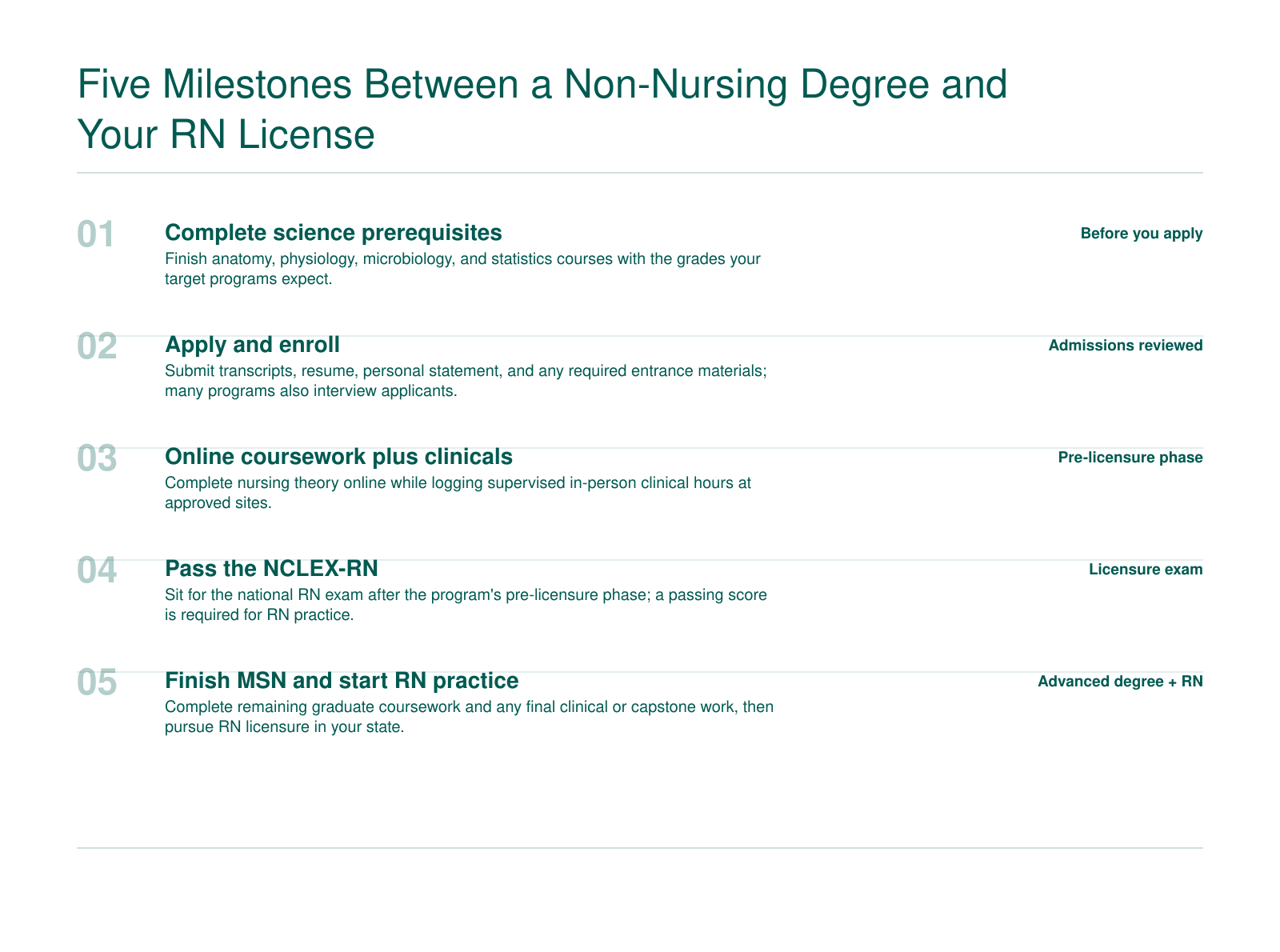
Getting from a non-nursing bachelor's degree to an RN license is a defined sequence, not a single leap. Admissions decisions turn on completed science prerequisites and GPA minimums, so verify those early, and clinical placement support can vary by school, so compare those policies before committing. Once enrolled, you complete online graduate nursing courses with in-person clinical hours, pass the NCLEX-RN after the pre-licensure phase, and only then finish the MSN and begin practicing as an RN.
Prerequisites, GPA Minimums, and What Non-Nursing Grads Need to Apply
- Degree baselineA bachelor’s in any field from an accredited institution is the baseline; some programs specify a non-nursing bachelor’s.
- GPA minimumsMinimum cumulative GPA typically ranges from 2.8 to 3.0. Saint Vincent may consider applicants below 3.0 provisionally down to 2.75.
- Common prerequisitesExpect anatomy and physiology with labs, microbiology, chemistry, statistics, nutrition, and lifespan or developmental psychology.
- Grades and recencyPrerequisite grade minimums vary, C at Rush and Mississippi State, B at Xavier, B- at Cincinnati. Recency rules vary, with six years at Pacific Lutheran, five at Xavier, seven for Marquette statistics, and up to 10 at Cincinnati.
- Online prerequisitesOnline prerequisite courses are accepted at Mississippi State; online labs are expressly accepted at Pacific Lutheran and offered by Johns Hopkins and Cincinnati, but acceptance varies by school.
- Application filesApplication files commonly include a personal statement and references. Where an exam is required, Herzing asks for a TEAS aggregate score of 66; many schools list no exam or no GRE.
In 2025, 86.7 percent of first-time, U.S.-educated NCLEX-RN candidates passed, according to NCSBN (192,916 tested, 167,272 passed). That was down from 91.2 percent in 2024. When you compare the programs below, check each school's published first-time pass rate against this national NCSBN benchmark.
Top Program-Level Earnings Among Ranked Schools
At California Baptist University, direct-entry MSN graduates earn a median of $143,804 five years after completion, the highest program-level earnings among the ranked schools.
Direct Entry MSN (MENP) programs by state
Quick Answers for Career Changers Weighing a Direct-Entry MSN
Thinking about switching into nursing from a non-nursing degree? These are the questions career changers ask most often, answered with the same lens we use across this guide: verifiable requirements, clinical realities, and cost before reputation.
Can I become a nurse with a non-nursing bachelor's degree through a direct-entry MSN?
Are direct-entry MSN programs fully online or hybrid?
How many clinical hours are required in direct-entry MSN programs?
Do online direct-entry MSN programs arrange clinical placements?
What is the cheapest online direct-entry MSN program?
Are online direct-entry MSN programs accredited?
Do direct-entry MSN graduates sit for the NCLEX-RN before finishing the master's?
Compare Direct Entry MSN (MENP) programs on the data that matters
Explore more Nursing specializations or browse every graduate field.
All Nursing programs