Best Direct-Entry MSN Programs in New York
Compare 5 accredited Direct Entry MSN (MENP) programs in New York at 4 schools, with graduate earnings, cost, debt, and completion data from IPEDS and the U.S. College Scorecard.

A bachelor's degree in anything can become an RN license and a master's in nursing in roughly 15 to 24 months. Columbia's direct-entry track runs 76 credits and 1,000 clinical hours; Rochester's hybrid version finishes in 20 months.
The catch is price. Reported graduate tuition stretches from about $16,000 at St. Bonaventure to roughly $58,000 at Columbia, and New York licensure adds its own fees, exams, and required coursework after graduation.
Key Points
- Columbia's first-time NCLEX-RN pass rate is 91.4%, based on 169 of 185 test takers.
- St. Bonaventure has the lowest reported tuition here, under a third of Columbia's price.
- Online direct-entry means hybrid: clinicals and skills labs always happen on site.
Top-Ranked Direct-Entry Master's in Nursing Programs in New York
These four New York programs are ordered by outcomes you can check in federal data, not by reputation surveys. Tuition and net price are institution-wide approximations from federal data, and graduation rates are school-wide, not program completion rates. Program-level earnings are not yet available for any of these programs, so we leave that figure off.
Columbia University in the City of New York
#1New York, NY · ~$58,000/yr (est.)
Best for: Career changers seeking academic medical center training
Columbia offers its Master's Direct Entry program in New York City on campus and in a hybrid format. Federal data lists tuition and fees of about $71,845 and an average net price near $21,590, both institution-wide approximations, with a school-wide graduation rate of about 96%. The program is based at the Irving Medical Center in Washington Heights and has a collaboration with NewYork-Presbyterian. We could not confirm CCNE or ACEN status for the direct-entry pathway, so check with the school before you apply.
- 15-month, full-time accelerated format for non-nurse graduates
- 76 to 78 credits, with one summer start each year
- Over 1,000 clinical hours in small group settings
- Six-week one-on-one integration experience with an RN
- Direct path into DNP or PhD study
- Prerequisite grades of B- or higher required
- Hybrid seven-semester option alongside the 15-month format
- Full-time and part-time options listed
- Pairs with the newer part-time DNP structure
University of Rochester
#2Rochester, NY · ~$39,000/yr (est.)
Best for: Hybrid learners based in western New York
The University of Rochester offers a full-time hybrid direct-entry MSN in Rochester, with online coursework and on-campus labs and clinicals. Federal data lists tuition and fees near $67,080 and an average net price around $29,278 (institution-wide approximations), with a school-wide graduation rate of about 85%. Federal accreditation records list ACEN, and program materials also cite CCNE, so confirm which accreditor covers the direct-entry pathway. A New York program comparison reports guaranteed clinical placement.
- 16-month, full-time hybrid MSN for non-nursing bachelor's holders
- 70 total credit hours
- 690 clinical hours and 90 lab hours
- Online coursework with on-campus labs and clinical rotations
- Prepares graduates for the NCLEX-RN
- Early action and regular decision deadlines
St Bonaventure University
#3Saint Bonaventure, NY · ~$16,000/yr (est.)
Best for: Campus students who want arranged clinical placements
St. Bonaventure's Master's Entry to Practice is an on-campus program in Saint Bonaventure, in western New York. Federal data lists tuition and fees near $41,735 and an average net price around $27,074 (institution-wide approximations), with a school-wide graduation rate of about 67%. The program is listed as CCNE-accredited in federal accreditor records. The department arranges clinical placements, so students do not hunt for preceptors.
- Six semesters of full-time, year-round study
- 65 total credit hours
- Department-arranged clinical placements, no preceptor search
- Prepares graduates for the NCLEX-RN in New York
- Emotional intelligence focus within the curriculum
- Students receive an iPad, with Apple-certified instructors
Utica University
#4Utica, NY · $25,000 – $30,000/yr (est.)
Utica University offers a hybrid direct-entry MSN in Utica, with rolling admissions and three start dates a year. Federal data lists tuition and fees near $26,930 and an average net price around $19,108 (institution-wide approximations), the lowest of the four, with a school-wide graduation rate of about 56%. Federal accreditor records list CCNE. The program page sits under a Florida-labeled section of the university site, so confirm which clinical sites serve New York students.
- Completed in under two years, full-time
- 80 total credit hours
- 800 clinical hours and 225 lab hours
- Rolling admissions with three start dates per year
- Clinical rotations at local hospitals
- Path to a second specialty master's degree
Cost & outcomes by school
Federal data for the highest-earning Direct Entry MSN (MENP) programs, independent of the ranking above. Earnings are this field's master's graduates four years after completing, where the Scorecard reports them.
| School | Earnings | Tuition / yr | Debt | Grads/yr | Format |
|---|---|---|---|---|---|
| Columbia University in the City of New York NY | $142,412 | $57,973 | $116,593 | 307 | Campus |
| University of Rochester NY | $119,636 | $39,310 | $34,054 | 76 | Hybrid |
| St Bonaventure University NY | — | $16,087 | — | — | Campus |
| Utica University NY | — | $26,750 | — | 93 | Hybrid |
Sources: U.S. Department of Education. Tuition and graduates: IPEDS. Earnings and debt: College Scorecard, this field's master's graduates; a dash means no figure is reported.
Cost, debt & payoff
Median earnings of this field's master's graduates (4 yrs after completing) vs. their median federal loan debt · U.S. College Scorecard
Across these programs the median graduate earns about $142,412 and finishes with roughly $116,593 in debt — a ratio that clears a common rule of thumb (keep debt below first-year salary). Tuition and debt vary widely school to school, so check the per-school figures in the table above before you shortlist.
Can You Earn a Direct-Entry Master's in Nursing Online in New York? Hybrid, Campus, and Part-Time Formats
The flexibility of online coursework only goes so far in nursing master's programs, because every direct entry MSN program still requires hands-on labs and supervised clinical hours. "Online" here means hybrid: some classes are remote, but you will be on site for skills training and rotations.
Campus and hybrid formats
Columbia University and St. Bonaventure University are campus-based. The University of Rochester and Utica University are hybrid, pairing online coursework with in-person components.
Pace and clinical hours
Columbia, Rochester, and Utica describe full-time cohorts. Rochester states that full-time study is required. St. Bonaventure runs a six-semester sequence, and its pace options are not clearly described. None of these programs advertises a part-time track, so confirm with admissions before assuming one exists.
Published clinical totals vary:
- Columbia: 1,000 hours, including one-on-one experience with an RN in New York.
- Utica: 800 hours plus 225 lab hours, with rotations at local hospitals.
- Rochester: 690 clinical hours plus 90 lab hours, with on-campus clinical rotations.
St. Bonaventure says students do not need to find their own preceptors. Rochester reports guaranteed clinical-training placement, while Columbia and Utica do not clearly promise placement, so ask whether sites are assigned or arranged by you.
If you live outside New York
Budget for travel and temporary housing during labs and rotations, and ask where sites are located before you commit to a hybrid program.
Which Ranked New York Direct-Entry MSN Programs Skip the GRE?
The clearest split in this group is between a program that states plainly the GRE is not required and schools whose public direct-entry MSN admissions pages do not publish a current test policy at all.
At Columbia University School of Nursing, the Master's Direct Entry (MDE) program for non-nurse bachelor's holders lists the GRE as not required. The admissions page does not describe a waiver or optional-submission process because there is nothing to waive: the exam is simply omitted from the application requirements.
The other ranked programs here are harder to classify from public materials alone. University of Rochester's hybrid Master's Direct Entry into Nursing Practice, St. Bonaventure University's campus Master's Entry to Practice, and Utica University's hybrid direct-entry MSN do not publish a current GRE requirement, waiver, or test-optional policy on the admissions pages available for this review. That is a publication gap, not evidence that a GRE score is or is not required.
Because test policies can change between application cycles, confirm the GRE requirement with the admissions office for your specific entry term before submitting. A quick call or email can save you from assembling materials for an exam that No-GRE master's programs may not require.
Related Articles
Admissions Checklist: Prerequisites, GPA, and Deadlines
Requirements differ by school, so confirm every detail on each program's admissions page. The details below are verified only for Columbia and NYU Meyers; Rochester's official prerequisite list, deadlines, and start dates were not confirmed.
- Bachelor's degreeApplicants need a bachelor's in a non-nursing field from an accredited institution. Rochester's route requires at least a 3.0 on that degree for its accelerated bachelor's, and then a 3.0 in that nursing program to apply for its nurse practitioner master's.
- Science and core prerequisitesColumbia requires psychology, statistics, human anatomy, microbiology, nutrition, and English composition, finished before the program starts. NYU Meyers requires anatomy and physiology I and II, chemistry with lab (4 credits), microbiology, nutrition, statistics, and developmental psychology, each with a C or better. Organic chemistry or biochemistry does not satisfy NYU's chemistry requirement.
- Minimum GPAColumbia sets no minimum GPA. NYU's page states prerequisite grades but no minimum cumulative GPA. Rochester's published figure is 3.0.
- Deadlines and start termsColumbia's 2027 cohort has a priority deadline of October 2, 2026 and a final deadline of November 16, 2026. NYU's fall entry (September start) has a March 1 priority deadline and a March 15 final deadline. Its spring entry (January start) has a September 15 priority deadline and an October 15 final deadline. NYU accepts no applications after the final deadline.
- Other application materialsRochester requires prior healthcare experience related to the nurse practitioner specialty, plus an active New York RN license for the master's stage. Check each school's page for recommendation letters, personal statements, and interviews, since those requirements were not confirmed here.
Cheapest to Priciest: Direct-Entry Master's in Nursing Costs, ROI, and New York Licensure
Sorted by reported graduate tuition, the lowest-cost option here (St. Bonaventure University) is less than a third of the price of the highest (Columbia University in the City of New York). Tuition is only part of the bill, since fees, uniforms, books, and clinical expenses add to it, so confirm a full-program total on each school's bursar page. Program-level debt and earnings are not yet published for these programs, so we do not offer a debt-to-earnings comparison. The licensure path is the same for all of them: graduate, pass the NCLEX-RN, receive an RN license from NYSED, and pursue nurse practitioner certification only if your track leads to advanced practice.
| School | Format | Credits | Graduate tuition (reported) | Average net price (institution-wide, approximate) | Program-level median debt and earnings | Full-program cost including fees and clinical expenses |
|---|---|---|---|---|---|---|
| St. Bonaventure University | Campus | 65 credits | $16,087 | $27,074 | Not yet available | Confirm with school |
| Utica University | Hybrid | 80 credits | $26,750 | $19,108 | Not yet available | Confirm with school |
| University of Rochester | Hybrid | 70 credits | $39,310 | $29,278 | Not yet available | Confirm with school |
| Columbia University in the City of New York | Campus | 76 credits | $57,973 | $21,590 | Not yet available | Confirm with school |
New York RN Licensure for Direct-Entry Graduates
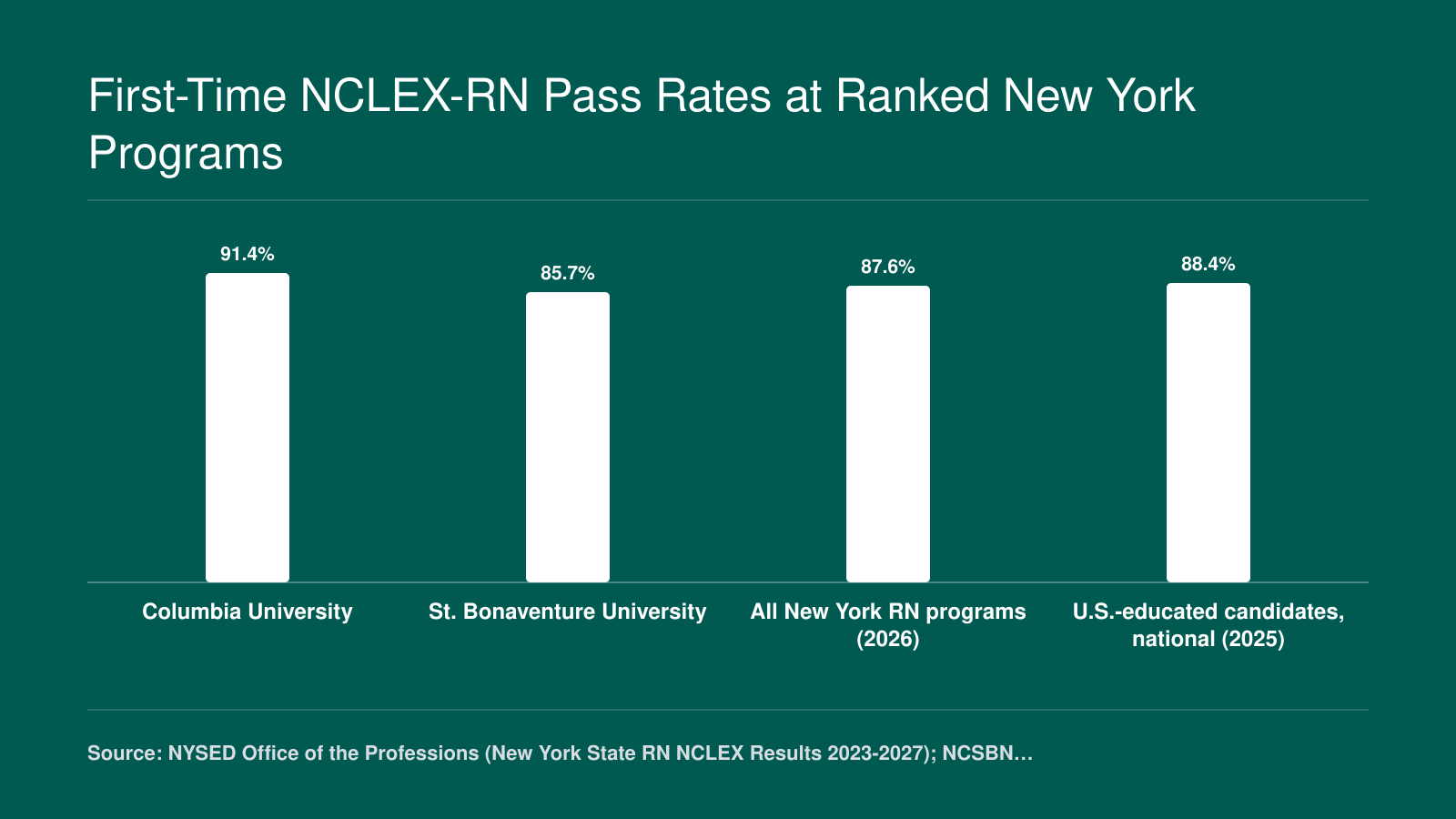
First-Time NCLEX-RN Pass Rates at Ranked New York Programs
Columbia reports a 2026 first-time rate of 91.4% (169 of 185 test takers). St. Bonaventure's most recent listing is 85.7% (6 of 7) under the 2027 reporting year, a very small group. State data does not separate direct-entry cohorts from other master's pathways, and no on-time completion rate is published for either school. Other ranked programs are not charted because we could not verify a program-level rate. Reporting years differ, so treat comparisons cautiously.
How We Rank Direct-Entry MSN Schools in New York
Direct-entry nursing has moved into an outcomes era, and career changers are right to ask which program actually pays off rather than which name sounds best. Our order rewards what a student truly walks away with: the price paid, the likelihood of finishing, and real earnings after graduation.
We begin with federal IPEDS program offerings, then layer in College Scorecard net price, graduation rate, program-level earnings, and debt. Campus and online or hybrid options are ranked together on the same criteria, because a New York student's financial and licensure tradeoffs do not change by delivery format.
The limits are stated plainly: graduation rate and net price are institution-wide, and some programs have not yet published earnings. Where outcomes are missing, we say so rather than guess.
Quick Answers for Career Changers Considering a New York Direct-Entry MSN
These answers cover the questions career changers ask most before applying. Timelines and policies vary by school, so confirm details on each program's admissions page.
How long does a direct-entry MSN take to finish in New York?
Do I need healthcare or nursing experience to apply?
Can I keep a job while enrolled in an accelerated direct-entry nursing master's?
Compare Direct Entry MSN (MENP) programs on the data that matters
Explore more Nursing specializations or browse every graduate field.
All Nursing programs