Accelerated Direct-Entry MSN Programs
Compare 130+ accredited fastest Direct Entry MSN (MENP) programs at 120+ schools, with graduate earnings, cost, debt, and completion data from IPEDS and the U.S. College Scorecard.
An accelerated direct-entry MSN lets someone with a bachelor's degree in biology, business, or almost any other field become eligible for the NCLEX-RN in roughly 12 to 18 months and earn a master's degree in about 24 to 48 months. It is a pre-licensure graduate program built for non-nurses: it covers the same core nursing science a BSN does, prepares students for RN licensure, and awards an MSN at the end.
The tension sits in what that extra credential buys. Some tracks move you straight toward advanced practice; others leave you licensed as a generalist RN with a graduate degree that cost more and took longer than a second-degree BSN. Which one you get depends on the specialty the program attaches to the entry pathway.
Key Points
- Saint Vincent College reports $199,496 median earnings one year out.
- In-state public tuition undercuts private schools in this list.
- In 2027, confirm in writing that the school arranges clinicals.
The 10 Fastest Accelerated Direct-Entry MSN Programs for Non-Nurses
Speed matters when you are changing careers, so this list leads with the shortest programs and then weighs cost, completion, and format. The schools below are ordered for direct-entry relevance; within each card, look for campus, hybrid, or online delivery and the clinical hours that shape your training.
Columbia University in the City of New York
#1New York, NY · ~$58,000/yr (est.)
Best for: Second-degree students wanting hybrid NYC training
Columbia University's Master's Direct Entry program turns career changers into registered nurses through a full-time 15-month path or a hybrid seven-semester option. Students complete more than 1,000 clinical hours and a six-week one-on-one RN integration in New York or at a global site. The program emphasizes advanced assessment, pharmacology, pathophysiology, and global health, and graduates can continue into DNP or PhD study. In-state and out-of-state graduate tuition and fees run about $71,845.
- Full-time 15-month accelerated pathway
- 1,000-plus clinical hours required
- Six-week one-on-one RN integration
- Hybrid seven-semester option available
- 91% licensure pass rate
- Prepares for NCLEX licensure
- Pathway to DNP or PhD
- Clinical rotations across labor, pediatrics, psych
University of California-Davis
#2Davis, CA · $15,000 – $20,000/yr (est.)
Best for: California residents seeking public university value
UC Davis offers an 18-month full-time campus Master's Entry Program in Nursing for students who already hold a bachelor's degree in another field. The curriculum includes case-based learning, clinical experiences, and a capstone portfolio, and graduates qualify for NCLEX-RN and Public Health Nurse certification. In-state graduate tuition and fees are about $16,774; out-of-state students pay about $50,974.
- 18-month full-time campus format
- 91 total quarter units required
- Capstone portfolio project, no thesis
- Prepares for NCLEX-RN and PHN certification
- Integrative case-based learning
- Classes Monday through Friday
Johns Hopkins University
#3Baltimore, MD · ~$65,000/yr (est.)
Best for: Recent graduates targeting doctoral pathways
Johns Hopkins University's MSN Entry into Nursing is a full-time, five-semester campus program for applicants with a bachelor's degree in another field. The curriculum integrates leadership, evidence-based practice, and global health, and students complete clinical rotations in various settings. Admission requires a 3.0 GPA, science prerequisites, essays, and an interview, and no GRE is required. Graduate tuition and fees are about $65,230.
- Full-time, on-campus five-semester format
- 3.0 minimum GPA required
- No GRE required
- ACEN, CCNE accredited
- Prepares for NCLEX-RN licensure
- Clinical rotations in various settings
- Science prerequisites required
Boston College
#4Chestnut Hill, MA · ~$38,000/yr (est.)
Boston College's Direct Entry Master of Science, Registered Nurse program is a campus-based, four-semester accelerated pathway for bachelor's degree holders from other fields. The 48-credit curriculum covers adult health, psychiatric care, pharmacology, and population health, with a synthesis practicum. Students meet both baccalaureate and master's education standards and prepare for the NCLEX-RN. Graduate tuition and fees are about $70,702.
- Accelerated four-semester program
- 48 academic credits required
- Campus-based full-time format
- Meets AACN baccalaureate and master's standards
- Covers adult health, psych, child health
- Nursing synthesis practicum included
- CCNE accredited
- B- minimum grade required
Fairfield University
#5Fairfield, CT · ~$21,000/yr (est.)
Fairfield University's Master's Entry to Practice Nursing (MEPN) offers an accelerated campus pathway to an MSN for students with a non-nursing bachelor's degree. The 24-month, 76-credit program is full-time, with rolling admission and summer starts. The curriculum focuses on advanced generalist nursing and leadership, and graduates are eligible for the NCLEX. Graduate tuition and fees are about $58,350.
- 24-month full-time campus program
- 76 credit hours required
- Rolling admission deadlines
- Summer start dates
- Prepares for NCLEX eligibility
- CCNE accredited
- Focus on leadership roles
Saint Louis University
#6Saint Louis, MO · ~$26,000/yr (est.)
Saint Louis University's 21-month direct-entry MSN lets bachelor's degree holders from other fields become RNs and clinical nurse leaders. The 61-credit, five-semester curriculum includes nearly 750 clinical hours starting in the first semester, plus simulation labs. Graduates can sit for the NCLEX and CNL certification and may continue toward nurse practitioner education. Graduate tuition and fees are about $55,760.
- 21-month, 61-credit program
- Two start dates: fall and spring
- Around 750 clinical hours
- Clinicals begin in first semester
- Prepares for NCLEX and CNL certification
- CCNE accredited
- Employer tuition reimbursement supported
- Seamless path to nurse practitioner
University of Vermont
#7Burlington, VT · $14,000 – $34,000/yr (est.)
The University of Vermont's Direct Entry Master of Science in Nursing combines a year of campus study in Burlington with asynchronous online MSN coursework. The first-year includes 675 clinical hours within the UVM Health Network, and students may earn Vermont RN licensure after passing the NCLEX-RN. This CCNE-accredited program also offers merit scholarships. In-state graduate tuition and fees are about $19,058; out-of-state students pay about $45,502.
- First year campus, then online asynchronous
- 675 clinical hours in UVM Health Network
- Eligible for Vermont RN licensure after first year
- 72.5 to 75.25 total credits
- No entrance exam required
- Test optional
- Rolling admissions
- CCNE accredited
Florida International University
#8Miami, FL · ~$11,000/yr (est.)
Florida International University offers an accelerated on-campus BSN/MSN pathway for foreign-educated physicians without an RN license. The eight-semester, 102-credit program is limited to about 45 students yearly and includes a BSN stop-out option. Graduates are eligible for the NCLEX-RN and advanced practice certifications. In-state graduate tuition and fees are about $6,565; out-of-state students pay about $18,964.
- Eight semesters, 102 total credits
- On-campus only at Biscayne Bay Campus
- Limited to 45 students yearly
- Fall semester start
- BSN stop-out option available
- Prepares for NCLEX-RN and APRN certification
- Meets CCNE standards
- For foreign-educated physicians
University of Iowa
#9Iowa City, IA · $13,000 – $32,000/yr (est.)
The University of Iowa's Master of Science in Nursing: Entry into Practice is a full-time, 20-month campus program for students with a non-nursing degree. It offers small class sizes, clinical placements, and simulation training, and graduates are prepared for the NCLEX-RN. The program also serves as a bridge to doctoral study. In-state graduate tuition and fees are about $11,283; out-of-state students pay about $33,371.
- 20-month full-time accelerated format
- Campus-based with small class sizes
- Clinical placements secured by school
- Prepares for NCLEX-RN exam
- Bridge to doctoral programs
- CCNE accredited
- Approved by Iowa Board of Nursing
University of Cincinnati
#10Cincinnati, OH · ~$15,000/yr (est.)
The University of Cincinnati's Accelerated Direct-Entry MSN is a five-semester campus pathway for students who already hold a non-nursing bachelor's degree. The program includes simulation learning and clinical placements at a leading pediatric hospital and the region's only Level I Trauma Center. Four courses apply toward a specialty MSN, shortening the path to advanced practice. In-state graduate tuition and fees are about $13,976; out-of-state students pay about $29,310.
- Five-semester direct-entry pathway
- Prepares for NCLEX-RN
- Four courses count toward specialty MSN
- Clinicals at top pediatric hospital
- Level I Trauma Center opportunities
- Immersive simulation learning
- For non-nursing bachelor's degree holders
- CCNE accredited
None of the ranked Direct Entry MSN (MENP) programs match the fastest lens yet. The full ranking is at the link above.
Cost, debt & payoff
Median earnings of this field's master's graduates (4 yrs after completing) vs. their median federal loan debt · U.S. College Scorecard
Across these programs the median graduate earns about $120,338 and finishes with roughly $55,606 in debt — a ratio that clears a common rule of thumb (keep debt below first-year salary). Tuition and debt vary widely school to school, so check the per-school figures in the table above before you shortlist.
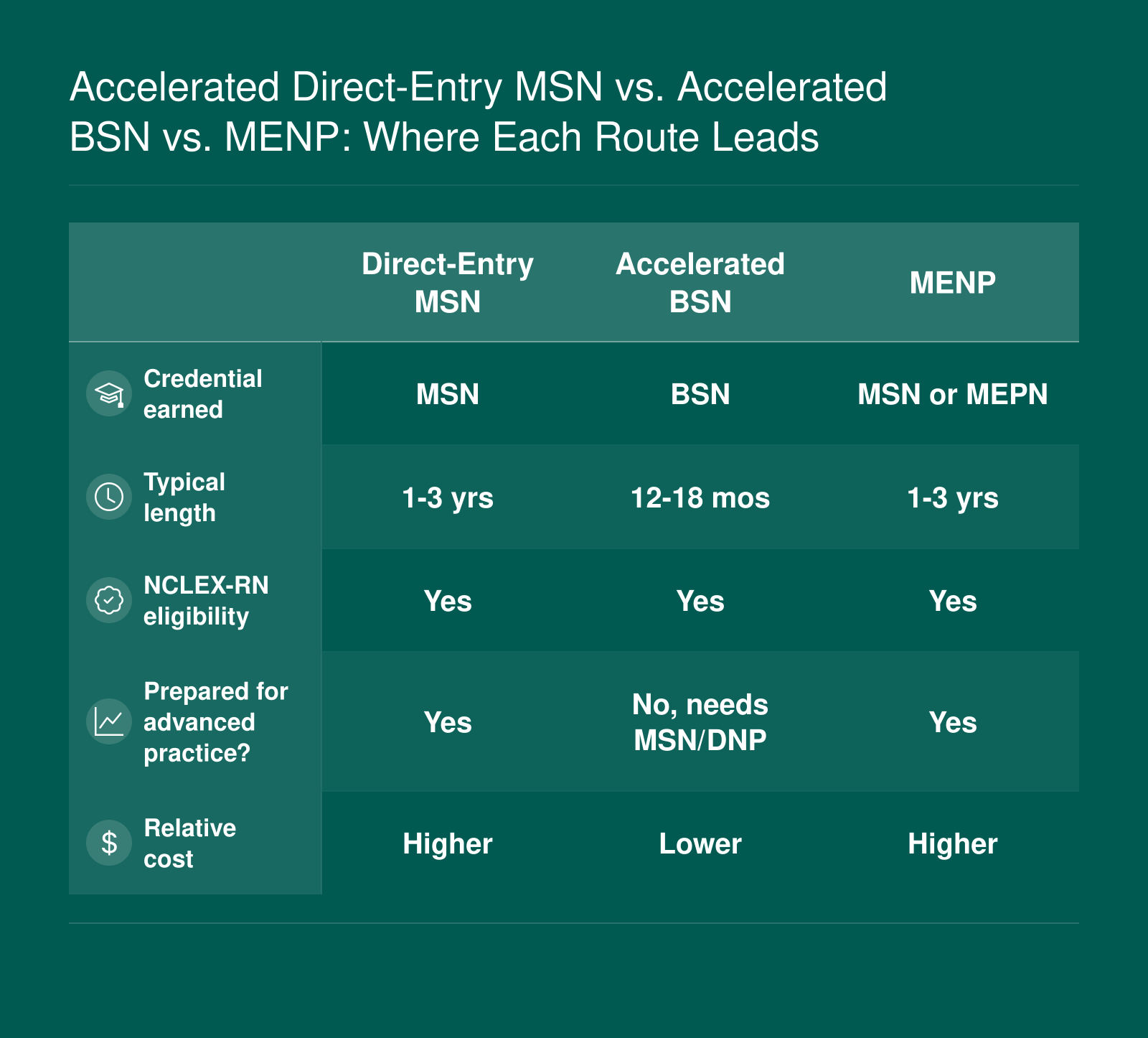
Accelerated Direct-Entry MSN vs. Accelerated BSN vs. MENP: Where Each Route Leads
These three second-degree nursing routes all prepare career changers for RN licensure, but they differ in the credential you earn, time to completion, cost, and how directly they lead to advanced practice. MENP is often a school-specific label for a direct-entry MSN, which is why search results conflate them. An accelerated BSN gets you into the RN job market sooner; a direct-entry MSN or MENP builds a graduate credential up front.
Direct-Entry MSN Program Cost: Sticker Tuition vs. What You'll Really Pay
Public universities price by residency, while private schools usually charge everyone the same rate. That split shapes the sticker price of a Direct Entry MSN more than almost anything else.
Public vs. Private, In-State vs. Out-of-State
Among the most affordable direct-entry MSN programs here, Western Carolina University lists annual graduate tuition of $7,876 for North Carolina residents and $18,595 for nonresidents. Troy University charges $8,550 in-state versus $17,100 out-of-state, and Western Kentucky University runs $12,140 versus $18,340. The residency gap widens at large publics: UC Davis lists $15,141 against $30,243, and the University of Arizona $14,856 against $34,110.
Private schools flatten that gap. Mount St. Joseph University charges $14,495 regardless of residency, and University of Detroit Mercy charges $22,544. For a nonresident, a private seat at Mount St. Joseph can undercut an out-of-state public one. Montclair State, though public, also lists a single $16,056 rate.
Net price looks friendlier, ranging from $9,288 at Florida International University to $16,674 at Arizona. Read it cautiously: it is an institution-wide average after grants, shaped mostly by undergraduates. Graduate students often receive less institutional aid, so your bill may sit closer to sticker tuition.
What Full Programs Actually Cost
Per-credit rates hide the total. Saint Leo University charges $825 per credit, which reaches $52,800 in tuition alone; fees, textbooks, course technology and clinical purchases are extra. Brenau University's $939 per credit totals $63,852. Trinity College of Nursing and Health Sciences publishes $62,540 in tuition and fees for 2026-27, split as $25,438, $25,385 and $11,717 across three years. None of these totals clearly includes every clinical expense.
Clinical-Phase Costs Students Miss
- Screening: Background checks and drug screens run about $50 to $65 per check in one school's estimate. Ask whether they repeat.
- Uniforms and equipment: Lab apparel, uniforms and instruments range from roughly $140 to $1,140.
- Books and supplies: Estimates run $1,500 to $4,000.
- Immunizations: Vaccines, titers and health clearances must be done before you enter a clinical site.
- Program fees: Western Kentucky adds a $575 fee each semester.
- NCLEX-RN: Registration costs $200 in 2026, retakes included, and rises to $350 for registrations on or after Feb. 1, 2027.
- Travel: Gas, parking and sometimes lodging add up when clinical sites sit far from campus or across state lines.
How to Read a Cost Page
Skip the per-credit headline and find the program's full cost-of-attendance page. Multiply the credit rate by total credits, then add every semester fee for the full program length. If the page lists tuition only, ask admissions for an itemized estimate of clinical costs before you pay a deposit.
Direct-Entry MSN NCLEX Pass Rates: How First-Time Test Takers Perform
How do first-time NCLEX-RN pass rates for accelerated direct entry msn programs compare with the national average? Where schools publish cohort-level figures, the strongest programs clear the benchmark comfortably, but the public data is uneven and the reporting years differ.
The National Benchmark
The National Council of State Boards of Nursing reported a first-time pass rate of 86.7% for U.S.-educated NCLEX-RN candidates in its 2025 NCLEX Examination Statistics.1 That figure covers every pathway to licensure, including associate and bachelor's graduates, so it is a baseline rather than a direct-entry-specific target. Use it as the line a program should be clearing.
School-Level Figures
Two schools here have published figures from state licensing authorities:
- Eagle Gate College, Master's Entry Program: 100% of first-time test takers passed in 2025, according to the Utah Division of Professional Licensing's overall 2025 NCLEX-RN pass rate table.2
- Yale School of Nursing, master's nursing program: 87% passed on the first attempt in 2024, per the Connecticut Department of Public Health's NCLEX pass rate reporting.3
Eagle Gate sits well above the 2025 national rate. Yale's 87% is essentially level with the national figure, though it comes from 2024, so it is not a same-year comparison. A highly selective, high-cost program is not automatically a program with higher pass rates, which is a useful reminder when you weigh prestige against price.
Read the Numbers Carefully
A few cautions apply before you treat any single percentage as a verdict:
- Reporting year: A 2024 rate and a 2025 rate come from different test-taker groups. One year can swing, so look for several years of results.
- Cohort size: A perfect rate means more when many graduates tested. Ask how many students sat for the exam.
- Source: State boards publish a school's rate by program or by institution. Check which one you are looking at.
Ask for the Cohort-Specific Rate
Some schools publish only a combined figure that blends traditional BSN students with entry-level master's students. That number can mask how the direct-entry cohort performed. Before you apply, email admissions and ask for the most recent first-time NCLEX-RN pass rate for direct entry msn programs, specifically the pre-licensure master's cohort alone, with the year and the number of candidates. Also ask for the state board's published figure so you can verify the school's claim. A program confident in its results will answer plainly, and hesitation is useful information in itself.
Early-Career Earnings for Direct-Entry MSN Completers
Saint Vincent College has the highest median earnings one year after finishing among the direct-entry MSN programs ranked here: $199,496.
Online, Hybrid, or On-Campus: Format Choices and Who Arranges Clinical Placements
A direct-entry MSN's format describes where the classroom lives, not where the nursing happens. You might watch lectures from your kitchen table, but you cannot learn to start an IV or manage a laboring patient over a video call. No pre-licensure program can be delivered fully online, because licensure requires hundreds of hours of hands-on, supervised patient care in real clinical settings.
Campus-Only Is Still the Norm
Among the programs ranked here, the campus-based format dominates. Johns Hopkins, Boston College, UC Davis, Fairfield, Saint Louis University, the University of Vermont, Florida International, Iowa, and Cincinnati all run their direct-entry tracks on campus. Columbia is one of the few offering a hybrid seven-semester option, but even its hybrid design pairs online coursework with in-person clinicals and a six-week integration experience. Treat "hybrid" as "online theory plus required in-person time," not as remote convenience.
Clinical Hours Vary by School and State
Supervised clinical hour expectations are not nationally fixed. One 2026 summary reports roughly 600 to 1,000+ direct hours, climbing to 900 to 1,200 total when graduate seminars count, against a common 500-hour floor. Among named programs:
- Columbia University: about 1,000 clinical hours, with global integration sites.
- Saint Louis University: 750 clinical hours, beginning in the first semester at St. Louis hospitals.
- University of Vermont: 675 clinical hours, placed within the UVM Health Network.
Across other tracks, Duke reports 672 to 784 hours, Vanderbilt 672 to 1,008, UCSF roughly 1,000, and Penn often above the 500-hour national floor.
Who Finds Your Clinical Site
This is the single most important question to ask an admissions office, and the answer varies widely. Some schools arrange everything: UC Davis, Iowa, Vermont, Saint Louis, and Cincinnati all place students in affiliated hospital networks, and Wayne State's coordinators fully arrange placements in pre-approved Michigan systems. Other programs make the site your responsibility. George Washington and Florida State require students to secure their own faculty-approved preceptor and site, and West Virginia uses a hybrid model where students collaborate with faculty to identify preceptors, with placement not guaranteed where state authorization is absent.
Student-sourced placement can delay graduation or force a specialty change if no preceptor says yes. Ask whether the school guarantees a site, how far you may have to travel, and what happens if a placement falls through.
Travel and Immersion Requirements
Hybrid and online programs often bundle in costs the brochure downplays. Expect on-campus intensives, skills labs, or immersion weeks that require travel and, in some cases, temporary relocation. Budget for that lodging and lost work time before you commit.
Related Articles
Prerequisites and Application Checklist for Non-Nursing Graduates
- Bachelor's degree and GPAHold a non-nursing bachelor's degree from a regionally accredited school. Minimum cumulative GPAs vary: University of Cincinnati requires a 3.0, UNC Greensboro lists 2.70 with 3.0+ prioritized, Brenau requires 3.0 on the last 60 credits plus a 3.0 science GPA, and Georgian Court expects 3.2 across all attempted work.
- Science prerequisitesCommon prerequisites include anatomy & physiology I/II, microbiology, chemistry, statistics, and nutrition or human development. University of Cincinnati and Georgian Court require B- or higher, generally within 10 years; Jacksonville University allows C or higher with A&P within 10 years. Some programs limit prerequisites in progress at application.
- Application materials and exam policiesNo cited admissions page lists a GRE requirement, so treat the GRE as likely waived unless a school confirms otherwise. Brenau requires a HESI score of 75%. Expect essays and references; healthcare experience or CNA status is not universally required, so check each program's supplemental checklist.
- Clinical readinessBefore clinicals, plan for a cleared background check, current immunizations, and CPR certification. Gather these early, especially if your program has a short deadline runway.
- Deadlines and start termsFor Spring 2027, University of Cincinnati lists a September 15, 2026 deadline and January 11, 2027 start; UNC Greensboro lists October 1, 2026 for January 2027 but its page indicated pending state approval when reviewed; Brenau lists November 6, 2026 for January 11, 2027.
Before you enroll, confirm in writing that the school arranges your clinical placements. A program that leaves you to find your own preceptors can add months and undercut the speed you came for.
Direct Entry MSN (MENP) programs by state
Quick Answers for Career Changers Considering a Direct-Entry MSN
These are the questions career changers ask most often when weighing an accelerated direct-entry MSN. The short version: it can be a fast route to RN eligibility, but the timeline and final role depend heavily on the specialty track you choose.
Will a direct-entry MSN make me eligible to take the NCLEX-RN?
How many months does an accelerated direct-entry MSN typically take?
Can I start working as a nurse practitioner right after finishing a direct-entry MSN?
Compare Direct Entry MSN (MENP) programs on the data that matters
Explore more Nursing specializations or browse every graduate field.
All Nursing programs