Accelerated MSN Programs
Compare 2,800+ accredited fastest Nursing (MSN) programs at 700+ schools, with graduate earnings, cost, debt, and completion data from IPEDS and the U.S. College Scorecard.
The Institute of Medicine-era push for more advanced-practice nurses, including online pediatric nurse practitioner MSN programs, has made the MSN, often on a family nurse practitioner track, the standard route to a primary care license. The real question is how few months it takes to get there. Two pathways dominate: accelerated BSN-to-MSN for working nurses, and accelerated direct-entry MSN for career changers with a non-nursing bachelor's degree.
The fastest programs are ranked first below, followed by clinical placement, accreditation, cost, and first-year earnings. Speed has a price, though: compressed timelines still require supervised clinical hours that schools cannot always place quickly.
Key Points
- Ohio State's in-state tuition is $13,901; UCLA's out-of-state is $29,578.
- Clinical placements require 500 practice hours; NP tracks require 750.
- Direct-entry MSN admits non-nursing majors; BSN-to-MSN requires an RN license.
Top Accelerated MSN Programs: Our 2027 Rankings
These accelerated MSN programs stand out for combining shorter completion timelines with strong nursing outcomes. The list spans online, hybrid, and campus formats, with concentrations from family nurse practitioner to acute care and nursing education.
Georgetown University
#1Washington, DC · $60,000 – $65,000/yr (est.)
Best for: Working RNs needing online acute care NP
Georgetown's online Adult-Gerontology Acute Care Nurse Practitioner program is a CCNE-accredited, part-time 23-month MSN that combines asynchronous and live synchronous coursework with three on-campus Objective Clinical Intensives. It requires a year of ICU, ED, or PCU experience and includes 750 clinical hours. The program reports strong recent certification outcomes and offers scholarships up to $35,000.
- CCNE-accredited online AG-ACNP program
- 23-month part-time format
- 40 total credit hours with 750 clinical hours
- Live synchronous and asynchronous coursework
- Requires one year ICU/ED/PCU experience
- Scholarships up to $35,000 available
- Three Objective Clinical Intensives required
- Eligible for ANCC and AACN certification
University of California-Los Angeles
#2Los Angeles, CA · ~$14,000/yr (est.)
Best for: California RNs pursuing campus FNP
UCLA's MSN-level Family Nurse Practitioner track sits within an advanced practice nursing program that offers four specialties and prepares graduates for doctoral-level advanced practice roles. It stresses advanced practice, leadership, evidence-based practice, and population health.
- CCNE accredited campus FNP
- Four specialty options including FNP
- California RN license required
- 3.0 GPA minimum plus three recommendations
- One year RN experience recommended
- Statistics, research, physical assessment, physiology prerequisites
Columbia University in the City of New York
#3New York, NY · ~$58,000/yr (est.)
Best for: Career changers needing hybrid direct entry
Columbia offers both a 15-month Direct Entry MSN for non-nursing college graduates and a highly regarded public health MPH, but the MSN is the one most readers here will compare. The hybrid direct-entry track includes 1,000 clinical hours, a six-week integration experience, and a 91 percent licensure pass rate, with full-time and part-time options.
- Six concentration options
- Six epidemiology-related certificate programs
- Applied Practice Experience required
- Accelerated one-year MPH option available
- 15-month full-time and part-time options
- 76 total credit hours
- Starts summer with one start date annually
- 91 percent licensure pass rate
- 1,000 clinical hours included
- Six-week integration experience required
- Small group clinical settings
- Pathway to DNP or PhD
Northeastern University
#4Boston, MA · ~$29,000/yr (est.)
Northeastern's Bouvé College offers a hybrid Family Nurse Practitioner MSN and a separate online Neonatal Nurse Practitioner track. The FNP requires 47 credits and 750 clinical hours, with no GRE, while the neonatal track is a one-year full-time option for experienced nurses. Both are CCNE accredited and emphasize clinical placement support.
- Hybrid online and in-person format
- 47 total credit hours
- 750 clinical hours required
- Full-time and part-time options
- No GRE required
- 3.0 GPA minimum and two recommendations
- Requires RN license and one year nursing experience
- On-campus intensives twice per program
- Fully online option available
- One year of full-time study
- 41 total credit hours
- No entrance exam required
- Prepares for National Certification Corporation
- Advisor arranges local NICU placements
- Care for high-risk neonates
Emory University
#5Atlanta, GA · ~$49,000/yr (est.)
Emory's Adult-Gerontology Acute Care Nurse Practitioner MSN is a hybrid program ranked highly nationally, blending online courses with in-person intensives. It requires 700 clinical hours and one year of acute or critical care RN experience, with full-time students finishing in four semesters. Clinical partners include VA and community hospitals.
- CCNE accredited hybrid program
- Four-semester full-time option
- 700 clinical hours required
- Requires one year acute/critical care RN experience
- Ranked #1 MSN program in nation
- Clinical partners include VA and hospitals
- State-of-the-art simulation center
- Part-time option up to seven semesters
Harvard University
#6Cambridge, MA · $55,000 – $60,000/yr (est.)
Harvard's entry in this list reflects a one-year and 1.5-year Master of Public Health in Health and Social Behavior rather than an MSN, so nursing-focused students should weigh it accordingly. The 45-credit track serves established professionals and medical students, while the 65-credit track targets early-career professionals with an applied practice experience. It is campus-based in Boston's Longwood Medical Area.
- One year full-time or two years part-time
- 45 total credit hours
- Designed for established professionals and medical students
- Three letters of recommendation required
- Work experience required
- Focus on health disparities and social determinants
- Applied practice experience required
- Apply through SOPHAS by December 1
- 1.5 years full-time or three years part-time
- 65 total credit hours
- Built for early career professionals
- Summer practicum required
- Ten additional credits of social and behavioral coursework
- Apply through SOPHAS
New York University
#7New York, NY · ~$43,000/yr (est.)
NYU's Rory Meyers College of Nursing offers campus-based MSN tracks in Adult-Gerontology Acute Care and Psychiatric Mental Health, including a substance use concentration. These 51-credit programs place students in premier New York hospitals and include simulation and procedural training. Admission typically requires a BS in nursing, a 3.0 GPA, and one year of relevant RN experience.
- 51-credit campus-based program
- Prepares for AGACNP certification
- Requires BS in nursing and 3.0 GPA
- One year RN experience required
- Clinical placements in New York hospitals
- Simulation center and procedural skills training
- Interprofessional simulation opportunities
- 51-credit campus-based program
- Prepares for ANCC certification
- Requires BS in nursing and 3.0 GPA
- One year psychiatric experience required
- Covers psychopharmacology and psychotherapy
- Faculty-arranged practicums at premier hospitals
- 51-credit campus-based program
- Focus on substance use disorders
- ANCC certification eligible
- New York State RN license required
- One year psychiatric experience required
- Faculty-arranged practicums
- Advanced pharmacotherapeutics covered
Ohio State University
#8Columbus, OH · ~$14,000/yr (est.)
Ohio State's Adult-Gerontology Acute Care Nurse Practitioner MSN is an on-campus program preparing RNs for certification in acute care. It requires one year of full-time acute care work experience and emphasizes health promotion, cultural competency, and simulation-based training. The program is available through multiple graduate pathways, including BSN to DNP and BSN to PhD.
- CCNE accredited on-campus program
- Requires one year acute care experience
- Eligible for AGACNP certification
- Includes clinical practicum courses
- Simulation equipment and research utilization
- Available in multiple graduate degree pathways
Angeles College
#9Los Angeles, CA
Angeles College is a smaller Los Angeles option offering an accelerated MSN in Nursing Education that finishes in 18 months across six quarters. The campus program totals $25,000 including tuition, fees, and practicum expenses, and includes 180 practicum hours. It requires a BSN and focuses on curriculum design and teaching principles.
- Accelerated 18-month program
- 670 total clock hours
- 54 quarter credits
- Campus-based in Los Angeles
- Total cost $25,000
- Requires BSN prerequisite
- 180 practicum hours included
University of California-Davis
#10Davis, CA · $15,000 – $20,000/yr (est.)
UC Davis offers an 18-month Master's Entry Program in Nursing for career changers with a prior bachelor's degree. The full-time campus program prepares graduates for the NCLEX-RN and Public Health Nurse certification, with 91 total units, case-based learning, and immersive clinical experiences. It emphasizes leadership, quality, and safety in diverse patient care.
- 18-month full-time campus program
- Prepares for NCLEX-RN exam
- Eligible for Public Health Nurse certification
- 91 total units required
- No thesis required
- Capstone portfolio project
- Prior bachelor's degree required
- Immersive clinical experiences included
Cost & outcomes by school
Federal data for the highest-earning Nursing (MSN) programs, independent of the ranking above. Earnings are this field's master's graduates four years after completing, where the Scorecard reports them.
| School | Earnings | Tuition / yr | Debt | Grads/yr | Format |
|---|---|---|---|---|---|
| Arkansas State University AR | — | $7,322 | — | 3,362 | Hybrid |
Sources: U.S. Department of Education. Tuition and graduates: IPEDS. Earnings and debt: College Scorecard, this field's master's graduates; a dash means no figure is reported.
Accelerated BSN-to-MSN vs. Direct-Entry MSN for Non-Nursing Majors
Which route fits you: BSN-to-MSN for nurses, or direct-entry MSN for career changers? The answer comes down to your first degree and RN license.
BSN-to-MSN paths serve registered nurses who hold a bachelor's degree, while direct-entry MSN programs admit bachelor's holders from non-nursing fields and fold NCLEX-RN eligibility into the curriculum. Accelerated here usually means year-round, full-time study with no scheduled breaks. Typical BSN-to-MSN timelines run 20 to 36 months; accelerated direct-entry MSN programs generally take 24 to 36 months including the prelicensure phase. A few tracks run shorter, such as Chamberlain's 8-month option for applicants who already hold a BSN, while West Coast tracks range from 8 to 36 months.
Before starting, expect prerequisites in anatomy and physiology, microbiology, chemistry, statistics, and human growth and development; nutrition is sometimes required. A cumulative GPA near 3.0 is the most common floor, though some programs accept as low as 2.75 or require up to 3.3. RNs without a BSN use accelerated RN-to-MSN programs with bridge work instead, such as Gonzaga's 15 credits or La Salle's four courses, with GPA expectations around 3.0 to 3.2.
Direct-entry tracks usually produce generalist nurses, so an FNP specialty may require extra coursework or a later post-master's step.
Clinical Hours and Placement: The Real Bottleneck
Across MSN schools, clinical hours are supervised, direct patient care you complete under a preceptor, and they decide when you can graduate. AACN Essentials sets a 500-hour practice baseline. The 2021 National Task Force standard calls for 750 direct-care hours for every NP student, but adoption is voluntary. In accelerated BSN to MSN programs, requirements commonly run 500 to 630 hours, and some programs reach 750 or more. Felician requires 750, UTA 720, and Walsh 700.
Three Placement Models
- School-arranged: Felician's placement team secures sites and preceptors near your community.
- Shared responsibility: UTA students find their own preceptors, with department help if they struggle.
- School-coordinated: Walsh assigns a dedicated placement coordinator.
Student-sourced placement can stall graduation, since new affiliation agreements may take up to 90 days and hours cannot start until approvals clear. One overview of online nurse practitioner MSN programs reports fees of $500 to $5,000 per semester when students cannot find a site, and $1,000 to $5,000 for preceptor-finding help. Add travel to distant sites.
Ask Admissions
- Do you guarantee a placement, in writing?
- What happens, and what does it cost, if I can't find a site?
- How far might I travel?
Related Articles
Accreditation and FNP Certification: What to Verify First
An accelerated master's program is worthless if it doesn't make you eligible to sit for the exam at the end, and speed is exactly where accreditation gaps tend to appear. New and newly expanded tracks are the ones most likely to be mid-process rather than fully accredited.
The AANPCB expects an active RN license, a graduate, postgraduate, or doctoral FNP program with advanced pathophysiology, advanced physical assessment, and advanced pharmacology, and at least 500 faculty-supervised direct patient care hours. The program must be accredited by a USDE- or CHEA-recognized body, which in nursing almost always means CCNE or ACEN. Confirm current rules in the certification handbook before you rely on any other accreditor, and check ANCC's own eligibility page separately.
One point that trips up career changers: generalist direct-entry MSN graduates sit for the NCLEX-RN. That degree alone does not make you FNP-eligible without a completed accelerated family nurse practitioner MSN program.
Before you deposit, verify:
- Accreditor: Find the exact program and degree level in the CCNE Accredited Programs directory or ACEN's program search, not just the school's name. A listing in CCNE's Programs Seeking Accreditation database means new applicant status, not full accreditation, and ACEN candidates have up to two years to finish the process with no guarantee. CCNE staff can clarify unclear status at 202-887-6791.
- Population focus: Confirm the track is family/lifespan, not adult-gerontology or another focus.
- Board eligibility: Get written confirmation from the program director that graduates qualify for your intended board.
NC-SARA reciprocity does not cover professional licensure. Under the federal disclosure rule (34 CFR 668.43), online nursing programs must publish state-by-state licensure information. Ashland University's disclosure lists 28 states where its MSN, DNP and APRN programs are not authorized.
What Accelerated MSN Programs Cost
Among the schools ranked here, Ohio State lists the lowest in-state graduate tuition at $13,901, and UCLA the lowest out-of-state figure at $29,578. Net price is lowest at UC San Diego, $12,470, though that is an institution-wide average after aid, not a nursing-specific number.
Full program totals run much higher. Direct-entry MSN estimates span roughly $50,000 at public universities to more than $125,000 at private or out-of-state schools, depending on whether fees and clinical costs are counted. Credit loads from under 50 to over 80 drive the gap. Affordable RN to MSN programs vary with transfer credit: Sacred Heart's RN-BSN-MSN totals $28,380 to $30,465 with transfer credits and $63,480 to $65,565 without, before fees.
Costs Beyond Tuition
Budget for clinical fees (Touro California's ADN-to-MSN lists $1,550), background checks, NCLEX and certification exams, and lost income during full-time study.
Paying for It
- Federal Direct Unsubsidized loans, plus Grad PLUS for borrowers still eligible
- Employer tuition assistance
- HRSA Nurse Corps scholarships or loan repayment
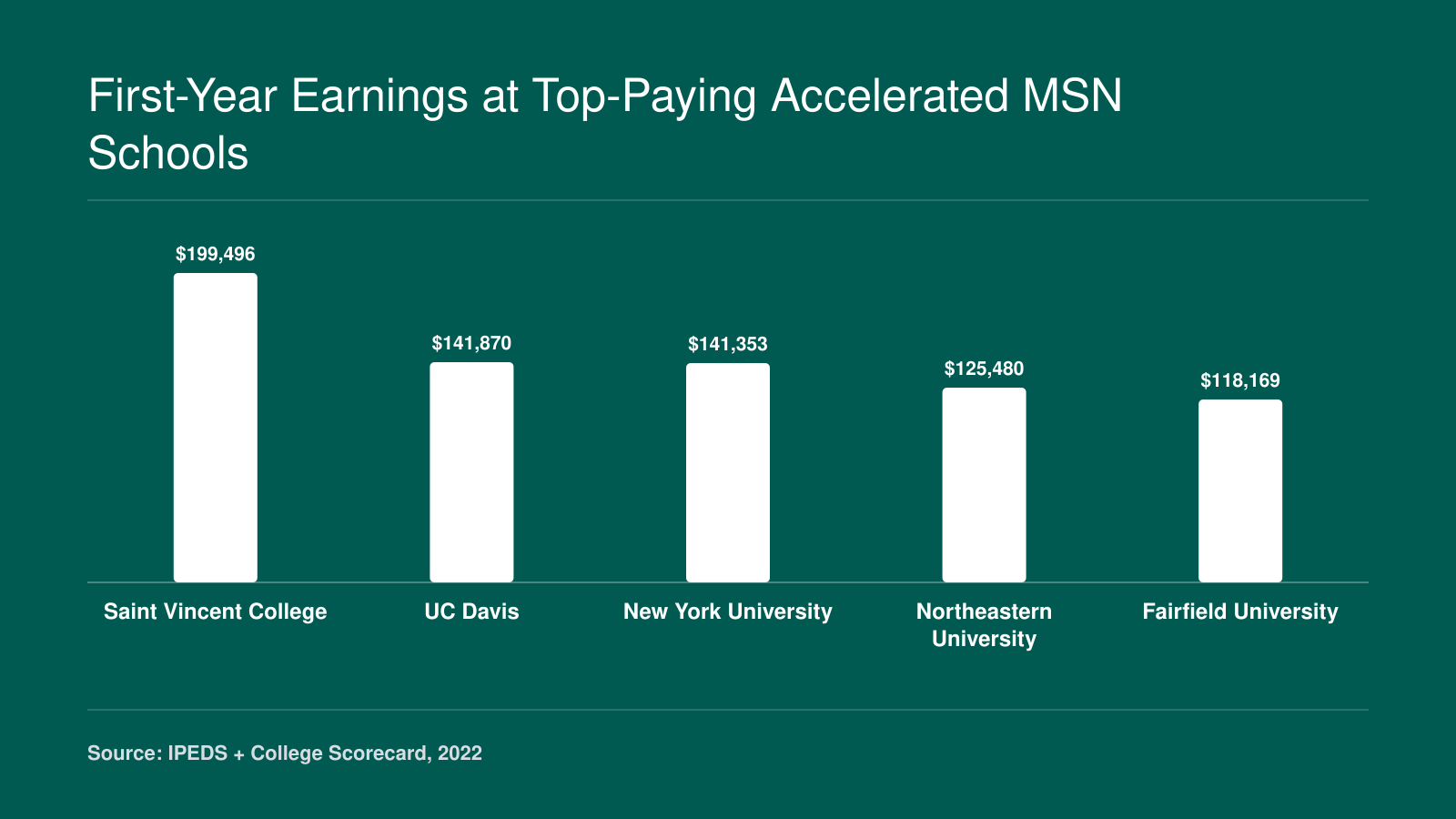
First-Year Earnings at Top-Paying Accelerated MSN Schools
This chart compares median earnings one year after finishing across the accelerated MSN schools shown. For return on investment, median program debt is $117,526 at Saint Vincent, $50,303 at UC Davis, $67,284 at NYU, and $57,068 at Northeastern; Fairfield's figure is not reported.
Nursing (MSN) programs by state
Frequently Asked Questions About Accelerated MSN Programs
What is the fastest accelerated MSN program online?
Can you get an MSN without a BSN in nursing?
Which states authorize online accelerated MSN programs?
Can direct-entry MSN graduates become family nurse practitioners right away?
Compare Nursing (MSN) programs on the data that matters
Explore more MSN specializations or browse every graduate field.
All MSN programs