Best Online Pediatric Nurse Practitioner (PNP) MSN Programs
Compare 60+ accredited online Pediatric Nurse Practitioner programs, with graduate earnings, cost, debt, and completion data from IPEDS and the U.S. College Scorecard.
Staying employed through an online pediatric nurse practitioner MSN is the goal for most working RNs, but online rarely means location-free. Didactic courses go remote; the supervised clinical hours a PNP must complete still require a pediatric preceptor and a site near enough to reach on your days off.
Only fully online MSN tracks qualified here; hybrid formats were excluded. Sorting through the remaining programs means comparing early-career earnings, the three lowest-cost options, primary versus acute care tracks, accreditation and state eligibility, and clinical placement support. The two variables that most decide fit are total price and whether the school actually helps find preceptors.
Key Points
- UT Arlington's net price after aid averages $13,951, the cheapest option here.
- Online PNP coursework streams home; clinical hours still require local pediatric preceptors.
- Fast PNP tracks demand full-time enrollment; asynchronous options stretch past three years.
The 10 Best Online Pediatric Nurse Practitioner MSN Programs (100% Online)
This ranking is limited to pediatric nurse practitioner MSN programs whose core didactic coursework is delivered online, with hybrid tracks that require routine weekly in-person classes excluded. A few programs on the list do include a short required on-campus intensive or residency, and those are flagged on the card. At publication time, Houston Christian University's PNP page shows a pending closure notice, so it is not ranked here. The list is ordered by cost, completion, and outcomes, not by clinical quality or board pass rates.
The University of Texas at Arlington
#1Arlington, TX · ~$11,000/yr (est.)
Best for: Working RNs seeking an accelerated RN to MSN
The University of Texas at Arlington offers an online RN to MSN in Pediatric Primary Care Nurse Practitioner designed for registered nurses who want to move directly into advanced practice. The CCNE-accredited pathway bundles BSN and MSN coursework into 76 credit hours and can run about 42 months, with clinical preceptorships arranged in pediatric settings. UTA posts an institution-wide average net price of about $13,951 and an institution-wide graduation rate of 54 percent. The concentration is primary care, with pay-by-the-course tuition and a locked tuition rate.
- 76 total credit hours
- $35,038 total program tuition
- 42-month accelerated pathway
- Clinical preceptorships in pediatric primary care
- 8-week courses with multiple start dates
- Locked tuition rate
- Prepares for national PNP certification
Maryville University
#2Saint Louis, MO · ~$16,000/yr (est.)
Best for: Online learners avoiding campus visits
Maryville University's online MSN Pediatric Nurse Practitioner program is built around primary care for patients from birth through young adulthood. The 100 percent online curriculum includes two practicums that can be completed locally, and the university reports no campus visits are required. Maryville lists an institution-wide average net price of about $22,066 and an institution-wide graduation rate of 66 percent. The program reports a 92 percent licensure pass rate and no entrance exam.
- 47-credit curriculum
- Two practicums completed locally with a preceptor
- No campus visits required
- No GRE or GMAT required
- 92% licensure pass rate
- Prepares for PNCB certification
- 100% online delivery
- Full-time or part-time study
Rasmussen University-Minnesota
#3St. Cloud, MN · ~$7,000/yr (est.)
Best for: BSN nurses needing January or July starts
Rasmussen University's online MSN Nurse Practitioner program offers a Pediatric Primary Care Nurse Practitioner concentration for BSN-prepared registered nurses. The CCNE-accredited pathway is designed to run about 27 months full time and includes virtual immersion and in-person practicums completed in the student's community. Rasmussen lists an institution-wide average net price of about $17,962 and an institution-wide graduation rate of 53 percent. The concentration is primary care, with January and July start dates.
- 27 months estimated full-time completion
- Virtual immersion experiences included
- In-person practicum in your community
- No GRE requirement
- BSN and 3.0 GPA required
- Active RN license and two professional references
- Estimated total cost $51,130
- Primary care pediatric concentration
Herzing University-Kenosha
#4Kenosha, WI · ~$9,000/yr (est.)
Herzing University's online MSN Pediatric Nurse Practitioner program prepares students for primary care roles with infants, children, and adolescents. The 48-credit, 20-month program includes 585 clinical hours and offers a clinical placement pledge, with 100 percent online didactic coursework. Herzing reports an institution-wide average net price of about $23,066 and an institution-wide graduation rate of 72 percent. Tuition is $770 per credit, and the program prepares graduates for CPNP-PC certification.
- $770 per credit
- 48 total credit hours
- 20-month completion
- 585 clinical hours
- Clinical placement pledge
- Rolling admissions
- 3.0 GPA minimum
- Prepares for CPNP-PC
Herzing University-Tampa
#5Tampa, FL · ~$9,000/yr (est.)
Herzing University's Tampa-area campus offers the same online MSN Pediatric Nurse Practitioner primary care format: 48 credits, 20 months, 585 clinical hours, and 100 percent online didactic work. The campus lists an institution-wide average net price of about $20,421, and tuition is $770 per credit. Rolling admissions, transfer credit, and military tuition discounts are part of the offering.
- $770 per credit
- 48 total credit hours
- 20-month completion
- 585 clinical practicum hours
- 100% online coursework
- Rolling admissions
- Eligible in 45 states
- Clinical placement support
Drexel University
#6Philadelphia, PA · ~$39,000/yr (est.)
Drexel University's online pediatric nurse practitioner options include a primary care track and a dual primary/acute care track. The primary care MSN is a 52-credit part-time online program with synchronous classes and required on-campus intensives; the dual option is a 62-credit program with residency requirements and eligibility for dual certification. Drexel reports an institution-wide average net price of about $38,509 and an institution-wide graduation rate of 78 percent. Tuition for both tracks is $1,169 per credit for 2026-2027, with classes starting January 4, 2027.
- $1,169 per credit for 2026-2027
- 52 total credit hours
- Part-time online format
- Synchronous online classes
- On-campus intensives required
- Prepares for ANCC or PNCB certification
- 10-week quarter system
- $1,169 per credit for dual track
- 62 quarter credits
- Online with residency requirement
- Average duration 4 years
- Eligible for dual primary and acute care certification
- BSN with 3.0 GPA required
- One year pediatric experience required
- Mandatory on-campus intensives
Regis College
#7Weston, MA · $15,000 – $20,000/yr (est.)
Regis College's online MSN Pediatric Nurse Practitioner program prepares nurses for primary care roles through a blend of core MSN courses and pediatric primary care coursework. The program offers three entry points: ADN to MSN, non-nursing bachelor's to MSN, and BSN to MSN. Regis lists an institution-wide average net price of about $27,477 and an institution-wide graduation rate of 72 percent. The program has a $1,061 per-credit rate and reports an 83 percent licensure pass rate.
- $1,061 per credit
- As few as 26 to 38 months
- No GRE required
- 83% licensure pass rate
- Clinical placements in your area
- Three entry points available
- Prepares for PNCB certification
- Transfer credits accepted
Spring Arbor University
#8Spring Arbor, MI · ~$8,000/yr (est.)
Spring Arbor University offers both an MSN Pediatric Nurse Practitioner-Primary Care track and an RN to MSN pathway for the same specialty. The primary care MSN runs 50 credit hours and can be completed in as few as two years and five months, with asynchronous online classes and one four-day campus residency. Spring Arbor lists an institution-wide average net price of about $19,353 and an institution-wide graduation rate of 64 percent. The program includes 500 clinical hours and prepares students for PNCB certification.
- $810 per credit
- 50 total credit hours
- As few as two years and five months
- 500 clinical hours
- Asynchronous online classes
- One four-day campus residency
- Prepares for PNCB
- Faith-based curriculum
- 82 total credit hours
- As few as four years
- 4 start dates per year
- Asynchronous online classes for RN to MSN
- One four-day campus residency required
- 500 clinical practicum hours
- Prepares for PNCB certification
- Faith-based Christ-centered education
Herzing University-Minneapolis
#9St. Louis Park, MN · $5,000 – $10,000/yr (est.)
Herzing University's Minneapolis-area campus offers the same online MSN Pediatric Nurse Practitioner primary care curriculum: 48 credits, 20 months, 585 clinical hours, and 100 percent online coursework. The campus lists an institution-wide average net price of about $16,670, and tuition is $770 per credit. The program includes a clinical placement pledge, rolling admissions, and military tuition discounts.
- $770 per credit
- 48 total credit hours
- 20-month completion
- 585 clinical hours
- Rolling admissions
- Prepares for CPNP-PC
- Military and veteran discounts
- Lifelong career coaching
Seton Hall University
#10South Orange, NJ · ~$37,000/yr (est.)
Seton Hall University's online MSN in Pediatric Primary Care Nurse Practitioner emphasizes acute care theory, clinical pharmacology, advanced health assessments, and healthcare policy leadership. The CCNE-accredited program is 100 percent online and is ranked first in New Jersey for online graduate nursing by U.S. News. Seton Hall lists an institution-wide average net price of about $31,446 and an institution-wide graduation rate of 69 percent. The concentration is primary care.
- CCNE accredited
- #1 in New Jersey for online graduate nursing
- 100% online program
- Primary care concentration
- Acute care theory and practice
- Clinical pharmacology and health assessments
- Leadership in healthcare policy
- Peer review and client advocacy
Cost & outcomes by school
Federal data for the highest-earning Pediatric Nurse Practitioner programs, independent of the ranking above. Earnings are this field's master's graduates four years after completing, where the Scorecard reports them.
| School | Earnings | Tuition / yr | Debt | Grads/yr | Format |
|---|---|---|---|---|---|
| New York University NY | $151,024 | $42,726 | $67,284 | 163 | Hybrid |
| Molloy University NY | $148,040 | $27,520 | $45,750 | 104 | Hybrid |
| Northeastern University MA | $143,345 | $26,020 | $57,068 | — | Online |
| University of Missouri-Kansas City MO | $139,097 | $13,726 | $43,050 | 81 | Hybrid |
| Wayne State University MI | $137,480 | $17,960 | $50,500 | 51 | Hybrid |
| Stony Brook University NY | $134,363 | $14,222 | $29,728 | 161 | Hybrid |
| Old Dominion University VA | $127,286 | $15,390 | $41,000 | 80 | Hybrid |
| Drexel University PA | $126,827 | $39,261 | $51,250 | 303 | Online |
| Texas Tech University Health Sciences Center TX | $126,759 | $7,153 | $50,275 | 162 | Hybrid |
| Upstate Medical University NY | $125,628 | $12,278 | $48,181 | 67 | Hybrid |
| Florida International University FL | $125,543 | $11,334 | $42,812 | 94 | Hybrid |
| Villanova University PA | $125,445 | $22,335 | $69,358 | 42 | Hybrid |
Sources: U.S. Department of Education. Tuition and graduates: IPEDS. Earnings and debt: College Scorecard, this field's master's graduates; a dash means no figure is reported.
Cost, debt & payoff
Median earnings of this field's master's graduates (4 yrs after completing) vs. their median federal loan debt · U.S. College Scorecard
Across these programs the median graduate earns about $122,994 and finishes with roughly $49,267 in debt — a ratio that clears a common rule of thumb (keep debt below first-year salary). Tuition and debt vary widely school to school, so check the per-school figures in the table above before you shortlist.
What Put These Schools on Our 100% Online PNP Shortlist
Hybrid programs were screened out before any scoring began. Only pediatric nurse practitioner MSN programs that can be completed fully online qualified, so a school requiring recurring campus residencies for the PNP track did not move forward.
How the Score Works
Programs that passed that filter received a composite score. It blends cost, using pediatric NP program total cost and degree-aware graduate tuition, with institution-wide graduation rates and College Scorecard outcome data. The inputs come from federal IPEDS and Scorecard sources, so every school is measured against the same public yardstick rather than marketing claims.
What the Numbers Can't Tell You
Federal figures have limits worth knowing. Graduation rates and net price describe the whole institution, not the PNP track specifically, so a school's number may differ from what a pediatric NP student actually experiences. Clinical placement support and board certification pass rates are not tracked in federal data, so later sections cover them separately instead of folding them into the score.
Using the List
Treat the ranking as a shortlist to verify, not a final verdict. Before you apply, confirm current tuition, any on-campus requirements, whether the school is authorized to enroll students in your state, and how it handles preceptor placement. A program that scores well on paper still has to fit your location and your schedule.
Cheapest Online Pediatric Nurse Practitioner Programs: Three Lowest-Cost Picks
In this comparison, UT Arlington is the cheapest online pediatric nurse practitioner program: its institution-wide average net price after aid is about $13,951. UT Arlington lists a total program tuition of $35,038 for 76 credits, while Herzing University-Minneapolis publishes $770 per credit for 48 credits, and South College lists 44 credits but no bundled tuition total. Net price is not a personal PNP quote; it is an average across all students after federal, state, and institutional aid, so sticker tuition and your own cost can run higher. Even the most affordable program can add background checks, clinical tracking software, travel to clinical sites, and the $407 PNCB CPNP-PC exam fee.
| School | Per-credit tuition | Total required credits | Clinical hours | Published program tuition | Average net price after aid | Median graduate debt |
|---|---|---|---|---|---|---|
| UT Arlington | N/A | 76 | N/A | $35,038 | $13,951 | $17,527 |
| Herzing University-Minneapolis | $770 | 48 | 585 | N/A | $16,670 | $21,500 |
| South College | N/A | 44 | N/A | N/A | $17,858 | $18,668 |
One Year Out: The Highest Early Earnings in Our Ranking
Online PNP Program Clinical Requirements: Hours, Preceptors, and Local Sites
Clinical hours are the supervised, hands-on patient care you complete with a pediatric preceptor, and they are the one part of an online PNP degree that cannot happen on your laptop. Coursework in online nurse practitioner programs streams to your home. Rotations do not.
How Many Clinical Hours Are Required?
The national baseline is at least 500 supervised direct-care hours to be eligible for PNP certification. Programs often go beyond that floor. Ohio State's BSN-to-DNP Pediatric Acute Care NP program lists 600 clinical hours, though it is a doctoral pathway rather than an Online MSN, so treat it as a reference point only. A secondary listing reports 616 hours for both of Duke's pediatric NP tracks (primary care and acute care), but we could not confirm that on Duke's own pages. For any school you are considering, get the exact total in writing from admissions.
Can I Complete Clinicals Near Home?
Usually, yes. Most online PNP students train at sites in their own communities, but how the preceptor gets found differs by school. Some programs guarantee placement, some assist, and some leave the search to you.
- Duke University: Describes its pediatric NP programs as distance-based, with clinical experiences near students' homes through a network of more than 2,000 facilities and practices. The school facilitates placement, but the sources we reviewed do not call it guaranteed.
- Ohio State University: Secondary reporting says a Clinical Placement Office manages placements through surveys and facility applications, and that students may not contact sites on their own without authorization. One account suggests Ohio-based students are typically placed while out-of-state students often secure their own, which you should verify directly.
For Maryville, Texas Tech, and South Alabama, we could not confirm current hour totals or placement policies, so ask each school directly.
Three Questions to Ask Admissions
- Who finds the preceptor? Get a clear answer on whether the school, you, or both share the work.
- What happens if a site falls through? Ask whether the program re-places you, and whether a delay pushes back your graduation date.
- Does the program have pediatric partners in my state? A national network means little if no pediatric practice near you has an agreement with the school.
Why This Matters More for PNPs
Pediatric preceptors are scarcer than family practice preceptors. Fewer practices take NP students, and many physicians and NPs in pediatrics already field requests from local programs. An FNP student can often fill hours at nearly any primary care clinic. Students in the best pediatric nurse practitioner programs need children's populations, and sometimes specific settings like acute care. That makes a school's placement support a real selling point, not a courtesy, and a student-arranged model carries more risk for you.
Related Articles
How Long an Online PNP MSN Takes and When You'll Need to Show up on Campus
Speed and stay-at-home convenience rarely come in the same package. The programs that move fastest often ask for continuous full-time enrollment, and several of the most flexible asynchronous options stretch past three years. These programs force you to choose between speed and scheduling flexibility.
Typical timelines and credit loads
Full-time study generally runs 24 to 36 months, while part-time schedules commonly take 36 to 48 months, often spread across five to seven semesters. Specific programs land across that span. Emory's primary care track covers 48 semester hours in four semesters of continuous full-time enrollment. UAB's primary and acute care tracks are built around roughly two years, with 45 credits in the primary care option. UT Arlington lists 41 credits over 29 to 33 months for primary care and 45 credits over 31 to 33 months for acute care. Spring Arbor's 50 credit hours take about 29 months, and Rasmussen estimates 27 months on a full-time pace. Maryville's 44-credit track is advertised anywhere from 28 to 40 months depending on your load. Drexel runs part-time only, averaging three years, at 52 quarter credits for primary care and 57 for acute care.
What "fully online" actually covers
Coursework being online does not always mean you never travel. Maryville is asynchronous with no campus visits and practicums arranged locally. Others expect you in person: UAB pairs orientation with three multi-day intensives, Emory requires onsite intensives in Atlanta, Spring Arbor schedules a single four-day residency, Vanderbilt uses five to seven short campus sessions, and Drexel holds intensives during clinical courses.
Live classes versus recorded ones
Synchronous courses meet at fixed times on video; asynchronous ones let you watch lectures and post discussion work whenever you can. If you are covering three 12-hour shifts a week, a Tuesday 6 p.m. seminar can be a scheduling problem. Emory and UAB both use live components; Maryville and Spring Arbor do not.
Before you apply, ask admissions for the exact number of required campus days and the dates, then price the flights and count the PTO.
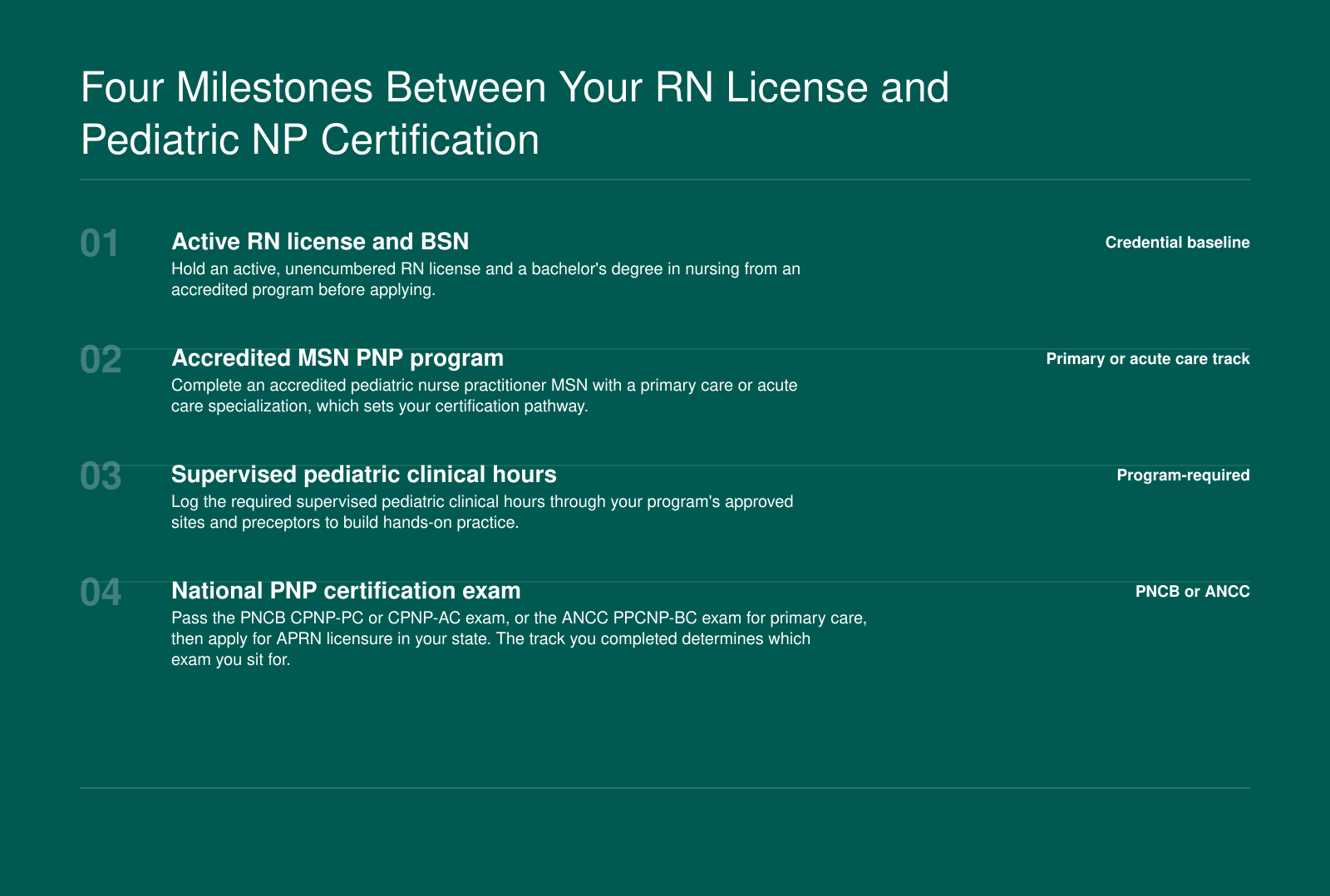
Four Milestones Between Your RN License and Pediatric NP Certification
The path from bedside RN to pediatric nurse practitioner moves through four clear milestones. The PNP track you choose, primary care or acute care, determines which national certification exam you sit for at the end.
Primary Care or Acute Care: Splitting the PNP Specialty in Two
Pediatric nurse practitioner programs split into primary care (PNP-PC) and acute care (PNP-AC) certification paths: PNP-PC prepares you for outpatient, well-child, and school health settings and leads to the CPNP-PC exam, while PNP-AC prepares you for hospital, ICU, and emergency department settings and leads to the CPNP-AC exam. The track you choose determines the certification you sit for and the settings where you can legally practice, so switching later usually requires a post-master's certificate. Several programs in this ranking offer primary care, acute care, or a dual primary/acute pathway.
| School | Primary care PNP (PNP-PC) | Acute care PNP (PNP-AC) | Dual primary/acute option |
|---|---|---|---|
| Drexel University | Yes | Yes | Yes |
| Northeastern University | Yes | Yes (via dual option) | Yes |
| University of Mississippi Medical Center | Yes | Yes | No |
| Maryville University | Yes | No | No |
| University of Delaware | Yes | No | No |
| University of Nevada, Reno | No | Yes | No |
Nurse Practitioner Wages Nationally, From Entry Level to Top Earners
The U.S. Bureau of Labor Statistics reports nurse practitioner wages across all specialties combined, so pediatric nurse practitioners fall within the national nurse practitioner distribution rather than at a separate published figure. The table below compares nurse practitioners with registered nurses to show the earnings difference after completing an MSN and NP licensure.
| Occupation | Total employment | 25th percentile annual wage | Median annual wage | 75th percentile annual wage | Mean annual wage |
|---|---|---|---|---|---|
| Nurse Practitioners | 323040 | 117990 | 132300 | 156700 | 137300 |
| Registered Nurses | 3379720 | 80330 | 97550 | 112350 | 101420 |
Pediatric Nurse Practitioner programs by state
Compare Pediatric Nurse Practitioner programs on the data that matters
Explore more Nursing specializations or browse every graduate field.
All Nursing programs