Best Pediatric Nurse Practitioner (PNP) MSN Programs in Wisconsin
Compare 6 accredited Pediatric Nurse Practitioner programs in Wisconsin at 4 schools, with graduate earnings, cost, debt, and completion data from IPEDS and the U.S. College Scorecard.
Wisconsin offers so few pediatric NP master's programs among nurse practitioner schools in Wisconsin that one wrong pick can take up most of your realistic options. Marquette University in Milwaukee is the one private campus-and-hybrid route, while Herzing University's Kenosha, Brookfield, and Madison campuses deliver the same 100% online pediatric primary care MSN. Programs are ranked together on one page, whatever the format.
The tension is plain. Marquette's tuition runs far higher than Herzing's $770 per credit, yet its institution-wide graduation rate is also far higher. Price and outcomes pull in opposite directions.
Key Points
- Marquette's pediatric NP master's runs $1,450 per credit, well above Herzing's $770.
- Accreditation and a Board-approved degree come first, since board-pass data is still thin.
- Wisconsin APNP credentialing becomes APRN licensure on September 1, 2026.
Wisconsin's Pediatric NP Master's Programs, Ranked for 2027
The strongest value in Wisconsin comes from weighing what a pediatric NP master's costs against how the school performs. Per-credit prices differ widely here, and so do institution-wide graduation rates. Each card below reports graduation rate for the whole school, not for the nursing program alone.
Marquette University
#1Milwaukee, WI · ~$25,000/yr (est.)
Best for: Aspiring PNPs seeking children's hospital training
Schools offering this program graduate 83% of students, the highest institution-wide rate on this list. Marquette runs hybrid pediatric NP tracks in primary care, acute care, and a dual option, with faculty who practice at Children's Hospital of Wisconsin and clinical sites across southeastern Wisconsin. Federal data for its pediatric nursing master's shows a median of $79,158 one year after graduation and $100,891 four years out, against median graduate debt of $61,329.
- Hybrid format: online coursework plus campus experiences
- Focuses on outpatient primary care for children and families
- CCNE accredited
- GRE not required; test optional
- Interview required for pediatric applicants
- Three letters of recommendation minimum
- Starts spring, summer, or fall with rolling admissions
- Prepares graduates to manage complex, critically ill children
- PALS certification required for admission
- One year of acute care experience required
- GRE not required to apply
- Interview required for pediatric applicants
- Rolling admissions with spring, summer, and fall starts
- Dual certification in primary and acute care
- 48 total credit hours at $1,450 per credit
- 250-hour clinical residency
- Training at Children's Hospital of Wisconsin
- 3.0 GPA minimum; part-time study available
- Starts spring or fall with rolling admissions
Herzing University-Kenosha
#2Kenosha, WI · ~$9,000/yr (est.)
Best for: Working RNs needing fully online coursework
Schools offering this program graduate 72% of students. Herzing's pediatric NP master's is an online primary care pathway, not a distinct Kenosha cohort, priced at $770 per credit, well below Marquette's rate. Federal data for the program shows a median of $103,068 one year after graduation, with median graduate debt of $40,934.
- 100% online coursework
- 48 total credit hours at $770 per credit
- 20-month program length
- 585 clinical hours with a clinical placement pledge
- Prepares graduates for the CPNP-PC exam
- 3.0 GPA minimum
- Rolling admissions; military benefits accepted
Herzing University-Brookfield
#3Brookfield, WI · ~$9,000/yr (est.)
Best for: Veteran nurses using military education benefits
Schools offering this program graduate 42% of students, a lower institution-wide rate than the first two schools. The Brookfield listing is the same online primary care pediatric NP pathway, with eligibility tied to the student's state of residence. It shares the $770 per credit rate and the federal earnings data of Herzing's other Wisconsin listings.
- 48 credits, entirely online, 20-month length
- 585 clinical practicum hours with placement support
- Prepares for the CPNP-PC certification exam
- Requires a current RN license and BSN with 3.0 GPA
- Enrollment limited to eligible states
- Military benefits accepted
- Rolling admissions with no application deadlines
Herzing University-Madison
#4Madison, WI · ~$9,000/yr (est.)
Schools offering this program graduate 28% of students, the lowest institution-wide rate here, so weigh that against the lower tuition. The Madison listing is the CCNE-accredited online MSN, a 24-month asynchronous format covering primary and acute care settings. Federal data for the program shows a median of $103,068 one year after graduation and $120,338 four years out.
- CCNE accredited
- 24-month program with asynchronous online classes
- 100% online coursework with a clinical practicum
- Clinical placement pledge
- Designed for BSN-prepared RNs
- Military benefits accepted
- Waived enrollment fee
Cost & outcomes by school
Federal data for the highest-earning Pediatric Nurse Practitioner programs, independent of the ranking above. Earnings are this field's master's graduates four years after completing, where the Scorecard reports them.
| School | Earnings | Tuition / yr | Debt | Grads/yr | Format |
|---|---|---|---|---|---|
| Herzing University-Madison WI | $120,338 | $9,370 | $40,934 | 375 | Online |
| Herzing University-Kenosha WI | $120,338 | $9,370 | $40,934 | — | Online |
| Herzing University-Brookfield WI | $120,338 | $9,370 | $40,934 | — | Online |
| Marquette University WI | $100,891 | $24,680 | $61,329 | 250 | Hybrid |
Sources: U.S. Department of Education. Tuition and graduates: IPEDS. Earnings and debt: College Scorecard, this field's master's graduates; a dash means no figure is reported.
Cost, debt & payoff
Median earnings of this field's master's graduates (4 yrs after completing) vs. their median federal loan debt · U.S. College Scorecard
Across these programs the median graduate earns about $110,615 and finishes with roughly $51,132 in debt — a ratio that clears a common rule of thumb (keep debt below first-year salary). Tuition and debt vary widely school to school, so check the per-school figures in the table above before you shortlist.
Accreditation and Board Results to Check Before You Compare Schools
Board-pass data for pediatric nurse practitioner MSN programs in Wisconsin is still catching up to program launches, which makes accreditation the firmer of the two checks right now.
Accreditation is not a quality badge you can trade off against price or convenience. Graduates of programs outside CCNE, ACEN, or NLN CNEA recognition cannot sit for Pediatric Nursing Certification Board (PNCB) or ANCC pediatric certification, and without certification there is no Wisconsin advanced practice credential. Confirm the status for the specific master's track, not just the nursing school.
Marquette University's graduate nursing programs appear in current CCNE listings, and its dual pediatric pathway (48 credits; 500 primary care, 500 acute care, and 250 residency hours) prepares graduates for both CPNP-PC and CPNP-AC. Marquette does not publish a program-specific first-time PNCB pass rate. Herzing University's nursing disclosure lists its Pediatric NP track with a 2025 board pass rate marked not applicable: the first cohort graduated in summer 2025 and tested in 2026, so no rate exists yet. Public sources do not confirm whether that track sits under CCNE or ACEN.
So ask. Email admissions for the most recent first-time pass rate, the cohort size behind it, and the track's accreditor in writing before you deposit.
Pediatric Primary Care vs. Acute Care NP Master's Tracks
Primary care and acute care pediatric NPs train for the same age group but for very different patients. The primary care track (PNP-PC) centers on well-child visits, common illness and chronic conditions managed in clinics, pediatric offices and schools. The acute care track (PNP-AC) prepares you for medically complex, unstable children in hospital units such as the PICU.
Each track maps to its own Pediatric Nursing Certification Board exam. The CPNP-PC requires a transcript showing a post-graduate certificate, master's or doctoral degree with a pediatric primary care concentration (or a dual primary/acute concentration).1 The CPNP-AC requires an accredited master's or doctoral degree with an acute care concentration, or an accredited post-master's acute care certificate program.2
Within Master's Programs in Wisconsin, Marquette University offers a Pediatric Primary Care NP MSN and a dual primary and acute care MSN; only the dual track leaves graduates academically eligible for both certifications. Herzing University lists a BSN-to-MSN pediatric primary care track.
Choose primary care for clinic and school-based practice, and acute care for PICU and inpatient hospital work.
Wisconsin APRN Credentialing at a Glance
Studying Online or Hybrid: Wisconsin PNP Options and Clinical Placements
The convenience of studying from home pulls against a hard reality: online pediatric nurse practitioner MSN programs still require pediatric clinical hours somewhere physical, with a real preceptor. Weigh both before you enroll.
Online Versus Hybrid Formats
The Herzing campuses in Kenosha, Brookfield, and Madison all deliver the pediatric primary care MSN fully online, with clinical practicum completed in person. Marquette runs its pediatric NP master's in a hybrid format that combines distance coursework with on-site work in Milwaukee.
How Placements Work
Herzing's clinical hour requirements vary by pathway: the BSN-to-MSN track lists 585 hours, while the RN-to-MSN track lists 630. Placement is largely student-led. You work with a dedicated placement advisor and a master's-prepared coordinator to identify your own sites and preceptors, starting at least two months before your placement begins and meeting your preceptor within seven days of confirmation. If you complete every step and still lack a site, Herzing says it will step in, so the pledge is conditional, not an automatic assignment. Marquette's dual pediatric pathway lists 500 primary care, 500 acute care, and 250 residency hours.
State Authorization
Online providers must be authorized to place Wisconsin students, and available research does not definitively confirm current Wisconsin authorization for these programs. Confirm pediatric preceptor availability in your own region, and the school's authorization in your state, before you commit.
Related Articles
Which Wisconsin PNP Master's Programs Waive the GRE?
Most PNP programs have dropped the GRE, so RN experience and pediatric clinical background now carry more weight in admissions decisions. Marquette University states plainly that the GRE is not required and publishes specific pediatric nursing experience requirements. Herzing University's cited admissions pages list RN licensure and GPA but say nothing about the GRE, so we mark that as no published policy rather than guess. Confirm current terms with each admissions office before applying.
| School | GRE Policy | Minimum GPA | RN Experience Required | Entry Pathways | Application Deadline |
|---|---|---|---|---|---|
| Marquette University, Dual Pediatric Primary Care and Acute Care PNP MSN/DNP | Not required | 3.0 on a 4.0 scale (undergraduate, for the MSN) | 6 months to 1 year of full-time (or part-time equivalent) pediatric acute care RN experience before clinical coursework | MSN/DNP program; graduates of foreign nursing schools need a nursing-school equivalency evaluation showing U.S. BSN equivalency | Rolling admissions for spring and fall |
| Marquette University, Pediatric Primary Care PNP Certificate/MSN/DNP | Not required | Not listed on cited page | 2 years of full-time RN practice in an inpatient pediatric setting before applying | Certificate, MSN, or DNP options | Rolling admissions for spring and fall |
| Marquette University, MSN pediatric specialties | Not required (applicants may submit scores if they strengthen the application) | Not listed on cited page | 1 year in an acute-care setting for pediatric acute-care students before clinical practicum coursework | Not listed on cited page | November 15 for spring; February 15 for fall (later applications may be considered space-available if complete by June 1) |
| Herzing University, BSN-to-MSN Pediatric Primary Care PNP | No published policy | 3.0 on a 4.0 scale | Current, active, unrestricted RN license; no experience duration stated | BSN-to-MSN | Not published on cited page |
| Herzing University, RN-to-MSN Pediatric Primary Care PNP | No published policy | Not listed on cited page | Current, active, unrestricted RN license; no experience duration stated | RN-to-MSN and RN-to-BSN-to-MSN tracks for applicants with an ADN/ASN/AASN | Not published on cited page |
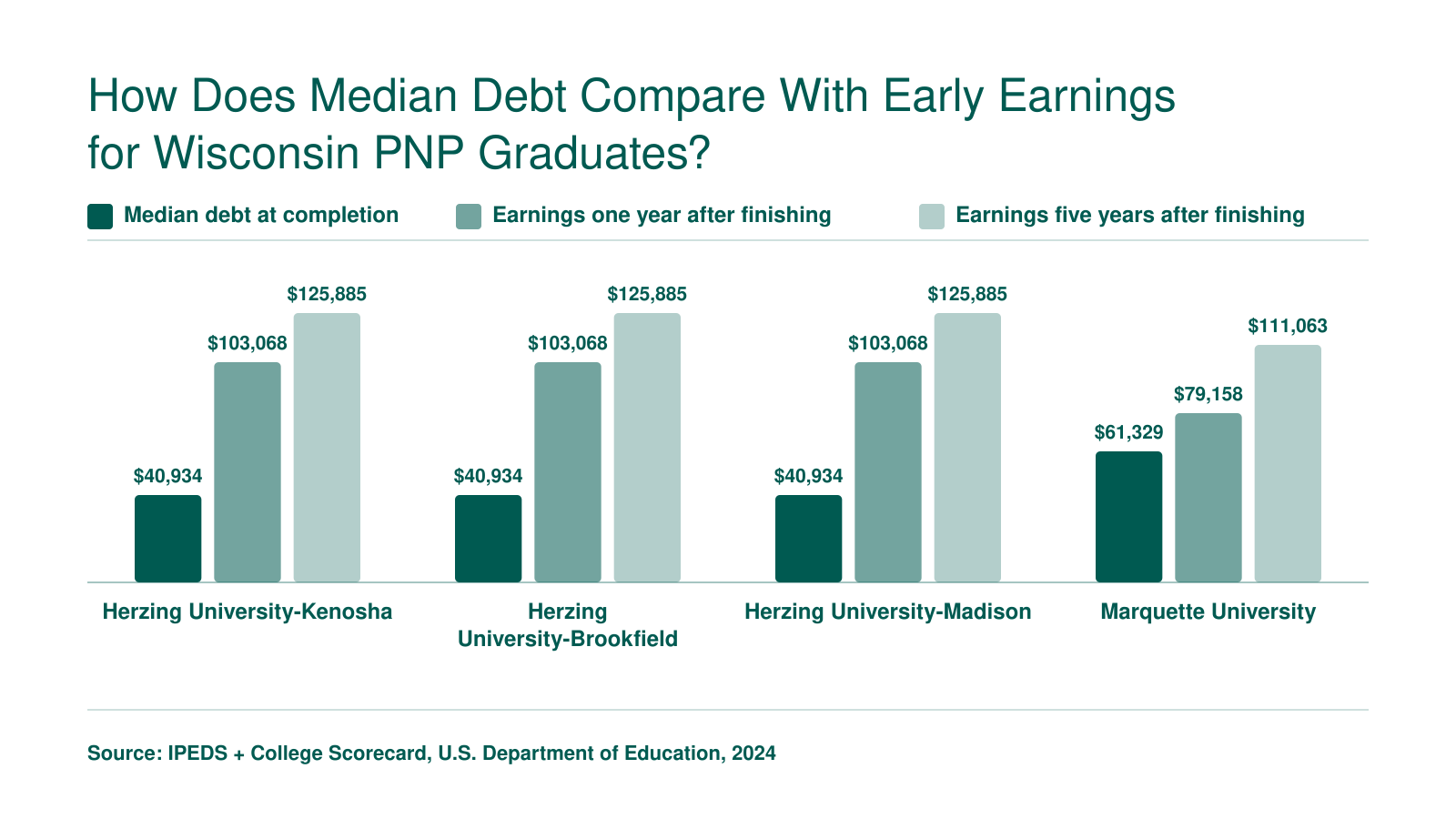
How Does Median Debt Compare With Early Earnings for Wisconsin PNP Graduates?
Each bar pairs median federal debt at completion with program-level median earnings, one year and five years after finishing. Herzing's three campuses report identical program figures. Because earnings exceed debt at every school shown, repayment looks manageable, though Marquette's smaller gap between debt and first-year pay leaves less room than Herzing's.
What a Pediatric NP Master's Costs in Wisconsin, and How to Weigh It
Marquette charges $1,450 per credit, which puts its 42-credit Pediatric Primary Care NP master's at $60,900 in tuition alone and its 48-credit dual primary and acute care track at $69,600. Herzing's BSN-to-MSN pediatric primary care program is $770 per credit across 48 credits, or $36,960. Those are tuition-only figures. Herzing estimates $7,025 in program and learner-resource fees, for about $43,985 in total. With 12 transfer credits, that falls to roughly $34,745. Marquette's clinical and program fees are not established, so no complete total is possible there.
Reported Tuition and Net Price
Federal graduate tuition figures look far lower: $24,680 for Marquette and $9,370 at the Herzing campuses in Kenosha, Brookfield, and Madison. They don't match the per-credit math, so use your own credit count instead. Net price, roughly $20,500 to $23,100 at the Herzing campuses and about $31,500 at Marquette, is an institution-wide average after aid, not a quote for your program.
Repayment and Program Size
The median 10-year monthly loan payment is $698 for Marquette graduates and $466 for the Herzing campuses. Marquette reports 290 nursing master's completions and Herzing-Madison 218, so both are established nurse practitioner programs.
A Three-Step Decision Rule
- Track: Confirm whether you need primary care or acute care before comparing prices, since the dual track costs more.
- Placement: Ask each school in writing how clinical sites are secured.
- Cost versus earnings: Set the total you calculated against the program's own earnings figure, not a state average, and compare it with the most affordable pediatric nurse practitioner MSN programs before choosing.
Compare Pediatric Nurse Practitioner programs on the data that matters
Explore more Nursing specializations or browse every graduate field.
All Nursing programs