Best Pediatric Nurse Practitioner (PNP) MSN Programs
Compare 70+ accredited Pediatric Nurse Practitioner programs at 50+ schools, with graduate earnings, cost, debt, and completion data from IPEDS and the U.S. College Scorecard.

The best pediatric nurse practitioner programs differ less in curriculum than in three constraints a working RN has to live with: price, format, and track. Primary care and acute care lead to different PNCB exams, so a school offering only one can rule out the job you want.
Cost shows the widest spread. Average net price after aid runs from about $9,800 at the University of South Florida to roughly $43,800 at Villanova, a gap of nearly $34,000 a year.
Format is the other catch. Duke, Michigan, and Vanderbilt are hybrid, so "online" still means campus intensives, and clinical hours are almost always completed in person, as in many online family nurse practitioner programs.
Key Points
- CPNP-PC first-time pass rate was 80.69% in 2024, versus 69.57% for CPNP-AC.
- BLS projects nurse practitioner jobs growing 41% from 2025 to 2035, adding about 137,800.
- Your track determines your PNCB exam, so choose primary or acute care before applying.
The 10 Best Pediatric Nurse Practitioner MSN Schools, Ranked
This ranking rewards programs that keep costs manageable after aid while still moving students through and into strong nursing earnings. The schools below pair CCNE-accredited pediatric NP tracks with meaningful clinical hours and certification preparation. Each card pairs program strengths with the school's approximate net price and overall completion picture.
Yale University
#1New Haven, CT · ~$50,000/yr (est.)
Best for: RNs seeking immersive Ivy campus training
A private Ivy League university with separate primary care and acute care pediatric NP tracks. The primary care path includes 518.5 clinical hours across New England and New York, while the acute care path expects inpatient pediatric experience. Both tracks offer part-time study and a post-master's certificate option.
- CCNE accredited
- 518.5 pediatric clinical hours
- Clinical sites in CT, MA, RI, and NY
- School-based health center rotation
- GEPN pathway for non-RNs
- 100% first-time PNCB pass rate
- Campus-based learning
- Two-year program length
- Requires acute inpatient experience
- Part-time study option
- Post-master's certificate offered
- Focus on acute pediatric care
Vanderbilt University
#2Nashville, TN · ~$58,000/yr (est.)
Best for: Working RNs needing hybrid online flexibility
A hybrid program blending online coursework with on-campus simulation, built around acute and primary care pediatric NP tracks. Students choose between 560 acute care clinical hours or 630 primary care hours, and the school assigns a dedicated clinical placement team. Cohorts are intentionally small, with faculty who practice in acute settings.
- CCNE accredited
- 4-semester full-time or part-time
- 560 clinical hours
- Work experience required
- Small cohort with clinical faculty
- Dedicated placement team
- Prepares for PNCB acute care exam
- Hybrid online and in-person format
- 630 clinical practice hours
- Full-time 4 semesters
- Part-time plans available
- Clinical placements in preferred areas
- BSN to DNP pathway
- Post-master's certificate available
University of Pennsylvania
#3Philadelphia, PA · ~$48,000/yr (est.)
Best for: Primary care nurses wanting part-time study
A campus-based Ivy League program focused on pediatric primary care. The curriculum groups six clinical courses together and includes research methods plus two graduate nursing electives. Full-time and part-time plans accommodate working nurses.
- CCNE accredited
- 2-year full-time or part-time
- Primary care practice focus
- Six clinical courses taken together
- Well-child and sick exam training
- Research methods course included
- Two graduate NURS electives required
Duke University
#4Durham, NC · ~$67,000/yr (est.)
A hybrid pediatric NP school offering both primary care and acute care tracks, with a distinctive dual certification in pediatric behavioral and mental health built into the primary care path. Distance-based learning is paired with campus intensives and a global clinical network. Rolling admissions and financial aid support working nurses.
- Rolling admissions
- Dual behavioral and mental health certification
- Distance-based with campus intensives
- Global clinical network
- Health equity and advocacy focus
- Scholarships available
- Rolling admissions
- Work experience required
- Distance-based online learning
- Worldwide clinical alumni network
- Financial aid and scholarships
- Simulation and interactive curriculum
University of Michigan
#5Ann Arbor, MI · $29,000 – $58,000/yr (est.)
A public flagship offering a hybrid primary care pediatric NP track with online coursework and on-campus intensive sessions each term. The curriculum emphasizes well-baby and well-child care, minor acute illness, and chronic condition support. Students can choose two-year or three-year plans.
- CCNE accredited
- 2-year program
- Online digital education format
- On-campus intensive sessions each term
- Focus on well-baby and well-child care
- Careers in school-based health centers
Purdue University
#6West Lafayette, IN · ~$10,000/yr (est.)
A public research university with a primary care pediatric NP specialization that emphasizes rural and underserved communities. The hybrid format pairs advanced nursing theory with clinical practice. It is a fit for RNs aiming to work in areas with limited healthcare access.
- CCNE accredited
- Rural underserved population focus
- Prepares for PNP primary care practice
- Hybrid format
Villanova University
#7Villanova, PA · $20,000 – $25,000/yr (est.)
A Catholic university offering a hybrid pediatric NP track with online core courses and in-person clinicals. The 47-credit curriculum secures placements across Pennsylvania, New Jersey, and Delaware. Graduates can continue seamlessly into the post-master's DNP.
- CCNE accredited
- 47 total credit hours
- Core courses online
- Clinical courses in-person
- Placement secured in PA, NJ, DE
- Pathway to Post-master's DNP
Ohio State University
#8Columbus, OH · ~$14,000/yr (est.)
A public flagship with both primary care and acute care pediatric NP tracks. Primary care students complete 16-20 weekly clinical hours and train at Wexner Medical Center; acute care students complete 600 clinical hours. Multiple pathways include the traditional MSN and BSN-to-DNP.
- CCNE accredited
- Wexner Medical Center clinical experiences
- 16-20 hours weekly clinical practice
- AACN Essentials aligned curriculum
- Multiple degree pathways available
- Prepares for PNCB certification
- Campus-based or online options
- Requires pediatric nursing experience
- 600 clinical hours
- Nationwide Children's Hospital placements
- Cleveland Clinic placements
- Post-master's study available
California State University-Long Beach
#9Long Beach, CA · $9,000 – $19,000/yr (est.)
A public California university offering an on-campus pediatric primary care NP specialty. The program requires a 3.0 minimum GPA and includes a thesis, project, or exam culminating option. It serves the state's diverse communities with a strong family-centered focus.
- CCNE accredited
- 3.0 GPA minimum
- Prerequisite courses required
- Thesis, project, or exam option
- Approved by California BRN
University of South Florida
#10Tampa, FL · ~$10,000/yr (est.)
A public Florida university offering an on-campus pediatric primary care NP track. The 57-credit curriculum includes a comprehensive examination and structured lock-step or new graduate plans. Graduates are eligible for the PNCB Pediatric Primary Care Nurse Practitioner certification.
- CCNE accredited
- 57 total credit hours
- Comprehensive examination required
- Lock step and new graduate plans
- Prepares for PNCB certification
Cost & outcomes by school
Federal data for the highest-earning Pediatric Nurse Practitioner programs, independent of the ranking above. Earnings are this field's master's graduates four years after completing, where the Scorecard reports them.
| School | Earnings | Tuition / yr | Debt | Grads/yr | Format |
|---|---|---|---|---|---|
| University of California-San Francisco CA | $159,229 | $14,738 | $77,233 | 136 | Campus |
| New York University NY | $151,024 | $42,726 | $67,284 | 163 | Hybrid |
| Molloy University NY | $148,040 | $27,520 | $45,750 | 104 | Hybrid |
| University of Akron OH | $146,142 | $10,125 | $41,000 | 59 | Campus |
| CUNY Lehman College NY | $144,722 | $11,570 | $22,052 | 18 | Campus |
| Northeastern University MA | $143,345 | $26,020 | $57,068 | — | Online |
| University of Missouri-Kansas City MO | $139,097 | $13,726 | $43,050 | 81 | Hybrid |
| California State University-Long Beach CA | $138,776 | $8,898 | — | 63 | Campus |
| Wayne State University MI | $137,480 | $17,960 | $50,500 | 51 | Hybrid |
| Stony Brook University NY | $134,363 | $14,222 | $29,728 | 161 | Hybrid |
| Old Dominion University VA | $127,286 | $15,390 | $41,000 | 80 | Hybrid |
| Drexel University PA | $126,827 | $39,261 | $51,250 | 303 | Online |
Sources: U.S. Department of Education. Tuition and graduates: IPEDS. Earnings and debt: College Scorecard, this field's master's graduates; a dash means no figure is reported.
Cost, debt & payoff
Median earnings of this field's master's graduates (4 yrs after completing) vs. their median federal loan debt · U.S. College Scorecard
Across these programs the median graduate earns about $122,994 and finishes with roughly $49,267 in debt — a ratio that clears a common rule of thumb (keep debt below first-year salary). Tuition and debt vary widely school to school, so check the per-school figures in the table above before you shortlist.
Why These Schools Made the Cut: Our Scoring Inputs
The scores behind this ranking come from two federal databases that track what schools charge and what graduates get out of them. IPEDS, the Department of Education's Integrated Postsecondary Education Data System, supplies tuition, enrollment, and graduation rates. The College Scorecard, also run by the Department of Education, adds net price, program-level earnings, and federal debt where those figures have been published. When a number is not yet reported for a program, we leave it out rather than estimate it.
How the pool was built
Every school offering a nurse practitioner program with a pediatric NP track in our dataset was scored. Many universities list several pediatric options, such as primary care and acute care, so those listings were consolidated by institution. Each school appears once.
What the scores do not capture
Federal data says nothing about certification pass rates, clinical placement quality, or faculty specialty. For a PNP student comparing MSN programs, those can matter more to daily training than any cost figure. Use the accreditation and clinical track sections to run those checks, and ask each admissions office how it secures preceptors and how many placements it arranges for you.
One honest caveat: institution-wide figures such as graduation rate describe the whole university, not just the PNP cohort. A strong rate points to a well-resourced school, but it is not a promise about outcomes in a small pediatric nursing program.
Net Price, Graduate Tuition, and Debt Across Ranked PNP Schools
Published graduate tuition can look much higher than what students actually pay after aid, but the net price column below shows an institution-wide average after grants and scholarships. For context, UT Arlington lists a $654 per-credit MSN pediatric NP rate, UAB is $744 per credit plus a $235 per-course fee, and Drexel charges $1,169 per credit for pediatric NP tracks. Many public universities charge online students either in-state rates or a flat e-tuition, so out-of-state tuition matters less for some online programs. Treat the net price as an estimate, not a personal quote.
| School | In-State Tuition | Out-of-State Tuition | Net Price | Median Debt | 10-Year Monthly Payment |
|---|---|---|---|---|---|
| The University of Texas at El Paso | $9,744 | $25,502 | $9,403 | $18,000 | $466 |
| University of South Florida | $6,410 | $17,324 | $9,812 | $17,988 | $602 |
| California State University-Long Beach | $7,350 | $19,950 | $10,440 | $14,289 | N/A |
| Texas Woman's University | $8,640 | $18,480 | $11,963 | $19,218 | $316 |
| University of Michigan | $17,736 | $60,946 | $13,138 | $19,500 | $591 |
| The University of Texas at Arlington | $11,950 | $29,582 | $13,951 | $17,527 | $551 |
| Purdue University | $9,992 | $28,794 | $14,600 | $19,500 | $266 |
| Vanderbilt University | $67,498 | $67,498 | $15,846 | $14,000 | $1,031 |
| University of Nevada-Reno | $9,578 | $27,720 | $15,927 | $18,922 | $466 |
| Ohio State University | $13,244 | $40,022 | $17,339 | $19,976 | $559 |
CPNP-PC or CPNP-AC: How the Two Pediatric NP Tracks Differ
Should you train as a primary care or an acute care pediatric nurse practitioner, and can you switch after graduation? The choice matters more than most applicants expect, because the track you complete decides which board exam you can take.
The Two Tracks Side by Side
- Patient population and acuity: Primary care PNPs, unlike family nurse practitioner programs, handle well-child visits, immunizations, screenings, sports physicals, and common illnesses, mostly in outpatient care for patients from birth through age 21. Acute care PNPs manage children who are acutely or critically ill, plus complex chronic conditions that need inpatient, emergency, surgical, or intensive care.
- Typical work settings: Primary care graduates usually work in pediatric offices, outpatient clinics, and school-based or community health centers. Acute care graduates tend to work in children's hospitals, PICUs, NICUs, pediatric emergency departments, and surgical or step-down units.
- Certification exam: Both credentials come from the Pediatric Nursing Certification Board (PNCB): the CPNP-PC for primary care and the CPNP-AC for acute care.
- Clinical hours: PNCB requires at least 500 supervised clinical hours in the matching population for each exam and recommends 600. Many programs build in more than the floor.
- Prior RN experience: Every track requires an active, unencumbered RN license, but experience expectations vary by school. Acute care and dual programs are more demanding; NYU's combined primary/acute care program and Drexel University's dual PNP option each expect at least one year of pediatric acute care nursing.
- Dual-track availability: Some schools offer formal dual primary and acute care preparation, which qualifies graduates for both exams. Most programs prepare you for one population only.
Your Track Locks In Your Exam
PNCB eligibility follows your coursework and clinical hours. A graduate of an acute-care-only program cannot sit for the CPNP-PC, and a primary-care-only graduate cannot sit for the CPNP-AC. Adding the second credential later usually means completing a post-master's certificate in the other focus. Day-to-day scope also depends on state law and employer credentialing, but employers generally hire to the certification that matches the role.
Acute Care Is Harder to Find
Acute care pediatric tracks are offered at fewer schools than primary care, and admissions committees often prefer applicants with inpatient pediatric or PICU nursing experience. If you lack that background, plan time to build it before applying.
A Simple Rule of Thumb
If you see yourself in a clinic or outpatient practice, choose primary care; if your goal is the hospital floor, the ED, or the PICU, choose acute care.
Related Articles
CCNE, ACEN, and the PNCB Board Exam: Credentials That Make a PNP Degree Count
A regionally respected university with an unaccredited nursing track versus a lesser-known school with CCNE accreditation: for a future pediatric NP, the second one is the only real option. Accreditation is not a prestige marker here. It is the gate that determines whether you can sit for the certification exam at all.
Verify accreditation before you apply
The Pediatric Nursing Certification Board (PNCB) requires that candidates for both the CPNP-PC (primary care) and CPNP-AC (acute care) exams graduate from a master's or doctoral nursing program, or an eligible post-master's certificate, accredited by ACEN, CCNE, or NLN CNEA, with the matching NP concentration. A master's is the minimum degree; a DNP is not required to sit for the acute care exam. PNCB also expects the didactic and clinical education supporting your application to be completed within the program that supplies your final transcript, so piecing coursework together across schools can create problems. Check any program you are considering against the accreditor's own online directory rather than trusting the school's marketing page, and confirm that the specific PNP track, not just the college of nursing, is covered.
Beginning January 1, 2030, PNCB candidates must have graduated within the prior five years, meaning 2030 test-takers need a graduation date no earlier than January 1, 2025. Plan your exam timing accordingly.
PNCB versus ANCC
ANCC's pediatric primary care credential (PPCNP-BC) is currently available for renewal only, so new graduates cannot obtain it. In practice, PNCB is the pathway for pediatric NP certification today. ANCC also expects APRN applicants to apply within five years of degree conferral.
Ask for pass rates directly
The national first-time pass rate for the CPNP-PC exam was 80.69 percent in 2024, across 1,318 candidates. Some schools publish their own numbers: Vanderbilt reported 98 percent primary care and 100 percent acute care first-time pass rates for 2025, and Boston College reported 100 percent for 2024. Most programs do not publish this at all, and it does not appear in federal data. Ask admissions for three years of first-time pass rates in writing, and treat evasion as an answer.
In 2024, the Pediatric Nursing Certification Board reported that 80.69% of first-time test takers passed the CPNP-PC exam (1,318 candidates), versus 69.57% on the CPNP-AC exam (691 candidates). Use these national rates as a yardstick when judging any single program's reported pass rate.
What You Need to Apply: BSN, GPA, and Pediatric RN Experience
Requirements vary by program and track, so treat these as typical benchmarks and confirm each school's current criteria before you apply.
- Unencumbered RN licenseExpect to hold an active, unrestricted RN license. Drexel, for example, requires an unrestricted U.S. license and current PALS. Online students should confirm which states the program can place clinicals in.
- BSN from an accredited programA BSN from a CCNE- or ACEN-accredited school is the standard entry point. Penn also lists a statistics prerequisite. Our research did not confirm RN-to-MSN bridge exceptions, so ask each school directly.
- Minimum GPA3.0 is the common benchmark at TWU, Drexel, Wayne State, UAB, UTA, Penn, Marquette, and UNMC. Some schools offer flexibility: TWU may consider lower last-60-hour GPAs individually, UTA's primary care track has a probationary 2.8–2.99 band, and UNMC offers a provisional route.
- RN experienceOne year is typical, and UTA asks for two. Acute care and dual tracks lean on pediatric inpatient or acute care hours (Drexel, Wayne State, UTA acute care, UNMC dual). Primary care is looser: UNC asks for six months of pediatric or child/family experience, and TWU allows provisional admission if you gain pediatric experience before practicum.
- Other materialsPlan on references, a personal statement, and possibly an interview. The GRE is no longer universal. UAB requires a GRE (297) or GMAT (480) score for applicants below its GPA threshold, and UTA lists the GRE only for probationary primary care applicants.
The Bureau of Labor Statistics projects nurse practitioner employment will grow 41% from 2025 to 2035, adding about 137,800 jobs, from 336,300 to 474,100. That pace is far faster than most occupations, which is why pediatric NP graduates entering the field now can expect a strong job market.
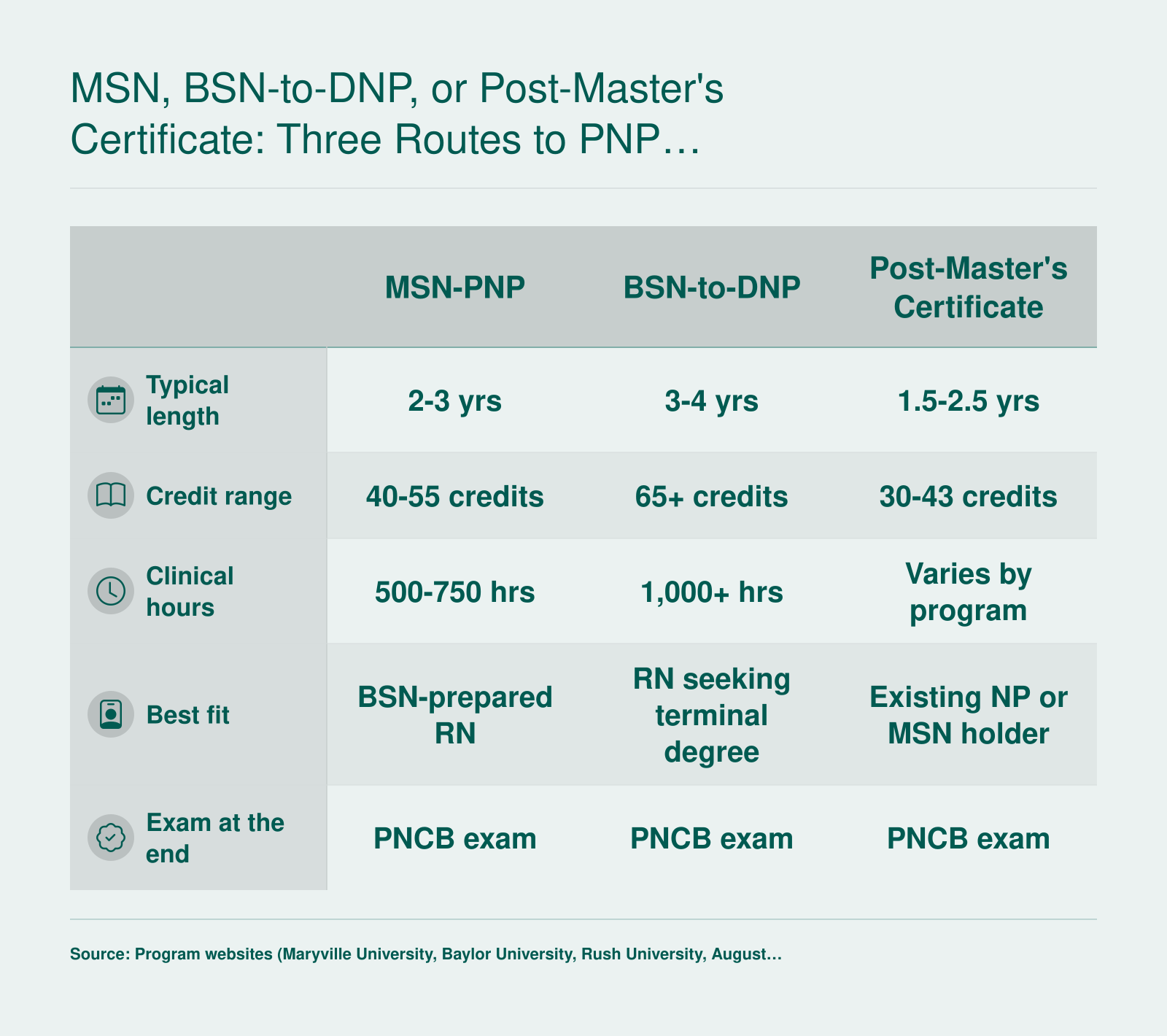
MSN, BSN-to-DNP, or Post-Master's Certificate: Three Routes to PNP Certification
Pediatric nurse practitioner training comes in three formats, and the right one depends on the credentials you already hold. DNP pediatric nurse practitioner programs take longest but end in a terminal degree. All three routes lead to the same PNCB certification exam.
Pediatric Nurse Practitioner programs by state
Compare Pediatric Nurse Practitioner programs on the data that matters
Explore more Nursing specializations or browse every graduate field.
All Nursing programs