Best Pediatric Nurse Practitioner (PNP) MSN Programs in Massachusetts
Compare 5 accredited Pediatric Nurse Practitioner programs in Massachusetts at 3 schools, with graduate earnings, cost, debt, and completion data from IPEDS and the U.S. College Scorecard.

Massachusetts pediatric nurse practitioner graduates earn roughly $104,000 to $125,000 within a year of finishing, yet only a few schools in the state offer a PNP master's at all, so each accredited option carries real weight. The practical question is rarely prestige. It is whether a program fits your budget, your schedule, and the track you want, primary care or acute care.
Those two tracks lead to separate board exams and different clinical settings, and not every Massachusetts school offers both. Acute care PNP training in particular is scarce across New England, which narrows the decision well before cost or format enters the picture.
Key Points
- Pediatric clinicals happen in person, so no PNP master's is fully online.
- Northeastern's PNP program states the GRE is not required.
- One year after finishing, Northeastern graduates earned a median $125,480.
Top-Ranked PNP MSN Schools in Massachusetts
These listings follow what graduates paid and later earned, not reputation surveys. Only three Massachusetts schools in our data offer a pediatric nurse practitioner master's, so confirm accreditation and current enrollment with each school before you apply.
Regis College
#1Weston, MA · $15,000 – $20,000/yr (est.)
Best for: Working RNs studying fully online
Regis College in Weston offers a fully online MSN with a pediatric nurse practitioner focus on primary care of the child. The school graduates about 72% of students overall. Students complete supervised preceptorships near home, with help from clinical coordinators, and can enter as an ADN, non-nursing bachelor's, or BSN holder. Regis does not require the GRE.
- 100% online coursework with local clinical placements
- Three entry points: ADN, non-nursing bachelor's, or BSN to MSN
- No GRE or entrance exam required
- Listed at $1,061 per credit
- Completion in as few as 26 to 38 months
- Online MSN students generally complete 664 to 724 clinical hours
- Prepares graduates for the PNCB certification exam
- Military and employer tuition benefits supported
Northeastern University
#2Boston, MA · ~$26,000/yr (est.)
Best for: Students targeting Boston pediatric hospital placements
Northeastern University in Boston offers pediatric NP tracks in primary care and a dual primary and acute care option. Clinical partners include Boston Children's Hospital and Massachusetts General Hospital, with an emphasis on urban and underserved children. The school page states CCNE approval and approval from the Massachusetts Board of Registration in Nursing.
- Total program tuition of $79,786 for 2026 to 2027
- CCNE-approved, per the school's program page
- Prepares for the Pediatric Primary Care certification exam
- Full-time or part-time study over 2 to 3 years
- Fall start
- Two letters of recommendation required
- Total program tuition of $101,192 for 2026 to 2027
- Graduates may sit for both pediatric primary and acute care exams
- CCNE-approved, per the school's program page
- Full-time or part-time study over 2 to 3 years
- Fall term entry only
- BSN and current RN license required
MGH Institute of Health Professions
#3Boston, MA · ~$69,000/yr (est.)
Best for: Career changers using direct-entry pathways
MGH Institute of Health Professions in Boston offers pediatric nurse practitioner training as one of seven specialties in its School of Nursing. The campus-based track prepares graduates for the primary care certification exam. Applicants can enter through Direct-Entry, Post-BSN, or Post-MSN curricula, which suits both career changers and practicing nurses.
- Campus-based program in Boston
- One of seven nursing specialty tracks
- Direct-Entry, Post-BSN, and Post-MSN curricula available
- Graduates eligible for the Certified Pediatric Nurse Practitioner, Primary Care exam
- Care focus spans infants through young adults
- Applications submitted through NursingCAS
Cost & outcomes by school
Federal data for the highest-earning Pediatric Nurse Practitioner programs, independent of the ranking above. Earnings are this field's master's graduates four years after completing, where the Scorecard reports them.
| School | Earnings | Tuition / yr | Debt | Grads/yr | Format |
|---|---|---|---|---|---|
| Northeastern University MA | $143,345 | $26,020 | $57,068 | — | Online |
| MGH Institute of Health Professions MA | $123,082 | $69,158 | $168,086 | 105 | Campus |
| Regis College MA | $123,036 | $17,910 | $47,833 | 371 | Online |
Sources: U.S. Department of Education. Tuition and graduates: IPEDS. Earnings and debt: College Scorecard, this field's master's graduates; a dash means no figure is reported.
Cost, debt & payoff
Median earnings of this field's master's graduates (4 yrs after completing) vs. their median federal loan debt · U.S. College Scorecard
Across these programs the median graduate earns about $123,082 and finishes with roughly $57,068 in debt — a ratio that clears a common rule of thumb (keep debt below first-year salary). Tuition and debt vary widely school to school, so check the per-school figures in the table above before you shortlist.
Online and Hybrid PNP Master's Options in Massachusetts
The flexibility of online coursework comes with a tradeoff: pediatric clinicals are always in person, so no pediatric nurse practitioner MSN program is truly online from start to finish. Expect Regis College, Northeastern University, and MGH Institute of Health Professions to fall somewhere between hybrid and campus-based among Master's Programs in Massachusetts, and confirm each program's current format on its own page before you apply.
Intensives and residencies
Hybrid programs typically pair online classes with required campus visits. Ask each school how many visits there are, how long each lasts, and whether they include skills labs or simulation. Plan travel and time off work around those dates.
Who arranges clinical placements
This is the question that matters most. MGH Institute is known for priority rotations within its affiliated hospital network, but that access does not guarantee every PNP student a specific pediatric site. Ask Regis and Northeastern whether the school places you, whether you must find your own preceptors, and whether you can complete clinicals outside Massachusetts.
Students who must locate their own preceptors often run into delays that push back graduation. Get placement support in writing before you enroll.
Which Massachusetts PNP Programs Waive or Make the GRE Optional?
Do Massachusetts PNP programs require the GRE? Two of the schools here say no, and the third is unclear.
- Northeastern University: The Pediatric Nurse Practitioner MS/CAGS states the GRE is not required. Applicants need a BSN, a current RN license, and at least one year of full-time pediatric RN experience to apply (two years before clinical coursework). The acute dual track adds inpatient pediatric experience and PALS. The deadline is August 1. The Pediatric NP MSN lists a July 1 fall deadline, a BSN, and RN licensure, but no GRE or experience policy. Non-BSN bachelor's holders can look at the best direct entry msn programs in massachusetts.
- Regis College: No entrance exam is required, and no GRE is stated, placing it among No-GRE master's programs. Entry points include ADN, non-nursing bachelor's, and BSN. The current online-program deadline is November 30, 2026. Experience and GPA thresholds are not published in the pages reviewed.
- MGH Institute of Health Professions: No testing policy was confirmed here, so check its admissions page directly.
Minimum GPA requirements were not established for any program, so verify them before applying.
Related Articles
What a PNP Master's Costs and How to Get Licensed in Massachusetts
Becoming a pediatric nurse practitioner in Massachusetts means paying for a graduate degree, then clearing national certification and state authorization before you can practice. Treat every cost figure below as an estimate and confirm it with each school's bursar.
Cost
Regis College is the cheapest option with comparable figures here. Its online PNP master's lists $1,061 per credit, and the college's institution-wide average net price is about $27,477. Net price covers the whole school, not this program, so it only approximates what a nursing student pays. Graduates of the program show median debt near $47,833. Total program cost depends on credit count and fees, which we could not verify, so multiply the per-credit rate by the credits on the current curriculum and add fees. Northeastern University and MGH Institute of Health Professions are not comparable on cost here; request their current rates directly.
Licensure path
- RN license: a current Massachusetts RN license in good standing. Temporary licenses are not issued for APRN authorization.
- Accredited master's: coursework must include pathophysiology, advanced physical assessment, and pharmacotherapeutics.
- PNCB certification: CPNP-PC exam eligibility covers CPNP-PC or CPNP-AC. From 2030, candidates must have graduated within five years.
- APRN authorization: apply through the state licensing portal for $150, and enroll with MassHealth.
Prescriptive authority comes after authorization. NPs with under two years of supervised practice need prescriptive-practice guidelines with a supervising professional.
Pediatric nurse practitioners certify through the Pediatric Nursing Certification Board, which offers separate exams for primary care (CPNP-PC) and acute care (CPNP-AC). Before you enroll, ask each program for its graduates' first-time pass rate on the exam that matches your track.
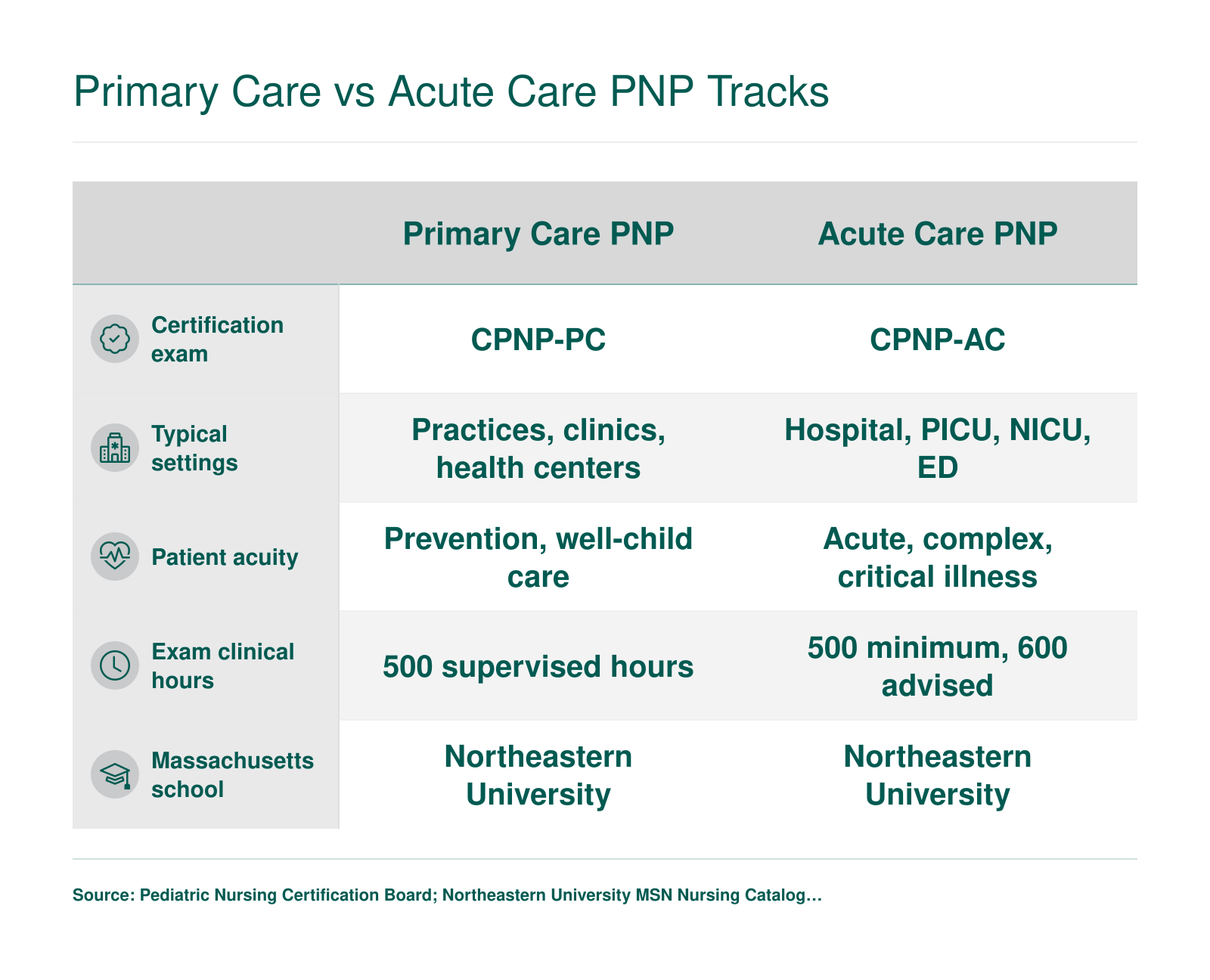
Primary Care vs Acute Care PNP Tracks
The two pediatric NP tracks lead to different board exams, workplaces and patients. Use this side-by-side view to match a track to the career you want, then check each school's current concentration list.
What Massachusetts PNP Graduates Earn
Pediatric nurse practitioner graduates from Massachusetts master's programs clear six figures within a year of finishing, and the gap between them comes down to debt, not pay.
- Northeastern University: median earnings of $125,480 one year after finishing, rising to $143,345 four years after finishing. Median program debt runs $57,068, about $649 a month on a standard 10-year repayment plan.
- MGH Institute of Health Professions: $104,551 one year after finishing and $123,082 at four years, carried against median debt of $168,086, roughly $1,912 a month over 10 years.
- Regis College: $111,204 one year after finishing and $123,036 at four years, on the lightest debt load of the three: $47,833, or close to $544 monthly.
Earnings converge by year four, so the borrowing figure is what separates a comfortable payment from a demanding one. The concentration of pediatric specialty care around Boston's children's hospitals keeps demand for certified PNPs steady, and graduates rarely struggle to place.
How We Rank Massachusetts PNP Programs
Each program on this list earned its place through federal outcome data, not marketing copy. We start with College Scorecard figures for the program itself: what graduates earn after finishing and the median debt they carry out the door. Net price, the average cost after grants and scholarships, carries real weight too. Institution-wide graduation rate serves as a secondary check on how reliably a school gets students to completion.
Two caveats apply. Net price is averaged across the whole institution, so it may not match what a PNP student actually pays. Some programs also have no published earnings figures, so cost, debt and completion carry more of their placement.
These rankings are independent. Schools cannot pay for a spot on this list or a higher position on it.
Questions Prospective PNP Students Ask
How many clinical hours do PNP master's programs in Massachusetts require?
Can I earn a PNP certificate if I already hold an MSN in another specialty?
Will Massachusetts PNP programs accept transfer credits from another graduate nursing program?
Can I add an acute care PNP specialty after finishing a primary care PNP program?
Compare Pediatric Nurse Practitioner programs on the data that matters
Explore more Nursing specializations or browse every graduate field.
All Nursing programs