Best Master's in Child Psychology Programs
Compare 17 accredited Child Psychology programs, with graduate earnings, cost, debt, and completion data from IPEDS and the U.S. College Scorecard.

Will a master's in child psychology qualify you to work with children, or only prepare you for a doctorate? It depends on the program. Missouri's MA accepts only PhD-track students and is not a terminal degree, while Assumption's 60-credit clinical counseling track is built for LMHC licensure.
Our ten ranked programs span campus, hybrid, and online formats, with institution-level average net prices running from about $14,100 at the University of Washington to $37,700 at Duquesne. Credit loads run from 30 to 60.
Two programs with similar names can lead to different careers, so the curriculum matters more than the label.
Key Points
- Net price and median debt decided rankings here, not school reputation or name recognition.
- Program-level graduate earnings aren't yet published for most ranked programs, from UC Davis to Tufts.
- CACREP standards require 700 supervised hours (100 practicum, 600 internship) before you can graduate.
10 Top-Rated Master's in Child Psychology Programs for 2027
These 10 programs stand out for combining child-focused training with practical experience, research opportunities, and delivery formats that fit working students. Cards highlight the degree's concentration, format, tuition, and any standout clinical or applied behavior analysis pathway. Net price is an average after aid; actual costs vary by household and aid package.
University of California-Davis
#1Davis, CA · $15,000 – $20,000/yr (est.)
Best for: Research-track students wanting developmental science
UC Davis takes a research-driven, interdisciplinary approach to child development, pairing cognitive and socio-emotional development study with supervised practical experience. The master's program includes two degree plans, so students can shape their coursework toward practice or further graduate study. The school reports an 86% graduation rate, and fellowship opportunities support students during the program.
- 2-year program
- Interdisciplinary graduate group
- Supervised practical experience included
- Two degree plans: M.S. Plan I and Plan II
- December 1 priority deadline for fellowship consideration
- March 1 final deadline
- Scholarships available
- Focus on cognitive and socio-emotional development
University of Washington-Seattle Campus
#2Seattle, WA · ~$19,000/yr (est.)
Best for: Working professionals pursuing applied prevention training
The University of Washington's applied child and adolescent psychology program emphasizes prevention and treatment, backed by a center for child and family well-being. Students learn through interdisciplinary approaches and faculty research activity that supports practical training. The school reports an 85% graduation rate.
- 15-month in-person program
- Interdisciplinary approaches in graduate training
- Faculty research tops $12 million yearly
- Parenting workshops at child well-being center
- PTSD therapy work with VA
- Careers: counselor, therapist, social worker
University of Missouri
#3Columbia, MO · ~$14,000/yr (est.)
Best for: PhD-bound students needing clinical-developmental training
Missouri's master's in psychology with a child development emphasis is designed for students admitted to the doctoral program, blending clinical child and developmental perspectives. The 30-credit curriculum requires a thesis and emphasizes developmental psychopathology. The school reports a 75% graduation rate.
- 30 total credit hours
- Thesis required
- Dual emphasis: clinical child and developmental
- Training in developmental psychopathology
- Not a terminal master's degree
- Accepts only PhD-track students
Montclair State University
#4Montclair, NJ · ~$16,000/yr (est.)
Montclair State's clinical psychology master's offers a child and adolescent concentration grounded in the scientist-practitioner model. Small cohorts and active research labs give students hands-on experience while preparing them for supervised master's-level roles or doctoral study. The school reports a 65% graduation rate.
- Child/Adolescent Psychology concentration
- STEM designated degree program
- Scientist-practitioner model
- Small cohorts and close mentorship
- Join active research labs
- Rolling admissions
- 3.0 GPA minimum
- Prerequisite courses required
University of Kansas
#5Lawrence, KS · $12,000 – $27,000/yr (est.)
The University of Kansas offers a clinical child psychology master's en route to doctoral study, with clinical practica and an empirical thesis. The curriculum covers psychopathology, assessment, and therapeutic interventions while emphasizing cultural responsiveness and ethics. The school reports a 69% graduation rate.
- 30 total credit hours
- Thesis required
- Clinical practicum experience
- Focus on children, adolescents, families
- Cultural diversity training
- Individualized plan of study
- Prepares students for doctoral study
Duquesne University
#6Pittsburgh, PA · $25,000 – $30,000/yr (est.)
Duquesne's 30-credit child psychology program is a one-year hybrid format designed to prepare educational advocates and behavior specialists. An optional applied behavior analysis pathway supports eligibility for behavior specialist licensure and the BCBA exam. The school reports a 77% graduation rate.
- 1-year program
- 30 total credit hours
- Hybrid modality
- Prepares for Behavior Specialist Licensure
- Pathway to BCBA exam eligibility
- Early start option for undergraduates
- 3.0 GPA minimum
- Application deadlines: Aug 1, Dec 2, May 1
Assumption University
#7Worcester, MA · ~$15,000/yr (est.)
Assumption's clinical counseling psychology master's includes a child and family interventions concentration with cognitive-behavioral therapy integrated throughout. Students complete a 100-hour practicum and 600-hour internship, supporting Massachusetts mental health counselor licensure preparation. The school reports a 75% graduation rate.
- Child & Family Interventions concentration
- Fully integrated CBT curriculum
- 100-hour practicum
- 600-hour internship
- Prepares for LMHC licensure
- Full-time and part-time options
- 3 start dates per year
- No GRE required
Southern New Hampshire University
#8Manchester, NH · ~$21,000/yr (est.)
SNHU's online psychology master's with a child and adolescent development concentration offers 10-week terms and a 15-month completion path. The curriculum covers developmental psychology, cognitive neuropsychology, and intervention strategies. The school reports a 43% graduation rate.
- Child and Adolescent Psychology concentration
- 15-month program
- 36 total credit hours
- 12 total courses
- 10-week online terms
- No entrance exam required
- $0 application fee
- Transfer up to 12 credits
National University
#9San Diego, CA · ~$16,000/yr (est.)
National University's online child and adolescent developmental psychology master's covers development from infancy through adolescence, including child psychopathology, ADHD, and autism spectrum disorders. Students choose a capstone or a 100-hour internship, and rolling Monday start dates support working adults. The school reports a 43% graduation rate.
- 30 total credit hours
- 10 total courses
- 16-month program
- 100-hour internship or capstone option
- Rolling admissions
- No entrance exam required
- One-to-one learning model
- Classes start every Monday
Touro University Worldwide
#10Los Alamitos, CA · ~$9,000/yr (est.)
Touro University Worldwide's online psychology master's with a child and adolescent development concentration emphasizes real-world cases and scholar-practitioner faculty. The 36-credit program can be completed in about 12 months, and this degree does not lead to licensure. The school reports a 29% graduation rate.
- Child and Adolescent Development concentration
- 36 total credit hours
- 1-year completion possible
- 8-week course terms
- Six start dates per year
- 100% online
- No GRE required
- Does not lead to licensure
Cost & outcomes by school
Federal data for the highest-earning Child Psychology programs, independent of the ranking above. Earnings are this field's master's graduates four years after completing, where the Scorecard reports them.
| School | Earnings | Tuition / yr | Debt | Grads/yr | Format |
|---|---|---|---|---|---|
| University of California-Davis CA | $62,626 | $15,141 | — | — | Campus |
| Duquesne University PA | $59,911 | $27,612 | — | 14 | Campus |
| Capella University MN | $53,408 | $15,092 | $43,258 | 130 | Online |
| William Carey University MS | $42,822 | $11,880 | — | 2 | Campus |
| Touro University Worldwide CA | — | $9,000 | — | — | Online |
| University of Cincinnati OH | — | $14,902 | — | — | Campus |
| Assumption University MA | — | $15,470 | — | — | Campus |
| National University CA | — | $16,416 | — | — | Online |
| George Mason University VA | — | $17,964 | — | — | Campus |
| Montclair State University NJ | — | $16,056 | — | 47 | Campus |
| University of Kansas KS | — | $11,971 | — | 6 | Campus |
| University of Missouri MO | — | $13,681 | — | 11 | Campus |
Sources: U.S. Department of Education. Tuition and graduates: IPEDS. Earnings and debt: College Scorecard, this field's master's graduates; a dash means no figure is reported.
Our Scoring Formula: Outcomes and Price Over Prestige
Reputation didn't earn a spot on this list. What graduates earn, owe, and pay did. A famous name on your diploma feels reassuring, but it won't pay down your loans or guarantee a licensable credential. The programs here rose or fell on numbers you can act on, not brand recognition.
What Goes Into the Score
Four inputs carry the weight: program-level graduate earnings from federal data, median debt at the time students finish, the effective net price after typical grant aid, and the institution's graduation rate. One honest caveat: graduation rate reflects the whole school, not the specific child psychology master's, since that figure isn't published at the program level. Treat it as a signal of institutional support, not a precise read on your cohort.
Earnings and debt are the real differentiators. A program where graduates leave with $13,000 in debt and strong early wages beats a pricier one with the same job titles, regardless of pedigree.
Verify Accreditation Yourself
Accreditation decides whether your degree counts toward licensure, so confirm it before you apply. Institutional accreditors recognized by the U.S. Department of Education or CHEA evaluate the entire school.1 Programmatic accreditation is narrower and matters most for defined career paths: CACREP for counseling tracks, MPCAC for counseling-related master's, and NASP for school psychology programs.2
Run this two-step check:
- Step one: Search the Department of Education's DAPIP database for the school's exact legal name and campus to confirm institutional accreditation, status, and dates.
- Step two: For a counseling psychology or school psychology pathway, search the CACREP directory (or MPCAC and NASP lists)3 for the specific program and delivery format. Absence from a programmatic list means no current status there.
An accredited institution and an accredited program are not the same thing, and neither automatically satisfies your state board's licensure rules.
Program Costs: Published Tuition, Net Price, and Cost per Credit
Among the ten ranked programs, the cheapest published tuition is about a third of the most expensive, and the gap grows once residency status comes into play.
What the Ranked Programs Charge
Yearly graduate tuition for in-state students runs from $9,000 at Touro University Worldwide to $27,612 at Duquesne University. For out-of-state students, Touro stays lowest at $9,000, while the University of Washington is highest at $32,811. Residency matters most at public flagships. The University of Kansas charges $11,971 in-state but $27,146 out-of-state. Montclair State and National University charge one rate regardless of where you live. Net price runs from $14,091 at the University of Washington to $37,730 at Duquesne.
Why Net Price Is Only a Starting Point
The net price figure is a school-wide average of what aided students pay after grants, and it draws heavily on undergraduate figures. Treat it as a rough signal of a school's affordability, not a quote for your degree. Your real bill depends on credit count. Non-licensure master's in psychology and development degrees often require 30 to 36 credits. Counseling tracks aimed at licensure usually require 45 to 60, and CACREP-accredited programs require at least 60 semester credits.
Per-Credit Rates and Extra Fees
In 2026, public programs range from roughly $168 to $865 per credit, depending on residency, format, and institution. Private examples cluster between $525 and $665, though some private online counseling programs charge $820 to $900. Beyond tuition, budget for:
- Term fees: Registration and technology charges, usually billed each term
- Practicum costs: Background checks, supervision arrangements, and travel to placement sites
- Residencies: Travel for in-person intensives, such as the two residency courses in Capella's school counseling track
- Materials: Items like Capella's $175 resource kit
Estimate Your Total
Use this formula: cost per credit × total credits + fees = estimated total program cost.
SNHU's child and developmental psychology track works out to $659 × 36 credits = $23,724 before fees. Capella's Child and Adolescent Counseling MS comes to $525 × 90 quarter credits = $47,250, plus the $175 kit. Ninety quarter credits equal about 60 semester credits, so confirm whether a school bills by quarter or by semester before you compare rates.
Related Articles
What Graduates Earn One to Five Years After Finishing
For most child psychology master's programs on this list, like many clinical psychology master's programs, the federal government does not yet release program-level earnings, and that is the honest limitation to understand going in. The schools profiled here, from UC Davis to Touro University Worldwide, do not currently have completed earnings or employment outcomes tied to this specific degree. That means we cannot tell you, program by program, what UW-Seattle or Montclair State graduates earned one, two, or four years after finishing. When those figures appear, the window matters enormously, so always check whether a number describes earnings one year out or four years out before you trust it.
What the Jobs Actually Pay Nationally
In the absence of program-level data, national wage figures for the occupations these graduates commonly enter give you a realistic floor and ceiling. The most recent complete federal percentile data comes from May 2023:
- Child, family, and school social workers (often entering through MSW programs): Median annual wage of $53,940. The bottom 10 percent earned about $37,900; the top 10 percent reached $85,590.
- Marriage and family therapists: Median annual wage of $58,510, with a 10th percentile near $39,090 and a 90th percentile of $104,710.
- Substance abuse, behavioral disorder, and mental health counselors: A May 2023 industry table (offices of mental health practitioners) reported a mean wage of $69,610, though this is an industry-specific figure, not the full national occupational median.
Treat these as the May 2023 national picture. A newer May 2025 release exists, but complete percentile breakdowns for all three roles were not confirmed at the time of writing.
Is It Worth It?
Run the math against debt. Median graduate debt across these programs clusters between roughly $13,000 and $37,730, with most falling in the $20,000 to $27,000 range. On a standard 10-year repayment plan, $25,000 at current federal rates runs around $270 to $290 per month. Against a $53,000 to $58,000 median salary, that payment is manageable, roughly 5 to 7 percent of gross monthly income. The lower-debt programs (UC Davis near $13,000, UW-Seattle near $14,600) tilt the equation further in your favor. For most graduates entering these fields, the numbers hold up.
MA, MS, or Med? How Degree Titles Shape Your Career Path
The letters after "Master's" matter less than what the curriculum is built to do. Non-clinical developmental degrees, such as Tufts University's MA in Child Study and Human Development or the University of Toronto's MEd in Developmental Psychology & Education, do not state that they lead directly to licensure. Clinical counseling programs with a child and adolescent focus, such as those at Boston University, Capella University, and Northern Kentucky University, are designed to meet state counselor-licensure coursework requirements, though state rules vary. Always confirm accreditation (CACREP or MPCAC) and your own state's board requirements before enrolling.
| Degree type | Typical focus | Leads to licensure? | Common job titles |
|---|---|---|---|
| MA in developmental or child psychology (example: Tufts MA in Child Study and Human Development) | Applied and research-informed study of intellectual, language, social, and family development, autism, and evidence-based interventions | Not stated by the program; graduates may pursue separate doctoral or licensure routes | Child development specialist, child advocate, research coordinator, curriculum specialist, program coordinator |
| MS in developmental or child psychology | Usually more research and methods oriented; check each program's curriculum, since titles vary by school | Generally no counselor licensure unless the program is a clinical counseling degree | Research assistant or coordinator, data analyst, preparation for a PhD track |
| MEd in child development or educational psychology (example: University of Toronto MEd in Developmental Psychology & Education) | Applying developmental psychology in educational and support settings | Not stated by the program | Mental health organization analyst, research project coordinator, academic administration, student support services |
| Clinical or counseling master's with child and adolescent focus (examples: Boston University, Capella University) | Applied clinical training with child-specific coursework, practicum, and internship; Capella's specialization is CACREP-accredited | Designed to meet educational requirements for clinical mental health counselor licensure, subject to state rules | Child and adolescent counselor, play therapist, community mental-health counselor, trauma or child-advocacy counselor |
| General clinical mental health counseling (examples: Northern Kentucky University, Texas State University) | Counseling preparation for community agencies, child-protective services, child-counseling clinics, and family-counseling centers | Northern Kentucky meets coursework specifications for licensure in Kentucky, Ohio, and Indiana, and standards in many other states | Private-practice counselor, residential-treatment counselor, agency counselor, family-counseling center counselor |
CACREP's professional practice standards require clinical mental health counseling students to complete at least 100 practicum hours and 600 internship hours, including 240 hours of direct client service in the internship. That's 700 supervised hours, so working students should plan for placement time well before they enroll.
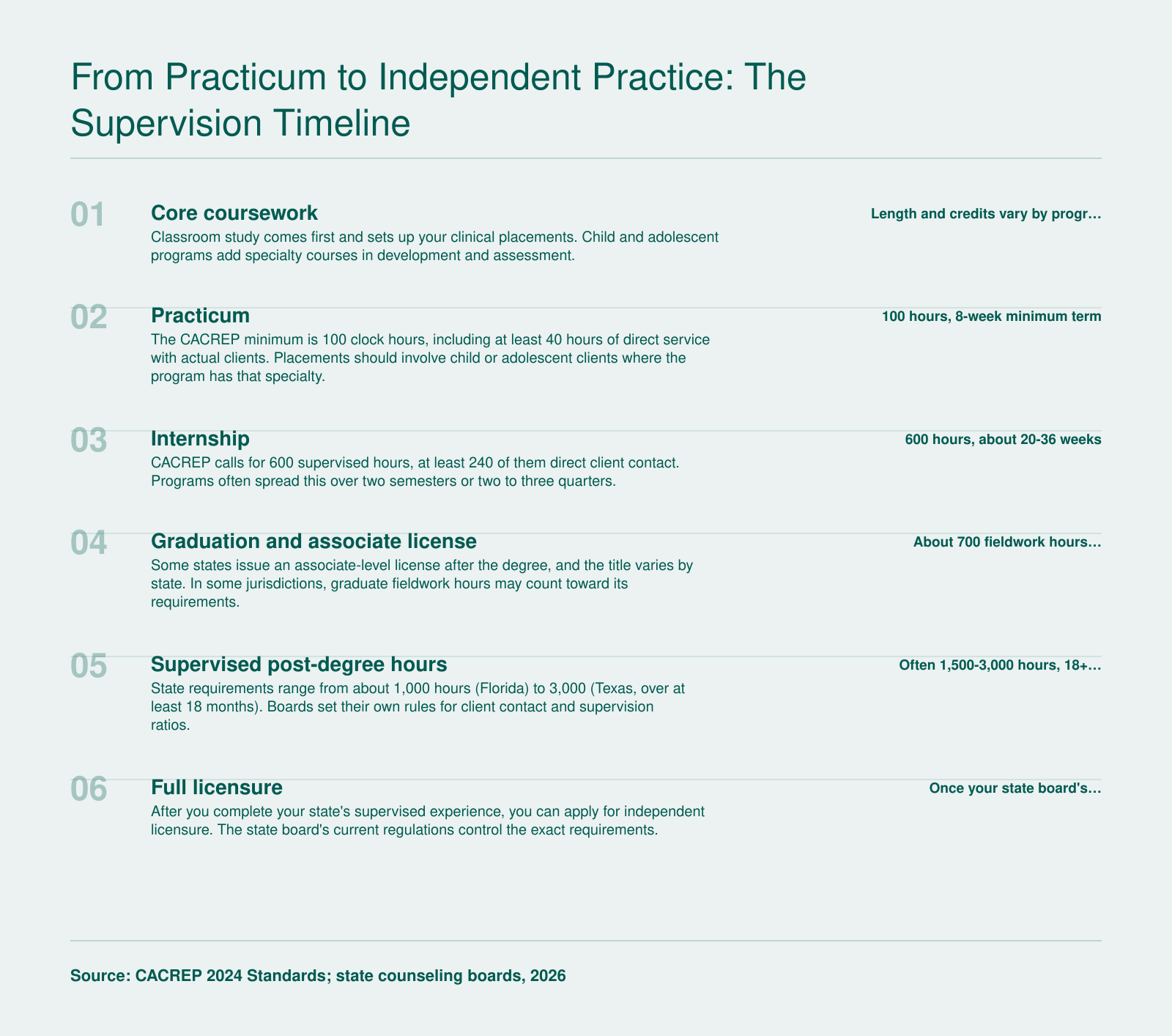
From Practicum to Independent Practice: The Supervision Timeline
Becoming a fully licensed child-focused counselor happens in stages, and the hours add up across graduate fieldwork and post-degree supervision. The ranges below are typical minimums. They vary by state and by program, so confirm the current rules with your state board before you commit to a program.
Getting in: Prerequisites, GRE Policies, and Deadlines
Requirements vary by program, so treat the figures below as examples and confirm them for your intake term.
- Bachelor's degree and prerequisitesPrograms expect an accredited bachelor's degree, but a psychology major is not always required. Prerequisites are program-specific: Golden Gate University requires none, Minnesota asks for one psychology or human development course, Brooklyn College lists 15 credits, and Alberta lists 24.
- GPA and GREA 3.0 is a common target, not a universal one. Minimums range from 2.3 at Capella's MS in Child and Adolescent Development and 2.5 at its counseling program, to 3.0 at Marquette and Minnesota and 3.30 at Brooklyn College. Hartford asks for a B average. The GRE is increasingly not required, as at Brooklyn, Chico State, Hartford, and Capella, though a few programs still prefer scores.
- Letters, statement, resume, interviewAlberta, Chico State, and Minnesota each require three recommendation letters. Expect a personal statement and transcripts, and sometimes a resume or relevant experience. Check each program's page for interview requirements.
- Background checksThese are not a universal admissions requirement. They typically come before child-facing practicum or internship placements, and may include fingerprinting or other screening depending on the program and state.
- DeadlinesNo national standard exists. San José State lists October 1, 2026, and Golden Gate lists November 8, 2026. Minnesota's deadline is February 15, and Chico State accepts applications from August 1, 2026 through February 12, 2027. Some rolling-admission programs accept applications later, so verify each date directly.
What Licensed Child-Focused Counselors Earn Nationally
Marriage and family therapists, a licensure path many child-focused master's graduates pursue, earn a national median of:
Child Psychology programs by state
Compare Child Psychology programs on the data that matters
Explore more Psychology specializations or browse every graduate field.
All Psychology programs