Best Online Master's in Child Psychology Programs
Compare 7 accredited online Child Psychology programs, with graduate earnings, cost, debt, and completion data from IPEDS and the U.S. College Scorecard.

Which online child psychology master's actually leads somewhere: licensure, a doctorate, or applied child development work? Many programs advertise the degree and never say. Most states reserve the title "psychologist" for doctoral-level practitioners, so the credential's value depends on the track behind it.
Every program ranked here is 100% online, with no required hybrid sessions or campus residency. Tuition, fieldwork rules, and accreditation vary widely across online master's programs, and those differences decide whether the degree pays off.
Key Points
- Capella online child psychology graduates earned a median $48,770 after five years.
- NYU's online program requires 100 practicum hours plus a 600-hour internship.
- Published tuition omits mandatory fees and transfer limits that inflate cost.
Top 100% Online Child Psychology Master's Programs, Ranked
These four programs deliver the master's in child psychology fully online, with no campus visits required. Hybrid and in-person options were excluded from this list.
Southern New Hampshire University
#1Manchester, NH · ~$21,000/yr (est.)
Best for: Working adults needing flexible 10-week terms
Southern New Hampshire University's MS in Psychology with a Child and Adolescent Psychology concentration examines psychological growth from childhood through adolescence through developmental psychology, cognitive neuropsychology, and intervention strategies. The 36-credit program uses 10-week online terms and can be completed in as few as 15 months. Institution-wide, about 43% of students graduate, and the average net price is approximately $36,708.
- 36 credit hours across 12 courses
- 10-week online terms; finish in as few as 15 months
- $659 per credit; $23,724 total program tuition
- No entrance exam or application fee
- Capstone integrates learning across the concentration
- Transfer up to 12 credits
Capella University
#2Minneapolis, MN · $15,000 – $20,000/yr (est.)
Best for: Self-paced learners choosing FlexPath billing sessions
Capella University's MS in Psychology, Child and Adolescent Development runs through two competency-based online formats, FlexPath and GuidedPath. FlexPath uses self-paced billing sessions, while GuidedPath follows a structured 53-quarter-credit sequence, and neither requires the GRE or GMAT. The school graduates about 20% of students institution-wide, and the average net price is approximately $17,956.
- FlexPath self-paced and GuidedPath structured formats
- FlexPath: 27 program points; GuidedPath: 53 quarter credits
- No GRE, GMAT, or application fee; 2.3 GPA minimum
- Four core and six specialization courses
- Integrative project required
- Not designed for counselor or psychologist licensure
- FlexPath billing sessions at $3,075 per 12 weeks
National University
#3San Diego, CA · ~$16,000/yr (est.)
Best for: Child advocates seeking internships and partnerships
National University's MS in Child and Adolescent Developmental Psychology blends theory with a choice of capstone or a 100-hour internship, and uses a one-to-one learning model with no group projects and rolling Monday starts. The school maintains partnerships with child and adolescent behavioral organizations, which may be useful for advocacy and school-based work. Institution-wide, about 43% of students graduate, and the average net price is approximately $22,878.
- 30 credit hours across 10 courses
- Finish in 16 months with rolling Monday starts
- Capstone or 100-hour internship option
- No GRE, essays, exams, or application fee
- One-to-one learning model with no group projects
- Up to 12 transfer credits accepted
Touro University Worldwide
#4Los Alamitos, CA · ~$9,000/yr (est.)
Touro University Worldwide's MA in Psychology with a Child and Adolescent Development concentration is taught by scholar-practitioners and uses 8-week courses with six start dates per year. The 36-credit program can be finished in as few as 12 months of full-time study and does not lead to licensure. The school graduates about 29% of students institution-wide, and the average net price is approximately $19,058.
- 36 credit hours with 8-week courses
- Finish in as few as 12 months full-time
- Six start dates per year
- No GRE or entrance exam required
- No residency required
- Taught by scholar-practitioners
- Does not lead to licensure
Cost & outcomes by school
Federal data for the highest-earning Child Psychology programs, independent of the ranking above. Earnings are this field's master's graduates four years after completing, where the Scorecard reports them.
| School | Earnings | Tuition / yr | Debt | Grads/yr | Format |
|---|---|---|---|---|---|
| Capella University MN | $53,408 | $15,092 | $43,258 | 130 | Online |
| Touro University Worldwide CA | — | $9,000 | — | — | Online |
| National University CA | — | $16,416 | — | — | Online |
| Southern New Hampshire University NH | — | $21,387 | — | — | Online |
| Northcentral University CA | — | $17,998 | — | 39 | Online |
| Northeastern University MA | — | $26,020 | — | — | Online |
| Northeastern University MA | — | $29,174 | — | 8 | Online |
Sources: U.S. Department of Education. Tuition and graduates: IPEDS. Earnings and debt: College Scorecard, this field's master's graduates; a dash means no figure is reported.
Can an Online Master's Make You a Licensed Child Psychologist?
In nearly every state, the protected title "psychologist" requires a doctorate plus a predoctoral internship, so a master's in child psychology alone will not get you there. What a master's can do is open related licenses and applied roles, and the difference comes down to how the program is built.
Clinical versus nonclinical tracks
Programs anchored in counseling psychology coursework with supervised practicum hours can feed licensure as an LPC or LMFT, the realistic clinical route into child work. In Texas, for example, an LPC associate completes 3,000 hours over at least 18 months, including 1,500 direct counseling hours and four supervision hours monthly; the LMFT associate path runs 3,000 hours over two years with 500 of the direct hours involving couples or families. Research-oriented or child development master's degrees, by contrast, prepare you for doctoral study, program evaluation, early intervention, or policy work.
States with master's-level credentials
A minority of states license master's practitioners under titles like Licensed Psychological Associate or Psychological Examiner. Texas requires 60 graduate credits, with no more than 12 in practicum or internship. Vermont's examiner credential calls for 4,000 supervised hours split between internship and post-graduate work, under two supervisors. Virginia licenses a master's-level psychological practitioner. Arizona does not: a doctorate and a 1,500-hour predoctoral internship are mandatory.
Confirm your own board's credit and practicum rules before you enroll.
Child Psychology vs. Child Development vs. Child Life Degrees
These three degrees sound similar but follow different career tracks. A master's in child psychology focuses on behavior, assessment, and clinical or behavioral health roles; a child development master's centers on growth, family systems, and education or program settings; a child life master's prepares students for hospital based certification. In short, choose child psychology for counseling and behavioral health, child development for early childhood education and program management, and child life for the Certified Child Life Specialist credential.
| Master's in Child Psychology | Master's in Child Development | Master's in Child Life |
|---|---|---|
| Coursework focus | Array | |
| Typical jobs | Array | |
| Licensure or certification path | Array |
Related Articles
Lowest-Cost Fully Online Options and the Fees Tuition Leaves Out
Published tuition rarely equals all-in cost for an online child psychology master's degree. The table below shows the most affordable published rates from the cited 2026 data and the separate fees or transfer limits that are documented. Schools listed without separate fee detail have not had their technology, practicum, background-check, textbook, or proctoring charges established in the cited sources.
| School | Published tuition | Published fee or transfer detail |
|---|---|---|
| Fayetteville State University | $3,438 in-state; $8,595 out-of-state annually | Separate technology, distance, practicum, background-check, textbook, and proctoring fees not published in cited sources |
| Angelo State University | $4,181 in-state; $11,471 out-of-state annually | Separate technology, distance, practicum, background-check, textbook, and proctoring fees not published in cited sources |
| Texas A&M University-Central Texas | $5,353 in-state; $12,697 out-of-state annually | Separate technology, distance, practicum, background-check, textbook, and proctoring fees not published in cited sources |
| Florida Atlantic University | $5,466 in-state; $16,695 out-of-state annually | Separate technology, distance, practicum, background-check, textbook, and proctoring fees not published in cited sources |
| Emporia State University | $5,578 in-state; $7,726 out-of-state annually | Separate technology, distance, practicum, background-check, textbook, and proctoring fees not published in cited sources |
| University of West Alabama | $429 per credit | $75 per semester technology fee; applicability to all online psychology students not specified |
| University of Louisiana at Monroe | $499 per credit | Separate fee amounts not published in cited sources |
| Southern New Hampshire University | $659 per credit | Accepts up to 12 transfer credits; requires at least 24 credits completed at SNHU |
| University of Phoenix | $698 per credit | $195 per-course resource fee; courses typically 3 credits, range 1 to 6 |
| Walden University | $610 per quarter credit; 48 quarter credits required | $185 per quarter program fee; estimated $30,205 at minimum completion; accepts up to 24 transfer credits |
| Liberty University | Not published in cited source | Accepts transfer credit for up to 50% of required credits; no fixed 6-credit or 12-credit ceiling |
Practicum and Internship Rules for Online Students
NYU's online program requires 100 practicum hours plus a 600-hour internship, and that pairing is typical of clinical tracks in online master's in clinical psychology programs.
Practica commonly run 100 to 150 hours. Texas A&M, Corpus Christi, Hood College, and NYU set 100, with 40 or more direct client-contact hours. Denver asks for 150 at roughly 15 hours a week. Internships usually start at 600 hours, often 20 to 25 hours weekly. Programs built around clinical child work can expect more, such as Illinois's two nine-month practica.
In an online master's in psychology, coursework is online, but fieldwork happens near home. Many programs expect you to find a local site and supervisor, and the school then approves them. NYU's placement team arranges sites within 75 miles of your address. Arcadia requires site approval and online group supervision twice a month. Before enrolling, ask who secures placements and what happens if no approved site is nearby.
Accreditation Checks to Run Before You Apply
Before you apply, run these four checks on the program and your state.
- Verify institutional accreditation.Search the U.S. Department of Education's DAPIP or CHEA directory for the school's recognized accreditor and status, not just the school's own “accredited” claim.
- Check programmatic accreditation for counseling routes.APA does not accredit master's programs, so if you're aiming for a counseling license, confirm MPCAC or CACREP accreditation as applicable.
- Confirm state authorization.Ask whether the program is authorized to enroll online students in your state, including SARA participation if relevant.
- Get licensure coursework in writing.Request written confirmation that the curriculum meets your state board's licensure coursework requirements before enrolling.
What Graduates of These Programs Earn
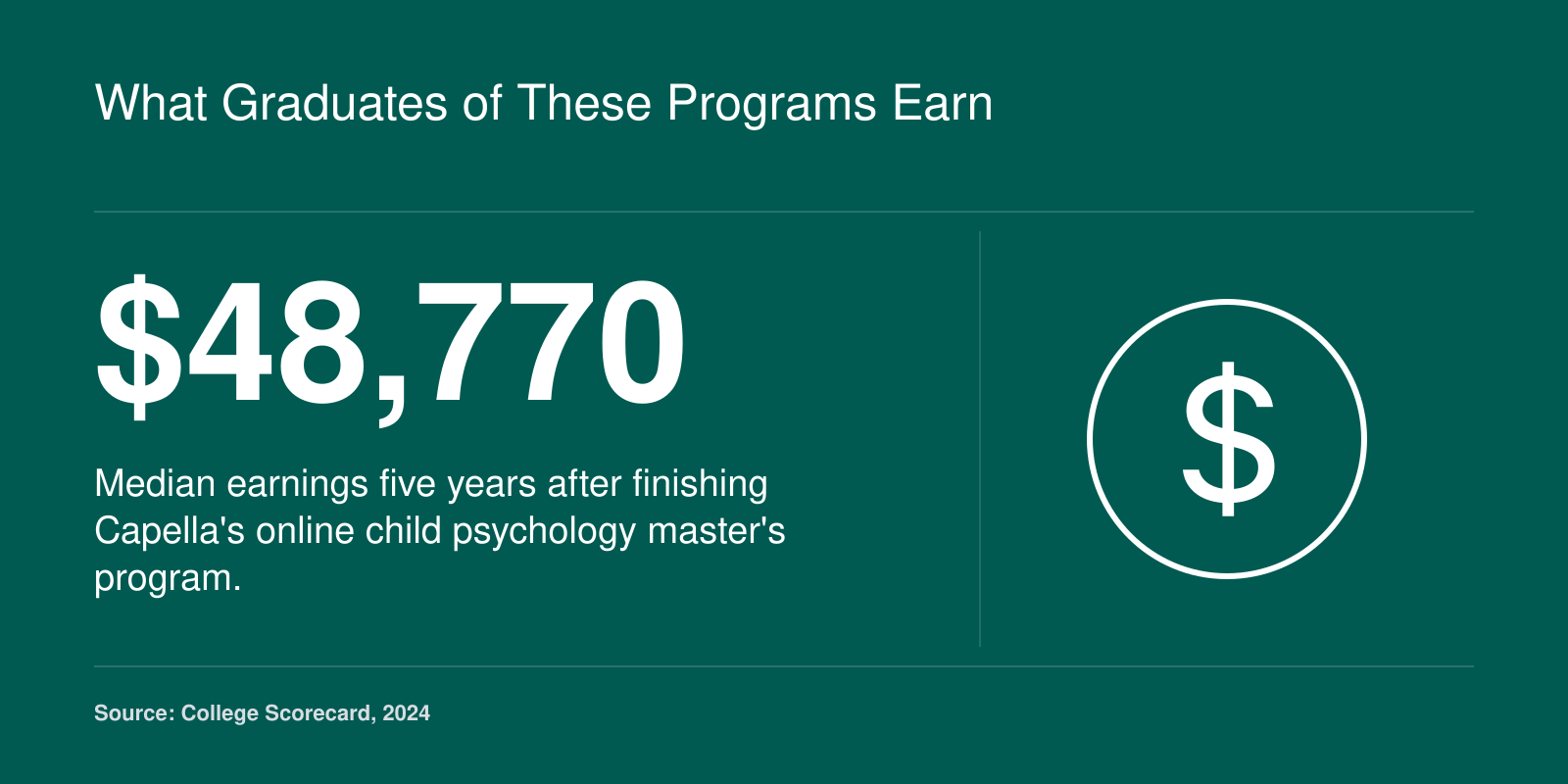
For graduates of Capella University's online child psychology master's, the median earnings five years after finishing were $48,770. Median federal debt for these same graduates was $43,258.
Careers You Can Pursue With a Child Psychology Master's
The jobs this degree opens have shifted toward community and school psychology settings faster than toward private practice. Graduates land in behavioral support and case management, child welfare and family services, research coordination at universities or hospitals, and early intervention work with infants and toddlers. With the right state license layered on top, child and adolescent counseling is on the table too, though that path depends on the counseling psychology coursework and supervised hours discussed earlier.
Employers rarely ask about delivery format. They check accreditation and whether you hold (or can earn) the license the role requires. Your diploma and transcript typically carry the university's name without noting that coursework happened online.
If you want the psychologist title, treat the master's as a stepping stone: many graduates use it to strengthen a PsyD or PhD application, and some credits transfer.
Next step: shortlist two programs from the ranking above and email each admissions office two questions. Does the program place students in practicum sites, and does its curriculum align with child psychology master's licensure requirements in your state?
Child Psychology programs by state
Compare Child Psychology programs on the data that matters
Explore more Psychology specializations or browse every graduate field.
All Psychology programs