Master's in Child Psychology Programs With No GRE Required
Compare 17 accredited no-gre Child Psychology programs, with graduate earnings, cost, debt, and completion data from IPEDS and the U.S. College Scorecard.

Many child psychology master's programs have dropped the GRE, but "no GRE" collapses score-optional, score-blind, and GPA-triggered waiver policies that shift by school and admissions cycle. This is a verification guide, not a ranking, and it claims no count.
The work is decoding policy language, confirming it on admissions pages, then checking accreditation, state licensure fit, cost, and format. A program that waives the GRE but can't route graduates toward licensure in the student's state leaves the degree unable to pay for itself.
Key Points
- No GRE can mean optional, waived, or not accepted.
- Verify a program's current GRE policy on its admissions page in 2026.
- A master's alone won't make you a child psychologist.
Master's in Child Psychology Programs With No GRE Required
-
#1
Capella University
MS in Psychology, Child and Adolescent Development
$53,408median earnings $15,092grad tuition / yr $43,258median federal debt 130grads / yrNo GRE required53 credits10 monthsVisit program site →64score -
#2
Touro University Worldwide
Master of Arts in Psychology
$9,000grad tuition / yrNo GRE required36 credits1 yearVisit program site →60score -
#3
Assumption University
Clinical Counseling Psychology
$15,470grad tuition / yrNo GRE required60 credits2 yearsVisit program site →54score -
#4
National University
Master's Degree in Child & Adolescent Developmental Psychology
$16,416grad tuition / yrNo GRE required30 credits16 monthsVisit program site →53score -
#5
Southern New Hampshire University
Master of Science in Psychology
$21,387grad tuition / yrNo GRE required36 credits15 monthsVisit program site →48score -
#6
Northcentral University
Master of Science in Child and Adolescent Developmental Psychology
$17,998grad tuition / yr 39grads / yrNo GRE required30 credits16 monthsVisit program site →48score
How we rank. Each program is scored on graduate figures only: the field's master's earnings and debt, graduate tuition and the number of master's graduates, normalized across all programs in this field. Data comes from the U.S. Department of Education's IPEDS and College Scorecard; no school pays for placement.
Compare the top programs
| Rank | School | Earnings | Tuition / yr | Debt | Grads/yr | Format |
|---|---|---|---|---|---|---|
| 1 | Capella University MN | $53,408 | $15,092 | $43,258 | 130 | Online |
| 2 | Touro University Worldwide CA | — | $9,000 | — | — | Online |
| 3 | Assumption University MA | — | $15,470 | — | — | Campus |
| 4 | National University CA | — | $16,416 | — | — | Online |
| 5 | Southern New Hampshire University NH | — | $21,387 | — | — | Online |
| 6 | Northcentral University CA | — | $17,998 | — | 39 | Online |
Sources: U.S. Department of Education. Tuition and graduates: IPEDS. Earnings and debt: College Scorecard, this field's master's graduates; a dash means no figure is reported.
Why 'No GRE' Doesn't Always Mean 'No Test Required'
Admissions offices now use several different GRE policies, and the phrase "no GRE" is often applied to all of them, including No-GRE master's programs.
Four policy types
- No GRE: Scores are not required, and the program may not accept them at all.
- Test-optional: Scores are considered if you send them.
- Test-blind: Scores are ignored even if submitted.
- Conditional waiver: The GRE is required unless you meet a GPA, prior graduate degree, or work-experience threshold.
What program pages currently say
National University's online MS in Child & Adolescent Developmental Psychology, a master's in child psychology program, lists no GRE or GMAT requirement, though its page names no cycle. Claremont Graduate University's MA in Psychology (Positive Developmental Psychology and Evaluation) is test-optional for Spring 2027, with a November 1, 2026 priority deadline.1 The University of Washington's MA in Applied Child & Adolescent Psychology is test-blind for 2026-2027, and its application deadline is December 1, 2026.
Why lists go stale
Some programs dropped the GRE temporarily during COVID-era cycles and later reinstated it. Third-party lists, including older roundups, can lag behind those changes. Treat any list as a starting point, and confirm the policy, the cycle it applies to, and whether it covers your specific track on the program's own admissions page. Policy type is only an admission criterion. It says nothing about quality or cost.
How to Verify a Program's GRE Policy on the Admissions Page
A no-GRE label is only as reliable as the page that confirms it. Check these details before you apply.
- Start with the program-specific pageGo to the department's program admissions page rather than the graduate school's general page; department rules can differ.
- Find the effective term and update dateLook for the admissions cycle the policy applies to, such as Fall 2027, and a last-updated date.
- Read for conditional languageWatch for phrases like "may be waived," "recommended," or "for applicants with a GPA below…" that leave the policy conditional.
- Compare online, campus, and funding groupsCheck whether the policy differs for online vs. campus or funded vs. unfunded applicants.
- Get written confirmationEmail admissions and save the written reply confirming the policy for your entry term.
- Confirm financial aid impactAsk whether skipping the GRE will affect assistantship or scholarship eligibility.
Admission Requirements Beyond the GRE
If a master's in psychology program drops the GRE, what does it look at instead? Mostly your transcript, your writing, and the people who vouch for you.
GPA and coursework
A 3.0 minimum is the most common threshold in child psychology master's programs and child development master's programs, and it is the stated floor at schools including Texas Woman's University, Cal Poly, Michigan State, and Montclair State. How it gets calculated varies: some count your full record, others only the last 60 semester credits or the final two undergraduate years. Review thresholds can sit lower, around 2.5 at Cal Poly and CSU Northridge, while Montclair State will weigh applications between 2.7 and 3.0 when the rest of the file is strong and does not consider anything below 2.7. Developmental psychology programs overall span roughly 2.5 to 3.5 and up.
Prerequisites cluster around introductory psychology, developmental or lifespan psychology, statistics, and research methods. Some are narrow: Florida asks for at least one statistics course, Minnesota for one psychology or human development course at B or higher. Others are broader: Georgian Court adds abnormal psychology, and Cal Poly adds abnormal psychology and personality theory.
Non-psychology majors
A psychology bachelor's is often not mandatory. Cal Poly accepts a wide variety of undergraduate degrees; Texas Woman's wants a relevant bachelor's but may consider others showing academic promise. Montclair State is stricter, requiring a psychology degree or at least 12 undergraduate psychology credits including statistics and experimental methodology, with introductory psychology not counting toward that total. Kansas recommends 15 credit hours. Leveling policies differ: some want prerequisites finished before enrollment, others allow them during the first term.
Everything else in the file
Expect a personal statement, a resume, and recommendation letters to carry real weight when there is no test score. Experience with children matters, and Pittsburgh requires it outright. Interviews are common, and practicum placements routinely trigger background checks, so resolve any clearance issues early.
Related Articles
Clinical, Counseling, School, and Developmental Tracks: Accreditation and Licensure Compared
Institutional accreditation is the baseline for all four tracks because it is generally required for federal student aid and for smoother credit transfer. Programmatic accreditation, such as CACREP, COAMFTE, or NASP, can simplify state licensure, but American Psychological Association (APA) accreditation applies to doctoral programs rather than terminal master's programs. Developmental or child psychology master's tracks usually lead to research, policy, and education roles rather than clinical licensure.
| Track | Key accreditor | Typical credential or license | Common child-focused careers |
|---|---|---|---|
| Clinical or mental health counseling with a child focus | Council for Accreditation of Counseling and Related Educational Programs (CACREP) | State counselor licensure, based on state education, supervised experience, examination, and other requirements | Child or adolescent counselor, school counselor, and related counseling roles |
| Marriage and family therapy | Commission on Accreditation for Marriage and Family Therapy Education (COAMFTE) | State marriage and family therapist licensure, based on state education, supervised experience, examination, and other requirements | Marriage and family therapist serving children, adolescents, couples, and families |
| School psychology | National Association of School Psychologists (NASP) | School psychologist state licensure and/or Nationally Certified School Psychologist (NCSP) certification; state alternative routes may apply | School psychologist |
| Developmental or child psychology (non-licensure) | Institutional accreditation; American Psychological Association (APA) accreditation does not apply to terminal master's programs | A master's degree in psychology does not by itself establish psychologist licensure; state rules determine whether it supports another behavioral-health credential | Psychology support, assessment, research, behavioral-health, or case-management roles with a child focus |
Can You Get Licensed? State Rules That Shape Your Choice
A license is a state's permission to practice independently as a counselor, therapist, or school psychologist. Each state writes its own child psychology master's licensure requirements for coursework, supervised hours, and exams. Counseling licenses often call for about 60 credit hours, but the details change at every state line.
California shows how layered this gets. Its Board of Behavioral Sciences issues the LPCC and LMFT licenses:
- LPCC: A degree of at least 60 semester units with 700 practicum hours1, then 3,000 supervised post-degree hours over at least 104 weeks2.
- LMFT: The same 3,000 post-degree hours across at least 104 weeks3.
School psychologists in California, including those in a Master's in School Psychology With No GRE Required program, take a separate route: a Pupil Personnel Services credential, which authorizes work based on the duties performed, not the job title.4 Texas offers a master's-level school psychology credential, the Licensed Specialist in School Psychology (LSSP). Confirm its current requirements with state regulators before you enroll.
Can an online master's lead to licensure? Yes, an online child psychology degree can lead to licensure if it is properly accredited and meets your state's credit, practicum, and supervision rules. Before you apply, check the program's state authorization or licensure disclosure page to confirm it meets requirements in your home state.
What a Child Psychology Master's Really Costs
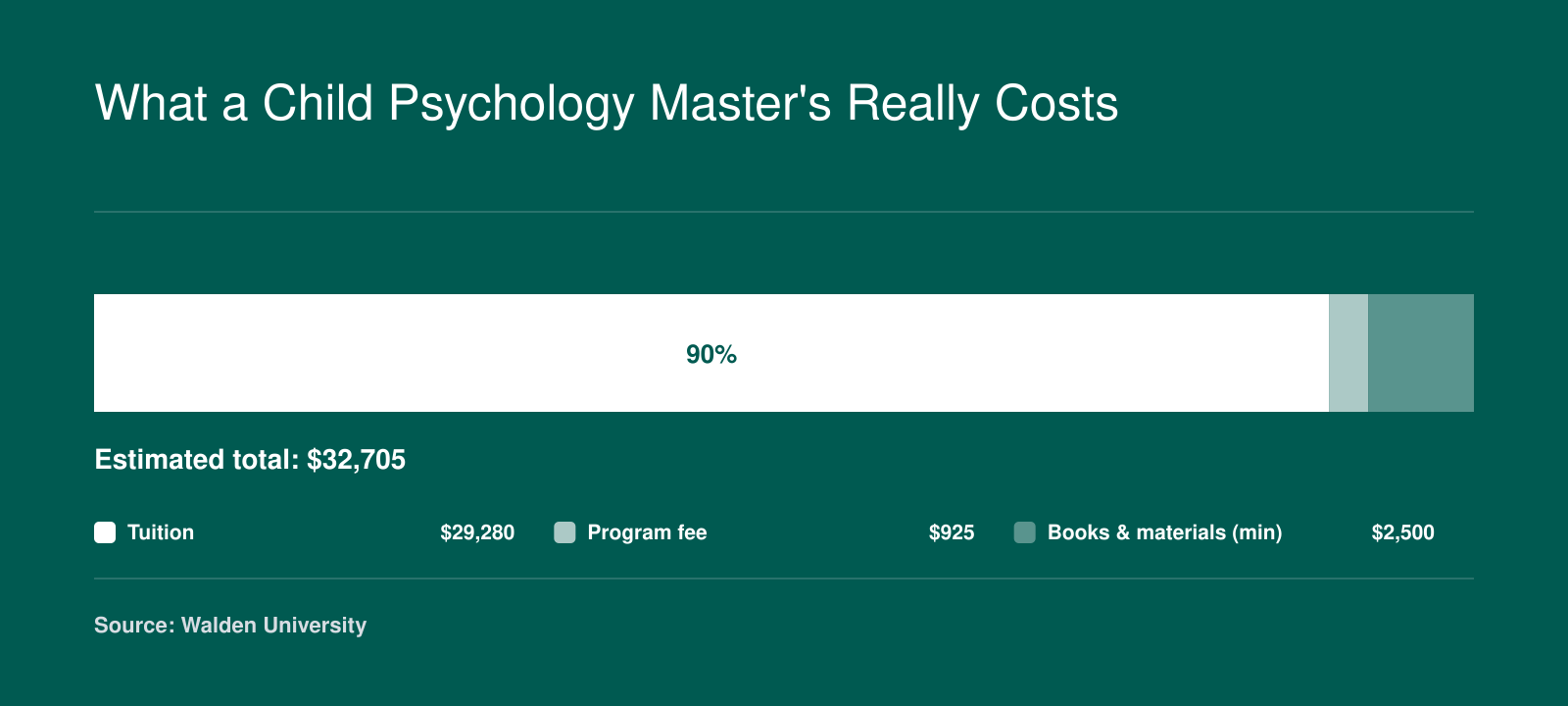
Most advertised per-credit rates understate the full bill. For example, Walden's 48-credit M.S. in Developmental Psychology lists $610 per credit, or $29,280 in tuition, plus a $925 program fee and $2,500-$3,500 for books and materials. Tuition-free options are rare; assistantships or employer tuition benefits are the realistic paths, so multiply a published per-credit rate by 30-60 credits, then add technology, practicum, background-check, and graduation fees before comparing.
Online vs. Campus Formats and Practicum Placement
Fully online no-GRE programs split between asynchronous courses you complete on your own schedule and synchronous classes with set live meeting times. Both can suit working students, but the two models' fieldwork expectations are similar: licensure-track child-focused counseling degrees still require in-person clinical hours.
For CACREP accredited counseling psychology master's programs no GRE, that commonly means 100 practicum hours plus 600 internship hours. Some online programs add required on-campus immersions, such as two in-person Chicagoland sessions in Northwestern's online MA in Counseling, while Marquette's online clinical mental health counseling program reports no residency requirement. Ask a program directly whether it arranges local placements or expects you to secure your own site and supervisor. Marquette and Holy Cross describe help matching students with approved sites; Walsh's School Counseling Master's With No GRE Required does as well, and Liberty states no placement guarantee. Non-licensure child development and early childhood programs may substitute a capstone or thesis for fieldwork, though some, such as Minnesota's child life program, still require 600 internship hours.
Child Psychology programs by state
Common Questions About No-GRE Child Psychology Master's Programs
Applicants often search for no-GRE child psychology master's programs without realizing that licensure and program availability depend on state rules and each school's policy. These answers clarify common points of confusion.
Can I become a licensed child psychologist with an online master's degree?
Are there fully online child psychology master's programs with no GRE?
Is a free master's in child psychology with no GRE realistic?
Will skipping the GRE hurt my chances of funding or a later PhD application?
Compare Child Psychology programs on the data that matters
Explore more Psychology specializations or browse every graduate field.
All Psychology programs