Best MPH Programs in Maryland
Compare 4 accredited Public Health (MPH) programs in Maryland, with graduate earnings, cost, debt, and completion data from IPEDS and the U.S. College Scorecard.

Johns Hopkins graduates carry a median of about $65,952 in debt after an MPH, while University of Maryland-College Park graduates carry about $41,326. That gap matters in a state where Baltimore's research hospitals and the federal health agencies around Washington give MPH graduates an unusually dense employer base.
Every qualifying Maryland MPH program, campus and online, appears on one ranked list.
The real decisions are practical: Johns Hopkins versus UMD, GRE rules, part-time paths, and whether earnings justify the price.
Key Points
- Johns Hopkins graduates carry median debt of $65,952, versus $41,326 at University of Maryland-College Park.
- Johns Hopkins lets students study online, onsite, or in a mix of both.
- Johns Hopkins requires a practicum of at least 100 hours at an established organization.
Best MPH Schools in Maryland: 2027 Ranked List
This list rewards Maryland master's programs that pair manageable cost with strong completion and solid graduate earnings, rather than name recognition alone. Four CEPH-accredited MPH options made the list, from a flexible Johns Hopkins program to a hybrid urban-health program at Morgan State. Compare cost and format side by side before you decide that a bigger name is the better value.
Johns Hopkins University
#1Baltimore, MD · ~$65,000/yr (est.)
Best for: Working professionals needing flexible online pacing
Johns Hopkins Bloomberg School of Public Health offers the most flexible MPH in Maryland, with onsite, online, and hybrid routes that run from 11 months to four years. Schools offering this program graduate about 94%, the highest completion rate on this list. Full-time tuition is $85,740 for 2025-26, but online and part-time students receive a Welch Scholarship that brings the 80-credit rate to $1,111 per credit. Epidemiology and biostatistics are the quantitative strength, through the combined Epidemiologic and Biostatistical Methods concentration.
- 80 credits; 11 months full-time or up to 4 years part-time
- Online, onsite, or hybrid, with three start dates a year
- Concentration: Epidemiologic and Biostatistical Methods for Public Health and Clinical Research
- Other concentrations include Aging and Public Health and Child and Adolescent Health
- 100-hour practicum plus a capstone project
- Standardized tests optional; about two years of health-related experience generally required
- STEM-designated, with OPT extension eligibility
- Welch Scholarship for online/part-time; Bloomberg Fellowship by separate application
University of Maryland-College Park
#2College Park, MD · ~$18,000/yr (est.)
Best for: Maryland residents focused on in-state tuition value
The University of Maryland, College Park offers a 45-credit MPH with a cohort model and an integrated core in epidemiology, biostatistics, policy, ethics, and leadership. Schools offering this program graduate about 89%. The 2026-27 School of Public Health rate is $1,120 per credit for in-state students versus $2,075 out-of-state, so Maryland residents get a real discount. Its position in the Maryland and DC capital region opens internships and capstones with government agencies and nonprofits, and a fully online Global Public Health MPH is slated to launch in fall 2027.
- 45 credits, completed in two years full-time
- Nine concentrations, including an online Public Health Practice and Policy track
- Integrated core in epidemiology, biostatistics, and policy planning
- Cohort-based learning model
- Internship and capstone access across the Maryland/DC capital region
- Separate in-state and out-of-state per-credit tuition
University of Maryland, Baltimore
#3Baltimore, MD · ~$18,000/yr (est.)
Best for: Aspiring epidemiologists wanting small cohorts
The University of Maryland, Baltimore houses its MPH in the School of Medicine, with three concentrations: Community & Population Health, Epidemiology, and Global Health. The cohort is small, about 50 students, and the program offers both full-time and part-time study. Joint degree options with law, medicine, nursing, and other professional schools suit students who want to combine public health with a clinical or legal credential.
- 42 credits with full-time and part-time options
- Concentrations: Community & Population Health, Epidemiology, Global Health
- Approximately 50 students per cohort
- Fall start in July
- Joint degree options with law, medicine, nursing, and other schools
- Low student-to-faculty ratio
Morgan State University
#4Baltimore, MD · $5,000 – $10,000/yr (est.)
Morgan State University in Baltimore runs a 48-credit MPH built around urban community health, with a generalist track and an Executive Health Management option. Delivery is hybrid, and each cohort starts in the fall. Admission calls for a bachelor's degree and a minimum 3.0 GPA. Schools offering this program graduate about 41% overall, so ask the department about completion for MPH students specifically.
- 48 credits including a practicum and capstone
- Generalist and Executive Health Management concentrations
- Urban public health focus on underserved communities
- Core domains: environmental health, quantitative analysis, health planning, social/behavioral science
- 3.0 minimum GPA; fall start only
- Hybrid delivery
Cost & outcomes by school
Federal data for the highest-earning Public Health (MPH) programs, independent of the ranking above. Earnings are this field's master's graduates four years after completing, where the Scorecard reports them.
| School | Earnings | Tuition / yr | Debt | Grads/yr | Format |
|---|---|---|---|---|---|
| Morgan State University MD | — | $9,981 | — | 536 | Hybrid |
| University of Maryland-College Park MD | — | $18,276 | — | 5,672 | Campus |
| University of Maryland, Baltimore MD | — | $17,827 | — | 1,906 | Campus |
| Johns Hopkins University MD | — | $64,730 | — | 17,502 | Hybrid |
Sources: U.S. Department of Education. Tuition and graduates: IPEDS. Earnings and debt: College Scorecard, this field's master's graduates; a dash means no figure is reported.
How We Built This Maryland MPH Master's Ranking
How do you tell a strong Maryland MPH from a well-marketed one? We start with cost and completion figures from federal IPEDS data to rank the best MPH programs in Maryland, then add program-level earnings and debt from College Scorecard. Net price is an average after aid, not a quote, so your own bill will differ among the most affordable MPH programs.
CEPH accreditation is the trust baseline for every school here. Johns Hopkins and the University of Maryland, College Park are accredited at the school level, while the University of Maryland, Baltimore holds MPH program-level accreditation. Both Maryland campuses are accredited through July 1, 2030, and Morgan State through December 31, 2031. A secondary source reports the same 2030 date for Johns Hopkins, but confirm it on the CEPH list.
The limits are real. Graduation rates cover the whole institution, not just the MPH, and some programs publish no program-level earnings, so those gaps stay visible rather than estimated.
Online, Hybrid, and Part-Time MPH Master's Options in Maryland
Fully remote study versus evenings on campus: in Maryland both exist, but "online" means something different at each school.
Johns Hopkins runs its MPH online, onsite, or as a mix. The Online Plus route is the closest thing to remote study here, though it still requires at least four credits completed onsite in Baltimore. Morgan State offers the clearest fully online track among Maryland's online MPH programs: its Executive Health Management concentration is delivered online at 42 credits (35 coursework plus a 7-credit capstone)1, while the Generalist concentration runs on campus with evening classes. The Baltimore campus of the University of Maryland allows full-time or part-time enrollment, and its Global Health concentration meets virtually in live sessions.
Timelines
Speed varies widely. Hopkins full-time students finish in 11 months (late June or early July start), online and part-time students typically take two to three years at one to three courses per term, and the degree must be completed within four years. Morgan State's accelerated MPH online sequence runs under 18 months.1
Working professionals should check start dates before format. Hopkins opens online and part-time entry in January, June, and November, while Morgan State and the Baltimore program start in fall only.
Related Articles
Which Maryland MPH Programs Waive or Drop the GRE?
Do you still need to take the GRE to apply to a Maryland master's in public health? For most MPH applicants to master's programs in Maryland, the short answer is no. The testing landscape has shifted toward optional or waived requirements among No-GRE master's programs, though the specifics vary by school and change from one admissions cycle to the next.
Most of these programs use SOPHAS, the centralized public health application service, sometimes paired with a university supplemental form. Where a test waiver applies, the common triggers are a prior graduate degree or substantial professional experience; admissions committees then lean on transcripts and application essays to gauge quantitative readiness.
- Johns Hopkins Bloomberg (MPH): Optional. Scores are not required, and applications are read holistically. Uses SOPHAS.
- University of Maryland, College Park (MPH): Not required. Uses SOPHAS plus a UMD supplemental application.1
- University of Maryland, Baltimore (MPH): GRE or substitute (MCAT, LSAT, PCAT, or DAT) required; a Fall 2026 waiver is listed. Confirm directly.
- Morgan State University (MPH): No exam required.
Policies shift each cycle, so verify the current stance on each program's admissions page before you apply.
The sticker price tells only half the story. The number that matters more is what graduates actually earn after they leave.
What an MPH Master's Costs in Maryland, Plus Certification Rules
Tuition for a master's in public health in Maryland spans a wide range, and the gap between public and private programs has only grown as costs climb statewide.
Full-Degree Cost, Not Just One Year
The most affordable path here runs through the public schools. University of Maryland, College Park charges roughly $1,120 per credit in-state, which brings its 45-credit MPH to about $50,400 before fees. University of Maryland, Baltimore sits lower still at around $946 per credit, though its full total depends on your track. At the top end, Johns Hopkins lists its 80-credit MPH near $1,429 per credit, or about $114,320 across the degree.
At the public schools, the in-state advantage is real: out-of-state per-credit rates run about $2,075 versus $1,120 in-state, so College Park's sticker price does not double for nonresidents. Morgan State's hybrid MPH (42 to 48 credits) offers another in-state option.
Certification, Not Licensure
Maryland does not license MPH holders generically. Two voluntary credentials matter:
- CPH (NBPHE): Requires a bachelor's plus five years of public health work, or a qualifying graduate degree.
- CHES (NCHEC): Requires a bachelor's and 25 semester credits across the Eight Areas of Responsibility, coursework often found in Master's in Health Education in Maryland programs.
Employers in health education and community roles often ask for one. To trim cost, pursue a graduate assistantship or establish in-state residency.
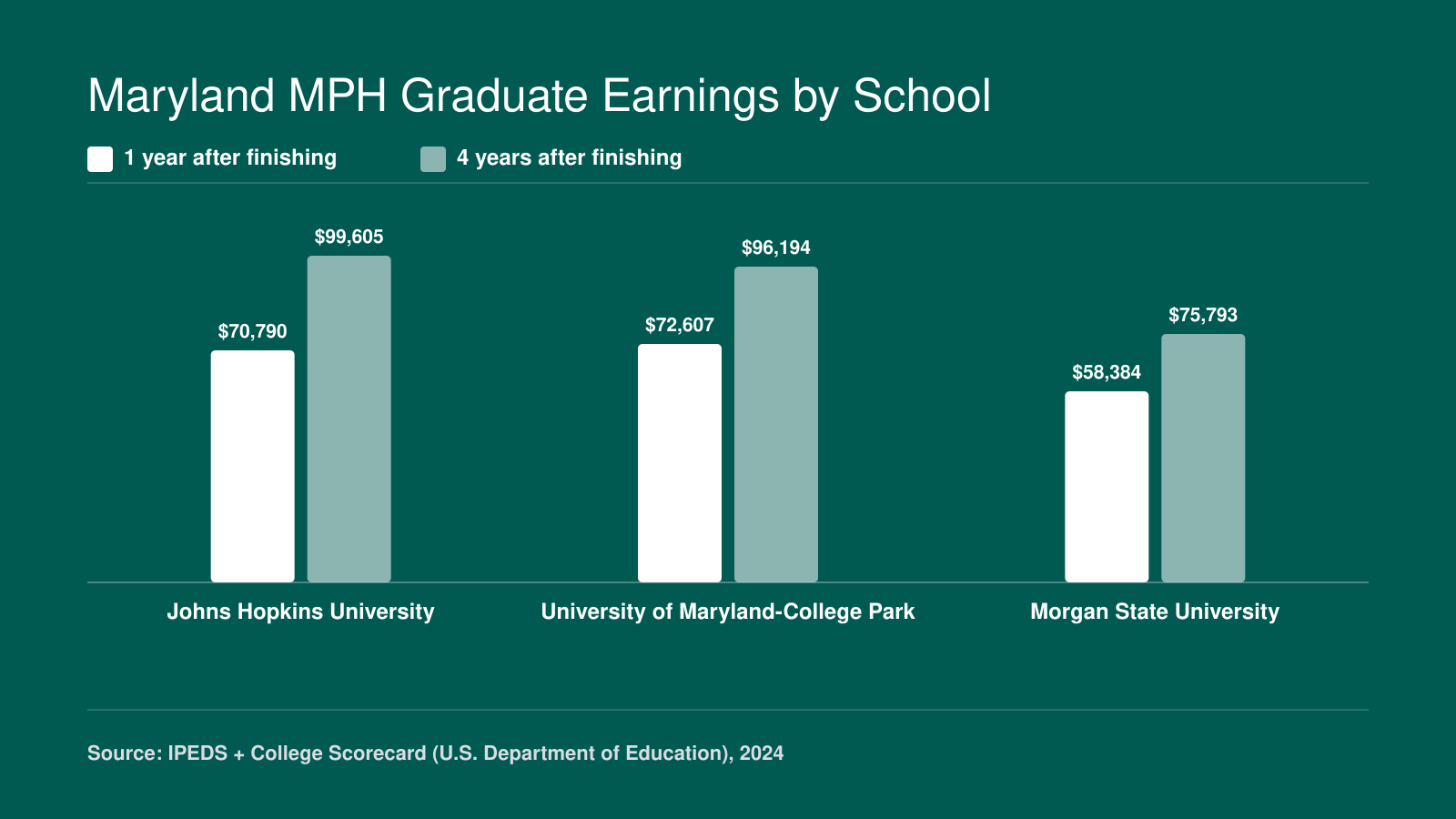
Maryland MPH Graduate Earnings by School
Median earnings for MPH graduates one year and four years after finishing, by school. Johns Hopkins graduates carry median debt of $65,952, a payment of about $750 a month. University of Maryland-College Park graduates carry $41,326 ($470 a month), and Morgan State University graduates $41,000 ($466 a month). Weigh each earnings jump against that payment. Programs without a published figure for both windows are left out.
From Practicum to Paycheck: Field Placements Across Maryland Programs
Johns Hopkins requires a population-level practicum of at least 100 hours at an established organization, approved by the MPH Practicum Team beforehand. Students can find their own site or take a practicum course, and shorter experiences can be combined. Settings include health departments, community organizations, and laboratories, plus Baltimore community placements and a small-team Biocontainment Unit practicum.
Published materials do not state required hours or name sites. Morgan State requires six practicum credits, split between service-learning and a capstone, hosted by health agencies, institutes, or academic units; hours are not specified.1 The University of Maryland, Baltimore publishes nothing we could confirm here.
Online students generally arrange fieldwork near home, so confirm that your program approves local sites. Before committing, ask admissions for a list of recent practicum sites and whether the school places you or expects you to find your own.
Quick Answers: Johns Hopkins vs. UMD and Maryland MPH Acceptance Rates
Section content unavailable.
Compare Public Health (MPH) programs on the data that matters
Explore more MPH specializations or browse every graduate field.
All MPH programs