Accelerated MPH Programs
Compare 440+ accredited fastest Public Health (MPH) programs, with graduate earnings, cost, debt, and completion data from IPEDS and the U.S. College Scorecard.

A standard MPH takes about two years. Accelerated MPH programs fit the same core courses, applied practice experience, and capstone into roughly 12 months, so graduates pay for fewer semesters and reach public health jobs a year sooner.
The cost is intensity. Many 1 year MPH programs run year-round and stack practicum hours on top of full-time coursework, which leaves little room for a paying job. The schools ranked here include online, campus, and hybrid formats, and several offer MPH programs with no GRE required; published graduate tuition ranges from $9,772 at the University of Mississippi to $68,652 at the University of Chicago.
That spread is the real decision. A faster degree only pays off when CEPH accreditation holds and the net cost stays manageable.
Key Points
- CEPH accreditation gates the federal and state jobs most MPH students want.
- Net price at the most affordable accelerated tracks undercuts published in-state tuition.
- 42% of public health employees planned to leave in March 2026.
Top 10 Accelerated MPH Programs, Fastest First
The ranking below treats time to degree as the first filter. Time to degree came first; cost, outcomes, and format decided ties. For each school, look at the program structure, accelerations, and concentrations rather than the name alone, because a shorter calendar often means an intensive schedule.
Tufts University
#1Medford, MA · ~$51,000/yr (est.)
Best for: Career changers wanting Boston health networks
Tufts offers a flexible MPH across on-campus, online, and blended formats, with an accelerated track that can be completed in 12 months. Students choose from six concentrations, including Epidemiology and Biostatistics, Global Health Science and Practice, and Nutrition, and complete an Applied Practice Experience and capstone. The Boston-area location puts learners near major hospitals and research institutions.
- Six concentrations from Epidemiology & Biostatistics to Nutrition and Health Management & Policy
- On-campus, online, and blended formats available
- Accelerated option can be completed in 12 months
- Full-time and part-time options with 3 start dates per year
- Applied Practice Experience and capstone project required
- Scholarships and financial aid available
- Small class sizes and a collaborative environment
- Test-score optional; no specific undergraduate major required
University of California-Los Angeles
#2Los Angeles, CA · ~$14,000/yr (est.)
Best for: Medical students wanting public health training
UCLA's MPH in Community Health Sciences is a two-year, on-campus program with 68 quarter credits and a 400-hour applied practice experience. It emphasizes health equity, program planning and evaluation, and offers an accelerated option for medical students and clinical doctorate holders. Graduates move into program manager, health educator, and evaluation analyst roles.
- CEPH accredited
- 68 quarter credits, typically completed in two years
- 400-hour applied practice experience
- Focus on health equity, program planning, and evaluation
- Accelerated option for medical students
- Field placement in the U.S. or abroad
- Prepares for program manager, health educator, and evaluation analyst roles
- Onsite, weekdays format
University of Virginia
#3Charlottesville, VA · ~$24,000/yr (est.)
Best for: Research-minded learners wanting intensive one-year format
UVA's MPH in Research in Practice uses 42 credits and can be finished in one intensive year or across three to four semesters. The curriculum focuses on quantitative and qualitative research, health policy, and community engagement, with combined-degree options across five schools. Students present research at state conferences and work on global projects.
- CEPH accredited
- 42 credit hours; can be completed in one intensive year
- Focus on quantitative and qualitative research methods
- Combined-degree options across five schools
- Community partnerships and global project opportunities
- Students present research at state conferences
- Financial aid available
- Windows environment required for some courses
University of Chicago
#4Chicago, IL · ~$69,000/yr (est.)
UChicago's CEPH-accredited MPH is an in-person program with four concentrations: Epidemiology and Global Health, Health Policy, Data Science, and Community Health Promotion. Students complete a practicum and capstone in a small cohort, and a 15-month path can be accelerated to 12 months for motivated learners. Full-time and part-time schedules support working professionals.
- CEPH accredited, in-person format
- Concentrations in Epidemiology & Global Health, Health Policy, Data Science, and Community Health Promotion
- 15-month curriculum with accelerated 12-month option
- Full-time and part-time schedules
- Required practicum and capstone project
- Small, focused cohort with Chicago community engagement
University of Miami
#5Coral Gables, FL · ~$47,000/yr (est.)
Miami offers a CEPH-accredited MPH that can be completed as a traditional two-year path or an accelerated one-year option. The 42-credit curriculum covers biostatistics, epidemiology, environmental health, health policy, and social and behavioral sciences, with a capstone field experience. Incoming students may receive a tuition waiver up to $60,000.
- CEPH accredited
- 42 credit hours
- Accelerated one-year option available
- Traditional two-year path also offered
- Capstone field experience included
- Five elective focus areas from Biostatistics to Prevention Science
- Tuition waiver up to $60,000
University of California-Davis
#6Davis, CA · $15,000 – $20,000/yr (est.)
UC Davis runs an accelerated, cohort-based MPH that can be finished in 10 to 12 months with 56 units. Students choose a General Public Health or Epidemiology concentration, complete a practicum, and learn through close partnerships with the California Department of Public Health and local agencies. The small cohort of about 40 students supports strong faculty relationships.
- CEPH accredited
- Complete in 10 to 12 months
- 56 credit hours
- Concentrations in General Public Health or Epidemiology
- Cohort-based with about 40 students
- Practicum placement required
- Partnerships with California Department of Public Health and local health departments
- 94% to 96% job placement within six months
Saint Anselm College
#7Manchester, NH · ~$21,000/yr (est.)
Saint Anselm College's MPH Pathway Program, in partnership with Tufts University School of Medicine, allows students to begin as early as sophomore year and complete the MPH in as little as one year after the bachelor's. The 42-credit curriculum covers evidence-based approaches, health systems, policy, communication, and leadership. In-person or online courses, year-round scheduling, and dual advising create an efficient path.
- Partnership with Tufts University School of Medicine
- Complete in as little as one year after bachelor's
- 42 credit hours
- Full-time and part-time options
- Starts in spring, fall, or summer
- Two free Tufts courses while an undergraduate
- Earn graduate credits for undergraduate courses
- In-person or online options
Binghamton University
#8Vestal, NY · $10,000 – $15,000/yr (est.)
Binghamton's MPH emphasizes population and global health with a transdisciplinary, community-engaged approach. The 48-credit program includes an internship and capstone, plus a 4+1 option for undergraduates to accelerate their bachelor's and MPH. Graduates are eligible for the CPH exam, and the coursework includes the CPH exam fee.
- CEPH accredited
- 48 credit hours
- Population and global health concentration
- Full-time and part-time options
- Internship and capstone required
- 4+1 option for accelerated bachelor's and MPH
- CPH exam fee included in coursework
- Scholarships available
The University of Texas at Dallas
#9Richardson, TX · ~$15,000/yr (est.)
UT Dallas offers an Accelerated Master's in Public Health pathway in partnership with UTHealth Houston School of Public Health. Students can begin graduate-level coursework as early as junior year, earn a Graduate Certificate in Public Health along the way, and then transition into the master's program. The curriculum spans epidemiology, biostatistics and data science, community health practice, and healthcare management.
- Partnership with UTHealth Houston School of Public Health
- Begin graduate coursework as early as junior year
- Earn a Graduate Certificate in Public Health along the way
- Seamless transition to the master's program at UTHealth
- Advanced fields include epidemiology, biostatistics and data science, community health practice, and healthcare management
- Hybrid delivery format
- Prepares for community, state, and global health roles
University of Mississippi
#10University, MS · $5,000 – $10,000/yr (est.)
Ole Miss provides an MPH with Community Health and Epidemiology concentrations through 42 credit hours of accelerated 8-week courses. Students can choose online or on-campus delivery and may complete the program in 18 or 24 months, with practicum experience and graduate assistantships available. The program also prepares students for CPH and CHES exams.
- Concentrations in Community Health and Epidemiology
- 42 credit hours of accelerated 8-week courses
- Online and on-campus options
- 18-month program; 18 or 24 month completion options
- Practicum in a public health setting
- Graduate assistantships available
- Prepares for CPH and CHES exams
- Integrative learning experience aligned with CEPH standards
Cost & outcomes by school
Federal data for the highest-earning Public Health (MPH) programs, independent of the ranking above. Earnings are this field's master's graduates four years after completing, where the Scorecard reports them.
| School | Earnings | Tuition / yr | Debt | Grads/yr | Format |
|---|---|---|---|---|---|
| Southeastern Oklahoma State University OK | — | $5,220 | — | 2,478 | Online |
Sources: U.S. Department of Education. Tuition and graduates: IPEDS. Earnings and debt: College Scorecard, this field's master's graduates; a dash means no figure is reported.
Behind the List: Speed-First Criteria and Where the Numbers Come From
Twelve-month and accelerated MPH programs are now standard at many schools of public health, so time to completion has become a comparison point rather than a curiosity.
What Qualified and How the Order Was Set
Eligibility was narrow on purpose: a program had to be structured as a one-year or otherwise accelerated MPH, with a published completion timeline shorter than the conventional two-year sequence. Programs that merely allow a motivated student to finish early, without a published accelerated pathway, were left out. Time to completion is the primary sort, so the fastest published timeline sits at the top. Cost and outcome figures inform the write-ups and the tradeoffs flagged throughout, but they do not reorder the list.
Where the Numbers Come From
Tuition and fee figures for graduate study come from the federal IPEDS collection, which every Title IV institution reports annually. Earnings, student debt, and completion data come from College Scorecard, which publishes both institution-level and, for many degrees, program-level figures. Using federal reporting rather than marketing copy keeps the comparison honest, but it also inherits the reporting lag and the gaps in those collections.
What These Figures Can and Cannot Tell You
Two cautions matter most. Net price is an institution-wide average after grant aid, weighted heavily toward undergraduates at many universities, so treat it as a directional signal and not a quote for your situation. Graduation rates likewise describe the whole institution, not the MPH cohort.
And some of what decides whether a fast MPH works for you is not in any federal dataset: faculty whose research matches your interests, how actively the school brokers practicum placements, and whether local health agencies take its students. Ask each program those questions directly before you commit.
Checking CEPH Accreditation on Accelerated MPH Programs
CEPH accredited accelerated MPH programs are the only ones worth shortlisting, because the Council on Education for Public Health credential gates the jobs most MPH students want. CDC fellowships, many federal and state health department positions, and eligibility for the Certified in Public Health (CPH) exam all depend on a degree from an accredited school or program.
What the Accreditation Covers
CEPH accredits at the school or MPH-program level, not by completion speed. An accelerated or one-year track inside an accredited school or program carries the same accreditation as the two-year version. None of the sources we reviewed show a fast track accredited separately. The question is whether the institution's MPH is accredited, not whether the 12-month option is.
Status Among the Schools Here
Confirmation is uneven, so treat it with care.
- Boston University School of Public Health: CEPH lists it as accredited since January 1981, with a term that ended July 1, 2026. Check the list for the renewal outcome.
- Chicago, Miami, UC Davis, and Binghamton: their program pages describe CEPH accreditation, but we did not verify that against CEPH's own list.
- Others in the ranking: research did not establish current CEPH status, so verify before you apply.
Elsewhere, Fairleigh Dickinson and Old Dominion appear as applicants rather than accredited.1 Liberty's site claims accreditation, while a 2026 secondary guide disputes it. A school's own marketing is not proof.
How to Check It Yourself
- Open CEPH's list of accredited schools and programs and search the institution by name.
- Confirm the category (school of public health or standalone program), the accreditation date, and the term end date.
- Make sure the degree you want, for example, an online MPH or generalist MPH, is the one listed.
- If the school appears only on the applicant list, treat it as unaccredited today.
Applicant or "pending" status is not a guarantee. A review can end without accreditation, and employers and the CPH exam board look at the degree's status, not your school's intentions. Ask the admissions office in writing what happens to graduates if accreditation is not granted.
Accelerated MPH Tuition: Sticker Price vs. What Students Pay
Published graduate tuition is the sticker price; for the most affordable schools in the data, average net price runs well below out-of-state tuition and often below in-state tuition. Net price is an institution-wide approximate average, so treat it as a starting point rather than a program-specific quote. Where programs publish per-credit rates, fully online accelerated options such as West Coast University ($608 per credit, 42 credits) and Chamberlain University ($590 per credit, 43 credits) are among the lower stickers, and a 12-month track concentrates that cost into fewer semesters while per-credit pricing can hide technology, practicum, and graduation fees.
| School | In-state tuition | Out-of-state tuition | Net price (avg) |
|---|---|---|---|
| Western Kentucky University | $11,652 | $27,000 | $10,990 |
| Indiana University-Indianapolis | $10,762 | $34,891 | $11,668 |
| University of California-Los Angeles | $15,203 | $49,403 | $12,548 |
| University of Mississippi | $9,772 | $28,600 | $13,314 |
| Delaware State University | $10,670 | $20,634 | $13,910 |
| University of California-Davis | $16,774 | $50,974 | $14,741 |
| University of Chicago | $70,662 | $70,662 | $14,860 |
| Wright State University | $11,522 | $21,222 | $15,415 |
| North Dakota State University | $11,110 | $15,764 | $15,543 |
| West Virginia University | $10,104 | $28,608 | $15,634 |
Related Articles
Online or On-Campus Accelerated MPH: Weekly Hours and Work Fit
Choosing between accelerated MPH programs online and a campus format usually comes down to weekly hours and whether your current job can flex around the schedule. Several schools here offer fully online tracks, some run campus cohorts, and others offer both. The workloads below show why most full-time accelerated formats, online or in person, are hard to combine with a 40-hour job, while part-time and one-course-at-a-time online MPH programs leave more room for work.
| Factor | Online accelerated MPH | On-campus accelerated MPH |
|---|---|---|
| Typical weekly study hours | Published guidance often lands at 20 to 30 hours, but the range is wide. Johns Hopkins lists 15 to 18 hours for a median 5 to 6 credit load per 8-week term, while GWU's one-year accelerated track lists 60 to 80 hours. | Guidance for accelerated one-year campus programs is 40 to 60+ hours. Dartmouth describes roughly 55 combined coursework and class time hours per week. |
| Course load per term | GWU's 18-month accelerated option lists 40 to 60 hours, while CUNY's one-year MPH lists 49 to 50 hours in summer and 45 hours in fall and spring. | Dartmouth's accelerated campus MPH runs roughly 55 combined coursework and class time hours per week. |
| Scheduled classes or live sessions | Online programs vary; many use scheduled live sessions and cohort check-ins, though the exact synchronous-hours requirement is program-specific. | Campus formats rely on fixed class meetings and scheduled cohort time. Dartmouth's 55-hour weekly estimate combines coursework and class time, making the format more fixed. |
| Practicum arrangement | Students usually arrange a practicum near home or at an approved local site, with preceptor and program approval. | Campus students typically complete practicum requirements through school-affiliated sites or regional placements, with supervision coordinated by the program. |
| Networking style | Networking is more intentional: live sessions, group projects, and virtual office hours replace spontaneous campus contact. | In-person cohort time, campus events, and direct faculty interaction create denser networking during the accelerated year. |
| Full-time work while enrolled | Most full-time accelerated online tracks are hard to sustain with a 40-hour job. Boston University's at least 20 hours is more workable than GWU's 60 to 80 hour one-year track. | Full-time work is generally unrealistic. Dartmouth notes students often do not take on full-time work, consistent with the 40 to 60+ hour campus workload. |
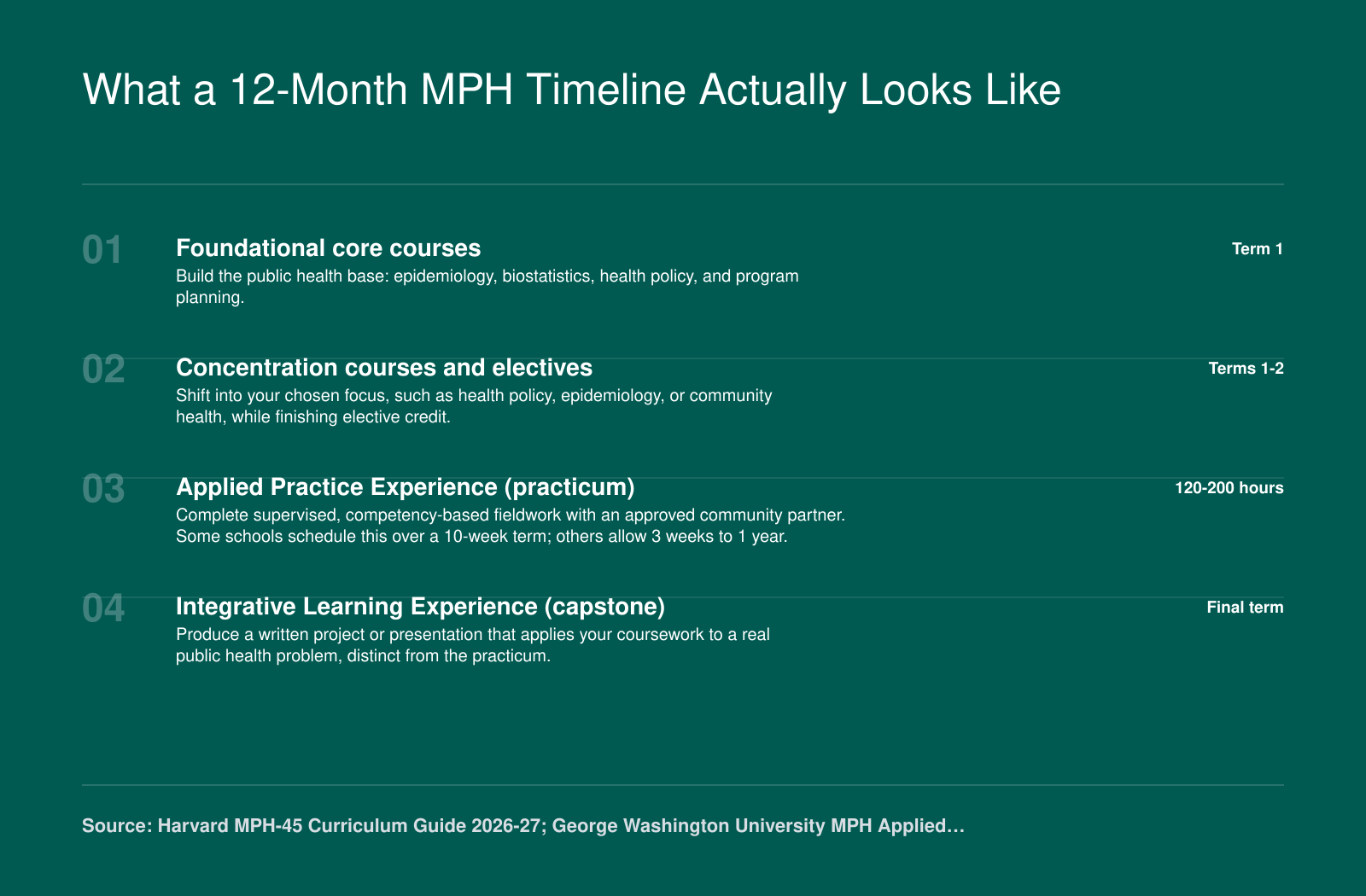
What a 12-Month MPH Timeline Actually Looks Like
A 12-month MPH compresses a traditional sequence into four overlapping stages. Practicum hours usually set the pace: named programs commonly require 120 to 200 supervised field hours, and total degree requirements often run 42 to 45 credits. Because CEPH does not impose one universal practicum-hour minimum, the field experience is what most often keeps a student from finishing faster.
Before You Apply: GPA, GRE, Experience, and Deadline Checklist
Admissions requirements vary widely by program and by track, so treat these as checkpoints rather than guarantees. Confirm the exact accelerated or one-year MPH page before applying.
- Accredited bachelor's degreeA completed bachelor's degree from an accredited university is the baseline; Boston University accepts all undergraduate majors, while CUNY's environmental health track requires 18 science or math credits including statistics or calculus.
- Minimum GPACutoffs differ: UMass Amherst lists 2.75 with most successful applicants near 3.0; UC San Diego requires 3.0 overall and 3.3 in the last two years; Northeastern requires 3.0 and targets 3.5; Columbia lists 3.0.
- GRE policyTest policies are mostly relaxed: Yale waives the GRE this cycle, BU neither requires nor considers it, and UC San Diego does not require it. Columbia is the key exception, waiving it at a 3.5 GPA but requiring it below 3.5.
- Work and health experienceSome accelerated tracks are limited to applicants with prior health or professional experience: Columbia requires 2+ years of health-care-related work, CUNY's one-year health policy track prefers 3+ years, and UMass requires two years of professional experience, with one year waivable for a public health bachelor's.
- Application systemSeveral programs route applications through SOPHAS, including CUNY, Northeastern, and UMass Amherst, which also asks for a supplemental application; UC San Diego uses its own graduate application instead.
- Deadline windowsFall priorities often fall in December and January: UC San Diego priority is December 2, 2026 with a standard February 3, 2027 deadline; BU fall priority is January 15, 2027; Northeastern's final deadline is August 1 in the 2026 cycle.
Early-Career Pay Snapshot for MPH Completers
In the de Beaumont Foundation's March 2026 PH WINS Pulse Check, 42 percent of governmental public health employees said they plan to leave public health, and 23 percent of those 61 and older intend to retire within the year. Finishing an MPH in 12 months puts you in front of those openings a year sooner.
Public Health (MPH) programs by state
Compare Public Health (MPH) programs on the data that matters
Explore more MPH specializations or browse every graduate field.
All MPH programs