Best MPH Programs in Virginia
Compare 14 accredited Public Health (MPH) programs in Virginia, with graduate earnings, cost, debt, and completion data from IPEDS and the U.S. College Scorecard.

George Mason University's MPH graduates earned a median of about $67,300 one year out, above the roughly $63,900 reported for University of Virginia graduates, at lower in-state tuition. In Virginia public health, prestige and payoff do not line up neatly.
Campus, hybrid, and online programs compete for the same applicants, and published annual tuition runs from about $8,730 at Liberty University to roughly $26,722 at Shenandoah University.
Virginia issues no general public health license, so CEPH accreditation and job-specific credentials carry more weight than a school's name.
Key Points
- Residency drives price: Liberty's tuition runs about $8,730 a year, while the highest-priced school nears $26,722.
- The University of Lynchburg offers the clearest fully online, asynchronous MPH among the schools ranked here.
- Virginia issues no general public health license, so credentials depend on the specific job.
Virginia's Top 10 Master's in Public Health Programs, Ranked
This list favors value over reputation by weighing what students pay after aid, how often students finish, and what graduates earn and owe. Net price is an approximate average after aid, not a quote, and graduation rates describe the whole institution, not the MPH alone. Figures draw on 2024 IPEDS and College Scorecard data.
University of Virginia
#1Charlottesville, VA · ~$24,000/yr (est.)
Best for: Aspiring researchers wanting quantitative training
The University of Virginia pairs a research-focused MPH with some of the strongest graduate earnings in the state's data. The 42-credit program can be finished in one intensive year or stretched over three to four semesters. Combined-degree options reach across several UVA schools, including Darden, Medicine, Batten, Law, and Architecture's urban planning program.
- Research in Practice concentration with quantitative and qualitative methods
- 42 credit hours, one year or three to four semesters
- Combined-degree options with five UVA schools
- Community partnerships, global projects, state conference presentations
- CEPH accredited, reaccredited through 2033
- Scholarship consideration for SOPHAS applicants by the January priority deadline
Virginia Polytechnic Institute and State University
#2Blacksburg, VA · ~$19,000/yr (est.)
Best for: Dual-degree seekers in veterinary medicine or medicine
Virginia Tech offers an in-person, CEPH-accredited MPH with a lower net price than most private options on this list. Students choose infectious disease or public health education, and full-time and part-time paths are available. Dual DVM/MPH and MD/MPH tracks suit students heading into clinical fields.
- Concentrations in infectious disease or public health education
- 42 credits, two-year curriculum
- In-person only, full-time or part-time
- 3.0 GPA minimum, no prerequisite courses required
- Supervised practice experience and culminating project
- Accelerated, DVM/MPH, MD/MPH, and simultaneous degree tracks
- CEPH accredited
George Mason University
#3Fairfax, VA · $15,000 – $20,000/yr (est.)
Best for: Aspiring policy advocates in Northern Virginia
George Mason in Fairfax offers a Health Policy MPH built for students who want to shape programs and legislation. It can be taken online, hybrid, or on campus, with spring and fall starts. Its Northern Virginia location gives students access to advocacy organizations and government agencies.
- Health Policy concentration focused on analysis and advocacy
- Online, hybrid, and on-campus formats
- 200-hour practicum
- Full-time and part-time options, spring and fall starts
- Interprofessional education focus
- CEPH accredited
- Online route applies separately through SOPHAS
Virginia Commonwealth University
#4Richmond, VA · ~$17,000/yr (est.)
VCU in Richmond offers an epidemiology-focused MPH close to state public health agencies. A fully online option was added beginning spring 2026 alongside the in-person format. Accelerated bachelor's-to-master's pathways and several dual degrees add flexibility.
- Epidemiology concentration with data analysis training
- 45 credit hours, fall or spring start
- 180-hour supervised internship plus capstone with poster
- 3.0 GPA minimum and two recommendations
- Dual degrees with MD, MSW, and PharmD
- Accelerated bachelor's-to-master's options
- CEPH accredited
Liberty University
#5Lynchburg, VA · ~$9,000/yr (est.)
Liberty University in Lynchburg offers the widest concentration menu on this list, with six tracks and both residential and online delivery. Admission is more flexible than at several peers, with a 2.5 undergraduate GPA listed. Faculty integrate a Christian worldview.
- Six concentrations: Community Health Promotion, Environmental Health, Epidemiology, Global Health, Nutrition, Public Health Policy
- 120-hour practicum
- Residential and online formats
- Core coursework in biostatistics, epidemiology, and environmental health
- Christian worldview integrated into the curriculum
- CEPH accredited
Shenandoah University
#6Winchester, VA · ~$27,000/yr (est.)
Shenandoah University's online MPH is aimed at working professionals serving rural and underserved communities. Classes are asynchronous and small, and no entrance exam is required. It is a faster, 18-month option, though its accreditation status is not shown in our data, so confirm it before applying.
- Rural and underserved populations focus
- 42 credits in about 18 months
- Asynchronous online classes of 10 to 15 students
- No entrance exam, 3.0 GPA minimum
- Two practicum courses
- Electives in global or maternal and child health
- Military benefits accepted
University of Lynchburg
#7Lynchburg, VA · ~$11,000/yr (est.)
The University of Lynchburg offers a fully online, asynchronous MPH at a modest per-credit rate. It requires no GRE or prerequisite courses and prepares students for the CHES exam. Its accreditation status is not shown in our data, so verify it directly.
- 36 credit hours, fully online and asynchronous
- $630 per credit
- No GRE, GMAT, or prerequisite courses
- 2.8 GPA minimum
- Capstone and practicum required
- Prepares for the CHES exam
- Study abroad and service learning opportunities
Marymount University
#8Arlington, VA · ~$23,000/yr (est.)
Marymount University in Arlington offers a Master of Science in Public Health Education and Promotion, not an MPH, and it keeps students close to Washington, D.C. health organizations. The 30-credit program is hybrid or in person with small classes. It prepares graduates for the CHES exam.
- Master of Science degree, 30 credit hours
- Hybrid or in-person format
- Fall and spring starts, 3.0 GPA minimum
- Two letters of recommendation
- Capstone research project
- Prepares for the CHES exam
- No specific undergraduate major required
Old Dominion University
#9Norfolk, VA · $15,000 – $36,000/yr (est.)
Old Dominion University in Norfolk delivers its CEPH-accredited MPH through the Joint School of Public Health with Norfolk State University. Hybrid and online formats suit working students, and the GRE is not required. Published materials point to a 43-credit online structure, so check the current requirements.
- CEPH accredited, offered through the ODU and Norfolk State Joint School of Public Health
- Online and on-campus formats
- No entrance exam required
- 2.8 GPA minimum, two recommendations, 500-word essay
- Applications through SOPHAS
- Practicum-based culminating experience
- Fall, spring, and summer online starts
Virginia Union University
#10Richmond, VA · ~$18,000/yr (est.)
Virginia Union University is a historically Black university in Richmond with an MPH centered on advocacy, data interpretation, and ethical problem-solving. Its published admission requirements are straightforward. Our data does not show CEPH accreditation, so confirm it before applying.
- 2.7 GPA minimum
- Three letters of recommendation and a resume
- 500-word personal statement
- TOEFL 550 for non-native English speakers
- Official transcripts required
- Careers include health educator, epidemiologist, and statistician
Cost & outcomes by school
Federal data for the highest-earning Public Health (MPH) programs, independent of the ranking above. Earnings are this field's master's graduates four years after completing, where the Scorecard reports them.
| School | Earnings | Tuition / yr | Debt | Grads/yr | Format |
|---|---|---|---|---|---|
| Liberty University VA | — | $8,730 | — | 19,236 | Campus |
| George Mason University VA | — | $17,964 | — | 7,100 | Hybrid |
| University of Lynchburg VA | — | $10,860 | — | 276 | Online |
| Norfolk State University VA | — | $13,412 | — | 252 | Campus |
| Old Dominion University VA | — | $15,390 | — | 2,004 | Hybrid |
| Virginia Commonwealth University VA | — | $17,252 | — | 2,876 | Hybrid |
| Virginia Polytechnic Institute and State University VA | — | $18,564 | — | 3,816 | Campus |
| South University-Richmond VA | — | $16,611 | — | 98 | Online |
| South University-Virginia Beach VA | — | $16,611 | — | 34 | Hybrid |
| Virginia Union University VA | — | $17,518 | — | 188 | Online |
| University of Virginia VA | — | $23,526 | — | 4,628 | Campus |
| Eastern Virginia Medical School VA | — | $23,229 | — | 436 | Hybrid |
Sources: U.S. Department of Education. Tuition and graduates: IPEDS. Earnings and debt: College Scorecard, this field's master's graduates; a dash means no figure is reported.
Online and Hybrid MPH Options at Virginia's Ranked Schools
A fully online MPH delivers coursework without scheduled campus visits, while a hybrid blends web courses with in-person sessions. The University of Lynchburg is the clearest fully online option in this Best MPH Programs ranking, with an asynchronous format. Shenandoah University also delivers asynchronous online classes, and Virginia Union University lists its program as online. Old Dominion University's online courses run in accelerated 8-week terms with no scheduled meeting times, and Liberty University's online MPH uses mostly 8-week sections. George Mason University offers on-campus, hybrid, and online formats, and its Public Health Practice concentration is 100% online with no required synchronous sessions. Virginia Tech is in-person only, and the University of Virginia lists a campus program.
None of the official pages we reviewed describe a required residency or intensive. Liberty and George Mason do not clearly state whether other courses require live meetings, so confirm that with admissions.
Practicum rules matter more for distance students. George Mason requires a 200-hour practicum after at least 21 credits. Old Dominion places students with a community organization, and an advisor can help you find one near you. Liberty's HLTH 698 requires a background check and coordinator approval. Lynchburg and Shenandoah build in practicum courses, but none of these schools clearly publishes whether a placement can be remote or out of state, so ask before you enroll.
GRE-Optional Master's in Public Health Programs and Application Deadlines
Virginia MPH admissions are test-flexible, placing them among the No-GRE master's programs: none of the ranked programs publishes a GRE requirement, and one major school leaves its policy unstated.
George Mason University says the GRE is not required and tells applicants not to submit scores to SOPHAS or Mason because they will not be reviewed. Virginia Commonwealth University also indicates no GRE, and Virginia Tech master's programs do not require the GRE for SOPHAS applicants. Shenandoah, Lynchburg, and Old Dominion list no entrance exam or GRE/GMAT requirement in online MPH materials. University of Virginia does not publish a GRE policy or waiver on its MPH admissions page, and it does not publish an MPH acceptance rate or class size.
Deadlines vary. UVA's fall MPH deadline is March 1 via SOPHAS; no spring deadline is stated. Mason's standard fall MPH deadline is not published, but online MPH materials list November 1 priority and December 1 final for spring. Mason's accelerated BSPH/MPH uses August 1 for fall and November 1 for spring, with a 3.25 GPA, GCH 300 and ENGH 302, and STAT 250 recommended. VCU's Spring 2026 deadline is November 14 through SOPHAS plus a supplemental VCU application. Common required items include transcripts, a statement of purpose, two or three letters, and a resume or CV; UVA asks for three letters, while Mason and VCU ask for two.
Related Articles
What a Virginia MPH Costs and Credentials to Pursue After Graduation
Residency status, not reputation, drives most of the price gap between these programs, and format decides the rest.
What the degree costs
Published annual graduate tuition among the schools here runs from about $8,730 at Liberty to roughly $26,722 at Shenandoah for students charged a single flat rate.2 Out-of-state students at the public campuses pay considerably more: George Mason lists $40,308, the University of Virginia $35,2721, and Old Dominion $36,174, against in-state figures closer to $18,000 to $23,500.2
Per-credit pricing makes full-program estimates easier for the most affordable options:
- Liberty: $290 per credit across 42 credits, about $12,180 in tuition.2
- University of Lynchburg: $630 per credit across 36 credits, about $22,680.2
- Shenandoah: $700 per credit across 42 credits, about $29,400.2
George Mason quotes its online MPH at one rate regardless of residency: $725 per credit over 42 credits, roughly $30,450, or near $31,920 once the $35 per-credit distance fee is added, plus a one-time $60 new-student fee. UVA posts $890 per credit for residents and $1,470 for nonresidents.1 VCU requires 45 credits; South University-Richmond requires 56.2 Net price figures are institution-wide averages after aid, so take them as approximations, not quotes.
Credentials after you finish
Virginia does not license general public health practitioners. Most graduates pursue voluntary national credentials instead: the CPH through the National Board of Public Health Examiners, or CHES and MCHES through NCHEC. Specific roles, such as environmental health specialist positions, carry their own separate licensing requirements.
Virginia Public Health Credentialing
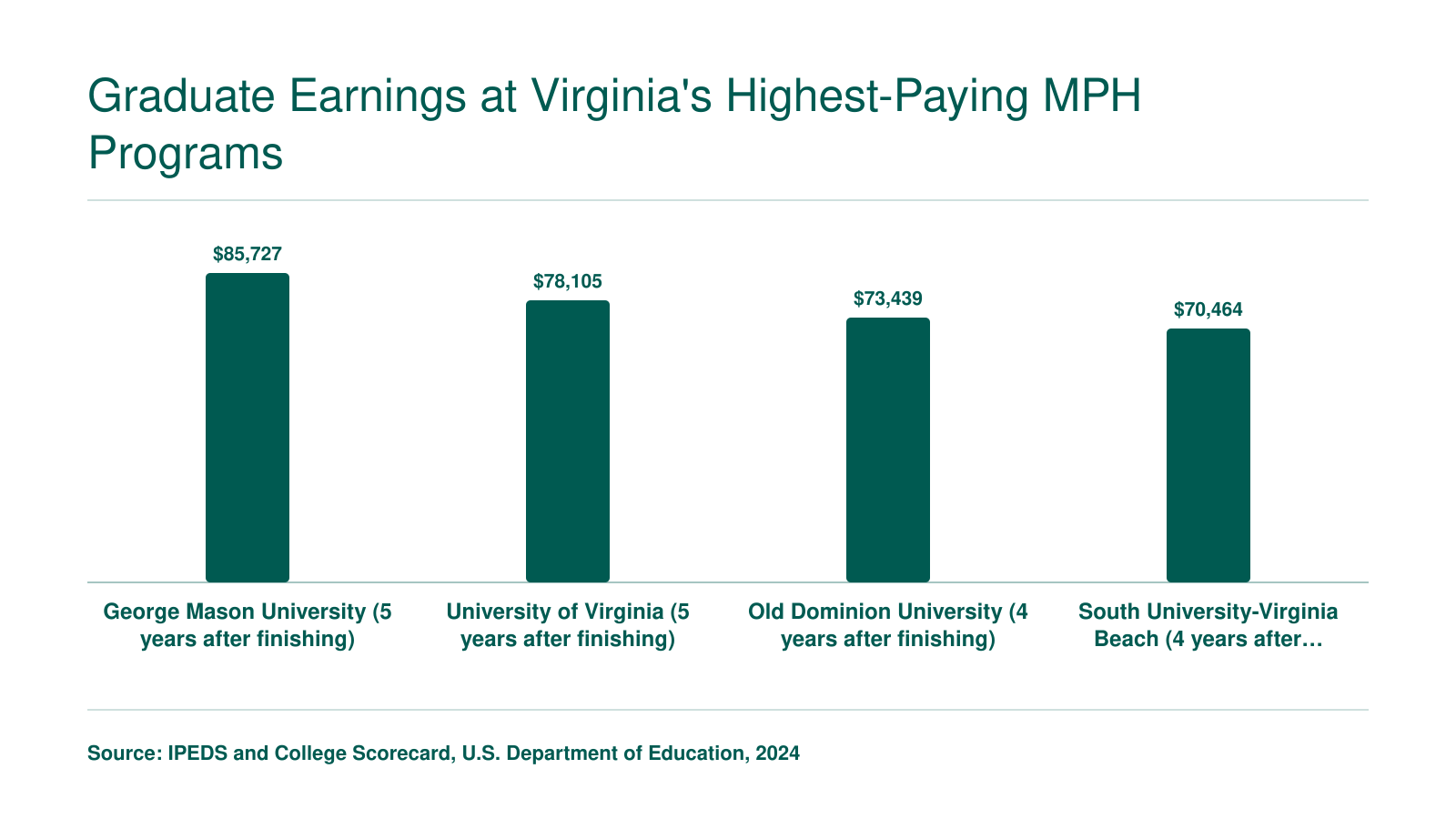
Graduate Earnings at Virginia's Highest-Paying MPH Programs
Median program-level earnings differ by school, and each bar is labeled with its measurement window because the windows are not identical. Programs with no published program-level figure, including Marymount University and Shenandoah University, are left off rather than filled in with institution-wide numbers. Pair earnings with median program debt: George Mason University reports $41,000, the University of Virginia $45,801, and South University-Virginia Beach $54,215. Old Dominion University does not report program debt.
Checking CEPH Accreditation and Concentrations Before You Apply
CEPH (the Council on Education for Public Health) is the body that accredits public health degrees. Its decisions fall into a few buckets: an accredited school of public health, an accredited standalone program, or applicant status for a school still working toward a first decision. Before you apply, confirm where each program sits and when its term ends.
Where the ranked programs stand
- University of Virginia: Accredited, term running through December 31, 2033, with no probationary status.
- Virginia Tech: Accredited through December 31, 2033, following a late-2025 review; no probation.
- George Mason University: The College of Public Health reports CEPH accreditation through July 1, 2030.
- Old Dominion University: Continuing accreditation after a November 2025 site visit; not on probation.
- VCU: Its School of Public Health is a CEPH applicant (accepted 2024), with a site visit set for October 28, 2026 and a decision expected June 8, 2027.
Applicant status matters: until CEPH confirms accreditation, graduates may face hurdles with Certified in Public Health (CPH) eligibility and some federal and state public health roles. Then match concentrations to your goals. Virginia Tech offers infectious disease tracks, George Mason leans toward health policy, VCU runs an epidemiology path, and Liberty spans epidemiology, global, and environmental health.
Quick Answers for Prospective Virginia MPH Students
How many years does a master's in public health take in Virginia, full-time versus part-time?
Can Virginia undergraduates start an MPH early through a combined bachelor's-to-MPH pathway?
What does Virginia Tech require for its accelerated bachelor's-to-MPH pathway?
Compare Public Health (MPH) programs on the data that matters
Explore more MPH specializations or browse every graduate field.
All MPH programs