Most Affordable MPH Programs
Compare 440+ accredited most affordable Public Health (MPH) programs, with graduate earnings, cost, debt, and completion data from IPEDS and the U.S. College Scorecard.

In-state graduate tuition among the programs ranked here runs from $6,381 at the University of Florida to $9,332 at New Mexico State University. That spread is modest on paper, but it widens once fees, out-of-state charges, and aid packages are applied. These programs are ranked on net price, aid, and graduate outcomes, not prestige.
The ranking that follows weighs the most affordable options first, then unpacks hidden costs, CEPH status, residency rules, and debt versus early-career earnings. For government and nonprofit employers, CEPH accreditation remains a practical hiring filter; a low tuition rate means little without that credential.
Key Points
- CEPH accreditation affects federal public health hiring and credentialing.
- Many online MPH programs charge a single flat tuition rate nationwide.
- Net price and graduate earnings reveal the real value of an MPH.
The 10 Most Affordable MPH Programs for 2027
Price tags only tell half the story. This list weighs what students actually pay after aid alongside what graduates earn and owe, using 2026 tuition and fee data and institutional net price estimates.
CUNY Hunter College
#1New York, NY · ~$11,000/yr (est.)
Best for: Urban RNs needing hybrid flexibility
CUNY Hunter College's MS in Community/Public Health Nursing is a 42-credit hybrid built for registered nurses who want to lead population health work. The CEPH-accredited program blends biostatistics, epidemiology and environmental health with 501 hours of supervised clinical experience. With in-state tuition and fees around $7,382 and an approximate net price near $2,984, Hunter is one of the most budget-friendly urban options on this list.
- 42 total credit hours
- Hybrid format for working nurses
- 501 supervised clinical hours
- 3.0 GPA minimum
- CEPH accredited
- Requires RN license in New York
California State University-Los Angeles
#2Los Angeles, CA · ~$9,000/yr (est.)
Best for: Downtown LA commuters wanting urban focus
Cal State LA's MPH in Urban Community Health is a 42-credit hybrid offered at both the main and downtown Los Angeles campuses, with some online coursework. The curriculum centers on health equity in dense urban settings and aligns with CEPH accreditation standards. In-state tuition and fees run about $7,160, while out-of-state students pay roughly $19,760 before aid.
- 42 total credit hours
- Hybrid with main and DTLA campus options
- Some courses available online
- 3.0 GPA strongly recommended, 2.5 may be considered
- Field experience required
- Focus on Los Angeles urban health
California State University-San Bernardino
#3San Bernardino, CA · ~$10,000/yr (est.)
Best for: Cohort learners prioritizing health equity
Cal State San Bernardino runs a two-year, 42-credit, cohort-based MPH with a strong emphasis on health equity and social justice. The hybrid program offers a thesis or capstone option and starts each fall. In-state students face tuition and fees near $8,093, and the institution-wide graduation rate is about 55 percent.
- 42 total credit hours
- Two-year cohort structure
- Fall start with March 31 application deadline
- Thesis or capstone option
- Focus on health equity and social justice
- CEPH accredited
University of Florida
#4Gainesville, FL · ~$13,000/yr (est.)
University of Florida offers a 48-credit, CEPH-accredited MPH with six concentrations and both campus and online formats. In-state tuition and fees are around $6,381, but out-of-state students pay roughly $28,659 before aid, making residency status a major cost factor. The approximate net price after aid is about $6,541, and the institution-wide graduation rate is 91 percent.
- 48 total credit hours
- Six concentration options
- CEPH accredited
- Applied Practice Experience and Integrated Learning Experience
- Online and campus MPH formats
- Combined degree options
California State University-Fullerton
#5Fullerton, CA · $9,000 – $19,000/yr (est.)
Cal State Fullerton's MPH is a 21-month residential program with three concentrations in community health promotion, epidemiology, and environmental and occupational health and safety. The redesigned curriculum emphasizes evidence-based practice, policy, and leadership. In-state tuition and fees sit near $7,470, while out-of-state students pay about $20,070.
- 21-month residential program
- Three concentration options
- CEPH accredited
- Welcomes diverse undergraduate backgrounds
California State University-Fresno
#6Fresno, CA · ~$9,000/yr (est.)
Fresno State's MPH in Health Promotion is a fully online, 42-credit, two-year cohort program with fall-only admission. The curriculum includes a field experience and a culminating thesis, project, or comprehensive exam. In-state tuition and fees are about $7,350, compared with $19,950 for out-of-state students.
- Fully online option available
- 42 total credit hours
- Two-year cohort with fall start
- Three letters of recommendation required
- Field experience and culminating experience
- Health Promotion emphasis
California State University-Northridge
#7Northridge, CA · ~$9,000/yr (est.)
CSUN's MPH offers concentrations in Community Health Education and Applied Epidemiology, with CEPH accreditation since 1971. The hybrid format is designed for working professionals, with online coursework available. In-state tuition and fees run about $7,458, while out-of-state students pay roughly $20,058.
- Two concentration options
- CEPH accredited since 1971
- Flexible for working professionals
- Online MPH option available
- Diverse LA-area student body
New Mexico State University
#8Las Cruces, NM · $7,000 – $19,000/yr (est.)
New Mexico State's MPH offers two concentrations: Health Behavior and Health Promotion, and Health Management, Administration, and Policy. The 42-credit program can be taken online or on campus, with a required field placement and a thesis or integrative learning experience option. In-state tuition and fees are around $8,183, while out-of-state students pay about $25,307.
- 42 total credit hours
- Two concentration options
- Thesis or capstone option
- Field placement required
- Online and on-campus formats
- Graduate minors in Gerontology and Border Health
California State University-Sacramento
#9Sacramento, CA · $10,000 – $20,000/yr (est.)
Sacramento State's MPH in Health Promotion, Policy, and Leadership is a 42-unit hybrid cohort designed for working professionals. The program combines online classes with three intensive on-campus residencies and can be completed in two years. In-state tuition and fees are about $8,018, with out-of-state students paying roughly $20,618.
- 42 total credit hours
- Hybrid for working professionals
- Three intensive residency sessions
- Complete in two years, five consecutive semesters
- Cohort-based
- Capstone required
- Leadership development focus
California State University-Long Beach
#10Long Beach, CA · $9,000 – $19,000/yr (est.)
Cal State Long Beach offers an MPH with a Community Health Education emphasis, held on campus with a strong health equity focus. The program is housed in the College of Health and Human Services and offers a Graduate Certificate in Latino Health. In-state tuition and fees are near $7,350, while out-of-state students pay about $19,950.
- Community Health Education emphasis
- CEPH accredited since 1983
- Health equity focus for underserved communities
- Graduate Certificate in Latino Health available
- Located in College of Health and Human Services
Cost & outcomes by school
Federal data for the highest-earning Public Health (MPH) programs, independent of the ranking above. Earnings are this field's master's graduates four years after completing, where the Scorecard reports them.
| School | Earnings | Tuition / yr | Debt | Grads/yr | Format |
|---|---|---|---|---|---|
| Columbia Southern University AL | — | $3,936 | — | 4,312 | Online |
| The University of Texas Health Science Center at San Antonio TX | — | $4,648 | — | 460 | Campus |
| Fort Hays State University KS | — | $4,949 | — | 1,544 | Online |
| Southeastern Oklahoma State University OK | — | $5,220 | — | 2,478 | Online |
| Northeastern State University OK | — | $5,771 | — | 934 | Online |
| Aspen University AZ | — | $5,910 | — | 1,212 | Online |
| American College of Education IN | — | $6,600 | — | 9,876 | Online |
| Georgia Southern University GA | — | $6,646 | — | 2,464 | Campus |
| University of Nevada-Reno NV | — | $7,032 | — | 1,932 | Campus |
| The University of Texas at El Paso TX | — | $7,166 | — | 2,264 | Campus |
| Texas A & M University-Corpus Christi TX | — | $7,179 | — | 2,582 | Online |
| East Texas A&M University TX | — | $7,338 | — | 3,020 | Online |
Sources: U.S. Department of Education. Tuition and graduates: IPEDS. Earnings and debt: College Scorecard, this field's master's graduates; a dash means no figure is reported.
Behind the Numbers: What Moved a School up This List
A low price and a strong outcome don't always arrive together, so this list of affordable MPH programs puts cost first and uses outcomes as a check. Net price and financial aid carried the most weight. Program-level College Scorecard figures for MPH completers (debt, earnings, and the share employed) served as supporting signals that moved schools up or down among similarly priced options.
What we left out
Prestige, research dollars, and reputation surveys play no part here. They tend to reward size and brand, and they say little about what a student pays or borrows. If you compare this page with a brand-name ranking, expect different schools near the top and some famous names sitting lower or missing. A bigger name isn't automatically the better value.
Know the data limits
- Institution-wide figures: Graduation rates and net price describe the whole university, not the MPH specifically.
- Program-level figures: Debt and earnings are Scorecard medians for MPH completers. They can rest on small groups and trail current conditions.
How to use the list
Shortlist on cost, then confirm current tuition, fees, and CEPH accreditation status directly with each school before you apply or put down a deposit. Rates change from year to year, and tuition for online MPH programs and in-state prices can differ.
Tuition Is Only Part of the Bill: Fees, Books, and Practicum Costs
How much will an MPH really cost once fees, books, and the practicum are added in? The answer comes from five line items, and only one of them is the per-credit rate schools put in their marketing.
The Five Pieces of Total Cost
- Tuition: the per-credit rate multiplied by required credits.
- Mandatory university fees: charged per term or per credit, often regardless of delivery format.
- Distance-learning or technology fees: common add-ons for online students.
- Books and software: methods courses in biostatistics or epidemiology may require paid software.
- Practicum costs: unpaid hours, travel, and pre-placement screening.
How Small Fees Add Up
George Mason University charges $725 per credit plus a $35 per-credit distance-learning fee. Across its 42 credits, that fee alone adds $1,470, and a $60 new-student fee comes on top. American Public University lists $470 per credit over 47 credits, then adds a $1,275 technology fee and a $350 graduation fee. Benedictine University charges a $125 student services fee every semester. Old Dominion University's Fall 2026 rate of $672 per credit combines $510 in standard tuition with a $162 mandatory auxiliary charge, so confirm which figure a comparison site is quoting. SIUE is the simpler case: it states that all fees are included in its $499.10 per-credit rate.
Practicum and Capstone Costs
CEPH-accredited MPH programs require an applied practice experience (APE) and an integrative learning experience, usually a capstone. The APE is where hidden costs surface. FIU and George Mason each require 200 practicum hours, and at Mason the APE runs as a zero-credit seminar. American Public's practicum spans 16 weeks. These hours are typically unpaid, which can mean giving up work shifts. Liberty University requires a background check through Castle Branch, and Benedictine's internship is on-ground, so ask about screening prices and budget for travel. FIU waives its practicum only for students with at least three years of relevant public health experience, and the approved 3-credit substitute keeps the degree at 45 credits.
A Quick True-Cost Formula
(per-credit rate × total credits) + (per-term fees × number of terms) + books + practicum and travel = true cost
Run this for every program on your shortlist before comparing sticker prices.
Related Articles
Checking CEPH Status Before You Pay a Deposit
CEPH accreditation is a formal review of an MPH program's curriculum, faculty, and outcomes against public health education standards. It is separate from a university's regional accreditation, and it is the credential that affects federal public health hiring, Certified in Public Health exam access, and some doctoral admissions. For budget-conscious students, the cheapest tuition is not a bargain if the degree cannot clear these gates.
Check the CEPH list first
Start at the accredited schools and programs list on ceph.org. CEPH updates the list within 30 days of accreditation decisions, so the live record is the authoritative source. Search the exact institution name, then read the record category. A school of public health has broader institutional accreditation; a standalone MPH program record covers only that degree. An MPH program record does not mean every public health degree at the university is CEPH accredited.
Next, confirm delivery scope. The CEPH degree database labels distance-based options, but distance-based does not automatically mean 100 percent online. Some distance programs still require an on-campus orientation or intensive. Ask the program whether the online format you plan to enter is inside the accredited scope.
Read status labels carefully
Treat Applicant as seeking accreditation, not holding it. Probationary Accreditation is a warning sign even if the program remains accredited at that moment. On the latest 2026 CEPH list, American Public University System holds standalone MPH program accreditation through December 2029, and Florida State University's MPH record runs through December 2026. California State University, San Bernardino and Eastern Washington University carried probationary accreditation endpoints in 2026, so confirm their live status before paying a deposit.
In-State vs. Out-of-State Tuition at Six Low-Cost MPH Schools
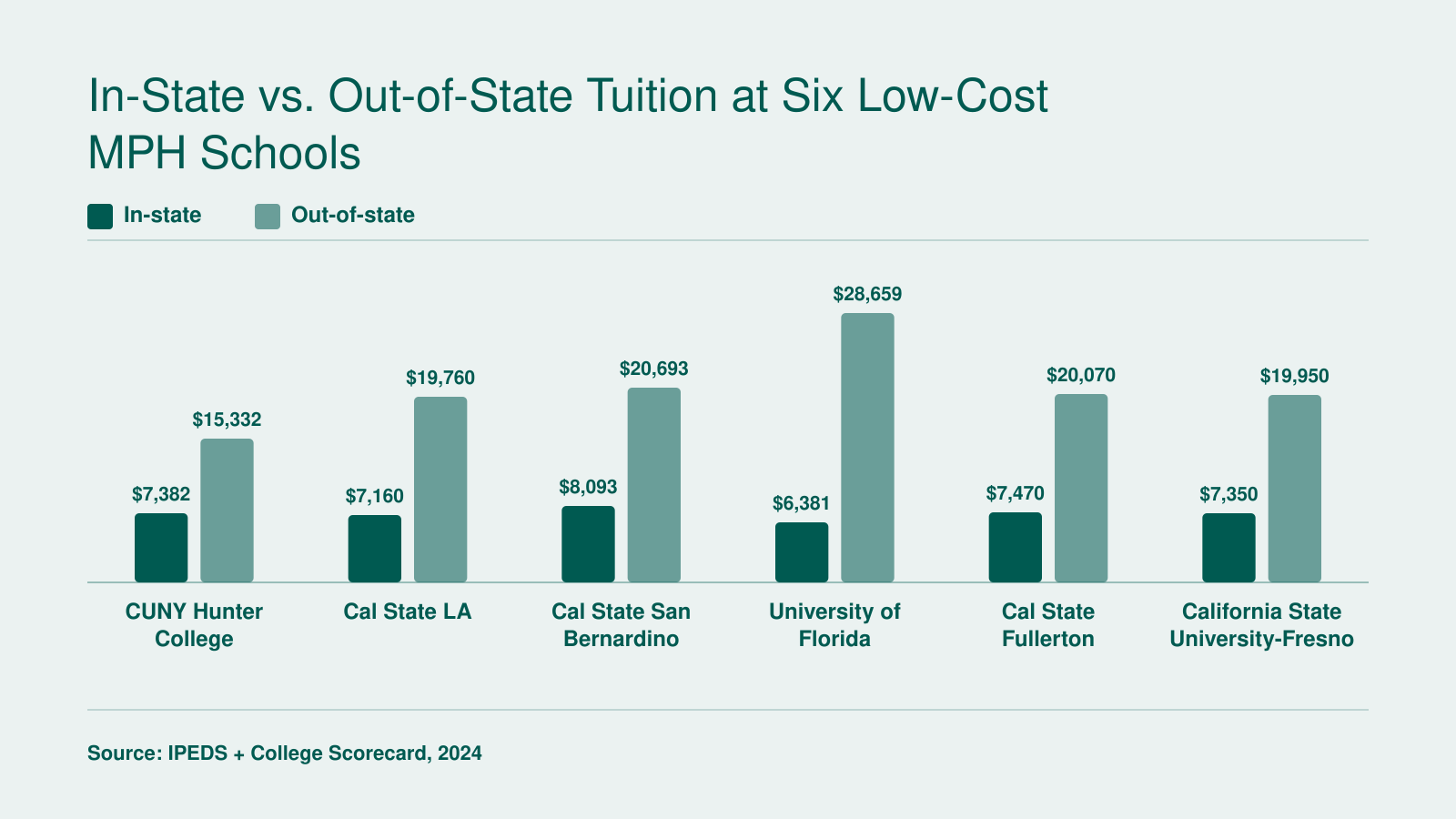
In-state tuition stays close among these public schools, but out-of-state charges vary sharply. Hunter, Cal State Fullerton, and Fresno State charge nonresidents roughly two to nearly three times the resident price, while the University of Florida runs more than four times higher; online students should confirm the flat rate before assuming the published out-of-state figure applies.
Online Tuition Policies That Erase the Out-of-State Penalty
For most public universities, your state of residence decides your tuition. Out-of-state students often pay two or three times the in-state rate on campus. But many online MPH programs break that rule, charging a single flat rate (sometimes called e-tuition) to every enrolled student no matter where they live. That one policy choice can wipe out the out-of-state penalty entirely, and it's often the difference between an affordable program and an expensive one.
Programs That Charge One Rate to Everyone
Several CEPH-accredited public programs use residency-neutral pricing. Florida International University advertises a flat online MPH rate with no in-state or out-of-state distinction, landing its program near $25,200 total. Southern Illinois University Edwardsville charges identical online tuition to in-state and out-of-state students, around $499 per credit with fees included (though it notes rates can change). The University of Florida states that for 2026-2027, all online-program tuition is assessed at the same rate regardless of where in the U.S. you live, at $550 per credit plus a modest online fee.
Not every public program follows suit. Old Dominion University still bills separate Virginia-resident and out-of-state online rates for Fall 2026, so confirm the policy before you assume distance learning means one price.
Reciprocity and Hidden Residency Triggers
If your target program isn't flat-rate, regional reciprocity may help. WICHE's Western Regional Graduate Program and the Southern Regional Education Board's Academic Common Market can extend reduced in-state tuition to residents of member states, but both are program-specific. Public health is not automatically covered, so check each degree against the official participating-program list rather than assuming eligibility.
One more question for admissions: ask whether any practicum, immersion, or on-campus term triggers campus-based fees or shifts you to residency billing. A program that quotes one flat online rate can still add location-specific charges for in-person requirements, and those costs rarely appear in the headline price.
Top Early-Career Earnings Among Ranked MPH Programs
Online vs. Campus MPH: Trade-Offs for Budget-Minded Students
Choosing between online and campus MPH delivery usually comes down to how you pay for flexibility. Online formats can protect your income and remove relocation costs, while campus formats unlock funding and fieldwork infrastructure that may offset a higher sticker price. The right choice depends on your current job, family setup, and how much structured support you need.
Pros
- Online programs let you keep a full-time salary and avoid moving, which removes two of graduate school's largest hidden costs.
- Several online MPH programs charge the same per-credit tuition to all students, eliminating out-of-state residency markups.
- Campus programs often provide graduate assistantships, research roles, and tuition waivers that are harder to secure remotely.
- In-person cohorts give you built-in practicum contacts and faculty connections that can reduce the time you spend arranging fieldwork.
Cons
- Online students frequently pay separate technology, distance learning, or course fees that add to each term's bill.
- Fully online practicums may require you to identify and secure your own approved site, a task that can delay graduation.
- Campus attendance usually means paying for housing and either reducing work hours or losing income for one to two years.
- Synchronous online sessions can conflict with full-time jobs, while part-time pacing spreads fixed fees across more semesters.
Public Health (MPH) programs by state
Quick Answers on MPH Price, Pace, and Eligibility
Price questions are rarely as simple as tuition per credit. These answers focus on the cost and pacing details that matter most when comparing affordable MPH programs, but always confirm current fees, transfer rules, and visa eligibility with each school before deciding.
Which MPH programs can be finished online in about 12 months, and do they actually cost less?
What does an MPH typically run per credit hour, and what is the total for a full degree?
Are there budget-friendly MPH options open to students living outside the U.S.?
Compare Public Health (MPH) programs on the data that matters
Explore more MPH specializations or browse every graduate field.
All MPH programs