MPH Programs With No GRE Required
Compare 440+ accredited no-gre Public Health (MPH) programs, with graduate earnings, cost, debt, and completion data from IPEDS and the U.S. College Scorecard.

The GRE general test costs $220, and most applicants spend weeks or months preparing for an exam that many public health schools no longer weigh. For a working professional or a recent graduate, that is time and money better spent on a strong application.
Many CEPH-accredited schools have dropped the requirement, but policies vary. Some programs still ask for scores from certain applicants, such as those with a low undergraduate GPA, and several list the test as optional rather than gone.
The real hurdles have shifted: prerequisites, practicum hours, work experience, and cost, the focus of the Most Affordable MPH Programs ranking, still separate programs far more than a test score does.
Key Points
- Out-of-state public MPH tuition can cost thousands more yearly.
- Scorecard earnings show whether a low-cost no-GRE MPH pays off.
- An online CEPH MPH carries the same degree as campus.
Best MPH Programs With No GRE Requirement: 10 Top Picks
These ten master's programs share one admission feature: none requires the GRE as a mandatory gate. Each school here earned its spot through a blend of student retention, completion, institutional quality, and moderate cost and earnings weighting. Use the list to compare test-optional and GRE-waived policies before you decide where to apply.
Johns Hopkins University
#1Baltimore, MD · ~$65,000/yr (est.)
Best for: Working professionals balancing full-time jobs
Johns Hopkins University offers one of the most flexible public health master's options, with a completion window from 11 months to 4 years. The GRE, GMAT, LSAT, and MCAT are optional for the MPH, though the joint MPH/MBA may require scores unless waived. Concentrations include Aging and Public Health, Child and Adolescent Health, and Epidemiologic and Biostatistical Methods. The university's overall graduation rate is 94%, and the program is CEPH-accredited.
- No entrance exam required
- GRE, GMAT, LSAT, MCAT optional
- 13 concentration options
- Complete in 11 months to 4 years
- 80 total credit hours
- 100 clinical hours practicum
- Prerequisite courses required
- STEM-designated program
Harvard University
#2Cambridge, MA · $55,000 – $60,000/yr (est.)
Best for: Busy professionals seeking part-time generalist training
Harvard T.H. Chan School of Public Health offers a 45-credit, part-time generalist track designed for working professionals. Standardized tests are test optional, and students complete an Applied Practice Experience plus core courses in biostatistics, epidemiology, health systems, and policy. The university's overall graduation rate is 98%, and the program is CEPH-accredited.
- 45 total credit hours
- Part-time available
- Applied Practice Experience required
- Healthcare Management Certificate option
- Applied Data Analysis Certificate option
- Test optional
University of California-Berkeley
#3Berkeley, CA · ~$16,000/yr (est.)
Best for: Epidemiology-focused learners wanting broad specialization options
UC Berkeley's MPH offers a foundation core and 11 specialized concentrations including Epidemiology, Health Policy and Management, and Global Health and Environment. The program does not require an entrance exam and emphasizes evidence-based practice. The university's overall graduation rate is 93%, and the program is CEPH-accredited.
- 11 concentration options
- No entrance exam required
- Test optional
- Foundation courses form the core curriculum
- Starts fall
University of North Carolina at Chapel Hill
#4Chapel Hill, NC · ~$13,000/yr (est.)
UNC's Gillings School offers four concentrations: Applied Epidemiology, Health Policy, Leadership in Practice, and Nutrition, Food Systems and Health. No GRE is required, and students complete a 200-hour mentored practicum. The university's overall graduation rate is 91%, and the program is CEPH-accredited.
- 4 concentration options
- No entrance exam required
- Test optional
- Complete in 20-36 months
- 200 clinical hours
- Capstone required
- Full-time and part-time options
- Holistic admissions review process
George Washington University
#5Washington, DC · ~$36,000/yr (est.)
George Washington University's Milken Institute School of Public Health offers concentrations in Health Informatics, Global Health, Climate Health, and Women, Youth and Child Health. The GRE is not required, and the program uses rolling admissions with multiple start dates. The university's overall graduation rate is 84%, and the program is CEPH-accredited.
- 4 concentration options
- Test optional
- Complete in as few as 12 months
- 45 total credit hours
- Rolling admissions
- 4 start dates per year
- Scholarships up to $15,000
- Practicum with partner organizations
Georgetown University
#6Washington, DC · $60,000 – $65,000/yr (est.)
Georgetown offers a Master of Science in Health and the Public Interest with full-time and part-time attendance and no GRE requirement. The university's overall graduation rate is 95%.
- No entrance exam required
- Test optional
- Priority application fee waived
- Regular application fee $90
- Full-time and part-time options
- Small cohort size
- Tailored career service advising
- Priority scholarship consideration
Boston University
#7Boston, MA · $65,000 – $70,000/yr (est.)
Boston University's 42-credit MPH is built around six sequential modules and an integrative seminar capstone, with an embedded practicum. The GRE is neither required nor considered, and two years of work experience is recommended but not required. The university's overall graduation rate is 89%, and the program is CEPH-accredited.
- No entrance exam required
- Test optional
- $25,000 total program tuition
- Locked tuition rate
- 42 total credit hours
- Six modules taken in sequence
- Practicum embedded in Module 5
- Two letters of recommendation required
University of Georgia
#8Athens, GA · ~$11,000/yr (est.)
The University of Georgia offers a two-year, full-time campus MPH with eight concentrations including Biostatistics, Disaster Management, and Health Promotion and Behavior. A 300-hour applied practice placement and integrative learning project are required. The university's overall graduation rate is 90%, and the program is CEPH-accredited.
- 8 concentration options
- No entrance exam required
- Test optional
- 2-Year program
- 44 total credit hours
- 3.0 GPA minimum
- 300 clinical hours
- Capstone required
University of Oklahoma – Hudson College of Public Health
#9Norman, OK · ~$9,000/yr (est.)
The University of Oklahoma's Hudson College of Public Health offers a 42-credit MPH in Community and Population Health designed for working professionals. No GRE is required, and the program includes a practicum and capstone. The university's overall graduation rate is 75%.
- 42 total credit hours
- No GRE required
- 16 total courses
- Rolling admissions
- 3.0 GPA minimum
- Capstone required
- Prepares for CPH certification
- Lean Six Sigma certificate available
University of North Texas Health Science Center
#10Fort Worth, TX · $8,000 – $23,000/yr (est.)
The University of North Texas Health Science Center offers a 48-credit campus MPH with four concentrations in Epidemiology, Biostatistics and Data Science, Public Health Leadership, and Maternal and Child Health. The program includes a 400-hour hands-on practice experience and features cohort-based classes with no GRE requirement. The program is CEPH-accredited.
- 4 concentration options
- Test optional
- 5-Semester program
- 48 total credit hours
- Cohort-based structure
- 400 clinical hours
- Small class sizes (20-35 students)
- 100% job placement rate
Cost & outcomes by school
Federal data for the highest-earning Public Health (MPH) programs, independent of the ranking above. Earnings are this field's master's graduates four years after completing, where the Scorecard reports them.
| School | Earnings | Tuition / yr | Debt | Grads/yr | Format |
|---|---|---|---|---|---|
| Walden University MN | — | $10,885 | — | 16,946 | Online |
| Louisiana State University-Shreveport LA | — | $7,349 | — | 6,496 | Hybrid |
| Southern New Hampshire University NH | — | $21,387 | — | 19,416 | Online |
| Lamar University TX | — | $8,642 | — | 7,008 | Online |
| University of Phoenix-Arizona AZ | — | $15,208 | — | 12,234 | Online |
| Southeastern Oklahoma State University OK | — | $5,220 | — | 2,478 | Online |
| Georgia Southern University GA | — | $6,646 | — | 2,464 | Campus |
| The University of Texas at El Paso TX | — | $7,166 | — | 2,264 | Campus |
Sources: U.S. Department of Education. Tuition and graduates: IPEDS. Earnings and debt: College Scorecard, this field's master's graduates; a dash means no figure is reported.
Truly GRE-Free or Conditionally Waived? How Each Policy Works
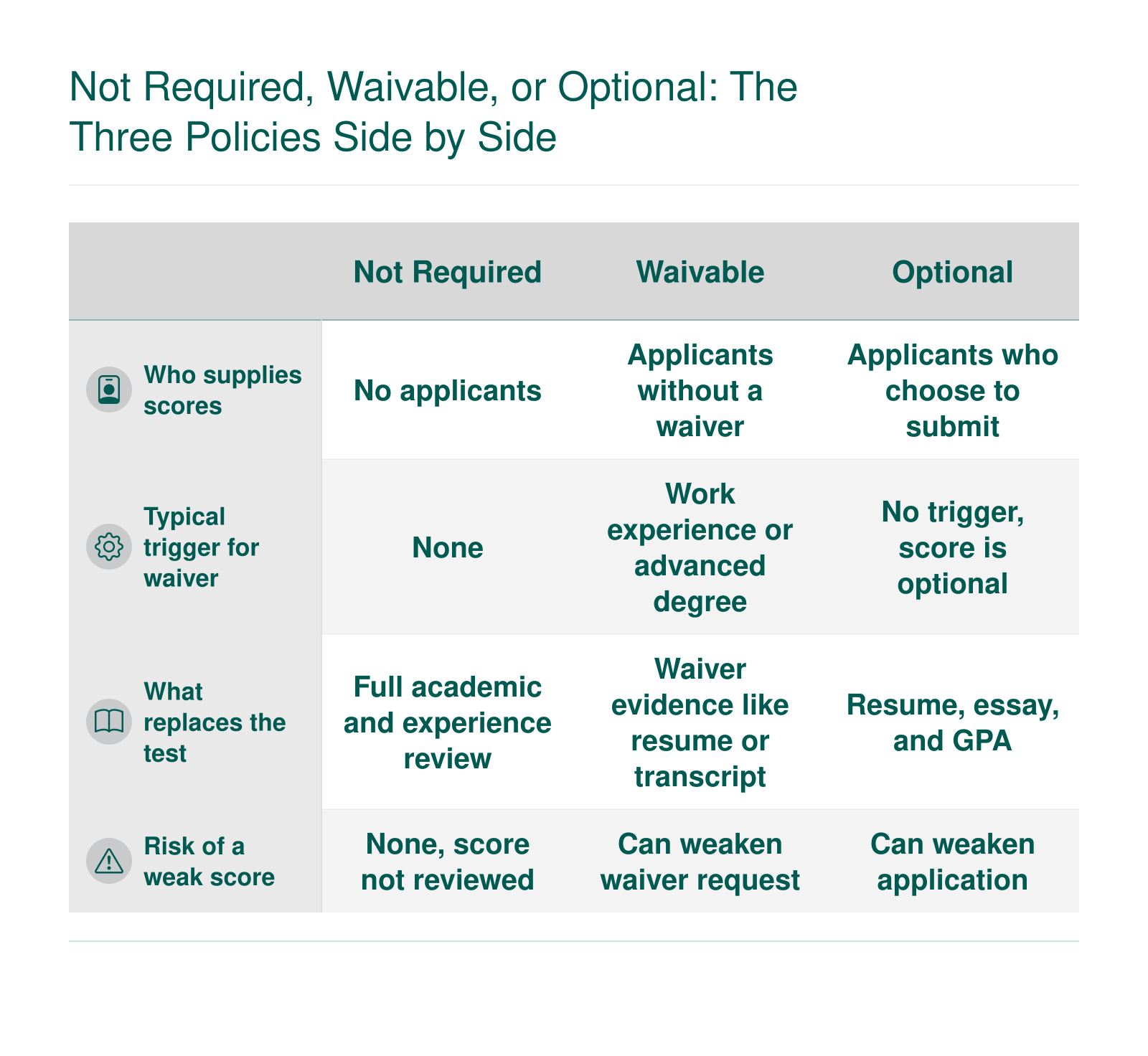
A "no-GRE" MPH is any program that will admit you without a GRE score, but the label covers three different policies, and they are not interchangeable. Which policy applies determines whether you can skip the test outright or must qualify for an exemption.
Never Required, Waived on Conditions, or Optional
A small group of schools simply drop the test for everyone. Boston University does not require the GRE and will not even consider submitted scores. UNC Chapel Hill and George Washington list their MPH programs without GRE as no GRE required, though you should confirm whether that holds for your specific format.
Conditional waivers work differently. Kent State's online MPH makes you request the waiver, submit a form and documentation, and have your credentials reviewed. Non-U.S. degrees get extra scrutiny. Yale's waiver is tied to the current 2026 cycle only, and the school instead asks for evidence of quantitative ability.
Optional policies let you send scores from tests like the GMAT or GRE if they help. UMass Amherst's online MPH admits applicants with a 3.0 or higher without a test, but those between 2.75 and 2.99 may submit a GRE, GMAT, or MCAT to strengthen the file.
GPA Cutoffs
The most common threshold is a 3.0, though some programs set 3.2 or 3.5, and the general range runs from 2.5 to 3.5. Read the fine print on what the number measures. UMass Amherst accepts either a 3.0 cumulative GPA or a 3.0 over the last 60 credits, which helps if you started college slowly. Boston University publishes no minimum, but competitive applicants typically report 3.0 or above.
Work Experience and Advanced Degrees
Experience waivers vary widely, from roughly two years to ten across MPH programs. Some programs accept two to three years of public health or clinical work, while others, such as Kent State, point to five or more. Ask whether the work must be health-related, since that rule is not uniform. Some schools also look at a supervisor letter or clinical licensure.
An advanced degree can satisfy the same waiver requirement. Kent State's criteria name doctoral degrees (MD, DO, PharmD, DPM, PhD, JD, DDS, DNP) and certain master's degrees (MSN, MPA, MBA). Other schools set their own lists.
A Practical Rule
Policies change by cycle, and third-party lists go stale. Before you plan around a waiver, read the program's own admissions page for this application cycle, and email admissions if the wording about your format or concentration is unclear.
Not Required, Waivable, or Optional: The Three Policies Side by Side
If you want certainty before you apply, look for programs that state the GRE is not required. A waivable policy still leaves room for conditions, and an optional score can still shape how your file is read.
What a No-GRE MPH Actually Costs: Tuition vs. Net Price
How much more will a no-GRE MPH cost if you don't live in the school's state? At most public universities here, the answer is thousands of dollars a year.
The Residency Gap
Among the No-GRE master's programs ranked here, yearly graduate tuition for residents runs from $6,646 at Georgia Southern University to $15,771 at Wright State University. Out-of-state students face a very different picture. The widest gaps:
- University of Georgia: $11,002 in-state vs. $29,774 out-of-state, an $18,772 difference.
- UNC Chapel Hill: $12,751 vs. $31,408, an $18,657 gap.
- Utah State University: $7,828 vs. $24,773, a $16,945 gap.
- University of Oklahoma: $9,353 vs. $26,142, a $16,789 gap.
At the other end, Louisiana State University-Shreveport lists the same $7,349 for everyone, and Angelo State University's gap is a more modest $7,380 ($7,509 vs. $14,889). University of Phoenix, a private school, charges $15,208 regardless of where you live.
Net Price Is a Signal, Not a Quote
The net price figures for these schools, which run from $7,022 at LSUS to $15,415 at Wright State, reflect what a school's students pay on average after grants and scholarships. That average is institution-wide and leans heavily on undergraduate aid, so it won't predict what you'll pay as an MPH student. Graduate aid often comes mostly as loans rather than grants. Treat net price as a rough read on how affordable a campus is overall, nothing more.
Online Rates Can Erase Residency
Many public universities charge online MPH students a single flat rate whatever their home state. If you're weighing an online or hybrid program, ask the admissions office whether the in-state or out-of-state figure applies to you, or whether a separate distance rate replaces both. That one answer can swing your total cost dramatically.
The Affordability Takeaway
If you can enroll at a public university in your own state, you'll usually see the lowest sticker price. Out-of-state applicants should focus on schools with flat or narrow pricing. The tuition chart below lays out both figures side by side.
Related Articles
Earnings and Debt After a No-GRE MPH: Reading the Scorecard Numbers
The cheapest no-GRE MPH on paper is not automatically the strongest financial move. Scorecard outcomes separate sticker price from payoff, and the key comparison is not tuition and fees alone but what graduates earn five years after finishing relative to what they owe.
Earnings Tell a Different Story
Among the programs below, Harvard's MPH graduates post the highest median earnings five years after finishing, at $204,275. UC Berkeley follows at $106,720 five years after finishing, just ahead of Johns Hopkins at $102,525. These are program-level figures, not campus-wide averages, so they reflect the degree itself rather than all alumni.
Debt Changes the Picture
Pairing those salaries with debt shows the tradeoff. Harvard's median debt is $49,681 with a $565 monthly payment, a manageable share of a $200,000-plus salary. Johns Hopkins graduates carry a higher median debt of $65,952 and a $750 monthly payment against lower earnings. UNC Chapel Hill offers a much lower debt load at $56,414 and a $642 monthly payment, with median earnings of $96,186 five years after finishing. George Washington graduates earn $91,259 five years after finishing but hold $75,171 in median debt and an $855 monthly payment, the steepest debt-to-earnings mix among the programs highlighted here.
The Takeaway
Lower sticker price does not guarantee the best payoff. A public option like UNC can deliver earnings close to Berkeley's while leaving graduates with a smaller monthly bill; a high-tuition program can underperform if debt rises faster than salary. Compare five-year earnings, median debt, and the monthly payment together, not tuition alone.
Online, Hybrid, or Campus: Matching Format to Your Schedule
The GRE score is not the quality filter many applicants assume. A CEPH-accredited online MPH carries the same degree name and accreditation as a campus program; what differs is weekly structure, live attendance, and how much networking happens without extra effort. Use the comparison below to match the format to your schedule, not to your perception of rigor.
| Aspect | Asynchronous online | Synchronous online | On-campus |
|---|---|---|---|
| Weekly time commitment | Flexible, often 10 to 15 hours per week. UNE students log in when convenient; FIU designs coursework around full-time employment. | Fixed weekly milestones plus scheduled live sessions. Brown offers optional weekly live sessions; BU adds weekly content and group work. | Set class hours each week plus commuting, making time on campus unavoidable. |
| Live-session requirements | None required. UNE records any live session for later viewing; FIU has no scheduled virtual class meetings. | May be optional or required. Brown live sessions are optional; BU Faculty Live sessions are optional but recommended, while some BU group meetings may be required for graded work. | Required attendance at scheduled in-person lectures, seminars, and labs. |
| Typical pace | Self-paced within assignment deadlines; ideal for working professionals who need to shift study hours week to week. | Structured weekly rhythm with live sessions and set due dates; less flexible than fully asynchronous. | Semester based with fixed weekly classes, exams, and campus schedule. |
| Networking | Less spontaneous; relies on discussion boards, group projects, and optional live events that students must seek out. | More real-time contact through live sessions and required group work; easier to form study groups. | Strongest organic networking through in-person events, faculty office hours, and cohort activities. |
| In-person obligations | Usually none. BU has no in-person courses, orientation, seminars, or meetings. | Mostly online, but some programs require synchronous group meetings; BU Modules 2 and 5 may require group work meetings. | Classes, orientation, practicum placements, and campus activities occur in person. |
| CEPH accreditation and degree name | Identical MPH credential and CEPH accreditation; the diploma does not note the delivery format. | Identical MPH credential and CEPH accreditation; the diploma does not note the delivery format. | Identical MPH credential and CEPH accreditation. |
SOPHAS, the centralized application service for public health graduate programs, reported more than 30,000 applicants in its 2025 cycle. Those applicants were choosing among 3,500+ programs at 120+ institutions, so even without a GRE, the applicant pool is large and competitive. Treat the figure as a snapshot of one cycle.
No-GRE MPH Application Checklist: Deadlines, Fees, and Documents
Use this checklist to verify the policy, fees, and deadlines for the programs below before you submit.
- Confirm the GRE policy for this cycleCheck each program's current admissions page: some are GRE-optional, some waived, and a few still recommend the test.
- Choose SOPHAS or a direct school applicationSeveral of the schools below use SOPHAS, which charges a $155 fee for 2026-2027. Direct routes include UC Berkeley's Slate portal ($135-$155) and UC San Diego's Graduate Division portal.
- Add any required school supplements or feesUMD asks for TerpEngage after SOPHAS, with a $90 fee; UMass Amherst lists a $65 supplemental fee and notes MPH/MHA applicants may be reimbursed after matriculating.
- Request official transcripts earlySend transcripts from every college or university you attended; processing can take several weeks.
- Write a focused statement of purposeExplain why you want public health training and how the program fits your goals.
- Secure two or three recommendationsAsk supervisors, professors, or public health practitioners who can speak to your readiness for graduate work.
- Update your résumé or CVInclude relevant work, volunteer, research, and public health experience.
- Note deadlines and start termsExamples of fall deadlines below include Yale Dec 15, Dartmouth Dec 1, UMD and BU Jan 15, and UCSD Feb 4. Spring deadlines include Berkeley online Aug 3 and Tufts Nov 1. UMass offers fall, spring, and summer starts.
Public Health (MPH) programs by state
Compare Public Health (MPH) programs on the data that matters
Explore more MPH specializations or browse every graduate field.
All MPH programs