Most Affordable Patient Safety and Quality MSN Programs
Compare 6 accredited most affordable Patient Safety & Quality programs, with graduate earnings, cost, debt, and completion data from IPEDS and the U.S. College Scorecard.

A quality and safety MSN does not have to cost more than a year of a nurse's salary. Grand Canyon University lists $600 per credit across 36 credits, roughly $21,600, and Southern New Hampshire University's total program tuition is $23,724.
Working RNs want the credential without heavy debt, and the lowest-cost options are named below, along with the tradeoffs that come with them.
Practicum requirements run from 80 to 135 hours across these schools, and that unpaid clinical time is the expense sticker prices leave out.
Key Points
- Average net price after aid drives this affordability ranking.
- Online programs usually charge the same tuition for in-state and out-of-state students.
- Drexel data shows higher earnings and lower debt.
The 5 Most Affordable Patient Safety and Quality MSN Programs
Average net price after aid is the primary ranking factor here, followed by each school's overall graduation rate and graduate outcomes. Net price is an institution-wide average, not a program-specific quote, so treat it as a comparison figure rather than an exact bill.
Grand Canyon University
#1Phoenix, AZ · ~$10,000/yr (est.)
Best for: Working nurses prioritizing online convenience
Grand Canyon University's online MSN with a Health Care Quality and Patient Safety emphasis prepares nurses for leadership roles in healthcare systems. The 36-credit program includes 200 practicum hours and covers quality improvement, patient safety, project management, and change management. It suits working professionals seeking career advancement without leaving the workforce.
- 36 total credit hours required
- $600 per credit tuition
- 200 practicum hours included
- 8-week course sessions
- CCNE accredited
- Focus on quality improvement and patient safety
- Project management and change management coursework
- Prepares for safety officer and quality coordinator roles
Southern New Hampshire University
#2Manchester, NH · ~$21,000/yr (est.)
Best for: RNs seeking no-GRE rolling admissions
Southern New Hampshire University's online MSN Healthcare Quality and Safety track prepares RNs to lead quality and safety initiatives. The 36-credit, 12-course curriculum includes healthcare quality improvement, health policy, finance, program design, and safety culture. It is CCNE accredited and offers rolling admissions with no application fee or GRE requirement, making it a flexible path for working nurses.
- $659 per credit, $23,724 total program tuition
- 36 total credits and 12 courses
- 135 clinical hours required
- CCNE accredited
- No entrance exam required
- Rolling admissions with 10-week terms
- Capstone required
- Transfer up to 12 credits
Capital University
#3Columbus, OH · ~$14,000/yr (est.)
Best for: Ohio-based nurses wanting Columbus clinicals
Capital University's CCNE-accredited MSN with a Quality and Safety concentration is delivered through asynchronous online courses designed for working registered nurses. The curriculum integrates applied statistics, advanced nursing science, holistic practice, and healthcare informatics, with more than 360 hours of field practice at leading Magnet hospitals in Columbus, including OhioHealth and Nationwide Children's Hospital. Small cohorts of 20 or fewer and 8- or 16-week course formats support personalized learning.
- CCNE accredited
- Asynchronous online classes
- 360+ field practice hours at Magnet hospitals
- 20 or fewer students per cohort
- 8- or 16-week course formats
- Complete in as few as six semesters
- Full-time and part-time options
- Work with interdisciplinary experts on performance improvement projects
Jacksonville University
#4Jacksonville, FL · ~$22,000/yr (est.)
Jacksonville University's online MSN in Healthcare Quality and Safety prepares working registered nurses to lead improvement in healthcare systems. The curriculum blends MSN core courses with specialized HQS courses in quality culture, health law, improvement science, and human factors, culminating in a capstone project. The program offers synchronous and asynchronous online classes in 7-week formats, small class sizes, and immersive learning with virtual reality labs and simulation scenarios.
- 18-month program completion possible
- Full-time and part-time options
- Synchronous and asynchronous online classes
- 7-week flexible course formats
- 3.0 GPA minimum required
- Capstone required
- Small class sizes with academic advisor assigned
- No GRE required for most applicants
Drexel University
#5Philadelphia, PA · ~$39,000/yr (est.)
Drexel University's online MSN in Quality, Safety, and Risk Management in Healthcare prepares nurses to lead improvement in healthcare outcomes. The curriculum covers leadership, human factors, systems thinking, and evidence-based practice. It is CCNE accredited and CAHME certified, with a 100% employment rate upon graduation and a mandatory two-day virtual residency.
- CCNE and CAHME accredited
- 100% job placement rate
- 3.0 GPA minimum required
- Two letters of recommendation minimum
- Mandatory two-day virtual residency
- Realistic virtual simulation experiences
- Four 10-week quarters per year
- Competency-based education approach
Cost & outcomes by school
Federal data for the highest-earning Patient Safety & Quality programs, independent of the ranking above. Earnings are this field's master's graduates four years after completing, where the Scorecard reports them.
| School | Earnings | Tuition / yr | Debt | Grads/yr | Format |
|---|---|---|---|---|---|
| Northeastern University MA | $81,227 | $26,020 | $41,000 | — | Online |
| Drexel University PA | $76,628 | $39,261 | $61,917 | 79 | Online |
| Southern New Hampshire University NH | $69,637 | $21,387 | $36,900 | 213 | Online |
| Grand Canyon University AZ | $68,242 | $10,015 | $45,080 | 151 | Online |
| Capital University OH | — | $13,530 | — | — | Online |
| Jacksonville University FL | — | $21,818 | — | — | Online |
Sources: U.S. Department of Education. Tuition and graduates: IPEDS. Earnings and debt: College Scorecard, this field's master's graduates; a dash means no figure is reported.
Cost, debt & payoff
Median earnings of this field's master's graduates (4 yrs after completing) vs. their median federal loan debt · U.S. College Scorecard
Across these programs the median graduate earns about $73,133 and finishes with roughly $43,040 in debt — a ratio that clears a common rule of thumb (keep debt below first-year salary). Tuition and debt vary widely school to school, so check the per-school figures in the table above before you shortlist.
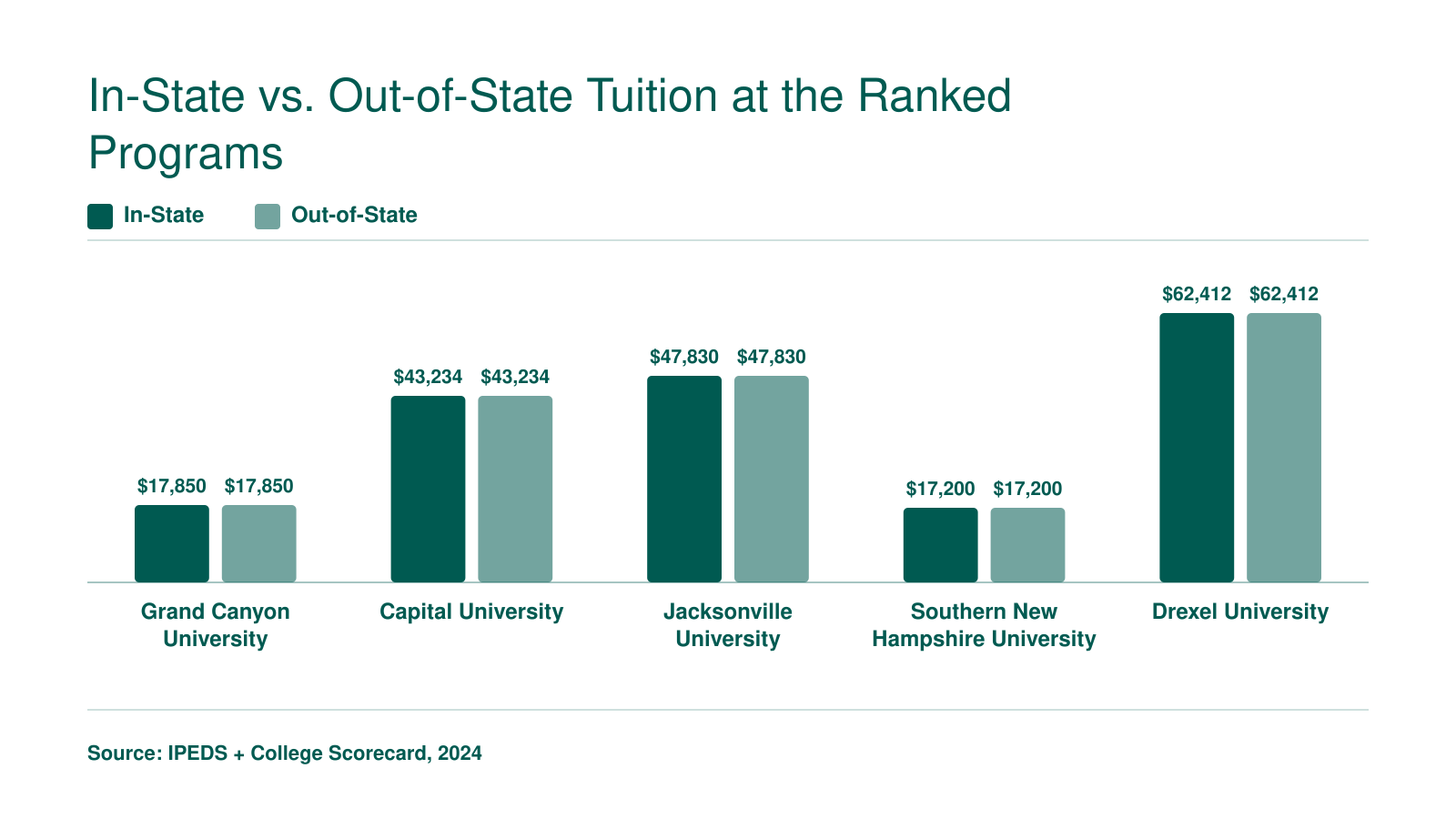
In-State vs. Out-of-State Tuition at the Ranked Programs
Online patient safety and quality MSN programs often charge the same graduate tuition for in-state and out-of-state students, so the residency gap shown here is zero for these schools. The chart compares annual graduate tuition and fees from IPEDS data for selected programs. To estimate the full cost, add per-credit totals and any fees: SNHU lists $659 per credit across 36 credits, while Drexel lists $1,169 per credit across 45 credits, and students should also budget for books, background checks, travel to practicum sites, and liability insurance.
Online Options and Practicum Hours: What Working Nurses Should Expect
Online coursework is the easy part; the practicum is where these patient safety and quality MSN programs differ. Yes, they are widely available online, and the ranked schools I checked, including Drexel, SNHU, Capital and Jacksonville, deliver the program that way.
Hours
These online patient safety and quality MSN programs are non-direct-care, so practicum requirements run lighter than APRN tracks, which typically demand 500 or more clinical hours. Where figures are published, they land between about 80 and 135 hours. Franklin requires 80 (2026 handbook), Holy Family 1082, and SNHU and Northern Colorado 135 each.
Who finds the preceptor
Expect to do the legwork at several schools. SNHU students locate their own sites and preceptors and submit them for approval. Northern Colorado students also identify sites, with placement help if needed. Holy Family lets you choose, though the instructor must approve and you can't use your own unit.2 Franklin is the exception: faculty and a clinical coordinator arrange the site.
Residencies
Drexel requires a mandatory two-day virtual residency, so no travel.1 Fayetteville State is different: students come to campus one to three times in the final semester during capstone practicum hours.
Related Articles
Admission Requirements and RN-to-MSN Bridge Options
Requirements vary by program, but most schools here expect a current RN license and either a BSN or an approved bridge pathway.
- RN licenseA current, unencumbered RN license is standard; some programs require it in your state of practice.
- Degree pathwayA BSN from an accredited program is usually required. Drexel University and Grand Canyon University offer RN-to-MSN bridge options for associate-degree or non-nursing bachelor's nurses.
- Minimum GPAA 3.0 GPA is typical. Cleveland State University and Mount Saint Mary's University waive the GRE; Indiana University South Bend may require it only for applicants below 3.0.
- Work experienceSome schools expect experience: Duquesne University requires one year of full-time RN practice, and Indiana University South Bend recommends two years.
- Transfer creditsPrior graduate coursework can lower cost. Indiana University South Bend and National University accept up to 12 credits; Duquesne accepts up to 9; SNHU also accepts up to 12.
Accreditation and State Authorization: Check Before You Apply
Programmatic accreditation is not the same as the school simply being accredited. Institutional accreditation covers the university; programmatic accreditation from the Commission on Collegiate Nursing Education (CCNE) or the Accreditation Commission for Education in Nursing (ACEN) covers the nursing degree itself. That distinction matters for employer recognition, federal financial aid eligibility, and admission to a future DNP, so verify accreditation for the specific MSN track, not the name on the diploma.
Among the schools here, Grand Canyon's MSN is accredited by CCNE, as are the programs at Southern New Hampshire, Capital, and Drexel. Jacksonville's program carries CCNE recognition as well.
This is a non-licensure track, meaning you earn no new clinical license, but accreditation still shapes the degree's career value. Online enrollment is also restricted by state: not every program can admit students from every state. Southern New Hampshire, for example, lists eligible states individually. Check each school's state authorization page before you apply.
The lowest per-credit rate doesn't always win. Total credits, program fees, and unpaid practicum hours decide what a patient safety and quality MSN actually costs you.
MSN Patient Safety and Quality Salary, Debt, and ROI
The question is whether a lower sticker price still leaves you better off once salary and debt are counted. Program-level federal data gives a partial answer for three of the schools here.
What graduates earn and owe
- Drexel University: median earnings of $86,305 five years after finishing, median debt of $61,917, and a typical payment of about $704 a month.
- Grand Canyon University: $70,527 five years after finishing, $45,080 in median debt, about $513 a month.
- Southern New Hampshire University: $69,637 four years after finishing, $36,900 in median debt, about $420 a month.
Figures for Jacksonville University and Capital University are not available at the program level, so they are left out rather than estimated.
BLS benchmarks
BLS reports May 2025 median pay of $97,550 for registered nurses2 and $123,860 for medical and health services managers1. Managers are projected to grow 24% from 2025 to 20351, against 6% for nurses2. BLS has no separate category for quality or patient safety nurses, so these are only benchmarks.
Weighing the payoff
At SNHU, a $420 payment is roughly $5,000 a year against earnings near $70,000. Drexel's $704 payment is about $8,400 a year. The larger pay gains likely come from moving into management-track roles, not from the degree alone.
Patient Safety & Quality programs by state
Patient Safety and Quality MSN: Frequently Asked Questions
Prospective students often ask how a patient safety and quality MSN translates into certification, admission, and cost. These answers focus on the credentials and cost questions that matter most when comparing programs.
What certifications can I earn with a patient safety and quality MSN?
Do I need a BSN to enroll in a patient safety and quality MSN program?
Which patient safety and quality MSN program is cheapest after mandatory fees and clinical expenses?
Can MSN coursework count toward CPHQ or CPPS exam eligibility?
Compare Patient Safety & Quality programs on the data that matters
Explore more Nursing specializations or browse every graduate field.
All Nursing programs