Most Affordable MSW Programs
Compare 1,100+ accredited most affordable Social Work (MSW) programs at 420+ schools, with graduate earnings, cost, debt, and completion data from IPEDS and the U.S. College Scorecard.

An MSW leads to a modestly paid profession, so overpaying for the degree can weigh on a budget for years. But the lowest sticker price is not automatically the best deal. Published graduate tuition across the schools ranked here runs from $6,693 (Florida Atlantic University, in-state) to $28,657 (University of Central Florida, out-of-state), more than a fourfold gap for the same credential.
Residency, program length, and delivery format decide where a student lands in that range, which is why the in-state and out-of-state columns need separate reading.
One constraint cannot be traded for savings: state licensure requires a degree from a CSWE-accredited program.
Key Points
- Fresno State's $7,350 resident rate and UT Rio Grande Valley's $8,589 show how low in-state MSW prices go.
- Out-of-state campus students at Cal State San Bernardino pay $19,692, double the $9,612 resident rate.
- Michigan's $30,265 billed total and $230 to $260 ASWB exam fees show costs beyond tuition.
The 10 Most Affordable MSW Programs for 2027
Cost after aid carried the most weight in this list, with graduate tuition, net price, and graduate outcomes from IPEDS and College Scorecard rounding out the comparison. The CSWE-accredited programs below combine a lower price tag with a clear route to licensure, though actual affordability still depends on your residency, aid package, and chosen format.
Brigham Young University
#1Provo, UT · $5,000 – $10,000/yr (est.) · ASWB pass rate 97.9% (3-yr weighted avg)
Best for: Clinical social work students prioritizing affordability
BYU's MSW sits in the School of Social Work and emphasizes clinical practice and research with families and children. The campus-based program builds competence in clinical social work and research, with CSWE accreditation. Median earnings one year after finishing were about $52,100, with typical debt near $15,500.
- CSWE accredited
- Focuses on clinical practice and research with families and children
- Builds competence in clinical social work
- Terminal degree for social work practice
- Prepares for wide range of social services
University of California-Berkeley
#2Berkeley, CA · ~$16,000/yr (est.) · ASWB pass rate 93% (3-yr weighted avg)
Best for: California residents drawn to anti-oppressive practice
UC Berkeley's Master of Social Welfare is a two-year, full-time CSWE-accredited degree that functions as the MSW equivalent and leads to licensure. The program trains multi-level practitioners through evidence-informed and anti-oppressive approaches, with optional school social work credential preparation and multiple concentration pathways.
- Two-year full-time program
- CSWE accredited
- Top 10 ranked social work school nationally
- Evidence-informed and anti-oppressive practice focus
- Integrates multiple disciplinary knowledge sources
- Prepares multi-level practitioners for licensure
- Prepares for California K-12 public school roles
- 45 semester units required
- 1,000-hour practicum including 450 school-based hours
- Requires Basic Skills Requirement and Certificate of Clearance
- SOCWEL 232 course required
- Eligible for Pupil Personnel Services Credential
The University of Texas at Austin
#3Austin, TX · ~$12,000/yr (est.) · ASWB pass rate 95.8% (3-yr weighted avg)
Best for: Texas professionals seeking dual degree options
UT Austin awards the Master of Science in Social Work with concentrations in Clinical Social Work and Administration and Policy Practice. Full-time, part-time, and Post-BSW advanced standing pathways are available, along with dual degrees such as MSSW/MBA and MSSW/JD. Median earnings one year after finishing were about $53,500, and typical debt was near $37,700.
- CSWE accredited
- Two concentration options: Clinical Social Work and Administration and Policy Practice
- Full-time two years or part-time 3-3.5 years
- No online study
- Practicum placements in community agencies
- Dual degrees with MBA, JD, MPH, and MDiv
- Complete in just over one year
- Requires BSW from a CSWE-accredited program
- 42-48 credit hours
- Part-time and full-time options
- Starts summer or fall
Nebraska Wesleyan University
#4Lincoln, NE · ~$10,000/yr (est.) · ASWB pass rate 100% (2-yr weighted avg)
Nebraska Wesleyan offers a trauma-conscious MSW in a hybrid format that pairs online coursework with in-person evening classes in Lincoln. Students choose between a 66-credit generalist track and a 34-credit advanced standing option for BSW graduates, with full-time completion in one to two years. The program requires field practicum hours and prepares graduates for clinical licensure or certification.
- Hybrid delivery combines online coursework with evening classes in Lincoln
- 66-credit generalist track
- Full-time completion in 1-2 years
- Trauma-conscious approach
- Requires 3.0 GPA, statistics coursework, and references
- 400-900 practicum hours
- 34-credit advanced standing option for BSW graduates
- Full-time 1-2 years or part-time 2-4 years
- Evening classes one night per week
- Prepares for clinical licensure or certification
University of North Carolina at Chapel Hill
#5Chapel Hill, NC · ~$13,000/yr (est.) · ASWB pass rate 92.1% (3-yr weighted avg)
UNC Chapel Hill enrolls about 300 MSW students each year and offers full-time, part-time extended, online, and advanced standing options. Concentrations include Direct Practice and Community, Management, and Policy Practice, with up to 1,100 field education hours. Median earnings one year after finishing were about $49,700, with typical debt near $42,300.
- CSWE accredited
- Two concentrations: Direct Practice and Community, Management, and Policy Practice
- 62 semester credit hours
- Full-time, part-time extended, and online options
- Up to 1,100 field education hours
- No credit for life or previous employment experience
- Employed 3-year students may use current job as field placement
- Accelerated one-year program for BSW graduates
- No entrance exam required
- Starts in May and graduates the following May
- Three letters of recommendation minimum
- Financial aid and scholarships available
Utah Valley University
#6Orem, UT · $10,000 – $15,000/yr (est.) · ASWB pass rate 88.2% (3-yr weighted avg)
Utah Valley's MSW is an Advanced Generalist program delivered hybrid-style: students attend in-person class once a week and complete the rest online, excluding practicum. Field placements occur at hospitals, mental health clinics, schools, and residential treatment centers, and the program reports a 90% job offer rate at graduation. Median earnings one year after finishing were about $51,100, with typical debt near $29,200.
- CSWE accredited
- Advanced Generalist MSW program
- In-person class once a week, remainder online
- 90% job placement rate reported
- Field education at hospitals, mental health clinics, schools, and residential treatment centers
- 3.0 GPA minimum
- 41 total credit hours
- Requires CSWE-accredited BSW degree
- Prepares for CSW licensure in Utah
- Trauma-informed, strengths-based practice training
- Two advanced field practicums
- Six-year completion window
California State University-Fullerton
#7Fullerton, CA · $9,000 – $19,000/yr (est.) · ASWB pass rate 82.9% (3-yr weighted avg)
Cal State Fullerton is the only public university offering an MSW in Orange County. It provides a 60-unit standard MSW with an Aging concentration, a three-year flex program focused on Community Mental Health, and 30-unit advanced standing tracks. Median earnings one year after finishing were about $64,200, with typical debt near $31,100.
- 60-unit MSW with Aging concentration
- Only public MSW in Orange County
- 42 units of required coursework
- 6-unit culminating master's project
- Requires 3.0 GPA in last 60 units
- One year of paid or volunteer human service experience
- Three-year flex program for working professionals
- Community Mental Health concentration
- Evening classes
- 576 clinical hours
- Cohort-based structure
- All courses are three units each
- Aging advanced standing track
- 30 credits total
- GPA minimum of 3.5
- Faculty adviser assigned on admission
- Interview required
- Prepares for leadership roles in public and nonprofit agencies
- Base advanced standing track
- Three concentration options
- No entrance exam required
- Test optional
- 3.5 GPA minimum
- No-credit summer bridge program required
- Two applications: Cal State Apply and department
- Community Mental Health advanced standing track
- 30 semester credits total
- Prepares for psychiatric hospitals and clinics
- Accepts BSW/BASW earned within past five years
- Requires no-credit summer bridge program
- Practice-based electives required
Utah State University
#8Logan, UT · $8,000 – $25,000/yr (est.) · ASWB pass rate 89.5% (3-yr weighted avg)
Utah State's MSW emphasizes anti-oppressive and strengths-based practice and offers Title IV-E Child Welfare and Public Mental Health and Substance Use pathways. A separate one-year advanced standing track reduces the load for BSW holders, with a clear route to CSW and LCSW licensure. Median earnings one year after finishing were about $53,200, with typical debt near $20,500.
- CSWE accredited
- Prepares for state licensure
- Title IV-E Child Welfare Program
- Public Mental Health and Substance Use Program
- Anti-oppressive and strengths-based approach
- 36 total credit hours
- One-year full-time program for BSW graduates
- 3.0 GPA minimum
- $55 application fee
- Prepares for CSW and LCSW licensure
- Starts summer
- Logan campus only
- Three letters of recommendation minimum
San Diego State University
#9San Diego, CA · ~$10,000/yr (est.) · ASWB pass rate 87.5% (3-yr weighted avg)
San Diego State offers an MSW with Direct Practice/Clinical and Administration and Community Development concentrations, plus an MSW/MPH dual degree and advanced standing options. Completion plans range from one to four years depending on prior BSW status and pace. Median earnings one year after finishing were about $62,000, with typical debt near $22,400.
- Direct Practice/Clinical concentration
- Evidence-based intervention methods
- Qualifying exam after 31 units
- Thesis or comprehensive exam options
- Field practicum in approved settings
- Emphasizes ethical practice, social justice, and cultural sensitivity
- Administration and Community Development concentration
- Completion plans from 1 to 4 years
- Community organizing electives
- Administration internships available
- Civic engagement course
- Three-year dual degree program
- 93-unit curriculum
- Requires SOPHAS application
- Full-time study expected
- Internships in second and third years
- Seven-year time limitation
- Direct Practice concentration
- One-year advanced standing path
- 38 semester credit hours
- Requires BSW earned within five years
- Thesis or capstone option
- Starts summer
- Two concentration options
- One-year accelerated track
- 38 total credit hours
- Requires BSW from CSWE-accredited program
- Full-time enrollment
- Summer bridge courses required
University of California-Los Angeles
#10Los Angeles, CA · ~$14,000/yr (est.) · ASWB pass rate 85.5% (3-yr weighted avg)
UCLA Luskin's Master of Social Welfare is a top-ranked, CSWE-accredited degree with concentrations in Child and Family Well-Being, Health and Mental Health, and Social and Economic Justice. Practicum education exceeds 1,000 hours through more than 400 Los Angeles agency partners. Median earnings one year after finishing were about $65,100, with typical debt near $53,600.
- CSWE accredited
- Three concentrations: Child and Family Well-Being, Health and Mental Health, and Social and Economic Justice
- Full-time two-year or part-time options
- Practicum education exceeds 1,000 hours
- More than 400 Los Angeles agency partners
- Research capstone required
- Cohort of about 150 students
Cost & outcomes by school
Federal data for the highest-earning Social Work (MSW) programs, independent of the ranking above. Earnings are this field's master's graduates four years after completing, where the Scorecard reports them.
| School | Earnings | Tuition / yr | Debt | Grads/yr | Format |
|---|---|---|---|---|---|
| Fort Hays State University KS | — | $4,949 | — | 1,544 | Hybrid |
| Florida Atlantic University FL | — | $6,693 | — | 3,718 | Online |
| Kennesaw State University GA | — | $6,702 | — | 3,708 | Campus |
| Arkansas State University AR | — | $7,322 | — | 3,362 | Campus |
| East Texas A&M University TX | — | $7,338 | — | 3,020 | Online |
| University of Nevada-Las Vegas NV | — | $7,413 | — | 2,582 | Campus |
| Wichita State University KS | — | $7,986 | — | 3,056 | Campus |
| University of North Carolina at Charlotte NC | — | $8,037 | — | 4,156 | Online |
| Texas Woman's University TX | — | $8,520 | — | 3,630 | Hybrid |
| The University of Texas Rio Grande Valley TX | — | $8,589 | — | 3,408 | Hybrid |
| University of Alabama at Birmingham AL | — | $8,640 | — | 4,976 | Campus |
| Georgia State University GA | — | $8,664 | — | 4,334 | Campus |
Sources: U.S. Department of Education. Tuition and graduates: IPEDS. Earnings and debt: College Scorecard, this field's master's graduates; a dash means no figure is reported.
What an MSW Really Costs Beyond the Tuition Line
The ASWB Masters exam costs $230 and the Clinical exam costs $260 in 20261, both nonrefundable2, yet that is the last bill in a long chain of expenses that begin well before graduation.
Fees the Tuition Line Leaves Out
A published per-credit rate rarely includes the mandatory per-semester charges that sit on top of it: technology, distance-education, and student services fees, plus books and course materials. These differ by campus and delivery format. We have not verified current dollar figures for them across the ranked schools, so pull the fee schedule from each program's bursar page instead of relying on the headline rate.
Field Placement Costs Few Students Budget For
Savannah State's MSW, for example, requires 900 clock hours of practicum (400 foundation, 500 advanced), scheduled during daytime hours with no evening or weekend placements. That is roughly 22 forty-hour weeks of unpaid work. Around those hours, expect some mix of the following, depending on the school, the agency, and your state:
- Background checks and fingerprinting: Many placement agencies require them, and whether the school, the agency, or you pay varies.
- Liability insurance: Some programs bundle it into fees, while others make students buy a policy.
- Travel and mileage: Placements can be far from campus or home, especially for students in hybrid and online programs.
- Lost income: Reduced work hours during practicum are often the largest cost of all.
Costs After You Graduate
ASWB charges $230 for the Masters exam and $260 for the Clinical or Advanced Generalist exam.1 Students heading toward clinical licensure typically sit for two exams over their careers, since the Clinical exam follows supervised post-master's experience. Your state board may add its own application, processing, fingerprinting, or licensing fees. Texas, for one, lists a separate $60 fee to preapprove testing accommodations.3
A Formula You Can Reuse
For any program, estimate the total this way:
(credits × per-credit rate) + (fees × number of terms) + placement costs + exam and license costs
Run it twice if you hold a BSW: once with the traditional credit count and once with the advanced standing count. Then add your lost income as a separate line so the comparison stays honest.
Where the Money Goes in a Typical MSW Bill
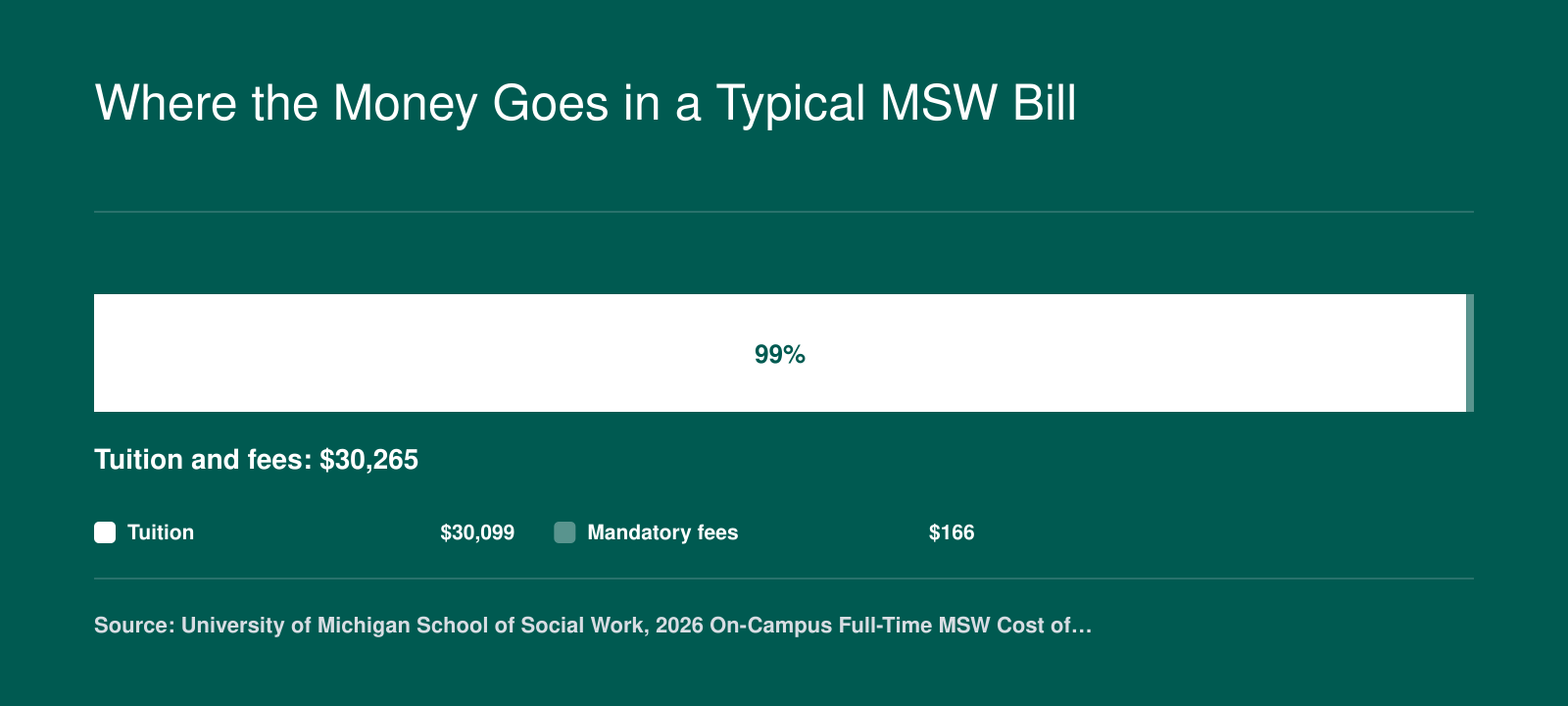
These figures come from the University of Michigan School of Social Work's 2026 cost sheet for its 16-month, on-campus, full-time MSW. Tuition is $30,099 and mandatory fees add $166, for $30,265 in billed charges. The slice that tends to surprise students is the one missing from this chart: books, field-placement expenses, and licensure exam fees sit outside the billed amount. The university does not break them out here, so budget for them separately.
Advanced Standing: How a BSW Can Cut Your MSW Bill Nearly in Half
A BSW is the most effective cost-cutting tool in social work graduate education, because it unlocks advanced standing MSW programs that let you skip the foundation year everyone else pays for.
Who Qualifies
Programs generally require a CSWE-accredited BSW earned recently, plus a minimum GPA. Published rules at public universities differ:
- Western Michigan: BSW within six years, 3.25 GPA, 39-credit advanced-standing program.1
- University of Utah: BSW within seven years of the application deadline. Older degrees route to the full-length track.2
- CSU San Bernardino: BSW within five years, 3.00 GPA, B or better in social work courses.3
- San José State: degree within seven years, 3.5 GPA, A- or better in major courses.4
- UT Arlington: BSW earned in 2010 or later, 3.0 GPA, B or higher in required social work courses.5
Recency windows run from five to seven years, and GPA floors from 3.0 to 3.5. Check the exact rule before you count on the discount.
What the Credit Math Looks Like
Advanced-standing tracks at public universities commonly run 39 to 42 credits, compared with about 60 for the traditional route. Take a hypothetical rate of $700 per credit (not any specific school's price). Sixty credits comes to $42,000. Thirty-nine credits is $27,300, and 42 credits is $29,400. That is a savings of roughly $12,600 to $14,700, or about a third. Programs with leaner advanced-standing loads, closer to 30 credits, approach half. Tuition for both tracks was not published consistently enough to compare across these schools, so multiply your target school's actual per-credit rate by each credit total.
Compare the Right Track
Be wary of lists that set one school's advanced-standing price beside other schools' traditional prices. That makes the first school look far cheaper than it will be for most applicants. If you don't hold a recent BSW, the traditional figure is the only one that applies to you. Utah, for example, states that BSW graduates applying to other programs cannot have first-year coursework waived.2
Fewer Placement Hours, Too
Advanced standing also removes the foundation field placement, so you complete one placement instead of two. That trims unpaid hours as well as tuition, which matters if you would otherwise cut back paid work to fit a placement into your week.
Online vs. Campus MSWs: Flat Rates, Residency Rules, and Hidden Logistics
Among the ranked schools, the out-of-state penalty on a campus program is steep: UT Rio Grande Valley charges $8,589 for residents versus $15,971 for everyone else, and Cal State San Bernardino jumps from $9,612 to $19,692. For a nonresident, that gap can double the sticker price. The ranked set leans heavily on campus and hybrid delivery (Hunter, the Cal State campuses, Sacramento State, and USF are classroom-based), with Florida Atlantic and UCF representing the fully online end.
Which Formats Charge One Rate
Some online programs ignore residency entirely. Boise State charges $565 per credit to every online MSW student regardless of home state, which works out to roughly $34,465 for the 61-credit regular track or about $20,905 for the 37-credit advanced-standing track. The University of Denver's online MSW likewise applies a flat per-credit rate to in-state and out-of-state students alike.
Regional compacts offer a middle path. Through WICHE's Western Regional Graduate Program, eligible residents of member states can attend qualifying programs at 150% of resident tuition. Arizona State and the University of Montana both participate; Montana's WRGP rate runs about $23,448 per year for out-of-state students who qualify. Note the fine print: Colorado State's WRGP eligibility applies to on-campus formats only, not online. "Online" does not automatically mean in-state pricing.
Feasibility Costs Nobody Lists on the Tuition Page
- Live sessions: Boise State runs mostly asynchronous coursework with a few live meetings, while some programs require weekly evening sessions. Confirm whether any mandatory synchronous times fit your time zone and work schedule.
- In-person requirements: Some online MSWs require no campus visits at all; others build in orientations, intensive weekends, or skills labs. There is no universal CSWE rule, so each program sets its own.
- State authorization: A program may be barred from enrolling or placing students in certain states. UNC Pembroke, for example, requires online field placements inside North Carolina and caps telehealth hours at 10% of the total.
Field Placement and the Verdict
Every online MSW still requires supervised field hours (roughly 900 for regular standing, often around 600 for advanced standing). Who arranges them varies: Boise State coordinators secure local placements for a $300 fee that covers liability, and some schools run an internship office that places you, while others expect you to find an approved agency yourself. Ask in writing who finds, approves, and guarantees your placement.
Online programs with flat tuition usually win on cost for out-of-state students. Campus wins when you qualify for low resident rates, want a named local placement network, or value in-person supervision.
Do Cheaper MSW Programs Pay Off? Earnings and Debt After Graduation
A $7,350-a-year resident seat at Fresno State and a $50,547-a-year non-resident seat at UC Berkeley lead to the same CSWE-accredited credential, the same licensure exam, and frequently the same job title. What differs is the payment you carry for the decade after graduation.
What the earnings data can and cannot tell you
The federal data that matters here reports what graduates of a specific master's program earned one year, two years, and four years after finishing. For the MSW programs ranked above, those program-level earnings have not yet been published. We will not substitute a campus-wide figure in their place: a university-level earnings number blends engineering, business, and health graduates, and it says nothing useful about what a social worker takes home. Any MSW earnings figure you encounter should carry its window with it. "Median earnings four years after finishing" is a claim you can check. A bare dollar sign with no timeframe is marketing.
The same rule applies to borrowing. Median debt for a program and the monthly payment that debt implies over ten years are the honest second half of the picture, because the only ratio that governs your first few years of practice is payment against income, not tuition in isolation.
Price is the variable you actually control
Early-career social work pay tracks geography, practice setting, and licensure status far more than it tracks where you earned the degree. A behavioral health role in the Bay Area and rural child welfare work pay differently no matter whose name is on the diploma. Tuition is the opposite: it is fixed, published, and knowable before you sign anything. Lower tuition shows up directly in a smaller monthly payment, every month, for ten years.
Run the number before you apply
- Credits times rate: San Jose State lists $695 per credit across a 37-credit advanced standing track. Do that multiplication yourself.
- Residency: Fresno State charges $7,350 in-state against $19,950 out-of-state, a gap larger than most scholarships.
- Net price, not sticker: CUNY Hunter's average net price runs under $3,000, well below its published tuition.
- Local salary: Compare your projected payment against licensed social worker pay in the metro where you plan to practice, not a national average.
Related Articles
Social Work (MSW) programs by state
Quick Answers: Part-Time Study and Licensure on a Budget
Two questions come up most often when students pick a lower-cost MSW: whether they can keep working while they study, and whether a cheaper degree limits licensure. Here are direct answers based on current state rules and 2026 compact updates.
Can you earn an affordable MSW part-time while keeping a full-time job?
Will a low-cost MSW limit where you can get licensed as a clinical social worker?
Which affordable MSW programs are CSWE accredited?
Compare Social Work (MSW) programs on the data that matters
Explore more MSW specializations or browse every graduate field.
All MSW programs