Accelerated MSW Programs
Compare 1,100+ accredited fastest Social Work (MSW) programs at 420+ schools, with graduate earnings, cost, debt, and completion data from IPEDS and the U.S. College Scorecard.

Can you really finish a CSWE-accredited Master of Social Work in 9 to 16 months instead of two years? Yes, through two routes: advanced standing for BSW holders, and full-credit accelerated tracks for graduates of other majors. The ranking below puts the fastest programs first, from Bryn Mawr's 10-month advanced standing MSW to NYU's 16-month accelerated option.
The tradeoff is that compression squeezes everything except fieldwork. Practicum hours stay largely intact, so a one-year program often means full-time classes plus an internship, with little room for outside paid work. Most state licensing boards care about accreditation and supervised hours, not how quickly the credits were earned.
Key Points
- CSWE's 2023-2024 survey shows 128 of 225 MSW programs offer online delivery.
- San Diego State University reports the highest early-career earnings on this page.
- Summer-start accelerated cohorts often close applications by January, February, or March 2027.
The 10 Best Accelerated MSW Programs, Fastest Tracks First
This list is built around compressed timelines. It weighs one-year completion options heavily, then graduation rates, earnings, and debt outcomes. The schools below offer accelerated or advanced standing MSW paths with details on concentrations and practicum demands.
The University of Texas at Austin
#1Austin, TX · ~$12,000/yr (est.) · ASWB pass rate 95.8% (3-yr weighted avg)
Best for: Texas residents wanting clinical social work
Texas flagship with a post-BSW route that compresses the MSSW into just over one year. The school graduates 89% of students. Its social work program offers clinical and administration options, with advanced standing requiring 42 to 48 credits.
- CSWE accredited with clinical or administration and policy practice concentrations
- Post-BSW advanced standing completes in just over one year
- Requires 42 to 48 credits for advanced standing
- Full time two years; part time three to three and a half years
- December 1 deadline with $65 application fee
- No GRE required
Columbia University in the City of New York
#2New York, NY · ~$58,000/yr (est.) · ASWB pass rate 86.7% (3-yr weighted avg)
Best for: Online learners needing nationwide practicum placements
Ivy League school with a mostly synchronous online MSW and six pathways. The school graduates 96% of students. Its one-year advanced standing option starts with a summer intensive.
- 100% online coursework with mostly synchronous classes
- Six pathways ranging from one to four years
- Practicum placements across the U.S.
- Four method specializations and seven fields of practice
- Prepares for LMSW and LCSW licensure
- One-year program with summer start
- 33 total credit hours plus 12 practicum credits
- Up to 27 transfer credits accepted
- Four concentration options
- Requires B or better in social work classes
University of North Carolina at Chapel Hill
#3Chapel Hill, NC · ~$13,000/yr (est.) · ASWB pass rate 92.1% (3-yr weighted avg)
Best for: BSW graduates wanting a one-year campus cohort
Chapel Hill's advanced standing MSW starts in May and finishes one year later. The school graduates 91% of students. Graduates report a 25% salary increase and a 95% first-time licensure pass rate.
- One-year advanced standing program beginning in May
- Direct practice or community, management, and policy practice concentrations
- 95% first-time licensure exam pass rate
- Practicum placements across more than 850 sites
- No GRE required
- Apply by January 12, 2027
University of Wisconsin-Madison
#4Madison, WI · ~$12,000/yr (est.) · ASWB pass rate 91.3% (3-yr weighted avg)
This Madison campus compresses the advanced standing MSW to 30 credits. The school graduates 90% of students. BSW holders can finish in one year full-time or two years part-time.
- One-year full-time advanced standing; two years part-time
- 30 credit hours instead of 49
- Requires CSWE-accredited BSW within five years
- Exemption from most foundation courses
- Separate admission pool for advanced standing
Ohio State University
#5Columbus, OH · ~$14,000/yr (est.) · ASWB pass rate 84.8% (3-yr weighted avg)
Ohio State offers an online 63-credit MSW and an advanced standing alternative that finishes in one year full-time. The school graduates 88% of students. Advanced standing requires a BSW earned within the last five years.
- 63 credit online MSW with traditional and advanced standing pathways
- Full-time traditional completes in four semesters; part-time runs eight to eleven semesters
- No GRE required
- Estimated total cost $28,834 for four-semester pathway
- Asynchronous courses with many live sessions
- One-year full-time or two-year part-time advanced standing
- 43 total credit hours
- Available online and on campus
- Requires BSW earned within last five years
- Ohio residents pay in-state tuition
Nebraska Wesleyan University
#6Lincoln, NE · ~$10,000/yr (est.) · ASWB pass rate 100% (2-yr weighted avg)
Nebraska Wesleyan's hybrid MSW pairs online work with in-person evening classes in Lincoln. The school graduates 66% of students. Advanced standing students complete 34 credits and 500 practicum hours in one year full-time.
- Hybrid advanced standing track with evening classes one night weekly
- 34 credit hours and 500 practicum hours
- Trauma-conscious clinical focus
- One year full-time or two years part-time
- Rolling admissions and fall start
- Eight-week course sessions
University of Georgia
#7Athens, GA · ~$11,000/yr (est.) · ASWB pass rate 85% (3-yr weighted avg)
Georgia's Athens campus advanced standing MSW runs three semesters and 40 credits. The school graduates 90% of students. Students choose micro, macro, or combined practice with a 20-hour weekly practicum.
- One-year advanced standing completed over three semesters
- 40 credit hours
- Micro, macro, or combined practice specializations
- Practicum placement averages 20 hours per week
- Apply by January 8, 2027
- 3.2 GPA minimum
New York University
#8New York, NY · ~$43,000/yr (est.) · ASWB pass rate 83.9% (3-yr weighted avg)
NYU Silver's MSW includes accelerated 16-month, full-time, part-time, and hybrid options, plus policy and global concentrations. The school graduates 88% of students. No GRE is required.
- 65 credit MSW with accelerated 16-month pathway
- Full-time, part-time, and hybrid formats available
- No GRE required
- Prepares for clinical licensure
- Concentration in policy and community practice
- Dual-degree options available
- Hands-on practicum placements
- Concentration in global social work
- Shanghai-New York program available
- Study abroad courses offered
University of Washington-Seattle Campus
#9Seattle, WA · ~$19,000/yr (est.) · ASWB pass rate 84.5% (3-yr weighted avg)
Seattle's MSW offers multiple tracks, including a one-year advanced standing option for BSW holders. The school graduates 85% of students. Concentrations span clinical social work, policy, and community-centered practice.
- 48 to 75 credits depending on track
- Two-year full-time, three-year part-time, and one-year advanced standing options
- Concentrations include clinical social work, administrative and policy practice, and community-centered integrative practice
- One-year advanced standing for qualified BSW holders
- 48 total credit hours
- Requires BSW from CSWE-accredited program
Bryn Mawr College
#10Bryn Mawr, PA · ~$55,000/yr (est.) · ASWB pass rate 87.5% (3-yr weighted avg)
Bryn Mawr's advanced standing M.S.W. finishes in 10 months with a summer start. The school graduates 82% of students. Students choose clinical social work or communities, organizations, policy, and advocacy.
- 10-month advanced standing program starting in summer
- Clinical social work or communities, organizations, policy, and advocacy concentrations
- B.S.W. within five years and 3.0 GPA required
- Summer classes meet twice a week for five weeks
- Practicum placement assigned by the Office of Practicum Education
Cost & outcomes by school
Federal data for the highest-earning Social Work (MSW) programs, independent of the ranking above. Earnings are this field's master's graduates four years after completing, where the Scorecard reports them.
| School | Earnings | Tuition / yr | Debt | Grads/yr | Format |
|---|---|---|---|---|---|
| The University of Texas at Austin TX | — | $12,006 | — | 6,768 | Campus |
Sources: U.S. Department of Education. Tuition and graduates: IPEDS. Earnings and debt: College Scorecard, this field's master's graduates; a dash means no figure is reported.
Advanced Standing MSW Programs: The Shortest Route for BSW Graduates
A BSW already covers the generalist foundation that a standard MSW spends its first year teaching. Advanced Standing MSW credits work, so you skip straight to specialized coursework. Most students finish roughly 30 to 39 credits instead of the roughly 60 a traditional MSW requires, which usually cuts a two-year degree to about one year of full-time study.
Who Qualifies
Programs set their own bar, but the pattern is consistent:
- Degree: A BSW from a CSWE-accredited program.
- GPA: A minimum around 3.0, often measured in social work coursework rather than overall.
- Recency: A degree earned within a set window, commonly five to seven years. Older graduates may be asked to take the full-length track.
Check each school's exact cutoffs before you apply, since a 2.9 or an eight-year-old degree can change which track you're offered.
How the Year Is Built
Many advanced standing tracks open with a summer bridge course. It reviews core social work content and aligns your preparation with the program's expectations. A fall-through-summer specialized year follows, covering your chosen concentration, such as clinical practice, community work, or policy. Field education is concentrated into that year, often with a heavier weekly placement load than a standard second-year practicum.
The Trade-Off
Speed has a price. With fewer months to absorb advanced material and complete placement hours, there's little slack for a demanding job, and a slow ramp-up isn't realistic. Students who plan to keep working full-time often do better in a part-time online advanced standing MSW format, even though it takes longer. If you can step back from work for one year, the savings in tuition and lost wages from affordable advanced standing MSW programs can be significant. If you can't, the shortest timeline isn't automatically the best value.
Application Deadlines and Cohort Start Dates to Plan Around
Deadlines for accelerated and advanced standing MSW cohorts vary widely, and many summer-start tracks close applications in January, February, or March. Use the dates below as a planning guide, but confirm each deadline and start term on the school's website because cycles shift every year. Some programs list a single deadline rather than separate priority and final rounds.
| School | Track | Application Deadline | Next Cohort Start | Program Length |
|---|---|---|---|---|
| Quinnipiac University | Advanced Standing MSW | April 1, 2026 | Fall 2026 (online students may also start in spring or summer) | N/A |
| George Mason University | Advanced Standing MSW | December 15 | N/A | N/A |
| Simmons University | Accelerated MSW | August 21, 2026 | January 2027 (May and September starts also offered) | As little as 16 months |
| UNC Pembroke | Advanced Standing MSW | January 15, 2027 | May 24, 2027 | 12 months |
| Colorado State University | Advanced Standing MSW | December 1, 2026 | Summer 2027 (mid-May) | 1 year |
| University of Denver | Advanced Standing MSW | December 18, 2025 | Fall 2026 (September) | N/A |
| University of Illinois Urbana-Champaign | Advanced Standing MSW | May 1, 2026 | Fall 2026 | N/A |
Related Articles
Accelerated MSW Programs Without a BSW: Full-Credit Tracks and 3+2 Pathways
A bachelor's degree in psychology, criminal justice, or English does not shut you out of a fast MSW. The confusion comes from conflating "accelerated" with "advanced standing." Advanced standing waives foundation coursework for BSW holders. An accelerated track for everyone else keeps the full credit load intact and simply compresses it, running year-round across short terms instead of stretching over two academic years with summers off.
Full-credit tracks on a compressed calendar
Most full MSW curricula for non-BSW students sit at roughly 60 credits, and accelerated versions of them typically finish in about 16 to 21 months of continuous full-time study. The 900 supervised field hours that come with a 60-credit track, including the 300 foundation-year hours, do not shrink. They get packed into tighter terms.
Simmons University's online MSW is a useful illustration of what compression actually feels like. It admits students without a BSW, runs 16 months across four 14-week terms, and requires 65 credits total: 48 in coursework and 17 in practicum. That works out to 15 to 17 credits per term with a practicum running every single term. By contrast, Syracuse's online MSW for students holding a bachelor's outside social work covers the same 60-credit foundation but can take as long as 36 months. Same degree, very different pace.
Dual-credit 3+2 and BA/MSW pathways
If you are still an undergraduate, some of the most affordable MSW programs are combined programs that let graduate coursework count twice. Grand View University's pathway finishes a bachelor's and an MSW in five years total, transfers up to 12 graduate credits back toward the bachelor's, and bills the first MSW year at the undergraduate tuition rate. The University of Denver's five-year option is open to any undergraduate major, starts MSW courses in year four, and awards the bachelor's after that first graduate year, with at least 153 credits completed in the first three. Fairleigh Dickinson and Quinnipiac run similar five-year combined degrees. Published dollar savings are rare, so compare the tuition rate you would pay in that overlap year against standard graduate pricing.
Which route fits you
Current undergraduates with time left should chase a 3+2. Career changers and anyone already holding a degree in an unrelated field should target a 60-credit accelerated track through MSW programs online no BSW and check prerequisites early, since psychology, sociology, statistics, and human biology coursework is commonly preferred.
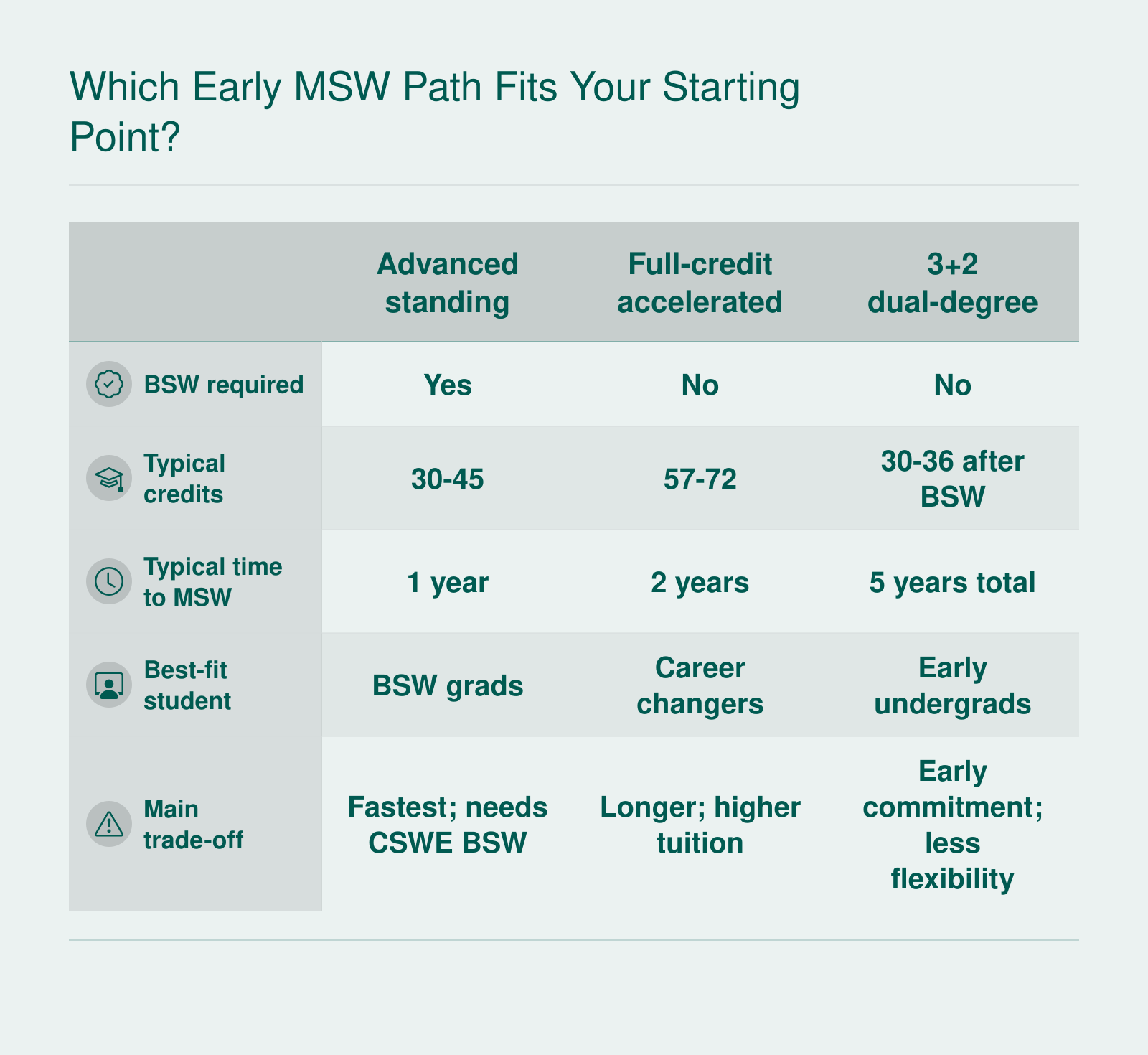
Which Early MSW Path Fits Your Starting Point?
Advanced standing, a full-credit accelerated MSW, and a 3+2 dual-degree pathway all shorten the timeline, but they make very different demands before you enroll. Use this scorecard to match the route to the BSW you already hold, the time you can give, and when you are ready to commit.
What Accelerated MSW Programs Cost in Tuition, Fees, and Debt
Tuition for the same CSWE-accredited credential now varies by a factor of eight depending on where you enroll and whether you count as a resident.
Sticker price and residency
Among the public universities ranked above, annual graduate tuition and fees for in-state students run from roughly $8,994 at UNC Chapel Hill to $13,244 at Ohio State. Non-residents at those same schools pay between $31,688 (Georgia) and $44,908 (UT Austin). Private programs charge one rate to everyone: $43,572 at Nebraska Wesleyan, $62,796 at NYU, $65,920 at Bryn Mawr, and $71,845 at Columbia. Qualifying for in-state status is the largest single cost lever most applicants control, often worth $20,000 or more per year.
Published net price figures (about $11,655 at UNC, $37,050 at NYU) describe the institution as a whole after aid, not this degree specifically. Use them to gauge how generous a school tends to be, not to budget.
Debt at graduation
Federal data reports median debt for social work master's completers and the estimated payment on a standard 10-year plan:
- Wisconsin: $29,000 median debt, about $330 a month
- UT Austin: $37,719, about $429 a month
- Ohio State: $38,169, about $434 a month
- UNC Chapel Hill: $42,252, about $481 a month
- Washington: $51,250, about $583 a month
- NYU: $78,508, about $893 a month
- Columbia: $82,150, about $934 a month
The costs nobody quotes you
Practicum is where budgets break. Placements are typically unpaid and can demand 20 hours a week, which means commuting costs, parking, and reduced work hours for the duration. Add criminal background checks and fingerprinting, professional liability insurance, and, at the end, the ASWB exam fee plus your state licensure application.
Why finishing early can cost less
A 10-to-12-month advanced standing track bills two or three semesters instead of four, and it puts you back on a full salary a year sooner. Even where the per-credit rate is higher, fewer credits and one less year of foregone wages usually beat the two-year total. Run both numbers before assuming the cheaper sticker price wins.
San Diego State University reports the highest published program-level median earnings one year after completion among accelerated MSW programs on this page.
In CSWE's 2023-2024 Annual Survey of Social Work Programs, 128 of the 225 MSW programs that responded reported offering online delivery, more than half. Those programs enrolled 55,935 master's students that year. Online study is now a common option, though the figure counts programs, not the share of students studying online.
Social Work (MSW) programs by state
Quick Answers on Accelerated MSW Timelines, Formats, and Accreditation
Accelerated MSW timelines and requirements vary by format and prior social work education. Use these quick answers to plan your schedule, understand the workload, and verify accreditation before you apply.
How many months does an accelerated master of social work take to finish?
Can a working adult realistically handle an online accelerated MSW?
How do I confirm an accelerated MSW program is CSWE-accredited?
Compare Social Work (MSW) programs on the data that matters
Explore more MSW specializations or browse every graduate field.
All MSW programs