Accelerated Advanced Standing MSW Programs
Compare 430+ accredited fastest Social Work Advanced Standing programs at 360+ schools, with graduate earnings, cost, debt, and completion data from IPEDS and the U.S. College Scorecard.

Employers and state boards still treat the MSW as the standard clinical credential, yet the two-year timeline is no longer fixed for everyone. BSW graduates can skip the foundation year and finish in as little as 9 to 12 months instead of two years.
The shortest programs come first, then eligibility, cost, online MSW programs, and practicum load.
Every program here is one of the CSWE-accredited MSW programs, which is what makes the degree eligible for state licensure.
Key Points
- In 2026, shortest ranked programs prioritize months, then price and format.
- ASWB reported 73.9% of first-time Master's exam takers passed in 2025.
- A low per-credit sticker price can still hide online and field fees.
10 Shortest Accelerated Advanced Standing MSW Programs in 2026
Speed was the deciding factor: programs that can move a BSW graduate to an MSW in the fewest months appear first, and cost and format break any ties. Each entry below is CSWE-accredited unless noted, and we flag residency or immersion requirements where they appear. California readers will find a direct one-year option at San Diego State, with several online and hybrid alternatives across the country.
Columbia University in the City of New York
#1New York, NY · ~$58,000/yr (est.) · ASWB pass rate 86.7% (3-yr weighted avg)
Best for: Recent BSWs focused on clinical specialization
Columbia's Advanced Standing Program is built for BSW holders who want a one-year, 33-credit path to an MSW. It blends an intensive six-week summer session with a specialized second-year sequence, including 12 practicum credits and three days per week in a field agency. The program is CSWE-accredited and offers four concentration options, with up to 27 transfer credits applied toward the degree.
- One-year hybrid program
- 33 total credit hours
- Intensive six-week summer session
- Up to 27 transfer credits
- Practicum three days per week
- B or better in social work classes
- CSWE accredited
- Four concentration options
University of North Carolina at Chapel Hill
#2Chapel Hill, NC · ~$13,000/yr (est.) · ASWB pass rate 92.1% (3-yr weighted avg)
Best for: Public university value seekers in North Carolina
UNC-Chapel Hill's 12-Month Advanced Standing MSW starts in May and graduates the following May, offering a full-time campus path for BSW graduates. Students choose between direct practice and community, management, and policy practice, with practicum placements at more than 850 sites. The program reports a 95% first-time licensure pass rate and is CSWE-accredited, with no GRE required.
- 12-month full-time campus program
- Starts in May, graduates following May
- Two concentration options: direct practice or community, management, and policy practice
- 95% first-time licensure pass rate
- No GRE required
- CSWE accredited
- 850+ practicum placement sites
University of Wisconsin-Madison
#3Madison, WI · ~$12,000/yr (est.) · ASWB pass rate 91.3% (3-yr weighted avg)
Best for: Full-time campus learners wanting streamlined path
The University of Wisconsin-Madison's advanced standing track is a 30-credit, one-year full-time option for BSW graduates from CSWE-accredited programs. Students are exempt from most foundation coursework and may also complete the program part-time over two years. The program is CSWE-accredited and uses a separate admission pool for advanced standing applicants.
- One-year full-time or two-year part-time
- 30 total credit hours
- Exempt from most foundation courses
- Separate admission pool
- 5-year BSW degree recency requirement
- CSWE accredited
Nebraska Wesleyan University
#4Lincoln, NE · ~$10,000/yr (est.) · ASWB pass rate 100% (2-yr weighted avg)
Nebraska Wesleyan's Master of Social Work Advanced Standing track is a hybrid, one-year full-time program with evening classes one night per week in Lincoln. It requires 34 credit hours and 500 practicum hours, with a trauma-conscious clinical focus and rolling admissions. The program is CSWE-accredited and can also be completed part-time over two years.
- One-year full-time or two-year part-time
- 34 total credit hours
- 500 practicum hours
- Hybrid evening classes in Lincoln
- Rolling admissions
- 3.0 GPA minimum
- Trauma-conscious clinical focus
- CSWE accredited
Ohio State University
#5Columbus, OH · ~$14,000/yr (est.) · ASWB pass rate 84.8% (3-yr weighted avg)
Ohio State's Advanced Standing Alternative Plan (ASAP) MSW can be completed full-time in three semesters or part-time over six semesters, with 43 credit hours. It offers four areas of emphasis and is available on campus and online, with synchronous and asynchronous options. The program is CSWE-accredited, and Ohio residents pay in-state tuition.
- Full-time one year, three semesters
- Part-time two years, six semesters
- 43 total credit hours
- Online and campus options
- Four areas of emphasis
- 3.0 GPA minimum
- Earned BSW within last five years
- CSWE accredited
University of Georgia
#6Athens, GA · ~$11,000/yr (est.) · ASWB pass rate 85% (3-yr weighted avg)
The University of Georgia's MSW Advanced Standing Program is a full-time, cohort-based, three-semester path requiring 40 credits. Students choose Micro, Macro, or Combined practice and complete a practicum averaging 20 hours per week. The program is CSWE-accredited, requires a 3.2 GPA, and does not require the GRE.
- Three-semester full-time program
- 40 total credit hours
- Micro, Macro, or Combined practice
- Daytime classes 4-5 per week
- Practicum 20 hours per week
- 3.2 GPA minimum
- No GRE required
- CSWE accredited
University of Washington-Seattle Campus
#7Seattle, WA · ~$19,000/yr (est.) · ASWB pass rate 84.5% (3-yr weighted avg)
The University of Washington's Advanced Standing MSW is a one-year, full-time, campus-based option for BSW graduates. It integrates a 17-credit field practicum and offers specialized courses in clinical practice, administration and policy, or community-centered integrative practice. The program is described as accredited by the Council on Social Work Education, though that status is not independently verified in this listing.
- One-year full-time campus program
- 48 total credit hours
- 17-credit field practicum
- Specializations: clinical, administration/policy, community-centered integrative practice
- Requires BSW from CSWE-accredited program
- CSWE accreditation not independently verified
Bryn Mawr College
#8Bryn Mawr, PA · ~$55,000/yr (est.) · ASWB pass rate 87.5% (3-yr weighted avg)
Bryn Mawr's Advanced Standing M.S.W. is a 10-month, campus-based program for students who earned a BSW within five years with a 3.0 GPA or higher. Students choose Clinical Social Work or Communities, Organizations, Policy, and Advocacy, and the program is CSWE-accredited. Classes meet intensively in summer and then weekly through fall and spring.
- 10-month campus program
- Summer session II start
- Two concentration options: Clinical Social Work or Communities, Organizations, Policy, and Advocacy
- 3.0 GPA minimum
- BSW within five years required
- CSWE accredited
San Diego State University
#9San Diego, CA · ~$10,000/yr (est.) · ASWB pass rate 87.5% (3-yr weighted avg)
San Diego State's Advanced Standing MSW is a one-year, full-time campus program with a Direct Practice concentration. It requires 38 credits, starts with summer bridge courses, and includes an advanced field practicum plus a thesis or comprehensive exam. The program is CSWE-accredited and requires a BSW earned within five years.
- One-year full-time campus program
- 38 total credit hours
- Direct Practice concentration
- Summer bridge courses required
- Advanced field practicum included
- Thesis or comprehensive exam
- 3.0 GPA minimum
- CSWE accredited
University at Buffalo
#10Buffalo, NY · $10,000 – $15,000/yr (est.) · ASWB pass rate 88.4% (3-yr weighted avg)
The University at Buffalo's Advanced Standing MSW is a one-year full-time or 1.5-year part-time program requiring 35 credits. It emphasizes trauma perspectives and human rights, with practicum education integrated into coursework. The program is CSWE-accredited and offers a part-time track designed for working students.
- One-year full-time or 1.5-year part-time
- 35 total credit hours
- Part-time track for working students
- Curriculum includes trauma and human rights
- Starts summer for full-time, spring for part-time
- CSWE accredited
Cost & outcomes by school
Federal data for the highest-earning Social Work Advanced Standing programs, independent of the ranking above. Earnings are this field's master's graduates four years after completing, where the Scorecard reports them.
| School | Earnings | Tuition / yr | Debt | Grads/yr | Format |
|---|---|---|---|---|---|
| California State University-Bakersfield CA | $86,527 | $9,611 | — | 60 | Campus |
| California State University-Sacramento CA | $84,100 | $9,542 | $33,556 | 103 | Campus |
| California State University-Northridge CA | $81,505 | $8,982 | $32,228 | 150 | Campus |
| Loma Linda University CA | $80,685 | $34,460 | $61,500 | — | Hybrid |
| San Diego State University CA | $78,813 | $10,252 | $22,395 | 78 | Campus |
| California State University-Los Angeles CA | $78,135 | $8,688 | $29,958 | 160 | Campus |
| California State University-San Marcos CA | $77,471 | $9,606 | $41,000 | 63 | Hybrid |
| Bridgewater State University MA | $75,783 | $9,297 | $40,772 | 98 | Hybrid |
| California State Polytechnic University-Humboldt CA | $74,253 | $9,921 | $29,654 | 57 | Campus |
| California State University-Chico CA | $72,273 | $9,996 | $18,968 | 108 | Hybrid |
| Westfield State University MA | $70,061 | $8,676 | $35,461 | 101 | Hybrid |
| Spring Arbor University MI | $69,441 | $8,364 | $20,500 | 104 | Online |
Sources: U.S. Department of Education. Tuition and graduates: IPEDS. Earnings and debt: College Scorecard, this field's master's graduates; a dash means no figure is reported.
Cost, debt & payoff
Median earnings of this field's master's graduates (4 yrs after completing) vs. their median federal loan debt · U.S. College Scorecard
Across these programs the median graduate earns about $62,890 and finishes with roughly $38,169 in debt — a ratio that clears a common rule of thumb (keep debt below first-year salary). Tuition and debt vary widely school to school, so check the per-school figures in the table above before you shortlist.
Advanced Standing vs. Accelerated: How the Two Combine to Shorten Your MSW
Advanced standing shortens what you must take, while accelerated shortens how fast you take it. They are separate levers, and the quickest MSW timelines pull both.
Advanced Standing: Fewer Credits
Advanced standing gives you credit for the generalist foundation year, which a CSWE-accredited BSW already covered. A traditional MSW runs about 60 credits. With advanced standing, that drops to roughly 30 to 39 credits, leaving only the specialized coursework and advanced practicum.
Accelerated: Faster Pacing
Accelerated describes compressed delivery: year-round terms with no long summer break, 7 to 8 week courses, and heavier credit loads in each term. A program can be accelerated without offering advanced standing, and the reverse is also true.
Common Timelines
- 9-month tracks: The most compressed full-time option, with a very heavy load.
- 12-month tracks: Full-time study across three or four terms.
- Two- and three-semester tracks: Full-time sequences, depending on whether summer is included.
- Part-time tracks: Typically 16 to 24 months.
The trade-off is simple: the faster the track, the less room you have to keep a full-time job. Part-time pacing gives the most flexibility, while the shortest full-time tracks leave little for outside work.
Who Gets Advanced Standing: GPA Floors, BSW Age Limits, and Foreign Degrees
A recent BSW and a strong transcript both help, but schools weigh each differently when applying MSW advanced standing requirements. The one fixed rule is a BSW from a CSWE-accredited program, earned inside the school's recency window.
Recency windows
- 5 years: NYU Silver, Portland State, Boise State (10 with significant post-BSW social work experience).
- 6 years: Boston University.
- 7 years: Simmons, Colorado State, Pittsburgh.
- 10 years: Michigan, counted to expected MSW completion.
GPA expectations
A 3.0 is the usual benchmark (NYU Silver, Boston, Simmons, Colorado State). Simmons also wants a 3.3 in social work courses and a B or better in each. Michigan asks for 3.5, and George Mason uses a 3.2 on your last 60 credit hours. Portland State and Boise State only recommend about a 3.0.
Foreign BSWs
A foreign social work degree alone is not enough. Where a pathway is stated (Portland State, Pittsburgh, Simmons, George Mason, UNC Charlotte), it runs through CSWE's International Social Work Degree Recognition and Evaluation Service or a CSWE agreement with international accreditors. Ask other schools directly.
Related Articles
Your Advanced Standing Application Packet, Item by Item
Most accelerated advanced standing applications are more documentation-heavy than test-heavy. Prepare these materials early, and verify deadlines by start term, summer cohorts often close earlier than fall.
- Official transcriptsRequest transcripts from every college attended, not just your BSW school, to verify CSWE accreditation, GPA, and prerequisites. Recency limits vary, for example, five years at George Mason and seven at Belmont.
- BSW field evaluationSubmit the practicum evaluation from your BSW placement; some programs ask for a specific field evaluation form.
- Personal statementWrite a goals or purpose statement tailored to advanced standing and your chosen concentration.
- ReferencesLine up two to three references, including at least one academic or field instructor, George Mason asks for two, Utah State for three.
- ResumeInclude a current resume or CV; George Mason and Utah State both list one as required.
- GRE and extrasThe GRE is rarely required, but some programs add an interview or writing sample. Check whether the program requires, waives, or does not consider scores.
- Deadline patternsFor summer or fall starts, priority deadlines often fall in January-February, Utah State February 1, Missouri priority January 15, with rolling or later online deadlines such as George Mason’s July 1 online date. Confirm start terms since several accelerated tracks begin in summer.
Advanced Standing MSW Tuition Cost: Sticker Price vs. Total Bill
Sticker price per credit only tells part of the cost story. An advanced standing MSW may look inexpensive at $350 per credit, but the total bill rises with credit loads, online fees, field placement charges, liability insurance, background checks, and travel to practicum sites. In-state public options can often land under $20,000, while some private programs can top $40,000 before every fee is added.
| School | Credits | Per-Credit Tuition | Estimated Total Cost | Format |
|---|---|---|---|---|
| Arkansas State University | 36 | $350 per credit | $12,600 | Online |
| Florida State University | 39 | $444 resident; $625 nonresident | $17,316 resident; $24,375 nonresident | Online |
| Adelphi University | 31 | $1,075 per credit | $33,325 | Online |
| Bethel University | 36 | $827 per credit | $29,772 | Online |
| University of Oklahoma | 33 | $645 per credit | $21,285 | Fully online |
| Cleveland State University | 30 | $655.90 in-state; $656.90 out-of-state | $19,677 in-state plus fees; $19,707 out-of-state plus fees | 100% online; field practicum in community |
| Aurora University | 30 | $650 per credit | Not reported | Online |
| Winthrop University | 39 | $699 per credit | Not reported | Online |
| Case Western Reserve University | 39 | $1,650 per credit for 1 to 11 credit hours | Not reported | On-campus weekly, on-campus weekend, or online |
According to ASWB, only 73.9% of first-time test takers passed the Master's licensing exam nationally in 2025. ASWB also publishes first-time pass rates for individual CSWE-accredited programs, so you can check how a school's graduates actually perform before you apply.
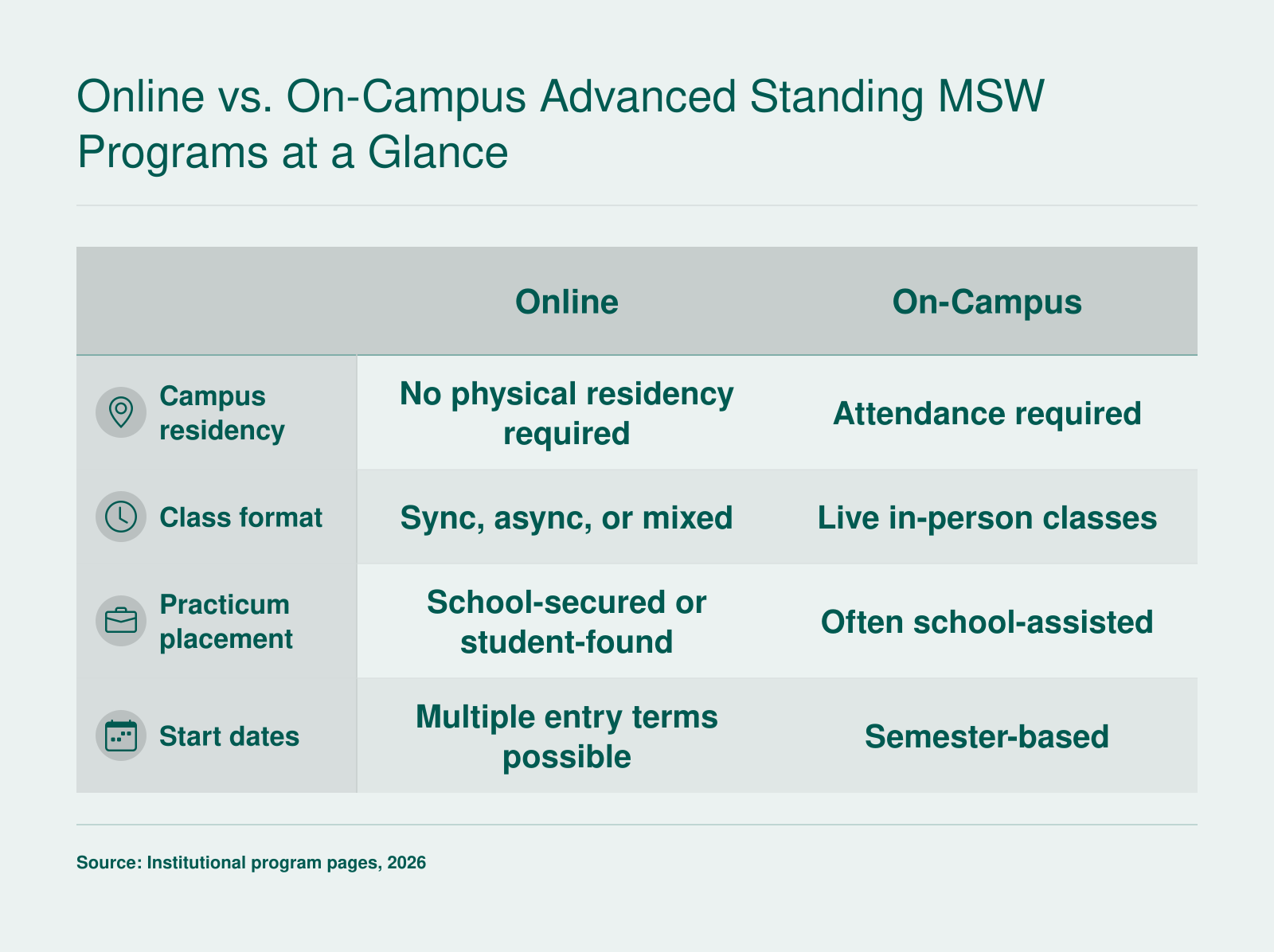
Online vs. On-Campus Advanced Standing MSW Programs at a Glance
Online advanced standing MSW programs can differ noticeably in how they handle live classes, practicum placement, and campus visits. This side-by-side shows how the online options compare with a traditional on-campus experience.
Practicum Hours and Whether You Can Keep Working
The practicum is the supervised, in-agency part of an MSW, and in advanced standing it is the largest block of your week outside class. CSWE requires at least 900 field hours for the full MSW, so students who get credit for BSW fieldwork typically owe roughly 450 to 600 specialized hours. Programs vary: NYU lists 450 for recent starts, Fordham 500, and George Mason's Social Work MSW Catalog lists 600, while UNC, Aurora and Simmons range from 600 to 672.
Hours per week depend on pace. Accelerated tracks often run about 24 hours a week of placement (UNC1, Simmons, Boston University full-time), on top of classes. Simmons puts the total schedule at 36 to 40 hours weekly. Slower tracks come closer to 16 (UNC's preferred pace1), and Fordham holds students to 15 to 21 hours.
Flexibility and the Working Verdict
Fordham accepts evening or weekend requests, but you still need 4 hours during regular business operations each week. USC's Prospective MSW Student FAQs and Aurora's Master of Social Work Field Placement FAQs allow a current employer as your practicum site with approval, and Aurora also requires separate supervision for internship tasks.
Working full time is realistic on part-time tracks, especially with an employer-based placement. On 9 to 12 month accelerated tracks it is very difficult, and NYU's full-time-only format rules it out.
Social Work Advanced Standing programs by state
Quick Answers Before You Compare Programs
What is the difference between accelerated and advanced standing MSW programs?
Are there accelerated MSW programs for people without a BSW?
How long does an accelerated advanced standing MSW program take to complete?
Compare Social Work Advanced Standing programs on the data that matters
Explore more Social Work & Social Sciences specializations or browse every graduate field.
All Social Work & Social Sciences programs