Best Master's in Human Services Programs
Compare 70+ accredited Human Services programs, with graduate earnings, cost, debt, and completion data from IPEDS and the U.S. College Scorecard.

A human services master's is a nonclinical credential for case management, advocacy, and program administration. Among the ten programs ranked for 2026, online, hybrid, and campus options run from $9,833 net price at University of Illinois Springfield to $30,371 at Nova Southeastern University, a spread that doesn't predict early-career earnings.
Accreditation is the hard filter: a degree counts toward the HS-BCP only from an institutionally accredited school, and the credential requires 350 hours of postdegree experience. The ranking weighs earnings, debt, completion, and net price, not prestige. Most programs have not released program-level earnings, so the few salary figures sharpen the cost comparison.
Key Points
- Only two ranked programs publish program-level earnings, so verify outcomes before you commit.
- The HS-BCP credential requires 350 postdegree hours and an institutionally accredited degree.
- All three most affordable programs are online, but net price reflects the whole school.
10 Master's in Human Services Programs for 2027
The strongest human services master's programs separate themselves in three practical ways: a net price that keeps debt manageable, program-level earnings that point in the right direction, and delivery options that fit working students. This list favors schools where those factors line up, not just the biggest name. Use the cards below to compare format, cost, and the credentials you can actually earn.
University of Delaware
#1Newark, DE · $20,000 – $25,000/yr (est.)
Best for: Aspiring nonprofit and early-childhood directors
University of Delaware's campus-based program pairs human development and family sciences with leadership training for nonprofit, state, and early-childhood settings. In-state graduate tuition is $16,810 and out-of-state is $41,400, with a net price of $17,799. The program reports a 2026-27 per-credit rate of $908, and a bachelor's-to-master's pathway is available for UD human services undergraduates.
- 33 total credit hours with three concentration options
- Full-time and part-time enrollment options
- 3.0 GPA minimum and three letters of recommendation
- Thesis or capstone option with field experience
- Interdisciplinary training with public policy coursework
- Focus on risk-and-resilience, multicultural issues, and prevention
- Monthly professional development series for students
- University reports a $908 per-credit rate for 2026-27
St. Joseph's University-New York
#2Brooklyn, NY · ~$23,000/yr (est.)
Best for: Working professionals needing online flexibility
St. Joseph's University-New York offers a fully online human services leadership program designed for working professionals who want to manage teams and advocate for vulnerable populations. Graduate tuition is $36,550, and the net price is $19,035. The curriculum leans into financial, legal, regulatory, political, social, and historical aspects of the field, with faculty who are practicing social workers, counselors, and agency directors.
- Fully online format with flexible scheduling
- Focus on leadership for child welfare, mental health, family support, and healthcare
- Faculty include practicing social workers, counselors, and agency directors
- Covers financial, legal, regulatory, political, social, and historical dimensions
- School-specific B.S. to M.S. pathway requires 18 additional credits
Boricua College
#3New York, NY · ~$19,000/yr (est.)
Best for: Students seeking culturally grounded research training
Boricua College's campus-based program in New York City emphasizes cultural competence, research methods, and clinical skill-building for leadership in management, policy, and research. Graduate tuition is $13,025, and the net price is $15,245. The curriculum includes study of the Latino experience and urban public health, with individualized instruction and small-group colloquia.
- 40 total credit hours with thesis, project, or capstone portfolio
- 2.0 GPA minimum for admission
- Clinical internships provide supervised helping experience
- Research workshops build data collection and clinical skills
- Cultural studies examine the Latino experience and urban public health
- Individualized instruction and small-group colloquia model
Mercer University
#4Macon, GA · ~$15,000/yr (est.)
Mercer University's hybrid program serves working adults with online, Saturday, and blended options. Graduate tuition is $42,312, and the net price is $23,847. Program graduates earned a median $44,355 one year after finishing, the clearest available earnings signal among this group.
- Online, Saturday, and blended delivery formats
- Median program earnings of $44,355 one year after finishing
- Emphasis on critical thinking, ethics, and applied skills
- Faculty bring diverse human services backgrounds
- Designed for advancement in social services and nonprofit agencies
University of Illinois Springfield
#5Springfield, IL · ~$12,000/yr (est.)
University of Illinois Springfield's fully online social services administration concentration is built around client assessment, advocacy, human development, and community support. In-state graduate tuition is $12,252 and out-of-state is $22,017, with a net price of $9,833. Program graduates earned a median $48,311 one year after finishing, and the program reports multiple start dates per year.
- Fully online format with multiple start dates per year
- 33 total credit hours
- $60 application fee
- Median program earnings of $48,311 one year after finishing
- Skills in client assessment, advocacy, and program supervision
- Financial aid and scholarships available
Winona State University
#6Winona, MN · ~$11,000/yr (est.)
Winona State University's human services professional program is listed as online and also has campus options in Winona and Rochester. In-state graduate tuition is $10,576 and out-of-state is $17,308, with a net price of $17,503. The 34-credit curriculum focuses on personal growth, ethics, human development, and organizational leadership for current human services professionals.
- 34 total credit hours
- Listed online with Winona and Rochester campus options
- Fall start date
- Focus on personal and professional growth
- Coursework in human development, ethics, and organizational leadership
- Designed for current human services professionals
McDaniel College
#7Westminster, MD · ~$10,000/yr (est.)
McDaniel College's hybrid human services management program includes a live-in internship at Target Community and Educational Services, a paid $47,000 graduate stipend, free room and board, and a 100% tuition scholarship for accepted Target Scholars. Published graduate tuition is $52,081, but the net price is $21,916, and the degree requires 30 credits. It prepares graduates for management roles in nonprofits, government, and for-profit human service organizations.
- 30 total credit hours
- $563 per-credit rate listed in program materials
- Live-in internship at Target Community and Educational Services
- Paid graduate stipend starting at $47,000
- Free room and board plus health, vision, and dental benefits
- 100% tuition scholarship for accepted Target Scholars
- Starts fall, spring, and summer
- 3.0 GPA minimum
California Baptist University
#8Riverside, CA · $15,000 – $20,000/yr (est.)
California Baptist University's fully online, asynchronous 30-credit master's in human services can be completed in 12 months with a full-time pace. Graduate tuition is $41,228, and the net price is $26,285; a $625 per-credit rate appears in program materials. The curriculum covers policy, grant writing, community mental health, and administrative leadership, with a faith-based perspective integrated throughout.
- Fully online asynchronous courses with 8-week terms
- 30 total credit hours
- Can be completed in 12 months
- $625 per-credit rate listed in program materials
- Starts fall, spring, and summer
- No residency or licensure requirements
- 20% tuition scholarship for partner employers
- Faith-based learning integration
Minnesota State University-Mankato
#9Mankato, MN · $10,000 – $20,000/yr (est.)
Minnesota State University, Mankato offers a campus-based sociology specialization in human services planning and administration. In-state graduate tuition is $9,572 and out-of-state is $18,942, with a net price of $19,139. Students choose between a 33-credit thesis track and a 34-credit alternate plan paper track, with coursework in program administration, planning, evaluation, and social research.
- 33-credit thesis track or 34-credit alternate plan paper
- Rolling admissions with fall and spring starts
- 3.0 GPA minimum
- Three letters of reference, resume, cover letter, and writing sample
- Restricted electives of 6 to 9 credits
- Coursework in program planning, evaluation, and social statistics
Nova Southeastern University
#10Fort Lauderdale, FL · ~$25,000/yr (est.)
Nova Southeastern University's online child protection master's builds skills in child protection law, family systems, case planning, intervention strategies, child development, and trauma. Graduate tuition is $38,700, and the net price is $30,371. The 30-credit curriculum can be completed in as little as 18 months, with three start dates per year and rolling admissions.
- 30 total credit hours and nine total courses
- Online coursework with field experiences
- Can be completed in as little as 18 months
- Rolling admissions with fall, spring, and summer starts
- 2.5 GPA minimum and $50 application fee
- Focus on child protection law, family systems, and case planning
- Prepares for child advocate, foster care caseworker, and juvenile justice roles
Cost & outcomes by school
Federal data for the highest-earning Human Services programs, independent of the ranking above. Earnings are this field's master's graduates four years after completing, where the Scorecard reports them.
| School | Earnings | Tuition / yr | Debt | Grads/yr | Format |
|---|---|---|---|---|---|
| Post University CT | $69,262 | $7,955 | $55,120 | 52 | Online |
| University of Illinois Springfield IL | $66,186 | $11,938 | $40,503 | 7 | Online |
| Lincoln University PA | $63,698 | $11,274 | $27,573 | 15 | Campus |
| Walden University MN | $56,751 | $10,885 | $41,000 | 134 | Online |
| Lenoir-Rhyne University NC | $56,364 | $13,020 | $33,755 | 3 | Online |
| Wilmington University DE | $55,617 | $9,726 | $28,506 | 37 | Hybrid |
| Purdue University Global IN | $52,013 | $10,211 | $44,397 | 169 | Online |
| The University of Arizona Global Campus AZ | — | $12,930 | $30,750 | 83 | Online |
| Newberry College SC | — | $6,000 | — | — | Online |
| Texas A&M University-Texarkana TX | — | $6,036 | — | — | Campus |
| Valdosta State University GA | — | $6,316 | — | — | Hybrid |
| Youngstown State University OH | — | $6,848 | — | — | Online |
Sources: U.S. Department of Education. Tuition and graduates: IPEDS. Earnings and debt: College Scorecard, this field's master's graduates; a dash means no figure is reported.
Cost, debt & payoff
Median earnings of this field's master's graduates (4 yrs after completing) vs. their median federal loan debt · U.S. College Scorecard
Across these programs the median graduate earns about $56,364 and finishes with roughly $41,000 in debt — a ratio that clears a common rule of thumb (keep debt below first-year salary). Tuition and debt vary widely school to school, so check the per-school figures in the table above before you shortlist.
How We Rank: Outcomes, Cost, and Student Success
This ranking treats a master's degree as a financial decision first, so verifiable outcomes and real costs drive every placement.
What Counts: Earnings, Debt, and Price
We lean on two federal sources. IPEDS supplies published tuition and graduation rates. College Scorecard supplies median earnings and median debt for graduates of Social Work & Social Sciences Master's Programs, broken out by academic field and degree level rather than by school marketing. That lets us compare what graduates actually earn after completing the degree, not what a program claims they might earn.
Program-Specific vs. Institution-Wide Metrics
Earnings and median debt are program-specific for the human services field at the master's level. Graduation rate and net price are institution-wide. Net price is the average cost once grant and scholarship aid is subtracted, not your guaranteed price. We use it as a cost signal, not a quote.
What We Do Not Measure
Prestige, reputation surveys, peer ratings, and marketing language carry no weight. A well-known name does not offset weak earnings or high debt. We exclude anything that cannot be verified in federal data.
What the Data Misses
Small cohorts may not have published earnings if the sample is too small to report. Program-level debt figures do not include every private loan. Net price is an average across students, so your aid package may differ.
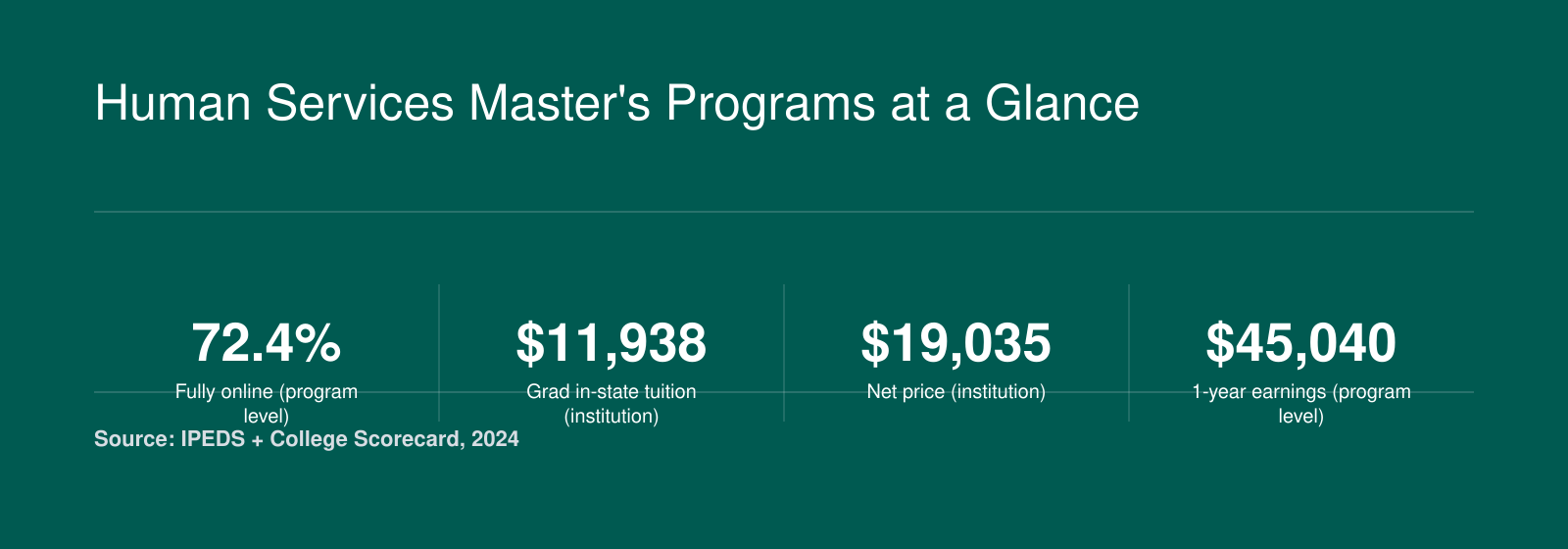
Human Services Master's Programs at a Glance
These are medians across the programs ranked here. Program-level figures (online share, 1-year earnings, graduate debt) describe the specific master's program. Institution-wide figures (tuition, net price, 10-year earnings) describe the whole school. Earnings and debt come only from programs where federal data is published.
Accreditation and the HS-BCP Credential: What to Verify Before You Apply
The Human Services-Board Certified Practitioner (HS-BCP) credential requires 350 hours of verified postdegree experience and a passing score on the HS-BCPE exam. Your degree only counts toward it if it comes from an institutionally accredited school, so accreditation is the first thing to check.
Two Layers of Accreditation
Institutional accreditation covers the entire college or university and comes from accreditors recognized by the U.S. Department of Education. This is the layer that matters most. It affects federal financial aid, credit transfer, and whether employers and credentialing bodies accept your degree. An online master's in human services is accredited when the institution is. Delivery format does not change accreditation status.
Programmatic accreditation is an optional second layer. In human services, it comes from the Council for Standards in Human Service Education (CSHSE), and relatively few master's programs hold it. Capella University and Purdue Global both state CSHSE accreditation for their MS in Human Services. Our research did not confirm CSHSE status for any of the 10 programs ranked on this page. Don't assume either way. Ask the program directly.
How to Verify It Yourself
- Institutional status: Search the school in the Department of Education's Database of Accredited Postsecondary Institutions and Programs (DAPIP).
- Programmatic status: Check the CSHSE accredited program directory, last updated October 4, 2026. Trust the current directory over a school's marketing pages or older lists.
What the HS-BCP Requires
The Center for Credentialing & Education (CCE) issues the HS-BCP. Requirements cover three areas:
- Degree: An associate, bachelor's, or advanced degree in human services or a related field such as Counseling Psychology, criminal justice, marriage and family therapy, or social work. Degrees in other fields may qualify through coursework: at least 15 semester (22.5 quarter) hours across 3 of 11 content areas. That coursework must include at least 2 semester (3 quarter) hours each in ethics in the helping professions, interviewing and intervention skills, and case management.
- Experience: 350 postdegree hours in a role your employer considers human services. CCE lists some exceptions, including graduates of CSHSE-accredited programs. Program guidance varies, though, and Purdue Global tells students that postdegree experience is still needed. Confirm your route with CCE.
- Exam: The HS-BCPE, which moved to a new content outline and format on June 1, 2026. Students in participating programs may test before graduating and carry a passing score forward. They still need a conferred degree and the remaining requirements.
Keep in mind that CSHSE accreditation describes a program, while HS-BCP eligibility depends on your degree, experience, and exam. One does not guarantee the other.
Human Services vs. Counseling vs. MSW: Which Degree Leads Where
Human Services Master's: Nonclinical Leadership
A master's in human services is generally a nonclinical degree built for case management, advocacy, program coordination, and nonprofit administration. There is no single clinical accrediting body for this pathway, and state licensure boards typically require a qualifying degree in counseling, social work, psychology, or another listed clinical discipline. That means a human services master's does not, by itself, lead to LPC/LMHC or LCSW licensure. Some programs include practicum experience, but those hours are usually nonclinical and cannot automatically substitute for counseling or social work field education unless a state board expressly accepts the placement, supervision, coursework, and documentation. If clinical licensure is a hard requirement, plan on a second qualifying degree in counseling or an online MSW program rather than assuming the human services master's will be accepted. Typical roles include case manager, program coordinator, community services director, and advocate.
Clinical Mental Health Counseling: LPC/LMHC
A CACREP-accredited clinical mental health counseling master's program is the standard route to LPC or LMHC licensure. CACREP-aligned programs typically require at least 100 practicum hours and 600 internship hours, a 700-hour total with at least 280 direct client hours. After graduation, states commonly require 2,000 to 3,000 supervised postgraduate hours, though totals, direct-service rules, supervisor credentials, and exams vary by state. This path fits students who want to deliver counseling and psychotherapy. Common roles include licensed professional counselor or mental health counselor in community agencies, hospitals, and private practice.
MSW: LCSW and the Social Work Route
A CSWE-accredited MSW program is the usual foundation for LCSW licensure. Clinical MSW students generally complete 900 to 1,200 supervised field hours split between foundation and advanced placements, followed by roughly 2,000 to 4,000 postgraduate supervised hours; California requires 3,200 and New York requires 3,000, for example. The MSW prepares you for clinical social work and broader systems-level roles. Common roles include clinical social worker, medical social worker, and school social worker.
When Human Services Is the Smarter Choice
Choose the human services master's when your goal is management, program coordination, or nonprofit leadership rather than clinical practice.
Related Articles
The 3 Most Affordable Master's in Human Services Programs
Net price below is the school-wide average across all students, not a guaranteed individual cost. Purdue Global is the most affordable option here and fully online with two concentrations, though per-credit pricing can shift total cost depending on transferred credits. North Georgia offers the lowest in-state tuition but a single fall start, while Illinois Springfield adds a social services administration concentration and a higher out-of-state tuition that makes residency a key factor.
| School | Graduate Tuition (In-State) | Graduate Tuition (Out-of-State) | Net Price | Median Debt | Format |
|---|---|---|---|---|---|
| Purdue University Global | $10,211 | $11,241 | $7,770 | $26,078 | Online |
| University of North Georgia | $5,416 | $18,484 | $9,823 | $17,750 | Online |
| University of Illinois Springfield | $11,938 | $19,515 | $9,833 | $19,128 | Online |
Top Early-Career Earnings Among Ranked Programs
Concordia University-Saint Paul reports the highest published program-level earnings among the ranked programs.
Admissions Requirements and Transfer Credits
Requirements vary by school, so confirm details on each program's admissions page. The patterns below come from published 2026 admissions information and should be treated as typical, not universal.
- Bachelor's degreeEvery program we reviewed expects a bachelor's degree from an accredited institution. Most do not require a human services major. Psychology, sociology, education, and public health backgrounds are common. Albertus Magnus College is a notable exception, asking for undergraduate preparation in psychology, human services, social work, or a related field.
- Minimum GPAPublished minimums range from 2.0 to 3.0. Liberty University lists 2.0, Touro University Worldwide 2.5, and Albertus Magnus 3.0. Some schools offer conditional or provisional admission to applicants slightly below the cutoff.
- GREMost programs do not require it. Touro University Worldwide and New England College both state no standardized test is required. Some programs may still ask for scores or waive them based on GPA, so check each school. Liberty accepts TOEFL or an approved alternative from non-native English speakers.
- Prerequisite courseworkMost programs list no specific prerequisites. Counseling or administration tracks may expect foundational field coursework, so confirm requirements for your chosen specialization.
- Application materialsExpect official transcripts from all institutions attended. Many programs also ask for a résumé, two references or recommendation letters, and a personal statement. Albertus Magnus also lists an interview. Several schools, including Touro Worldwide, Liberty, and New England College, report no application fee.
- Transfer creditsMost schools do not clearly publish a maximum for graduate transfer credit. Liberty assesses applicants with at least 12 graduate credits. Policies commonly cap transfers at about 6–12 credits and set an age limit on credits, but this is general guidance, so request a written credit evaluation before enrolling.
- Deadlines and start termsAlbertus Magnus uses fixed August and January starts. Liberty appears to admit on an ongoing basis. Many online programs enroll year-round, but several schools do not state their deadline structure, so verify the next start date directly.
Human Services programs by state
Master's in Human Services FAQs
These answers cover the questions prospective students ask most about degree names, internships, time to completion, and licensure. Details vary by school and by state, so confirm specifics with each program and your state board.
What is the abbreviation for a master's in human services?
Do I need an internship to complete a master's in human services?
How long does a master's in human services take, full-time vs part-time?
Can I become a licensed counselor or social worker with a master's in human services later?
Compare Human Services programs on the data that matters
Explore more Social Work & Social Sciences specializations or browse every graduate field.
All Social Work & Social Sciences programs