Best Clinical Mental Health Counseling Master's Programs
Compare 670+ accredited Clinical Mental Health Counseling programs at 580+ schools, with graduate earnings, cost, debt, and completion data from IPEDS and the U.S. College Scorecard.
Nearly every program ranked here requires 60 credit hours, and most run two to three years. The price range is nowhere near as uniform: Florida State's published in-state rate sits near $5,700, while George Washington lists $2,000 per credit for its 60-hour counseling master's.
The coursework barely moves across that spread. Practicum, internship, psychopathology, group counseling, and the supervised hours your state board demands look much the same at a public school in Tallahassee as they do on Foggy Bottom.
So the list below favors net price, graduate earnings, and debt over reputation. Licensure boards scrutinize accreditation and clinical hours. They do not weigh the name on the diploma.
Key Points
- Our ranking weighs net price, earnings, and debt above school prestige.
- Eight of the lowest-cost ranked schools are public, with steep out-of-state premiums.
- Online programs still require in-person clinical placements, and program-level earnings data isn't published yet.
The 10 Top Clinical Mental Health Counseling Master's Programs
These programs stand out because they pair clinical rigor with a clear line to licensure and measurable career returns. The list favors schools where graduates leave with manageable debt and real earning power across campus, online, and hybrid formats.
University of Florida
#1Gainesville, FL · ~$13,000/yr (est.)
Best for: Aspiring LMHCs wanting small applied cohorts
Florida pairs a dual M.Ed./Ed.S. in mental health counseling with a compact cohort model, keeping class sizes around 15 and emphasizing trauma, crisis, and substance abuse work. The 72-credit CACREP-aligned curriculum is built for state licensure and the National Counselor Examination, with no GRE required. Four years after finishing, graduates earn a median of $59,616.
- CACREP accredited
- No entrance exam required
- 72 total credit hours
- Dual M.Ed./Ed.S. degrees awarded
- Average class size 15 students
- Complete in 2.5 years
- Trauma, crisis, and substance abuse focus
- Fall entry
Florida State University
#2Tallahassee, FL · ~$11,000/yr (est.)
Best for: Future dual-credential counselors seeking fast completion
Florida State's clinical mental health counseling major stacks a master's and specialist degree into five semesters, with clinical placements across more than 10 settings and a CACREP-aligned pathway to LMHC eligibility. The cohort model emphasizes wellness, prevention, and early intervention. Four years after finishing, graduates earn a median of $61,024.
- Earn both M.S. and Ed.S. degrees
- 5-semester program
- 60 total credit hours
- Clinical placements in 10+ settings
- No entrance exam required
- Fall start
- 3.0 GPA minimum
- Eligible for LMHC licensure
Boston University
#3Boston, MA · $65,000 – $70,000/yr (est.)
Best for: Students wanting medical school clinical training
Boston University's mental health counseling master's sits inside an academic medical school, pairing clinical mental health training with behavioral medicine, health psychology, and neuroscience. Students complete 1,000 hours of supervised fieldwork across over 100 training sites. It is a two-year, full-time program with a September start and a focus on evidence-based, multidisciplinary care.
- CACREP accredited
- 2-year program
- 60 total credit hours
- 1,000 clinical hours
- Housed in academic medical school
- Over 100 clinical training sites
- Capstone required
- Prepares for LMHC licensure
Florida International University
#4Miami, FL · ~$11,000/yr (est.)
FIU's clinical mental health counseling master's prepares students for certification and state licensure with coursework in cross-cultural counseling, psychopathology, substance abuse, and crisis intervention. The Miami-based program serves a majority Hispanic, multilingual region and includes practicum and internship experiences. Four years after finishing, graduates earn a median of $62,347.
- CACREP accredited
- Prepares for national certification and state licensure
- Study personality theories and psychopathology
- Substance abuse counseling course
- Crisis intervention course
- Practicum and internship included
- Fall start
University of South Florida
#5Tampa, FL · ~$10,000/yr (est.)
USF's clinical rehabilitation and mental health counseling program combines mental health and rehabilitation training, preparing graduates for dual licensure as licensed mental health counselors and certified rehabilitation counselors. The 60-credit CACREP-accredited curriculum is delivered on campus and includes concentrations in clinical mental health, clinical rehabilitation, and addictions and substance abuse. The program is ranked #18 nationally by U.S. News and #1 in Florida for rehabilitation counseling.
- CACREP accredited
- Complete in 2 to 3 years
- 60 total credit hours
- 71% licensure pass rate
- Prepares for CRC and LMHC licensure
- Clinical mental health counseling concentration
- Ranked #18 nationally by U.S. News
- Ranked #1 in Florida for rehabilitation counseling
- Prepares for Certified Rehabilitation Counselor exam
- CACREP accredited through 2032
- Clinical rehabilitation counseling concentration
- Field placement opportunities
- Addictions and substance abuse counseling concentration
- Careers in state VR and mental health agencies
- Substance abuse treatment careers
- Focus on behavioral health for disabled populations
- Scholarships available
- 36 students graduated in 2023-2024
Wake Forest University
#6Winston-Salem, NC · $35,000 – $40,000/yr (est.)
Wake Forest's master's in counseling offers a clinical mental health concentration in both a full-time campus cohort and a part-time online format designed for working professionals. The 60-credit CACREP-accredited program includes a 20-hour-per-week internship in community settings and prepares students for NCE, NCMHCE, and LPC licensure in North Carolina. The university graduates about 89% of its students overall.
- CACREP accredited
- Hybrid online and campus delivery
- 3-year program
- 60 total credit hours
- Full-time and part-time options
- Internship with 20 hours weekly
- Prepares for NCE and NCMHCE
- Prepares for LPC licensure in NC
Arizona State University
#7Tempe, AZ · ~$14,000/yr (est.)
ASU's Master of Counseling is a 60-credit, MPCAC-accredited program available on campus in Tempe or fully online, with fall and spring starts. Students gain supervised clinical hours in a Counselor Training Center and can choose a practitioner or research track. The curriculum emphasizes multicultural counseling, trauma, and evidence-based practice.
- MPCAC accredited
- Online or on-campus delivery
- 60 total credit hours
- Starts fall or spring
- Thesis or capstone option
- Clinical practicum and two internships
- 3.0 GPA minimum
- Prepares for LPC licensure in Arizona
Wheaton College
#8Wheaton, IL · ~$20,000/yr (est.)
Wheaton's clinical mental health counseling master's integrates clinical training with a Christian worldview, requiring 60 credits, three semesters of supervised clinical work, and a cohort-based structure. The program features a 98% licensure pass rate and offers an optional Trauma Certificate. One year after finishing, graduates reported a median salary of $43,719.
- CACREP accredited
- 2-year program
- 60 total credit hours
- 98% licensure pass rate
- 3 semesters of clinical training
- Cohort-based structure
- Trauma certificate available
- Faith and counseling integration
University of Oklahoma – Hudson College of Public Health
#9Norman, OK · ~$9,000/yr (est.)
Oklahoma's Master of Clinical Mental Health Counseling is a 60-credit program available in Norman, Tulsa, and hybrid formats, with no GRE required. The curriculum emphasizes social justice and multicultural competency, includes a 100-clock-hour practicum, and leads to LPC licensure in Oklahoma. Four years after finishing, graduates earn a median of $70,094.
- CACREP accredited
- No entrance exam required
- 60 total credit hours
- 100 clinical hours
- Hybrid, Norman, or Tulsa options
- Leads to LPC licensure in Oklahoma
- Emphasizes social justice and multicultural competencies
- No thesis or capstone required
University of Utah
#10Salt Lake City, UT · $9,000 – $28,000/yr (est.)
Utah's M.Ed. in Clinical Mental Health Counseling is a selective three-year on-campus program, admitting about 10% of applicants, with an 800-hour field-based internship. The 60-credit MPCAC-accredited curriculum emphasizes socially just practices and leads to LCMHC licensure. No GRE is required.
- MPCAC accredited
- 3-year program
- 60 total credit hours
- 800 clinical hours
- Approximately 10% acceptance rate
- No entrance exam required
- Prepares for LCMHC licensure
- Research-based, socially just practices
Cost & outcomes by school
Federal data for the highest-earning Clinical Mental Health Counseling programs, independent of the ranking above. Earnings are this field's master's graduates four years after completing, where the Scorecard reports them.
| School | Earnings | Tuition / yr | Debt | Grads/yr | Format |
|---|---|---|---|---|---|
| Ohio State University OH | $91,866 | $13,901 | — | 10 | Campus |
| George Washington University DC | $84,511 | $36,414 | $61,500 | 28 | Campus |
| Virginia Commonwealth University VA | $82,962 | $17,252 | $41,000 | 21 | Hybrid |
| Wayne State University MI | $79,789 | $17,960 | — | 8 | Campus |
| Bowie State University MD | $79,149 | $10,854 | — | 14 | Campus |
| Bay Path University MA | $79,114 | $15,162 | $56,228 | 25 | Online |
| Fairfield University CT | $74,031 | $21,448 | $51,250 | 47 | Campus |
| Indiana State University IN | $73,874 | $8,596 | $36,342 | 28 | Campus |
| CUNY Brooklyn College NY | $73,843 | $11,524 | $36,646 | 28 | Campus |
| Viterbo University WI | $73,502 | $9,888 | $42,780 | 14 | Campus |
| Western New Mexico University NM | $72,205 | $6,165 | — | — | Campus |
| CUNY Hunter College NY | $71,978 | $11,398 | $41,000 | 62 | Campus |
Sources: U.S. Department of Education. Tuition and graduates: IPEDS. Earnings and debt: College Scorecard, this field's master's graduates; a dash means no figure is reported.
Cost, debt & payoff
Median earnings of this field's master's graduates (4 yrs after completing) vs. their median federal loan debt · U.S. College Scorecard
Across these programs the median graduate earns about $59,927 and finishes with roughly $56,013 in debt — a ratio that clears a common rule of thumb (keep debt below first-year salary). Tuition and debt vary widely school to school, so check the per-school figures in the table above before you shortlist.
Inside Our Scoring: Net Price, Earnings, and Debt Over Prestige
A big name can cost you two years of elevated tuition and five figures in debt, and still leave you earning the same as a graduate from one of the best clinical mental health counseling graduate programs you have never heard of. We weigh that tradeoff by looking at what students actually pay and what they actually earn, not at reputation.
What We Measure
Our scoring leans on a handful of outcome-driven inputs, all drawn from federal data:
- Net price: What students pay on average after grants and scholarships, not the sticker tuition.
- Graduate tuition: The published cost of the counseling program itself.
- Earnings after completion: Median pay for people who finished the specific program, measured a set period after graduation.
- Debt at completion: The median federal loan balance graduates carry when they finish.
Why Program-Level Data Matters
Institution-wide earnings figures are dominated by undergraduates and tell you almost nothing about graduates of Counseling Master's Programs specifically. A university famous for its engineering or business alumni can post impressive campus-wide numbers while its counseling cohort earns far less. Program-level earnings and debt cut through that, showing the result for people who studied what you plan to study.
Where the Data Falls Short
We will not pretend the picture is complete. Net price is reported as a sector average, so it does not isolate counseling students alone. Graduation rates are institution-wide rather than program-specific. And some smaller programs have no published earnings yet, which limits what we can say about them.
This is the opposite of a prestige ranking. Reputation surveys reward research output and peer opinion, neither of which pays your rent after graduation. We rank on student value instead.
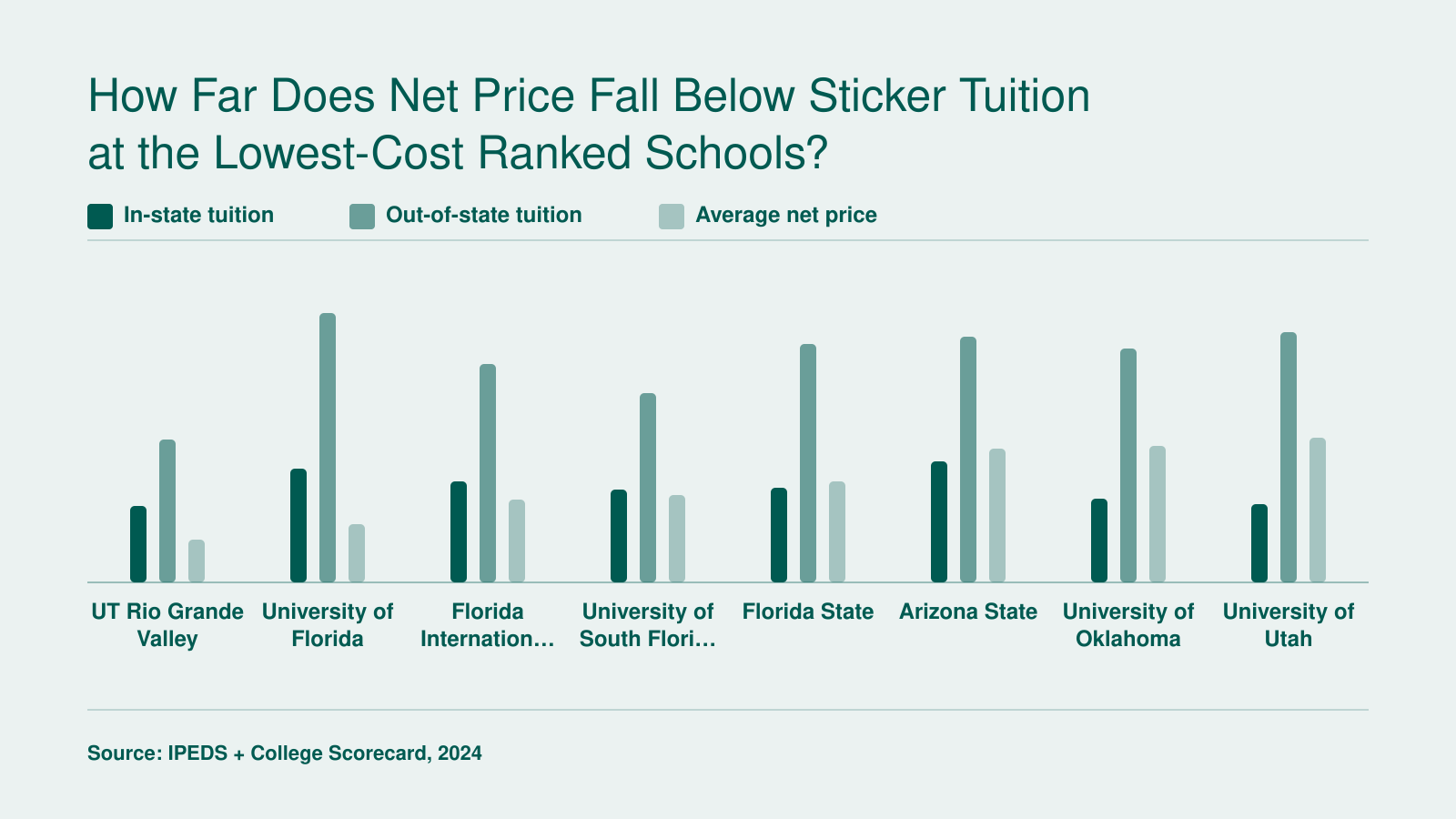
How Far Does Net Price Fall Below Sticker Tuition at the Lowest-Cost Ranked Schools?
All eight of these lowest-cost ranked schools are public, so each posts a lower in-state graduate rate and a much higher out-of-state rate. Private schools tend to publish a single rate and discount it more heavily through aid, which makes their sticker price a weaker guide to what you will pay. Net price is an institution-wide average, and graduate students often receive less grant aid than undergraduates, so treat the third bar as a floor rather than a promise.
CACREP's total of accredited programs shifts with every accreditation meeting, which is why no static list stays current. Clinical mental health counseling is accredited under the 2016 standards. To verify, search CACREP's live directory and check each school's own program page. Broader counseling data is available through BLS.gov and the American Counseling Association.
Which Ranked Programs Hold CACREP Accreditation, and Why It Matters
Does your counseling master's have to be CACREP accredited before you can get licensed? In a handful of states, yes.
What CACREP Is and Why It Matters
CACREP, the Council for Accreditation of Counseling and Related Educational Programs, is the main accreditor of counseling degrees. A CACREP degree streamlines licensure because boards can accept your coursework and clinical hours without a line-by-line review. As of 2026, Florida, Kentucky, North Carolina, Ohio, and Utah require it for professional counselor licensure. Florida's rule tightens after September 1, 2027, when applicants must hold a CACREP or COAMFTE degree. Most other states have no CACREP-only rule, but many name it in law or move CACREP graduates through review faster, which also helps if you relocate.
Federal employers care too. Per a 2026 source, the VA requires counselor candidates to hold a master's from a CACREP-accredited program, and TRICARE requires it for counselors seeking independent-practice certification. Requirements can vary by position, so check the specific job announcement. Accreditation alone does not finish the job: you may still need a counseling exam, a background check, and a state jurisprudence exam.
Ranked Programs That Report CACREP Status
Program pages for the University of Florida, Florida State University, Boston University, Wake Forest University, Wheaton College, and George Washington University all describe their clinical mental health counseling programs as CACREP accredited. George Washington says it has held accreditation since 1984. The University of South Florida says it is accredited through 2032. These are school-reported details. We have not confirmed directory review dates for the ranked schools, so treat the dates as a starting point.
Programs to Question Before You Apply
- Florida International University: Its program page does not mention CACREP. Confirm status before enrolling, especially with Florida's 2027 rule.
- University of Oklahoma: The page cites approval by the Oklahoma licensing board, not CACREP.
- Arizona State University and University of Utah: Both list MPCAC accreditation instead. Utah reportedly limits clinical mental health counseling licensure to CACREP graduates, so Utah applicants should ask the state licensing division directly.
None of the ranked programs is described as being in candidacy. A candidacy program is still working toward accreditation, and your licensure eligibility can depend on whether it is granted by the time you graduate.
How to Verify Status Yourself
Search the CACREP online directory by institution and look for the Clinical Mental Health Counseling specialty itself, since a school may be accredited in some tracks and not others. Check the status and the two dates. The first marks when students are recognized as graduates of an accredited program. The second marks the end of the current cycle, when a review or interim report may be due.
Related Articles
Online, Hybrid, or Campus: Residencies and Clinical Placements Explained
An online counseling degree is online coursework wrapped around in-person clinical work, and no program in this field removes the face-to-face requirement entirely. Of the schools ranked here, Arizona State University lists online delivery, while Wake Forest University and the University of Oklahoma list hybrid formats. The rest are campus-based. Arizona State holds MPCAC rather than CACREP accreditation, so check how that fits your state's licensing rules.
Residency requirements
There is no standard residency format. Among online CACREP programs outside our ranked list, the range runs from one weekend at Southern Connecticut State to a three-day intensive at Nova Southeastern, two three-day intensives at the University of Phoenix, and two four-day intensives at Seattle University. Bellevue also requires two residencies. Confirm current schedules with each school, since formats change.
Budget for airfare, lodging, meals, and time away from work for each visit. Two residencies can cost noticeably more than one, and that expense rarely appears in tuition comparisons.
How placements work
Residency is separate from fieldwork. CACREP-style programs commonly pair a 100-hour practicum with a 600-hour internship, and Old Dominion specifies at least 40 direct client hours in the practicum.4 Remote students complete these hours near home, and policies differ:
- School-supported: Seattle University places students at in-person sites wherever they live in the U.S., with weekly online group supervision.
- Coordinator-assisted: John Carroll University has staff help students find partner agencies nearby.5
- Student-secured: At The Chicago School6 and Bellevue, students identify their own sites and supervisors, subject to university approval.
Sites generally need a qualified, licensed supervisor, and the university must approve both site and supervisor. Finding one can take months in rural areas.
State limits
Accreditation does not guarantee a program enrolls students from every state. Bellevue admits students only from states where it meets licensure requirements, and Phoenix reports serving 40+ states3, which is broad but not universal. Check your state's list before applying.
Three questions for admissions
- Does the school secure placements, or must I find my own site and supervisor, and what happens if I cannot?
- What qualifications must a supervisor hold, and do you vet sites in my state?
- Is my state authorized for enrollment and for licensure through this program?
What Graduates Earn and Owe: Program-Level Outcomes
The honest answer to "what will I earn, and what will I owe?" is harder to give for counseling than for many fields, because the federal College Scorecard has not yet published program-level earnings or median debt for most of the master's programs on this list. That gap matters, so we lean on what programs do report directly: licensure exam results and employment rates in their own CACREP outcome documents.
Why the Earnings Picture Is Incomplete
At the program level, median earnings one year after completion, median federal debt at graduation, and the typical 10-year monthly payment are simply not yet available for these counseling degrees. We will not substitute institution-wide earnings figures, because an engineering or business graduate's pay tells you nothing about what a counseling graduate takes home. When a program's own outcome dollars arrive, we will add them. Until then, treat any single earnings number you see elsewhere with skepticism.
What Programs Do Report
Employment and exam results give a partial but useful read. A few examples from the ranked and comparison schools:
- Auburn University: An 88% National Counselor Examination pass rate in 2024-2025 against an 80% benchmark, with 92% of graduates employed 6 to 12 months after completing the degree.2
- University of Texas at San Antonio: An 80% NCE pass rate, and 92.6% of job-seeking graduates found counseling-related work within 180 days (2022-2023).3
- Capella University: An 83% NCE pass rate in 2024 (107 of 128 test-takers), with 88% of responding alumni employed or advancing in counseling.
Nationally, the most recent NCE pass rate we could identify was roughly 83% for Fall 2025.1 Compare any program's figure against that, but read the fine print: schools count different exams, cohorts, and reporting windows, so the numbers are not strictly interchangeable.
The Early-Career Reality
Employment "within six months" rarely means full licensure. After the degree, most graduates enter a supervised practice period (often two years, varying by state) before earning an independent license such as LPC or LMHC. Pay during this associate stage typically runs below the independently licensed rate. Factor that lag into any budget: your first post-graduation salary is usually not your earning ceiling, and your debt payments start regardless of licensure status.
Clinical Mental Health Counseling programs by state
Quick Answers: Program Choice, Length, and Admissions
These answers cover the three questions applicants ask most before they start comparing programs. Requirements vary by school, so confirm details with each program before you apply.
What is the best clinical mental health counseling master's program?
How long does a clinical mental health counseling master's program take?
Do clinical mental health counseling programs still require the GRE or a psychology bachelor's?
Compare Clinical Mental Health Counseling programs on the data that matters
Explore more Counseling specializations or browse every graduate field.
All Counseling programs