Best Clinical Mental Health Counseling Master's Programs in Ohio
Compare 29 accredited Clinical Mental Health Counseling programs in Ohio at 25 schools, with graduate earnings, cost, debt, and completion data from IPEDS and the U.S. College Scorecard.

Ohio's two-tier LPC and LPCC licensing system means the master's program a counselor chooses keeps shaping the career years after the diploma. In-state tuition across the ranked programs spans $8,400 at Ashland University to $31,864 at Ursuline College.
What follows sorts those costs against online and hybrid formats, GRE policies, licensure steps, and early graduate earnings, including the most affordable clinical mental health counseling programs. CACREP accreditation is the practical gate for the best clinical mental health counseling graduate programs, so cost and flexibility matter only after that requirement clears.
Key Points
- Ohio State, Akron, Kent State and Cincinnati all hold CACREP accreditation for clinical mental health counseling.
- Ranking weighs graduate earnings, net price, and debt, not prestige or advertising.
- GRE policies differ by school, so check each admissions page before applying for 2027.
The 10 Best Clinical Mental Health Counseling Master's Programs in Ohio
Every program below is listed as CACREP accredited for clinical mental health counseling in the accreditor's directory. Reaffirmation is in process at the University of Dayton and Ohio University, so confirm current status with those programs before you apply. Where a school has no extra detail beyond its published facts, the entry stays short.
Ohio State University
#1Columbus, OH · ~$14,000/yr (est.)
Best for: Full-time cohort students in Columbus
Ohio State's Counselor Education master's offers a Clinical Mental Health Counseling concentration in Columbus, where the field-placement network spans community agencies, private practices, schools, hospitals, and college counseling centers. It is an in-person, full-time cohort with evening classes and no GRE requirement. Listed graduate tuition is $12,890, and the university graduates 88% of its students. CACREP accredited.
- CACREP accredited for Clinical Mental Health Counseling
- In-person, full-time cohort model
- Evening classes with no summer coursework
- Minimum of 61 hours reported by the program
- 3.0 GPA requirement, no GRE requirement
- 2 concentration options in the counselor education program
University of Dayton
#2Dayton, OH · ~$20,000/yr (est.)
Best for: Working adults needing flexible pacing
The University of Dayton is the pick for students who need pacing options, with 2.5-year and 3.5-year tracks and summer or fall starts on its Dayton and Columbus campuses. Its program reports a 96% first-time pass rate on the National Counselor Examination, and listed graduate tuition is $19,530. The university graduates 80% of its students. The CACREP directory shows reaffirmation in process, so confirm current status with the program.
- Two campuses: Dayton and Columbus
- Flexible pacing: 2.5 or 3.5 years
- 2.8 GPA minimum, 3 letters of recommendation
- GRE or MAT required for applicants with a low GPA
- Rolling admissions, 2 start dates per year
- Faculty with LPCC-S credentials
- Dual license option with school counseling
- Ecotherapy concentration within the CMHC degree
- Entrance exam required (GRE or MAT)
- Summer or fall start dates
- Practicum and internship in clinical settings
John Carroll University
#3University Heights, OH · ~$16,000/yr (est.)
Best for: Hybrid and online learners near Cleveland
John Carroll University in University Heights pairs on-campus, online, and hybrid coursework, with a fully online option available. More than 100 community partners support internships across the Cleveland area, and the program totals over 700 clinical hours. Listed graduate tuition is $15,782, and the university graduates 79% of its students. A state Ohio Behavioral Health Scholarship was available to students entering by fall 2026, so ask about current aid.
- CACREP accredited, 2.5-year program
- 100-hour practicum and 600-hour internship
- 3.0 GPA minimum, 2 letters of recommendation
- 3 concentration options: substance use, ABA, school-based
- Nine elective credits
- Fully online option available
- Rolling admissions
- Ohio PC and PCC licensure pathway
University of Cincinnati
#4Cincinnati, OH · ~$15,000/yr (est.)
The University of Cincinnati offers a two-year Master of Arts in Mental Health Counseling with no GRE required. Coursework meets Ohio counselor board training requirements for LPC licensure, and faculty research teams include master's students. Listed graduate tuition is $13,224, and the university graduates 75% of its students. CACREP accredited.
- Master of Arts in Mental Health Counseling
- Two-year, campus-based program
- No entrance exam required
- Meets Ohio counselor board LPC training requirements
- Prepares for the National Counselor Examination
- Eight and a half full-time counselor educators
Ashland University
#5Ashland, OH · ~$8,000/yr (est.)
Ashland University's program, housed in Ashland Theological Seminary, integrates faith-based care into a 64-credit curriculum with one cohort day per week. It reports an 89.6% pass rate on the National Counselor Examination. Listed graduate tuition is $8,400, among the lowest here, and the university graduates 61% of its students. CACREP accredited.
- 64 total credit hours
- Cohort-based, one cohort day per week
- Faith-based counseling training
- Flexible field experiences
- Prepares for LPC and LPCC licensure in Ohio
Ohio University
#6Athens, OH · ~$10,000/yr (est.)
Ohio University in Athens admits one cohort each fall to its Clinical Mental Health Counseling M.Ed., and it offers a combined clinical mental health and clinical rehabilitation counseling specialization. The program reports a 100% job placement rate within 12 months. Listed graduate tuition is $9,444, and the university graduates 65% of its students. CACREP accredited, with reaffirmation in process.
- Offered annually on the Athens campus, fall entry
- Eligible for LPC licensure and NCC certification
- Training in psychopathology, diagnosis, and crisis intervention
- Combined clinical rehabilitation counseling specialization option
- Professional organizations include Chi Sigma Iota, ACA, OCA
Xavier University
#7Cincinnati, OH · ~$19,000/yr (est.)
Xavier's Cincinnati program is a two-year, 60-credit Master of Arts with evening and weekend classes, full-time and part-time options, and three start dates a year. It is test optional and meets licensure requirements in Ohio, Kentucky, and Indiana. The university graduates 69% of its students. CACREP accredited.
- 60 credit hours over 24 months
- 600 clinical hours
- Test optional, no entrance exam required
- 3.0 GPA minimum, 2 letters of recommendation
- Evening and weekend classes
- Spring, summer, or fall start
- Meets licensure requirements in OH, KY, and IN
Ursuline College
#8Pepper Pike, OH · $30,000 – $35,000/yr (est.)
Ursuline College in Pepper Pike blends clinical mental health counseling with art therapy in a year-round, late-afternoon and evening format. Graduate assistantships with tuition remission can offset a listed graduate tuition of $31,364, the highest on this list. The college graduates 67% of its students. CACREP accredited.
- Combines counseling with art therapy
- Classes in late afternoon and evenings
- Year-round program including summer
- Workshop-style elective format
- Prepares for LPC and LPCC licensure
- Prepares for ATR-BC art therapy certification
Kent State University
#9Kent, OH · ~$12,000/yr (est.)
Kent State's in-person Master of Education has two practicums and a 600-hour internship in community settings. Students can study full time or part time, starting in fall or spring. Listed graduate tuition is $12,483, and the university graduates 64% of its students. CACREP accredited.
- 60 total credit hours
- Two practicums plus a 600-hour internship
- Full-time and part-time options
- Fall or spring start
- 3.0 GPA minimum, 2 letters of recommendation
- Electives in addictions, child, and family counseling
Bowling Green State University
#10Bowling Green, OH · ~$10,000/yr (est.)
Bowling Green State University runs a 60-credit program built around evening, mostly on-campus classes, and it accepts any undergraduate degree. The program reports a 97% national counseling exam pass rate. Listed graduate tuition is $8,418, among the lowest on this list, and the university graduates 64% of its students. CACREP accredited.
- 60 total credit hours
- Full time averages 2.5 years, part time 4 to 5 years
- Evening classes, fall start
- Any undergraduate degree accepted
- Reports 100% of graduates employed in the field within 180 days
- Self-awareness activities in each course
Cost & outcomes by school
Federal data for the highest-earning Clinical Mental Health Counseling programs, independent of the ranking above. Earnings are this field's master's graduates four years after completing, where the Scorecard reports them.
| School | Earnings | Tuition / yr | Debt | Grads/yr | Format |
|---|---|---|---|---|---|
| Ohio State University OH | $91,866 | $13,901 | — | 10 | Campus |
| John Carroll University OH | $62,761 | $15,782 | $52,322 | 36 | Hybrid |
| Antioch University OH | $59,927 | $27,846 | $94,422 | — | Hybrid |
| Bowling Green State University OH | $56,349 | $10,291 | $41,000 | 32 | Campus |
| Walsh University OH | $56,229 | $13,500 | $48,591 | 11 | Online |
| Xavier University OH | $55,005 | $19,218 | $50,545 | 44 | Campus |
| Kent State University OH | $53,674 | $12,483 | $45,601 | 48 | Campus |
| University of Akron OH | $53,389 | $10,125 | $57,604 | 50 | Campus |
| University of Dayton OH | $52,889 | $19,580 | $44,742 | 28 | Campus |
| University of Toledo OH | $51,339 | $17,605 | $44,165 | — | Campus |
| University of Cincinnati OH | $51,320 | $14,902 | $51,500 | 20 | Campus |
| Franciscan University of Steubenville OH | — | $11,088 | — | — | Campus |
Sources: U.S. Department of Education. Tuition and graduates: IPEDS. Earnings and debt: College Scorecard, this field's master's graduates; a dash means no figure is reported.
Cost, debt & payoff
Median earnings of this field's master's graduates (4 yrs after completing) vs. their median federal loan debt · U.S. College Scorecard
Across these programs the median graduate earns about $54,340 and finishes with roughly $48,591 in debt — a ratio that clears a common rule of thumb (keep debt below first-year salary). Tuition and debt vary widely school to school, so check the per-school figures in the table above before you shortlist.
What Moves a Program up This Ohio List
Every school in this ranking of master's programs in Ohio earned its spot through figures a prospective counselor can actually check. The ranking leans on verifiable figures rather than reputation or marketing, so you can see exactly what you are paying for and what graduates tend to earn afterward.
The inputs are straightforward:
- Cost: Published graduate tuition and the net price students pay after grants and scholarships.
- Outcomes: Program-level earnings and debt loads where the government reports them.
- Completion: Institution-wide graduation rate, which reflects the whole university rather than the counseling program specifically.
- Format: Whether you can study on campus, online, or in a hybrid or evening schedule.
CACREP status is verified separately against the accreditor's directory and flagged on each school's card. That matters because Ohio licensure is far simpler and faster coming from CACREP accredited clinical mental health counseling programs, so it is worth confirming before you commit.
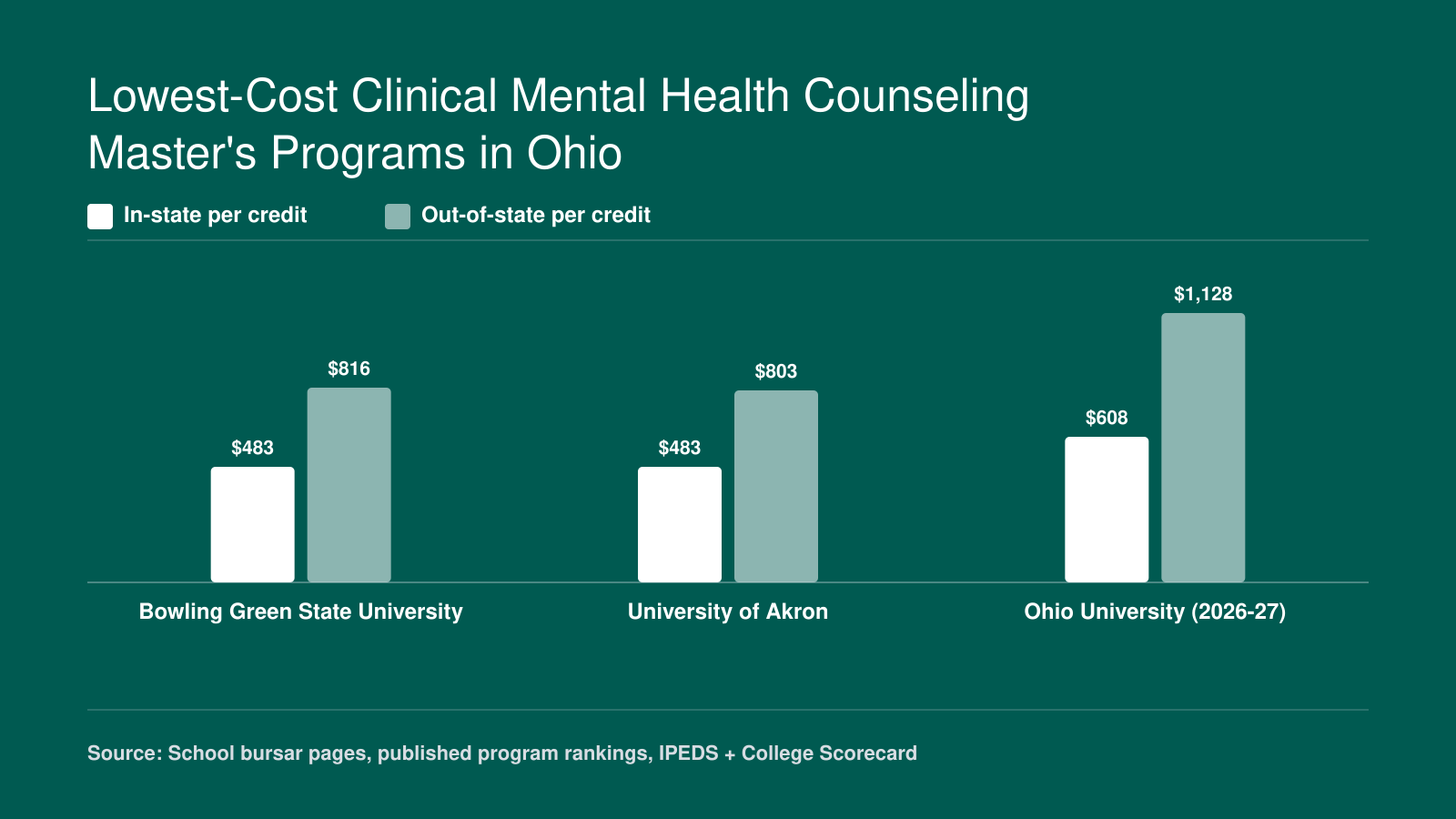
Lowest-Cost Clinical Mental Health Counseling Master's Programs in Ohio
Per-credit rates are charted for the schools with published resident and nonresident figures. Bowling Green and Akron list a 60-credit program, and their rates come from a ranking source that excludes fees, so confirm them with each bursar. Ohio University's 2026-27 rate includes a $78 general fee per credit. Youngstown State (about $28,440 in estimated program tuition) and Kent State (about $31,920) have no confirmed per-credit rate. The cheapest public option runs near $29,000 for 60 credits, and private schools such as John Carroll, Xavier, and Capital generally charge well above public rates. Net price is an institution-wide average after aid, not a quote for this program.
Online, Hybrid, and Evening Paths to a CMHC Master's in Ohio
Flexibility and structure pull in opposite directions here: the more a schedule bends around your job, the more you must organize yourself. Most of the programs below still meet in person, so the first step is sorting them by format.
Fully online and hybrid
Walsh University's online master's in clinical mental health counseling requires no campus visits, built for part-time pacing of just over three years. The University of Akron is hybrid, mixing online, web-enhanced, and in-person courses, with late-afternoon and evening meetings.1 Ashland University is also hybrid and cohort-based, with one cohort day per week. John Carroll University lists a fully online option, so confirm current delivery with the department.
Evening and weekend campus options
Xavier University advertises evening and weekend classes, and Bowling Green State University and Ursuline College schedule evening or late-afternoon sections. Kent State University and Xavier offer part-time tracks. Baldwin Wallace University runs a full-time 24-month cohort.
Placements and timing
Online students still complete a local practicum and internship, typically 100 and 600 hours under CACREP, so ask each school how placements are arranged. Sixty credits usually take about two to three years. Akron allows up to six years from the first course.2 Ask any program about residency requirements before you apply.
Related Articles
Which Ohio Clinical Mental Health Counseling Master's Programs Waive or Make the GRE Optional?
A GRE policy simply tells you whether a graduate admissions office wants a standardized test score alongside your transcript; applicants who want to skip that exam can compare clinical mental health counseling master's with no GRE required options. Among the schools here, the policies fall into three groups.
- No GRE required: Ohio State says it will no longer require the GRE.1 University of Cincinnati lists no entrance exam.
- Optional or waivable: Xavier makes the MAT or GRE optional for everyone, though applicants under a 3.0 GPA may submit scores to strengthen a file.2 Ohio University's Athens programs waive the GRE at a 2.9 GPA or higher and ask for Verbal and Quantitative scores below that. University of Dayton asks for GRE or MAT scores from low-GPA applicants.
- GRE required for all: none of the pages we read.
Baldwin Wallace's page does not mention the GRE, so confirm directly rather than assume. The same goes for any school not named above.
The pages we read mostly lean on GPA minimums and recommendation letters. Interview requirements varied by school, and writing samples were mostly not specified, so check each school's checklist.
One last tip: verify the policy for your exact entry term. Baldwin Wallace's page, for instance, refers to the fall 2027 cohort, and policies can change between cycles.
Ohio CMHC Application Checklist: Deadlines, GPA, and Prerequisites
Requirements vary by school, so confirm every date on the program's admissions page before you apply for fall 2027.
- Bachelor's degreeEvery program here expects a completed bachelor's. None of the schools reviewed lists specific undergraduate psychology courses as an admissions prerequisite. The counseling courses on program pages are degree requirements, not entry requirements, so confirm with each admissions office.
- Minimum GPAMost thresholds fall between 2.5 and 3.0. Marietta prefers 2.50, Baldwin Wallace typically looks for 2.75, and Ohio University requires 2.9. Xavier, Kent State, Ohio State, and John Carroll set 3.0. Xavier and Ohio University let applicants below their cutoff submit GRE or MAT scores. Ohio State does not require the GRE.
- Recommendation lettersTwo letters are standard at Xavier, Ohio University, Kent State, John Carroll, and Marietta, which asks for one academic and one professional. Baldwin Wallace requires three professional recommendations.
- Personal statementOhio State requires a Special Statement of Intent covering why you want to counsel, your background, your helping experience, and your post-master's goals. Expect a similar essay elsewhere.
- InterviewBaldwin Wallace, Kent State, John Carroll, and Marietta interview applicants. Marietta's is a virtual meeting with the program director. Xavier and Ohio University do not state an interview requirement.
- Background checkThe sources reviewed did not detail admissions-stage background checks. Ask each program, since clinical placements usually require one later.
- DeadlinesOhio State's autumn-only cohort and Baldwin Wallace's priority date are both December 1, with Baldwin Wallace's falling in 2026. Kent State and Xavier list February 1 for fall. John Carroll's fall date is August 1. Marietta has no fixed fall deadline.
Turning an Ohio Counseling Master's Into an LPC, Then an LPCC
Ohio licenses professional counselors in two tiers, both issued by the Ohio Counselor, Social Worker and Marriage and Family Therapist Board. The first, the Licensed Professional Counselor (LPC), is the entry-level credential you can apply for after graduating. The second, the Licensed Professional Clinical Counselor (LPCC), adds the authority to diagnose and treat mental and emotional disorders independently.
LPC: degree and exam
LPC applicants need a master's in clinical mental health counseling, clinical rehabilitation counseling, or addiction counseling from a CACREP-accredited program. For applications beginning January 1, 2026, a passing score on either the NCE or the NCMHCE qualifies. No post-degree supervised experience is required to hold the LPC itself. Credit-hour minimums vary by pathway, so confirm yours with the Board.
LPCC: supervised practice
The LPCC requires a counseling master's, a passing NCE or NCMHCE, and at least two years (24 months) of post-LPC clinical work. The Board's 2026 guidance cites 3,000 work hours plus at least 150 hours of training supervision, with at least half of the work in face-to-face client contact. Your training supervisor must be an LPCC-S, and the final supervisor must submit every hour, including those earned under earlier supervisors.
Ohio joined the Counseling Compact on January 5, 2026.
First-Year Paycheck Snapshot
Early-career pay for Ohio counseling graduates
Ohio CMHC Master's Programs With the Highest Graduate Earnings
These five programs post the strongest median graduate earnings in the federal IPEDS and College Scorecard data (2024). Earnings windows differ by program, so read each figure alongside its window. Counselors in Ohio typically earn more as they move from the initial LPC to the independent LPCC license, which lets them practice and supervise without oversight, so first-year pay understates the long-run picture. Compare each earnings figure with the debt and monthly payment to judge return on investment.
| Program | Median graduate earnings | Earnings window | Median federal debt | Monthly payment (10-year plan) |
|---|---|---|---|---|
| Ohio State University | $91,866 | Four years after finishing | ||
| Bowling Green State University | $56,349 | Four years after finishing | $41,000 | $466 |
| Xavier University | $56,250 | Five years after finishing | $50,545 | $575 |
| Walsh University | $55,669 | Five years after finishing | $48,591 | $553 |
| University of Toledo | $53,610 | Five years after finishing | $44,165 | $502 |
Compare Clinical Mental Health Counseling programs on the data that matters
Explore more Counseling specializations or browse every graduate field.
All Counseling programs