Best Clinical Mental Health Counseling Master's Programs in North Carolina
Compare 28 accredited Clinical Mental Health Counseling programs in North Carolina at 20 schools, with graduate earnings, cost, debt, and completion data from IPEDS and the U.S. College Scorecard.
How much should an affordable clinical mental health counseling master's in North Carolina cost if it leads to the same LCMHC license? Average net price among the ranked schools ranges from $10,260 a year at UNC Pembroke to $28,719 at Wake Forest. Those figures cover each whole institution, not the counseling program alone.
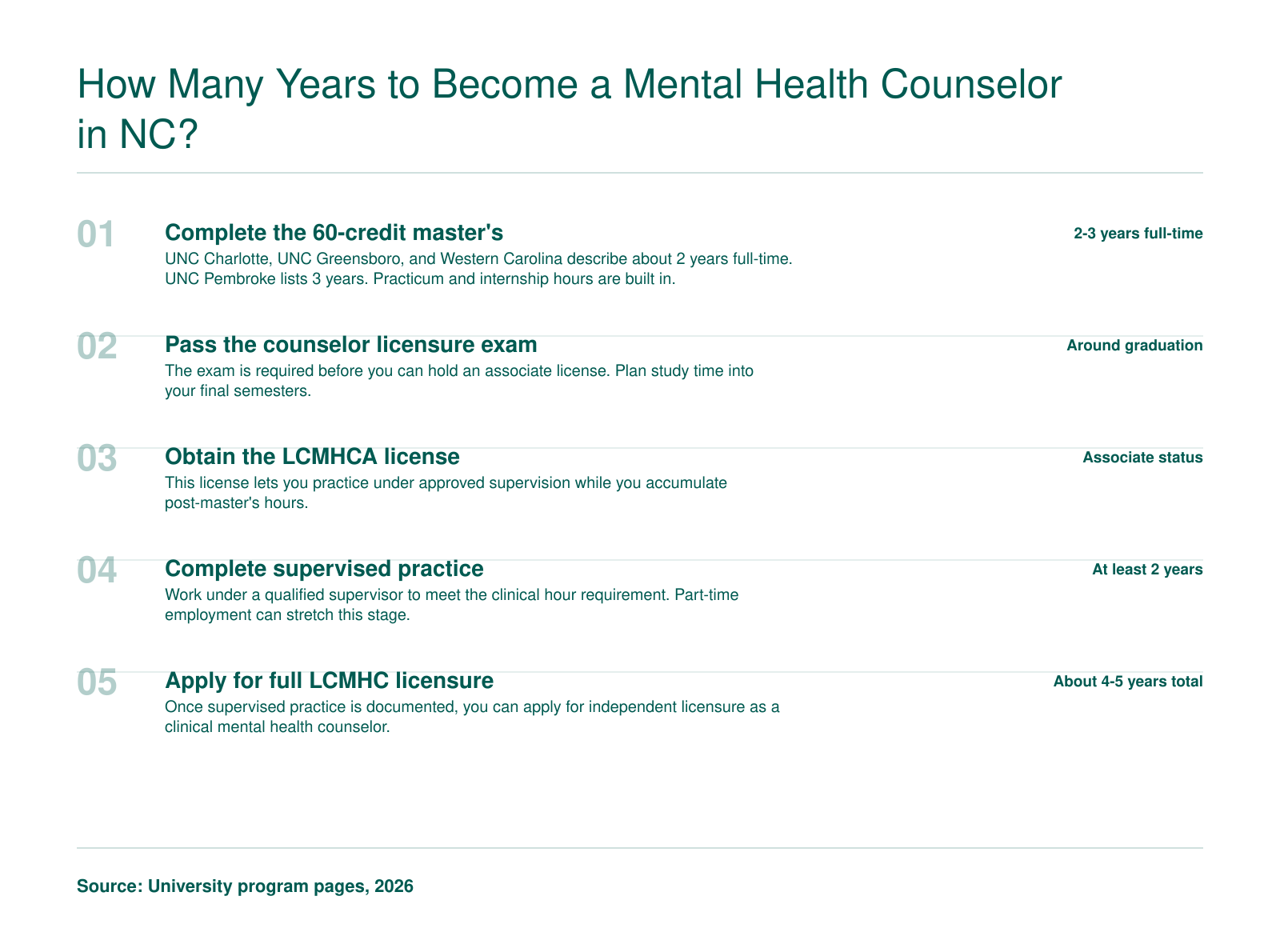
The credential is more uniform. North Carolina expects at least 60 semester hours, and graduates after July 2022 need a CACREP-accredited program. Then comes the LCMHCA stage: years of supervised practice that no tuition figure captures.
Key Points
- Catawba College's online master's requires two residencies in Salisbury, in person or virtually, as of July 2026.
- Wake Forest, UNC Charlotte, NC State, and UNC Greensboro do not require GRE scores.
- Full LCMHC licensure typically arrives four to five years after the bachelor's degree.
The 10 Best Clinical Mental Health Counseling Master's Programs in North Carolina
Each school earned its spot by weighing what students pay after aid against what completers go on to earn and how many finish. Graduation rates below describe the whole institution, not just the counseling program. Program-level earnings appear only where federal data publishes them, with the time window stated.
University of North Carolina at Chapel Hill
#1Chapel Hill, NC · ~$13,000/yr (est.)
Best for: Aspiring disability-focused counselors
UNC-Chapel Hill is a campus program in Chapel Hill with in-state graduate tuition of $8,994 and out-of-state tuition of $41,203. The net price is $11,655, and the school graduates 91% of students. Its distinguishing feature is a disability-focused concentration in developmental and psychiatric disabilities, with students choosing a specialization after the first semester. Full-time students can finish in about two years, while part-time students generally need at least four.
- CACREP accredited
- Concentration: working with persons with developmental and psychiatric disabilities
- 60+ credit hour program
- Eligible for the National Certified Counselor credential
- Meets licensure requirements
- Concentration: working with persons with psychiatric disabilities
- Evidence-based practices training
- Culturally responsive counseling training
- Careers in mental health, private practice, and government
- Meets licensure requirements in most states
- Concentration: developmental disabilities
- 2 concentration options
- Thesis or capstone option
- Pre-admission interview required
- Holistic file review
- 3 letters of recommendation (minimum)
- Practicum and internship included
Wake Forest University
#2Winston-Salem, NC · $35,000 – $40,000/yr (est.)
Best for: Working professionals studying part-time online
Wake Forest in Winston-Salem offers its counseling master's both full-time on campus and part-time online, so it suits students who cannot relocate. Graduate tuition is $67,642 for in-state and out-of-state students alike, with a net price of $28,719. It is the priciest option in this group, and the school graduates 89% of students. Required addiction counseling and ethics coursework round out the clinical curriculum.
- CACREP accredited
- 60 total credit hours
- Full-time and part-time options
- Starts fall, spring, or summer
- Internship with 20 hours weekly
- Capstone required
- Prepares for NCE and LPC licensure in NC
- Study abroad elective in Vienna
Appalachian State University
#3Boone, NC · $9,000 – $25,000/yr (est.)
Best for: Budget-minded students seeking assistantships
Appalachian State's campus program in Boone costs $7,579 in-state and $25,212 out-of-state, with a net price of $16,836. The school graduates 75% of students. Program-level federal data shows median earnings of $46,417 one year after completion and $57,614 about four years after. Graduate assistantships add funding and professional experience.
- CACREP accredited
- Complete in 2-3 years full time
- Fall start; December 1 fall deadline
- Graduate assistantships available
- Prepares for LPC and Licensed Clinical Addiction Specialist paths
- Prepares for National Certified Counselor credential
North Carolina A & T State University
#4Greensboro, NC · ~$8,000/yr (est.)
North Carolina A&T in Greensboro offers a campus program with in-state graduate tuition of $6,813 and out-of-state tuition of $20,673. Net price is $10,846, and the school graduates 57% of students. Program-level earnings are not yet available. The curriculum includes trauma, addiction, and family counseling coursework.
- CACREP accredited
- 60 total credit hours
- 2 concentration options
- Covers eight core counseling areas
- Includes trauma and addiction counseling
- Family counseling coursework included
East Carolina University
#5Greenville, NC · ~$8,000/yr (est.)
East Carolina University in Greenville delivers its clinical counseling master's in a hybrid format at $7,361 in-state and $23,638 out-of-state, with a net price of $15,739. The school graduates 63% of students. Program-level federal data shows median earnings of $46,547 one year after completion, $60,136 about four years after, and $61,394 about five years after. The addictions emphasis prepares students for both LCMHC and LCAS licensure, and no entrance exam is required.
- CACREP accredited
- Concentration: Addictions
- 62 total credit hours; 2-year program
- 700 clinical hours
- No entrance exam required
- Hybrid course delivery
- Prepares for LCMHC and LCAS licensure
- On-campus counseling clinic
University of North Carolina at Pembroke
#6Pembroke, NC · ~$7,000/yr (est.)
UNC Pembroke offers a hybrid program with evening classes that meet on campus every other week. It is the lowest-cost option in the group at $3,648 in-state and $7,648 out-of-state, with a net price of $10,260. The school graduates 44% of students. Program-level earnings are not yet available. Rolling admissions and two start dates a year add flexibility for working adults.
- CACREP accredited since 2013
- 60 total credit hours
- 700 clinical hours
- Rolling admissions; 2 start dates per year
- 2.8 GPA minimum
- Graduate assistantships available
- Post-master's certificate also available
Gardner-Webb University
#7Boiling Springs, NC · ~$12,000/yr (est.)
Gardner-Webb in Boiling Springs offers in-person, hybrid, or fully online study at $34,760 tuition for both in-state and out-of-state students, with a net price of $17,674. The school graduates 55% of students. Program-level federal data shows median earnings of $47,147 one year after completion, $56,338 about four years after, and $54,695 about five years after. An accelerated pathway lets eligible psychology undergraduates begin graduate coursework early.
- CACREP accredited
- In-person, hybrid, or fully online options
- Accelerated pathway for undergraduates
- ACE program for rural communities
- Prerequisite courses required
- Prepares for LPC licensure
Lenoir-Rhyne University
#8Hickory, NC · ~$13,000/yr (est.)
Lenoir-Rhyne in Hickory runs a campus program with Hickory and Asheville locations. Graduate tuition is $31,900 for in-state and out-of-state students, and net price is $20,689. The school graduates 48% of students. Program-level federal data shows median earnings of $42,066 one year after completion and $56,560 about four years after. Three start dates a year help students begin without waiting for fall.
- CACREP accredited
- 61 total credit hours
- Full-time and part-time options
- 3 start dates per year
- Capstone required
- Prepares for LCMHC licensure
- Hickory and Asheville campus locations
Catawba College
#9Salisbury, NC · $5,000 – $10,000/yr (est.)
Catawba College in Salisbury delivers its counseling master's fully online at $34,300 tuition for in-state and out-of-state students, with a net price of $17,879. The school graduates 47% of students. Program-level earnings are not yet available. No entrance exam is required, and class size is capped at 18.
- CACREP accredited
- 100% online coursework
- 60 total credit hours; 2-year program
- No entrance exam required
- 3.0 GPA minimum
- Residencies available in person or virtual
- Fall start
Pfeiffer University
#10Misenheimer, NC · ~$12,000/yr (est.)
Pfeiffer University in Misenheimer offers an online program at $400 per credit, with graduate tuition of $35,070 and a net price of $19,076. The school graduates 35% of students. Program-level federal data shows median earnings of $51,170 about four years after completion and $56,796 about five years after. The program is pursuing CACREP accreditation, so applicants should verify its status before enrolling.
- Pursuing CACREP accreditation
- 63 total credit hours; about 2.5 years
- No on-campus residency required
- Evening synchronous classes
- CPCE exit exam required
- Child and adolescent therapy elective
- Concentration: Human Sexuality and Contextual Sex Therapy
- 2 concentration options
- Online with synchronous and asynchronous options
- Welcomes recent graduates and career changers
Cost & outcomes by school
Federal data for the highest-earning Clinical Mental Health Counseling programs, independent of the ranking above. Earnings are this field's master's graduates four years after completing, where the Scorecard reports them.
| School | Earnings | Tuition / yr | Debt | Grads/yr | Format |
|---|---|---|---|---|---|
| East Carolina University NC | $60,136 | $7,658 | $41,000 | 87 | Hybrid |
| North Carolina Central University NC | $59,513 | $7,638 | $86,964 | 28 | Hybrid |
| Appalachian State University NC | $57,614 | $8,570 | — | 16 | Campus |
| Lenoir-Rhyne University NC | $56,560 | $13,020 | $53,419 | 57 | Campus |
| Gardner-Webb University NC | $56,338 | $12,125 | $55,998 | 12 | Hybrid |
| Montreat College NC | $55,401 | $11,820 | — | 16 | Hybrid |
| Pfeiffer University NC | $51,170 | $12,240 | $61,455 | 1 | Online |
| University of North Carolina at Pembroke NC | — | $6,928 | — | — | Hybrid |
| University of North Carolina at Charlotte NC | — | $8,037 | — | — | Campus |
| Western Carolina University NC | — | $7,876 | — | — | Hybrid |
| North Carolina A & T State University NC | — | $8,368 | — | — | Campus |
| University of North Carolina at Greensboro NC | — | $8,614 | — | — | Campus |
Sources: U.S. Department of Education. Tuition and graduates: IPEDS. Earnings and debt: College Scorecard, this field's master's graduates; a dash means no figure is reported.
Cost, debt & payoff
Median earnings of this field's master's graduates (4 yrs after completing) vs. their median federal loan debt · U.S. College Scorecard
Across these programs the median graduate earns about $56,449 and finishes with roughly $61,455 in debt — a ratio that clears a common rule of thumb (keep debt below first-year salary). Tuition and debt vary widely school to school, so check the per-school figures in the table above before you shortlist.
Online and Hybrid Clinical Mental Health Counseling Master's Options in North Carolina
Effective July 2026, Catawba College's fully online clinical mental health counseling master's requires two residencies in Salisbury, NC, available in person or virtually.1 Pfeiffer University is the opposite among the online options here: no on-campus residency, with evening synchronous classes and asynchronous work. UNC Pembroke, Wake Forest, East Carolina, and Gardner-Webb blend online or hybrid formats with required face-to-face clinical training. Regardless of format, every clinical mental health counseling student completes an in-person practicum and internship. UNC Pembroke supports field placements across North Carolina, though students still contact sites to arrange their own spot. Other ranked programs generally require students to secure an approved site, and some do not publish geographic limits. Catawba's two residencies are the clearest required intensives to plan for, even though the virtual option softens the travel burden.1
Which Ranked NC Programs Waive or Drop the GRE
Most clinical mental health counseling programs here have moved away from requiring the GRE, following the broader pattern of master's programs with no GRE required. Wake Forest, UNC Charlotte, NC State, and UNC Greensboro do not require GRE or MAT scores; UNC Charlotte's program page confirms this.1 Wake Forest, UNC Charlotte, and NC State generally expect a 3.0 undergraduate GPA, while UNC Greensboro asks applicants below 2.75 to submit a statement explaining earlier performance; that is a lower-GPA application step, not a GRE waiver.
Catawba and East Carolina list no entrance exam in their program details but publish no separate waiver formula. Western Carolina is the exception: it requires GRE minimums of 150 verbal, 150 quantitative, and 4.0 analytical writing, with a waiver for applicants holding a bachelor's degree with a 3.0 GPA or a conferred master's degree.
For Appalachian State, UNC Chapel Hill, North Carolina A&T, UNC Pembroke, Gardner-Webb, Lenoir-Rhyne, and Pfeiffer, the 2026 GRE policy is not clearly published, so ask the program directly. Across masters programs in North Carolina, admissions language typically emphasizes transcripts, interviews, personal statements, and recommendations over test scores.
Application Deadlines and Prerequisites to Plan Around
Deadlines vary widely across the schools here, so confirm current dates on each program's admissions page before you build your timeline.
- Bachelor's degree with a minimum GPAExpect a regionally accredited bachelor's degree and a GPA floor of roughly 2.8 to 3.0. University of Mount Olive and North Carolina Central University set 3.0, and UNC Pembroke sets 2.8. UNC Greensboro states no numeric minimum, but applicants at 2.75 or below must submit an explanatory statement.
- Priority and final deadlinesFall entry is the norm, and February 1 is the most common date (UNC Pembroke, Western Carolina final, North Carolina Central). UNC Greensboro is earliest at November 15. Campbell closes January 15. Mount Olive (April 15) and NC A&T (July 1) are later. Spring starts exist at Mount Olive and NC A&T, both with November 1 final dates.
- Personal statement, résumé, and recommendationsUNC Pembroke asks for an essay, three references, and a résumé or CV. North Central Central asks for a personal statement, two letters, transcripts, and a $50 fee.
- Admissions interviewUNC Pembroke, UNC Greensboro, and North Carolina Central require one. Mount Olive interviews by invitation, and NC State interviews selected candidates.
- Prerequisite courseworkUNC Greensboro and North Carolina Central list no specific prerequisite courses. Check each program page for psychology or statistics requirements.
- Background check before practicumThe admissions pages reviewed do not spell out background-check rules. Ask each program, since practicum sites commonly require one. NC State also requires field experiences in North Carolina.
Related Articles
Per-credit tuition is only the sticker price. What actually shapes your finances is the total cost of the program and the debt you carry out of it.
Getting Licensed in North Carolina: From LCMHCA to LCMHC
How Many Years to Become a Mental Health Counselor in NC?
Most people reach full LCMHC licensure about four to five years after the bachelor's degree. Part-time study extends the timeline: Western Carolina, for example, describes about 4 years part-time for its 60-credit master's.
Quick Answers for NC Counseling Applicants
How long does it take to become a mental health counselor in NC?
Can I work as a counselor in North Carolina while completing my supervised hours?
What are the main licensure requirements for clinical mental health counselors in North Carolina?
Compare Clinical Mental Health Counseling programs on the data that matters
Explore more Counseling specializations or browse every graduate field.
All Counseling programs