Best Clinical Mental Health Counseling Master's Programs in Florida
Compare 33 accredited Clinical Mental Health Counseling programs in Florida at 26 schools, with graduate earnings, cost, debt, and completion data from IPEDS and the U.S. College Scorecard.
Florida will not license a counselor who holds the wrong master's. An LMHC applicant needs a qualifying 60-semester-hour degree with supervised clinical training, so the program you choose sets your cost, your licensure timeline, and your earnings in the first years of practice.
Program quality varies widely. Annual tuition runs from under $7,000 at some public universities to more than $60,000 at some private ones, while first-year graduate earnings cluster in a much narrower band.
The programs below, campus and online together, include several master's programs with no GRE required and are ranked on that tradeoff.
Key Points
- The University of Central Florida is the lowest-cost option for residents, at $369.65 per credit.
- Jacksonville University offers a two-year hybrid cohort, with clinical training still done in person.
- Florida International University graduates report median earnings near $52,800 one year after finishing.
Ranked: Florida's 10 Strongest Clinical Mental Health Counseling Master's Programs
These 10 Florida programs cover campus, hybrid, and partly online study. Tuition and net price figures on each card are approximate institution-wide averages, not program-specific costs, and graduation rates describe the whole school. CACREP status lines list directory end dates only, which are not guarantees of continued accreditation.
University of Florida
#1Gainesville, FL · ~$13,000/yr (est.)
Best for: Students planning later doctoral study
The University of Florida's Mental Health Counseling track awards a dual M.Ed./Ed.S. and is built around 72 credits, with one practicum semester and two internship semesters. The university's institution-wide graduation rate is about 91%. CACREP lists the program as accredited through March 31, 2029.
- 72 credit hours, about 2.5 years, with fall entry only
- Dual M.Ed./Ed.S. degrees; thesis students may earn an M.A.E. instead
- One practicum semester and two internship semesters
- No GRE required; 3.0 GPA minimum
- Average class size of 15 students
- Median earnings about $35,991 one year after finishing
- Prepares for Registered Intern status and the National Counselor Examination
Florida State University
#2Tallahassee, FL · ~$11,000/yr (est.)
Best for: Applicants wanting varied clinical placement settings
Florida State University's Clinical Mental Health Counseling major combines a master's and specialist degree over five semesters of coursework, practica, and internship. The university's institution-wide graduation rate is about 86%. CACREP lists accreditation through March 31, 2027, so check the directory for the renewal outcome. The GRE is waived, and admission is selective.
- 60 credit hours over five semesters, fall start only
- Earn both M.S. and Ed.S. degrees
- GRE waived; 3.0 GPA minimum
- Personal statement, resume, and three recommendation letters required
- Clinical placements in 10+ settings
- Median earnings about $50,259 one year after finishing
- Designed to meet Florida LMHC licensure requirements
Florida International University
#3Miami, FL · ~$11,000/yr (est.)
Best for: Students serving multicultural Miami communities
Florida International University offers an M.S. in Counselor Education with a Clinical Mental Health Counseling major in Miami. It is delivered on campus with some online courses and emphasizes multicultural populations. The university's institution-wide graduation rate is about 74%. CACREP status and review date are not confirmed in the CACREP directory for this listing.
- Campus-based with some online courses; fall start
- Includes practicum and internship
- Courses in psychopathology, crisis intervention, and substance abuse counseling
- Median earnings about $52,818 one year after finishing
- Prepares for national certification and state licensure
University of Central Florida
#4Orlando, FL · ~$9,000/yr (est.)
The University of Central Florida's M.A. in Counselor Education with a Clinical Mental Health Counseling track includes 700 clinical hours, 100 of them at the UCF Community Counseling and Research Center. The university's institution-wide graduation rate is about 78%. CACREP status is not confirmed in the CACREP directory. It admits in fall and spring.
- 63 credit hours with fall and spring starts
- 700 clinical hours: 100 on campus, 600 in community sites
- Thesis or capstone option
- Maximum of three courses per semester
- Median earnings about $40,214 one year after finishing
- Professional exit exam (CPCE) required
University of South Florida
#5Tampa, FL · ~$10,000/yr (est.)
The University of South Florida's 60-credit Clinical Rehabilitation and Mental Health Counseling program is delivered on campus and prepares graduates for both LMHC and rehabilitation counselor credentials. The university's institution-wide graduation rate is about 77%. CACREP lists accreditation through October 31, 2032.
- 60 credit hours; most students finish in 2 to 3 years
- Prepares for LMHC licensure and the Certified Rehabilitation Counselor exam
- Field placements in state rehabilitation agencies and community mental health centers
- Program cites a 71% pass rate on the rehabilitation counselor exam
- Rehabilitation counseling concentration within the same 60-credit master's
- Focus on counseling people with disabilities
- Careers in vocational rehabilitation and veterans' services
- Addictions and substance abuse concentration, also 60 credits
- Prepares for substance abuse treatment careers
- Same LMHC and rehabilitation counselor preparation
University of Miami
#6Coral Gables, FL · ~$47,000/yr (est.)
The University of Miami's Master's in Mental Health Counseling uses a scientist-practitioner model and is delivered on campus. The program materials cite accreditation from MPCAC, not CACREP, through 2032, which matters when you check licensure pathways. The university's institution-wide graduation rate is about 84%, and it is a private institution with much higher tuition than the public options on this list.
- Scientist-practitioner training model with an emphasis on DSM-5-TR diagnosis
- Accredited by MPCAC per program materials; not CACREP
- Culturally responsive, hands-on skills curriculum
- Median earnings about $48,813 one year after finishing
- Early and general application deadlines
Florida Atlantic University
#7Boca Raton, FL · $7,000 – $18,000/yr (est.)
Florida Atlantic University's M.Ed. in Clinical Mental Health Counseling is campus-based and emphasizes therapeutic counseling over case management. The university's institution-wide graduation rate is about 63%, the lowest-but-one on this list. Program materials describe CACREP accreditation, but a review date is not confirmed in the CACREP directory. Its admissions page lists the GRE as required.
- M.Ed. with four semesters of practicum and internship
- In-person admission interview required
- GRE listed as required
- Minimum 3.0 GPA to continue in the program
- Median earnings about $47,612 one year after finishing
- Prepares for LMHC licensure in Florida
University of North Florida
#8Jacksonville, FL · $10,000 – $15,000/yr (est.)
The University of North Florida's M.S. in Clinical Mental Health Counseling is a practitioner-oriented, cohort-based program with about 900 hours of field experience. The university's institution-wide graduation rate is about 69%. Program materials describe CACREP accreditation, but a review date is not confirmed in the CACREP directory. It admits only for fall, with interviews for selected applicants.
- 60 credit hours in a full-time, two-year cohort
- About 900 hours of field-based experience before graduation
- Fall admission only; interviews for selected applicants
- Resume and letter of intent required
- Median earnings about $45,840 one year after finishing
- Graduate assistantships and awards available
Rollins College
#9Winter Park, FL · ~$23,000/yr (est.)
Rollins College offers an in-person M.A. in Clinical Mental Health Counseling in Winter Park, with average class sizes of 12. The college reports that 92% of graduates in the combined 2023 and 2024 classes found employment in the field within 180 days. The college's institution-wide graduation rate is about 75%. CACREP accreditation is described in program materials, but a review date is not confirmed in the CACREP directory.
- In-person Winter Park campus; cohort-based
- Average class size of 12 with a 9:1 student-faculty ratio
- Faculty are licensed mental health counselors
- Social justice and advocacy focus
- Prepares for doctoral study
- 61 credits on a three-year or four-year course of study
- Prepares for LMHC and LMFT licensure
- 100 hours of advocacy fieldwork and a capstone
- Test optional for this track
- Applied neuroscience concentration, 61 credits
- Full-time and part-time options
- No GRE required
- $0 application fee
Jacksonville University
#10Jacksonville, FL · ~$22,000/yr (est.)
Jacksonville University's M.S. in Clinical Mental Health Counseling with a Marriage and Family Counseling concentration is a hybrid, cohort program that blends self-paced online work with in-person classes. The university's institution-wide graduation rate is about 51%, the lowest on this list. CACREP lists accreditation through March 31, 2027, so check the directory for renewal. It uses rolling admissions with fall starts.
- 60 credit hours; two-year full-time hybrid cohort
- 800-hour clinical field experience
- Daytime hybrid option and evening classes for working professionals
- Meets LMHC and LMFT licensure requirements
- Rolling admissions; three recommendation letters
- 2024 SACES Outstanding Master's Program Award
- Median earnings about $52,738 one year after finishing
Cost & outcomes by school
Federal data for the highest-earning Clinical Mental Health Counseling programs, independent of the ranking above. Earnings are this field's master's graduates four years after completing, where the Scorecard reports them.
| School | Earnings | Tuition / yr | Debt | Grads/yr | Format |
|---|---|---|---|---|---|
| University of Miami FL | $63,911 | $46,870 | — | 31 | Campus |
| Florida International University FL | $62,347 | $11,334 | $41,250 | 95 | Campus |
| Florida State University FL | $61,024 | $10,553 | $41,000 | 388 | Campus |
| University of North Florida FL | $59,696 | $10,364 | $41,000 | 48 | Campus |
| University of Florida FL | $59,616 | $12,737 | — | 60 | Campus |
| Florida Atlantic University FL | $58,963 | $6,693 | $25,469 | 159 | Campus |
| Nova Southeastern University FL | $55,344 | $24,830 | $79,244 | 44 | Online |
| South University-West Palm Beach FL | $55,052 | $16,611 | $62,262 | 4 | Campus |
| Palm Beach Atlantic University FL | $54,393 | $12,305 | $51,043 | 65 | Hybrid |
| University of West Florida FL | $53,287 | $9,062 | $26,352 | 134 | Campus |
| Stetson University FL | $48,739 | $18,176 | $66,500 | 29 | Campus |
| Florida Gulf Coast University FL | — | $8,961 | — | — | Campus |
Sources: U.S. Department of Education. Tuition and graduates: IPEDS. Earnings and debt: College Scorecard, this field's master's graduates; a dash means no figure is reported.
Cost, debt & payoff
Median earnings of this field's master's graduates (4 yrs after completing) vs. their median federal loan debt · U.S. College Scorecard
Across these programs the median graduate earns about $55,344 and finishes with roughly $41,125 in debt — a ratio that clears a common rule of thumb (keep debt below first-year salary). Tuition and debt vary widely school to school, so check the per-school figures in the table above before you shortlist.
Online and Hybrid Routes to a Clinical Mental Health Counseling Master's in Florida
In counseling, an online master's in clinical mental health counseling usually means the coursework moves to a screen while the hands-on clinical training stays in person. Among the programs ranked here, the clearest flexible options are:
- Jacksonville University: A two-year, full-time hybrid cohort that meets on campus once a week in fall and spring and twice weekly in summer. The rest is self-paced online. Daytime and evening versions exist, but no part-time track is published.
- Florida International University: Applicants choose an accelerated hybrid track (one full day on campus weekly) or an online track mixing live and self-paced classes. The two cannot be combined. Practicum runs through FIU's on-campus Center for Children and Families, so plan to be near Miami either way.
USF is described elsewhere as fully online, but its own program page does not confirm that. UNF and UF describe their programs as campus-based, while some other ranked schools offer hybrid or fully online options.1
Every clinical mental health counseling master's program format still requires supervised practicum and internship hours at approved sites. Ask each school how it secures placements before you commit.
Which Ranked Florida CMHC Master's Programs Waive or Drop the GRE
Several of the strongest Florida programs have dropped the GRE for the clinical mental health counseling master's, including the University of Florida, Florida International University, the University of Central Florida, and the University of North Florida. The most common condition attached to admission is a minimum GPA, such as 3.0 at UF and 3.2 at FIU, and the University of South Florida still requires the exam but reviews waivers case by case. "Not published" means we could not confirm a policy on the program's admissions page, so no policy is assumed. Confirm current rules with each program before applying.
| School | GRE policy | Criteria or note |
|---|---|---|
| University of Florida | Not required | 3.0 GPA expected in upper-division or last 60 credits |
| Florida State University | Not required | Listed as waived through Fall 2026; confirm for the counseling master's |
| Florida International University | Not required | 3.2 cumulative undergraduate GPA; a graduate GPA of 3.2 or higher can substitute for applicants with a completed master's |
| University of Central Florida | Not required | Applies to the master's; the exam is still required for doctoral programs |
| University of South Florida | Required | Waiver decided case by case by the Program Director, based on related graduate coursework or a completed master's |
| University of Miami | Not published | No policy found |
| Florida Atlantic University | Required | Based on a 2024 program document with a 2.5 GPA benchmark; 2026 policy not confirmed |
| University of North Florida | Not required | No longer required |
| Rollins College | Not published | A comparison source lists no GRE, but the program page does not confirm it |
| Jacksonville University | Not published | No policy found |
| Stetson University | Not published | A comparison source lists no GRE, but the program page does not confirm it |
| Nova Southeastern University | Not published | A third-party summary cites a GPA-based waiver, unconfirmed by the school |
| Palm Beach Atlantic University | Not published | A comparison source lists no GRE; the program page lists a 3.0 GPA minimum |
| Keiser University-Ft Lauderdale | Not published | No policy found |
| Lynn University | Not published | A comparison source lists no GRE, but the program page does not confirm it |
Admission Requirements and Application Deadlines to Expect
Requirements differ by program, so confirm details on each school's admissions page before applying.
- Bachelor's degreeMost programs accept any major. Jacksonville University asks for a regionally accredited bachelor's with no set major, and Nova Southeastern University prefers related fields but considers relevant experience. The published pages do not flag psychology prerequisites.
- Minimum GPAPublished floors run from 2.5 (Florida Atlantic University, Nova Southeastern University) to 3.0 (University of Central Florida, generally on the final 60 hours; Jacksonville University) and 3.2 (Florida International University). The University of North Florida states no minimum.
- Application materialsExpect two or three recommendation letters, plus a statement and resume. The University of Central Florida, Florida International University (group format), and Nova Southeastern University require interviews. The University of North Florida interviews top candidates only.
- DeadlinesFall-only entry is common: the University of North Florida and Florida International University close February 1, Florida Atlantic University January 15, and Jacksonville University February 15. The University of Central Florida also admits for spring, with a September 1 deadline.
- Background checkFingerprinting or a background screening is typically required before practicum placement, so confirm the timing with your program.
Related Articles
Cost and Florida LMHC Licensure for a Clinical Mental Health Counseling Master's
Public versus private is a weaker guide to cost than you might expect. Among master's programs in Florida with published per-credit rates, the University of Central Florida is the lowest-cost option for Florida residents at $369.65 per credit. Florida State University is the highest, at $959 in-state and $2,348 out-of-state, which puts its resident rate above Palm Beach Atlantic University's $695.
What the Full Program Costs
Multiplying per-credit tuition by required credits gives a rough total before fees and aid:
- University of Central Florida: 63 credits × $369.65 = about $23,288 in-state; × $1,276.48 = about $80,418 out-of-state.
- Florida International University: 60 × $455.64 = about $27,338 for residents.1
- Palm Beach Atlantic University: 60 × $695 = $41,700.
- Nova Southeastern University: 60 × $955 = $57,300.
- Florida State University: 60 × $959 = $57,540 in-state; 60 × $2,348 = $140,880 out-of-state.
These are estimates. Fee treatment varies, and the credit total at UCF is reported differently by different sources, so confirm with each bursar.
Institution-wide average net price after aid runs from roughly $6,500 at the University of Florida to about $30,400 at Nova Southeastern. Treat that as an approximate benchmark, not a quote.
Why Credits Drive Cost
Florida's LMHC pathway requires a 60-credit qualifying master's,1 so total credits, not just the per-credit rate, set your clinical mental health counseling degree cost.
Florida LMHC Licensure Snapshot
How Long It Takes to Become an LMHC in Florida
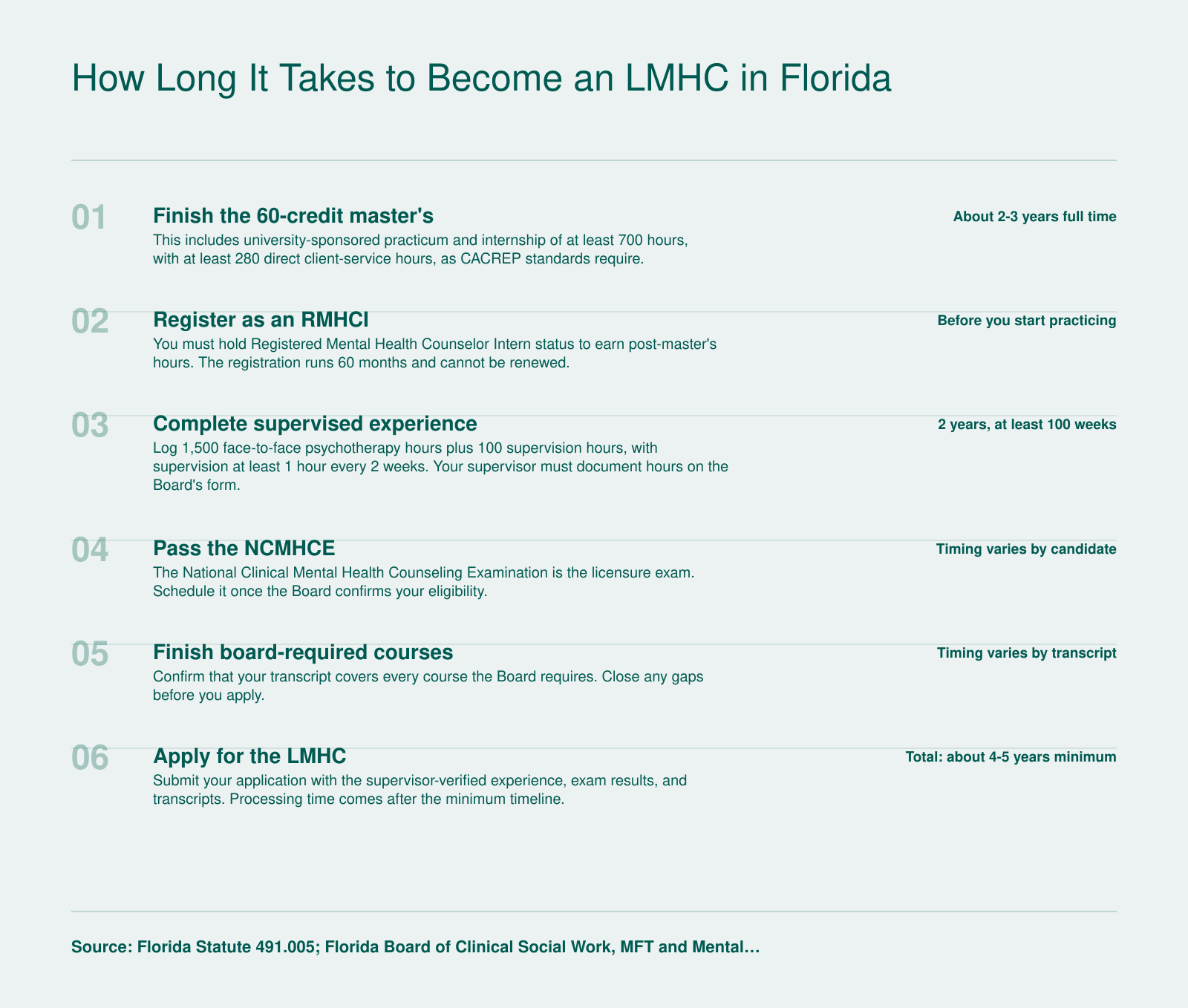
From the first day of the master's to a Florida LMHC license, expect roughly 4-5 years at the fastest on a full-time track, plus exam scheduling and application processing time. Part-time study stretches the first step, and the supervised experience cannot be shortened below 100 weeks.
Career and Salary Outlook for Florida Mental Health Counseling Graduates
First-year salary figures understate what graduates of the best clinical mental health counseling graduate programs eventually pay, and that gap is the thing to plan around.
One year after finishing, graduates of Florida International University's clinical mental health counseling master's report median earnings near $52,800. Jacksonville University's sit at about $52,700, Florida State University's at roughly $50,300, and the University of Miami's at about $48,800. Stretch the window to four years and the Miami median climbs to roughly $63,900, with FIU's near $62,300.
Debt belongs in the same frame. Typical borrowing at FIU, Florida State and Jacksonville lands around $41,000, which translates to roughly $466 to $469 a month on a standard ten-year repayment schedule. Florida Atlantic University graduates carry noticeably less, about $25,500, or near $290 monthly.
The modest early number has a plain explanation: most new graduates are working as registered mental health counselor interns, accruing supervised hours at agency wages. For those comparing clinical mental health counseling master's with no GRE required programs, pay generally steps up once full LMHC licensure is granted.
In Florida, the supervised hours you complete after graduation matter as much as the degree itself when you pursue LMHC licensure.
Behind the List: The Outcomes That Shaped These Rankings
Reputation surveys start with who people have heard of; this list starts with what students pay and what they walk away with.
The inputs are graduate tuition, net price after aid, program-level earnings and borrowing reported through the federal College Scorecard, how many students actually finish each counseling master's, and institution-wide graduation rates.
A few limits matter. Net price and graduation rates describe the whole university, not the counseling program alone, so they are a rough proxy rather than a precise read. Some programs have no published earnings figures yet, and newer or smaller cohorts are the usual reason. Earnings and debt reflect the most recent Scorecard release, which lags current graduates by several years.
Accreditation status, GRE policies, and delivery format were checked directly against school pages and the CACREP directory as of October 2026.
Compare Clinical Mental Health Counseling programs on the data that matters
Explore more Counseling specializations or browse every graduate field.
All Counseling programs