Best Advanced Standing MSW Programs in Minnesota
Compare 14 accredited Social Work Advanced Standing programs in Minnesota at 13 schools, with graduate earnings, cost, debt, and completion data from IPEDS and the U.S. College Scorecard.

Net price after grants and scholarships ranges from $11,704 at Saint Mary's University of Minnesota to $29,155 at the University of St Thomas, a $17,451 spread before a single field hour.
A BSW holder can skip the foundation year and finish a CSWE-accredited Accelerated Advanced Standing MSW in as few as 30 credits, roughly half the standard program. Campus, hybrid, and online advanced standing programs still require in-person practicum. Cost, format, and BSW recency rules create the real tradeoffs, so the decision comes down to which structure and aid package fit a working clinician's timeline.
Key Points
- Saint Mary's University of Minnesota posts the lowest average net price among the schools here.
- No program is fully remote, because CSWE-accredited degrees require in-person field hours.
- Check each school's admissions page before 2027 applications, since GRE policies vary and some publish none.
The 10 Best Advanced Standing MSW Schools in Minnesota
This list looks at what students pay after aid, how often students at each university finish, and what graduates go on to earn, using federal IPEDS and College Scorecard figures. Graduation rates describe the whole university, not the MSW cohort. Application deadlines and admission requirements are noted where schools publish them, so confirm dates with each program before you apply.
University of Minnesota-Duluth
#1Duluth, MN · $22,000 – $33,000/yr (est.) · ASWB pass rate 90.4% (3-yr weighted avg)
Best for: Working professionals needing a hybrid schedule
The University of Minnesota Duluth graduates about 65% of its students. Its hybrid advanced standing MSW pairs online coursework with one on-campus day a week and offers child welfare and clinical tracks, plus a focus on American Indian social services. Applicants need a CSWE-accredited BSW and a 3.0 undergraduate GPA. A current application deadline was not confirmed, so check with the program.
- 34 credits with a 500-hour practicum
- Hybrid format with one day per week on campus
- Classes meet Thursday and Friday
- Full-time and part-time options at the same tuition rate
- Concentrations in child welfare and mental health/clinical practice
- Requires a CSWE-accredited BSW and a 3.0 GPA
- Coursework meets Minnesota clinical licensure education requirements
- Scholarships and over 200 practicum agencies
University of St Thomas
#2Saint Paul, MN · ~$21,000/yr (est.) · ASWB pass rate 85% (3-yr weighted avg)
Best for: Aspiring LICSW clinicians choosing blended or in-person
The University of St. Thomas graduates about 76% of its students, the highest rate on this list. Its advanced standing MSW focuses on clinical practice and prepares students for LICSW licensure. Students choose a one-year blended hybrid format with monthly Saturday sessions or a two-year in-person part-time path. It requires a CSWE-accredited BSW.
- One-year blended hybrid or two-year in-person part-time
- Monthly Saturday campus sessions in the hybrid format
- Requires a CSWE-accredited BSW at graduation
- Over 200 field practicum sites
- Optional emphasis areas in immigrant/refugee or older adult practice
- MSW/LADC dual licensure pathway
- Two start dates per year, summer and fall
- About 90% of faculty are clinically licensed
St Catherine University
#3Saint Paul, MN · $15,000 – $20,000/yr (est.) · ASWB pass rate 86.7% (3-yr weighted avg)
Best for: Evening-class students focused on justice-oriented practice
St. Catherine University graduates about 61% of its students. Its advanced standing MSW takes a justice-oriented clinical approach, with evening classes on campus and a summer start. Applicants need a social-work bachelor's degree from a CSWE-accredited program. The reduced-credit path replaces a regular-standing route that requires 51 credits and 900 field hours.
- 33 credits and 500 clinical fieldwork hours
- Listed at $760 per credit, $25,080 total program tuition
- Evening on-campus classes, summer start
- Complete in 1, 2 or 3 years
- Requires a CSWE-accredited BSW
- Dual degree option with Holistic Health Studies
- CSWEP grant offsets tuition
- 200+ fieldwork settings
Winona State University
#4Winona, MN · ~$11,000/yr (est.) · ASWB pass rate 85.6% (3-yr weighted avg)
Winona State University graduates about 57% of its students and delivers its advanced standing MSW fully online with asynchronous classes. The program centers on trauma-informed clinical practice and prepares students for LICSW licensure. Applications are considered by January 15, with later ones reviewed only if space remains. Advanced standing applicants should expect at least a 3.4 in social work coursework and a CSWE-accredited BSW, with earlier degrees possibly admitted provisionally.
- Fully online, asynchronous classes in 7-week blocks
- 42 credits and 600 clinical hours, in as little as one year
- January 15 consideration date, May start
- At least 3.4 GPA in social work courses for advanced standing
- Requires a CSWE-accredited BSW earned in 2013 or later
- Trauma-informed clinical focus, prepares for LICSW
- Over 140 field partner agencies
- Two start dates per year
Minnesota State University-Mankato
#5Mankato, MN · $10,000 – $20,000/yr (est.) · ASWB pass rate 85.3% (3-yr weighted avg)
Minnesota State University Mankato graduates about 54% of its students. Its 34-credit advanced standing MSW uses an advanced generalist framework and a cohesive cohort model, preparing graduates for LGSW licensure. Applications open September 15 with a January 15 priority date. Applicants need a CSWE-accredited BSW, a 3.0 GPA, three letters of recommendation, and documented human-service experience.
- 34 credits over four semesters
- January 15 priority deadline, applications open September 15
- Requires a CSWE-accredited BSW and a 3.0 GPA
- Three recommendation letters and an application essay
- Documented human or social service experience required
- Advanced generalist curriculum, cohort model
- Prepares for LGSW licensure
- Mid-May start, on campus
Augsburg University
#6Minneapolis, MN · ~$14,000/yr (est.) · ASWB pass rate 83.3% (3-yr weighted avg)
Augsburg University graduates about 52% of its students. Its hybrid advanced standing MSW offers weeknight or weekend schedules with online work between on-campus sessions. Two tracks are available: Anti-Oppressive Clinical Practice and Anti-Oppressive Macro Practice. Applicants need a CSWE-accredited BSW earned within 15 years and a 3.0 GPA. A February 14 priority date applies, with later rolling dates.
- 37 credits and 500 field practicum hours
- Full-time (about 13 months) or part-time (25 months)
- Hybrid weeknight or weekend schedule
- Requires a CSWE-accredited BSW within 15 years
- 3.0 GPA minimum, two references and a personal statement
- February 14 priority deadline
- Portfolio project required for graduation
- 38 credits and 500 field practicum hours
- Macro track offered on weekends only
- 13-month full-time option, part-time available
- Requires a CSWE-accredited BSW
- Capstone required, 3.0 GPA maintained
- Degree must be completed within four years
Saint Mary's University of Minnesota
#7Winona, MN · ~$12,000/yr (est.) · ASWB pass rate 76.9% (3-yr weighted avg)
Saint Mary's University of Minnesota graduates about 66% of its students and offers a 100% online advanced standing MSW with no GRE required. It is a 30-credit, one-year track with three start dates a year and a field placement arranged near you. The program lists a 2.8 minimum GPA and two recommendation letters. Published deadlines were not found for this guide.
- 30 credits, complete in one year, part-time available
- 100% online with synchronous and asynchronous options
- Listed at $925 per credit
- No GRE or GMAT required
- 2.8 GPA minimum and two recommendation letters
- Start in summer, fall or spring
- Optional Addiction Studies Certificate
- Field coordinator helps arrange placement near you
The College of Saint Scholastica
#8Duluth, MN · ~$15,000/yr (est.) · ASWB pass rate 75.7% (3-yr weighted avg)
The College of Saint Scholastica graduates about 71% of its students. Its advanced standing MSW is a one-year, cohort-based track with live online classes on Tuesday and Wednesday evenings and a three-day summer residency in Duluth. Admission requires a 3.0 GPA and no GRE. The priority deadline is February 15 and the final deadline is April 15, for a May start.
- 38 credits and 450 supervised field hours
- Listed at $777 per credit
- Live online evening classes plus a three-day summer residency
- February 15 priority and April 15 final deadlines, May start
- 3.0 GPA minimum, no GRE required
- Concentration areas include CBT, trauma and co-occurring disorders
- Prepares for LICSW licensure and the ASWB exam
- HRSA stipend grant opportunity
Minnesota State University Moorhead
#9Moorhead, MN · ~$12,000/yr (est.) · ASWB pass rate 74.5% (3-yr weighted avg)
Minnesota State University Moorhead graduates about 57% of its students. Its MSW offers an advanced standing option for BSW holders, delivered through flexible online-plus classes in a cohort model. Students can choose Multicultural Clinical or Social Change and Leadership specializations. Current deadlines and requirements were not confirmed, so check directly with the program.
- Advanced standing option for BSW graduates
- Two specializations: Multicultural Clinical and Social Change and Leadership
- Flexible online-plus delivery in a cohort model
- CSWE accredited
- Faculty advisor and mentor available
Saint Cloud State University
#10Saint Cloud, MN · ~$11,000/yr (est.) · ASWB pass rate 71.3% (3-yr weighted avg)
Saint Cloud State University graduates about 40% of its students, the lowest rate here, but it sits at the low end of tuition in this group. Its hybrid advanced standing MSW is offered on campus and online with full-time and part-time options and a fall start. The program uses an anti-oppression lens and offers graduate assistantships. Deadlines and requirements were not confirmed for this guide.
- Hybrid delivery, on campus and online
- Full-time and part-time options
- Fall start, one start date per year
- Anti-oppression lens on race, class and gender
- Graduate assistantships and financial aid available
- Advanced generalist preparation, CSWE accredited
Cost & outcomes by school
Federal data for the highest-earning Social Work Advanced Standing programs, independent of the ranking above. Earnings are this field's master's graduates four years after completing, where the Scorecard reports them.
| School | Earnings | Tuition / yr | Debt | Grads/yr | Format |
|---|---|---|---|---|---|
| Minnesota State University-Mankato MN | $71,402 | $10,449 | $27,558 | 31 | Campus |
| Augsburg University MN | $69,129 | $13,766 | $39,933 | 70 | Hybrid |
| Saint Cloud State University MN | $68,318 | $10,924 | $23,636 | 30 | Hybrid |
| University of St Thomas MN | $65,240 | $21,151 | $41,000 | 64 | Hybrid |
| The College of Saint Scholastica MN | $64,773 | $15,084 | $40,097 | 25 | Hybrid |
| Walden University MN | $63,559 | $10,885 | $72,715 | 1,197 | Online |
| University of Minnesota-Duluth MN | $62,641 | $21,630 | $37,319 | 35 | Hybrid |
| Capella University MN | — | $15,092 | — | — | Online |
| Saint Mary's University of Minnesota MN | — | $12,474 | — | 102 | Online |
| Winona State University MN | — | $10,886 | — | 58 | Online |
| Bethel University MN | — | $10,260 | — | 13 | Online |
| Minnesota State University Moorhead MN | — | $11,902 | — | 26 | Online |
Sources: U.S. Department of Education. Tuition and graduates: IPEDS. Earnings and debt: College Scorecard, this field's master's graduates; a dash means no figure is reported.
Cost, debt & payoff
Median earnings of this field's master's graduates (4 yrs after completing) vs. their median federal loan debt · U.S. College Scorecard
Across these programs the median graduate earns about $66,779 and finishes with roughly $39,933 in debt — a ratio that clears a common rule of thumb (keep debt below first-year salary). Tuition and debt vary widely school to school, so check the per-school figures in the table above before you shortlist.
Online or Hybrid? How Minnesota's Advanced Standing Formats Actually Work
Can you finish an advanced standing MSW in Minnesota without relocating? Partly. No program here is fully remote, because every CSWE-accredited degree requires in-person field hours.
Format by program
University of Minnesota-Duluth offers the clearest split: a hybrid path with classes about one day a week, and an online synchronous option, one of the online MSW programs, for advanced standing students, meaning live sessions rather than self-paced work. Minnesota State University-Mankato and Augsburg University run hybrid advanced standing tracks. Saint Cloud State University lists campus, online, and hybrid options. St. Catherine University offers on-campus and online study, and University of St Thomas runs a weekend-oriented hybrid with some weeknight meetings. Most of these programs do not publish residency requirements; confirm them directly with each admissions office.
Field placement outside the Twin Cities
Online students generally complete practicum at an approved site near home. Duluth cites more than 200 agency partners and requires an MSW supervisor. Ask each school whether it arranges placements in your community or accepts employer-based sites.
Quick fit guide
- Working adults: Duluth's online synchronous option, if evening or scheduled live classes fit your week.
- Rural students: Prioritize schools that confirm local placement support.
- In-person cohort seekers: Mankato, Augsburg, and St Thomas hybrids keep regular campus contact.
Minnesota Master's in Social Work Programs That Waive or Don't Require the GRE
For most applicants, the GRE question comes down to one tradeoff: skip the test and save weeks of prep, or submit a score anyway to strengthen a borderline application. For candidates in advanced standing MSW programs in Minnesota, the test is often moot, since several no-GRE master's programs here don't require it at all.
What the Programs Say
- No GRE required: University of Minnesota Duluth and University of St. Thomas both state plainly that no entrance exam is needed.
- Optional, per the most recent document: St. Cloud State's student handbook references scores "if submitted," which suggests the GRE is optional rather than mandatory, though no formal current waiver is published.1
- No policy published: Minnesota State Mankato's catalog requirements don't mention the GRE at all. Absence isn't the same as a waiver, so don't assume one.
Where no exam applies, admissions turn on your undergraduate GPA, your BSW field evaluations, and a personal statement. Because policies shift between cycles, confirm the current requirement with each program's admissions office before you apply.
Related Articles
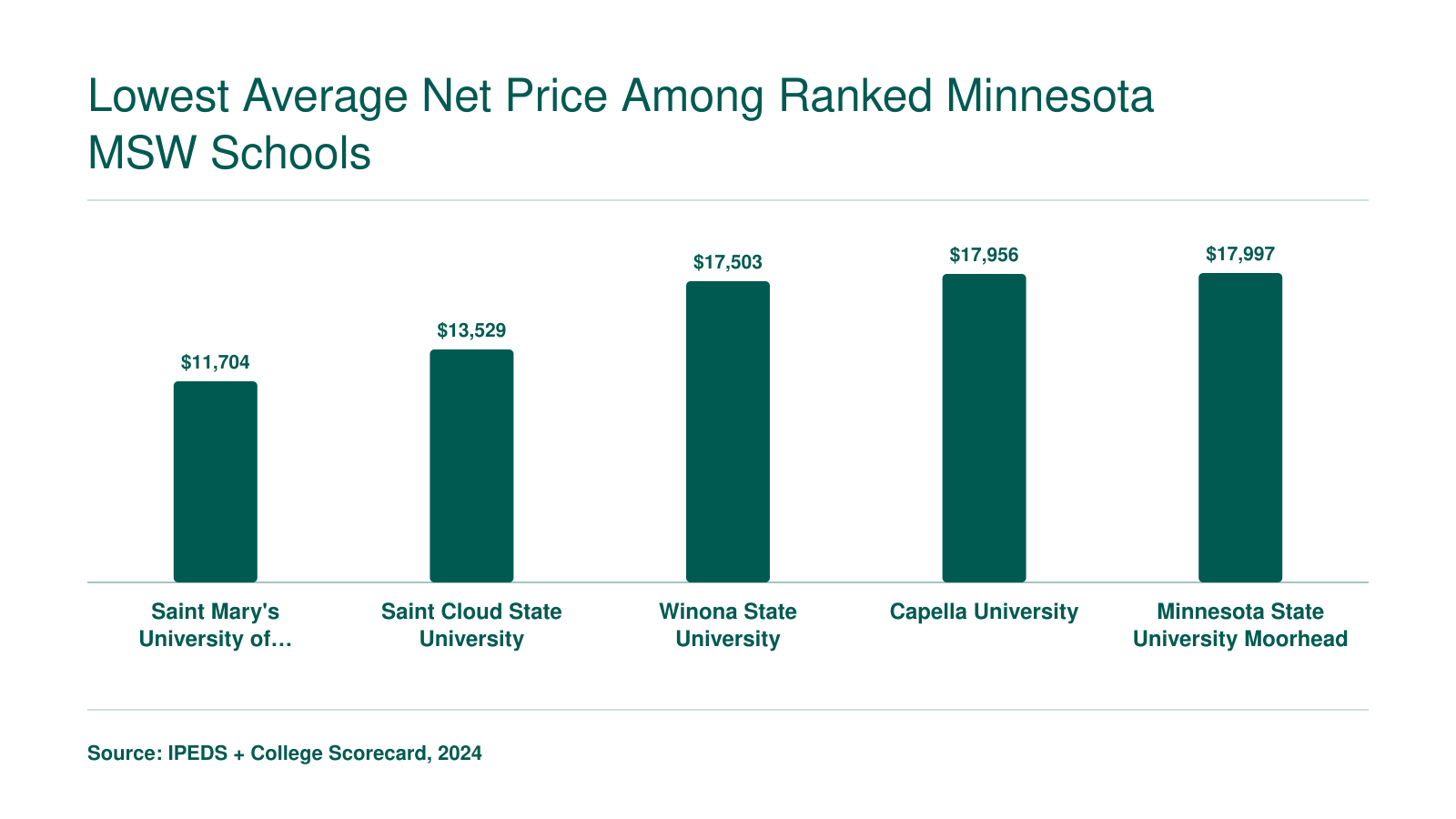
Lowest Average Net Price Among Ranked Minnesota MSW Schools
Net price is the average an undergraduate-era student pays after grants and scholarships. It is an institution-wide figure, not an exact quote for the master's in social work. Saint Mary's University of Minnesota, a private school, posts the lowest average, while the public universities cluster higher. Capella University, also private, sits close to them.
What an Advanced Standing Master's Costs in Minnesota, and How It Prepares You for Licensure
The lowest sticker price is not always the lowest bill, and the reverse is also true. Start with published tuition, then adjust for aid, as the Most Affordable Advanced Standing MSW Programs ranking does.
Estimated Program Tuition
Minnesota State University, Mankato is the clearest case: about $616.95 per credit for residents plus a $60.00 MSW program fee, with the 34-credit advanced standing program totaling $22,615. Nonresidents pay a higher rate, listed at $863.95 per credit. Other figures come from third-party listings, so confirm them with each school, using a Minnesota master's programs tuition comparison to cross-check. St. Catherine University is estimated near $25,080 (listed at $760 per credit), Augsburg University near $30,155, and Saint Cloud State University near $18,488. Ask each bursar about field, technology, and online fees, which may not be included.
Why Net Price Looks Different
Published tuition is a sticker price. The net price figures ranked on this page subtract grant aid, so they can sit well below or simply differ from a program's per-credit math.
Funding Routes
"Fully funded" is rarely accurate. Real options include Title IV-E child welfare stipends, graduate assistantships, and employer tuition benefits. Each carries its own eligibility rules, and stipends often come with a work commitment. Ask every program what it offers advanced standing students.
Path to Licensure
Clinical concentrations build the assessment and treatment skills behind the LGSW. The LICSW follows after supervised post-degree practice.
Minnesota Board of Social Work Licensing at a Glance
Advanced Standing Programs With the Highest Graduate Earnings
These figures are median earnings for graduates of each school's master's in social work program, from IPEDS and College Scorecard data, and each is labeled with the time window it covers. Windows differ by row, so compare them with that in mind. Augsburg University graduates report the highest earnings alongside median debt of $39,933, while Saint Cloud State University graduates report $62,758 with median debt of $23,636.
| School | Median graduate earnings | Time window | Median debt |
|---|---|---|---|
| Augsburg University | $73,043 | Five years after finishing | $39,933 |
| University of St Thomas | $70,173 | Five years after finishing | $41,000 |
| The College of Saint Scholastica | $66,642 | Five years after finishing | $40,097 |
| Saint Cloud State University | $62,758 | Five years after finishing | $23,636 |
| University of Minnesota-Duluth | $62,641 | Four years after finishing | $37,319 |
Compare Social Work Advanced Standing programs on the data that matters
Explore more Social Work & Social Sciences specializations or browse every graduate field.
All Social Work & Social Sciences programs