Best Patient Safety and Quality MSN Programs
Compare 6 accredited Patient Safety & Quality programs, with graduate earnings, cost, debt, and completion data from IPEDS and the U.S. College Scorecard.

Patient safety and quality MSN programs ask for anywhere from 135 practicum hours to 360, and published graduate tuition in this specialization runs from roughly $10,000 a year to nearly $40,000. That spread matters more than it looks, because the job titles on the other side, quality coordinator, risk manager, patient safety officer, tend to pay within a narrower band than the tuition gap suggests.
It is also a small, concentrated field. Few schools offer a dedicated quality and safety track, most deliver it online, and CCNE accreditation is not universal among them, which is worth verifying before an employer or a certification board asks.
Key Points
- Drexel University ranks first, pairing a roughly 78% graduation rate with a quality-focused curriculum.
- Rankings use federal IPEDS and College Scorecard data, not reputation or advertising.
- The CPHQ suits broad quality roles, while the CPPS fits hands-on patient safety work.
Best Patient Safety and Quality MSN Programs: Our 2027 Rankings
Leading the list is Drexel University, where a specialized quality, safety, and risk management curriculum pairs with a 100 percent employment rate. The next four schools lean into flexible online delivery and competitive net prices, giving working registered nurses several credible paths into patient safety leadership.
Drexel University
#1Philadelphia, PA · ~$39,000/yr (est.)
Best for: Nurses leading quality, safety, and risk oversight
Drexel's MSN in Quality, Safety, and Risk Management in Healthcare pairs systems thinking and human factors with evidence-based practice, preparing nurses to lead improvement across hospitals and healthcare organizations. Its interdisciplinary faculty includes practicing experts in law, quality, and risk, and graduates report a 100 percent employment rate. The online format uses 10-week quarterly terms for flexibility.
- Led by practicing experts in law, quality, and risk management
- 100 percent job placement rate
- 3.0 GPA minimum with letters waived for qualifying applicants
- Four 10-week quarters per year
- Competency-based education with interactive video discussions
- Interdisciplinary collaboration focus
Grand Canyon University
#2Phoenix, AZ · ~$10,000/yr (est.)
Best for: Budget-conscious working nurses needing online flexibility
Grand Canyon University's online MSN emphasis in Health Care Quality and Patient Safety builds the project management, change management, and data analysis skills nurses need to lead quality improvement. Coursework focuses on evidence-based practice and stakeholder engagement, with eight-week sessions that keep the schedule predictable for working professionals.
- $600 per credit tuition
- 8-week course sessions
- Focus on quality improvement and patient safety
- Project management and change management training
- Data analysis and stakeholder engagement skills
- Requires nursing background
Capital University
#3Columbus, OH · ~$14,000/yr (est.)
Best for: Columbus-area nurses pursuing Magnet hospital field placements
Capital University's online MSN with a Quality and Safety concentration uses asynchronous coursework and applied statistics to help registered nurses make data-driven improvement decisions. Small cohorts and 8- or 16-week formats support working nurses, and field experiences at Columbus-area Magnet hospitals connect students to real quality and safety projects.
- Online asynchronous classes
- Complete in as few as six semesters
- Small cohorts of 20 students or fewer
- 8- or 16-week course formats
- Field experience at Columbus-area Magnet hospitals, including OhioHealth and Nationwide Children's Hospital
- Applied statistics and healthcare informatics emphasis
- Full-time and part-time enrollment options
Jacksonville University
#4Jacksonville, FL · ~$22,000/yr (est.)
Jacksonville University's online MSN in Healthcare Quality and Safety prepares registered nurses for quality improvement director and patient safety officer roles through courses in improvement science, human factors, and health law. Small classes, 7-week formats, and immersive virtual reality labs give students an applied, flexible route into quality leadership.
- Average salary $97,000 for nursing administrator
- Part-time and full-time tracks with 7-week courses
- Synchronous and asynchronous online options
- Small class sizes and assigned academic advisor
- Immersive virtual reality and simulation learning
- 3.0 GPA minimum with no GRE for most applicants
- Capstone project required
Southern New Hampshire University
#5Manchester, NH · ~$21,000/yr (est.)
Southern New Hampshire University's online MSN Healthcare Quality and Safety track builds skills in quality improvement, health finance, policy, and safety culture for nurses moving into quality director or nurse manager roles. Ten-week terms, rolling admissions, and a no-application-fee policy keep the pathway straightforward for working RNs.
- 10-week terms
- Rolling admissions and $0 application fee
- No entrance exam required
- 3.0 GPA minimum
- Transfer up to 12 credits
- Military benefits and employer reimbursement supported
- 93.4 percent online student recommendation rate
- Capstone required
Cost & outcomes by school
Federal data for the highest-earning Patient Safety & Quality programs, independent of the ranking above. Earnings are this field's master's graduates four years after completing, where the Scorecard reports them.
| School | Earnings | Tuition / yr | Debt | Grads/yr | Format |
|---|---|---|---|---|---|
| Northeastern University MA | $81,227 | $26,020 | $41,000 | — | Online |
| Drexel University PA | $76,628 | $39,261 | $61,917 | 79 | Online |
| Southern New Hampshire University NH | $69,637 | $21,387 | $36,900 | 213 | Online |
| Grand Canyon University AZ | $68,242 | $10,015 | $45,080 | 151 | Online |
| Capital University OH | — | $13,530 | — | — | Online |
| Jacksonville University FL | — | $21,818 | — | — | Online |
Sources: U.S. Department of Education. Tuition and graduates: IPEDS. Earnings and debt: College Scorecard, this field's master's graduates; a dash means no figure is reported.
Cost, debt & payoff
Median earnings of this field's master's graduates (4 yrs after completing) vs. their median federal loan debt · U.S. College Scorecard
Across these programs the median graduate earns about $73,133 and finishes with roughly $43,040 in debt — a ratio that clears a common rule of thumb (keep debt below first-year salary). Tuition and debt vary widely school to school, so check the per-school figures in the table above before you shortlist.
How We Ranked These Patient Safety and Quality MSN Programs
What data decides which patient safety and quality MSN programs rank highest? We relied on two federal sources rather than reputation or advertising. IPEDS supplied graduate tuition, graduation rates, and delivery format. The U.S. Department of Education's College Scorecard supplied net price, program-level earnings, and debt.
What We Weighed
We considered four factors, described here in qualitative terms rather than as fixed weights:
- Affordability: Graduate tuition and net price, since cost is the clearest difference between otherwise similar programs.
- Completion: The institution's graduation rate, as a signal of whether students who start actually finish.
- Earnings and debt: Program-level graduate earnings and borrowing, wherever the Scorecard publishes them.
- Format flexibility: Online and hybrid options that suit working nurses who cannot step away from a clinical job.
Limits You Should Know
Federal data has gaps, and you should read the rankings with them in mind. Graduation rates describe the whole institution, not the MSN cohort. Net price averages all students; your actual cost depends on aid, employer tuition benefits, and transferred credits. Some programs still have no published earnings or debt figures; we leave those blank rather than estimating. A school with missing outcome data is not necessarily a weaker program, only a less transparent one.
What We Checked Separately
Accreditation and certification alignment do not appear in the federal datasets in a usable form, so we verified them on their own. Confirm each program's CCNE status directly with the accreditor before you apply. For how coursework connects to credentials, see the CPHQ vs. CPPS section below.
Patient Safety MSN Tuition Cost Comparison: Sticker Price vs. Net Price
Tuition and net price figures below are the latest published rates as of 2026 unless noted. Rows are ordered by institution-level net price, lowest first. Many online MSN programs charge a flat per-credit rate regardless of residency, so in-state and out-of-state graduate tuition are often identical; debt and payment amounts are for program completers only and come from federal College Scorecard data.
| School | Program | In-state graduate tuition | Out-of-state graduate tuition | Net price (after grants and scholarships) | Per-credit tuition | Estimated total program tuition | Median federal debt (program completers) | 10-year monthly payment (program completers) |
|---|---|---|---|---|---|---|---|---|
| Grand Canyon University | MSN: Health Care Quality and Patient Safety | $17,850 | $17,850 | $22,472 | $600 (published rate) | $21,600 (estimated from 36 credits at $600) | $45,080 | $513 |
| Capital University | MSN, Quality and Safety concentration | $43,234 | $43,234 | $22,576 | N/A | N/A | N/A | N/A |
| Jacksonville University | MSN in Healthcare Quality and Safety | $47,830 | $47,830 | $25,180 | N/A | N/A | N/A | N/A |
| Southern New Hampshire University | MSN in Healthcare Quality and Safety | $17,200 | $17,200 | $36,708 | $659 (published rate) | $23,724 | $36,900 | $420 |
| Drexel University | MSN in Quality, Safety, and Risk Management in Healthcare | $62,412 | $62,412 | $38,509 | $1,169 (2026-2027) | $53,774 (2026-2027, plus $125 program fee) | $61,917 | $704 |
How Long It Takes: Program Length, Pacing, and Practicum Hours
For most working RNs, program length is really two questions: how many months of coursework and how the required practicum fits around a current job. In MSN programs focused on patient safety and quality, that clinical requirement is often built around a quality improvement project, not a return to bedside rotations.
Credit Loads and Timelines
Credit loads in the schools below generally land between 36 and 40 semester credits, though quarter-based programs use a different scale. Southern New Hampshire University lists 36 credits with 10-week terms; taking two courses per term can finish in under 18 months. Fayetteville State University's online patient safety and quality track is 36 credits, with full-time students completing in four 16-week semesters, and part-time pacing available without a published standard completion time. Drexel University's healthcare quality, patient safety, and risk management program is listed at 45 to 46 quarter credits and averages about two years over four 10-week quarters per year. Texas State reports average nursing master's completion around 24 months full-time and 36 months part-time, but its public materials do not identify a separate patient safety and quality MSN track.
Practicum Hours and the Quality Improvement Capstone
Quality and safety programs often frame the practicum as a QI or change initiative. Southern New Hampshire University's final course requires 135 supervised direct practicum hours with a preceptor. Florida State's 2025-2026 MSN handbook lists 500 clinical or practicum hours across its MSN tracks and requires students to secure a preceptor and obtain clearance before starting.2 Fayetteville State does not publish a total practicum hour count, but its capstone course includes required campus attendance one to three times in the final semester at instructor-determined dates. Drexel's public materials do not state a required practicum hour total.
Placement Support and Campus Time
Placement policies are not uniform. Texas State expects students to contact clinical sites and develop a schedule with a preceptor while a coordinator facilitates approvals; simulations are virtual, but direct practicum hours remain in person, and the school does not assign preceptors because locations vary.1 Florida State similarly requires students to secure a preceptor with the program coordinator and submit planning documents before clinical work begins.2 Public pages for Southern New Hampshire University, Fayetteville State, and Drexel do not specify whether the school assigns preceptors or guarantees a site. For campus scheduling, Drexel is 100 percent online with no on-campus residency, while Fayetteville State adds a short campus component only during the capstone semester.
Admission Requirements: Do You Need a BSN?
Most programs expect a BSN, but the path is not universal. Here is the safest baseline for 2026 planning.
- Accredited BSN or bridgeA BSN from an accredited program is standard. Drexel accepts a BSN or ASN, and National University accepts a diploma, associate degree, or BSN. Bridge options are school-specific: Grand Canyon University offers one online, and Drexel's is planned.
- Active, unencumbered RN licenseEvery program reviewed requires a current RN license with no restrictions. Some also require validity in the state where your practicum takes place.
- Minimum GPA3.0 is the most common threshold, though cutoffs range from about 2.75 to 3.3. SNHU may admit 2.67–2.99 provisionally, and Graceland lists 2.50.
- Clinical work experienceUsually preferred, not required. Drexel requires none; Graceland prefers 1,000 hours, and Duquesne lists one year.
- GRETypically not required. Confirm with each school.
- Statistics prerequisiteA college statistics course is the most common prerequisite, often with a C or higher. Recency limits commonly run 5–10 years.
- References and personal statementExpect official transcripts, letters of recommendation, a statement of purpose, and proof of RN licensure.
Related Articles
CPHQ vs. CPPS: Which Certification Fits Your MSN?
Should you sit for the CPHQ or the CPPS after an MSN in quality and safety? The CPHQ, issued by NAHQ, fits broad quality improvement, data, and accreditation roles.1 The CPPS, issued by IHI and CBPPS, fits people whose daily work centers on preventing harm.3
Side-by-Side Basics
- CPHQ eligibility: No formal requirement, though NAHQ recommends about two years in healthcare quality.1
- CPPS eligibility: Duties must include patient safety, plus a bachelor's degree with three years in a healthcare setting (or an associate degree with five). Clinical rotations and residency can count.3
- CPHQ exam: Computer-based, 140 multiple-choice questions, scored 200 to 800 with 600 to pass. Sources differ on how many items are unscored.1
- CPPS exam: Computer-based, 150 minutes,4 four content domains, scored 200 to 800 with 500 to pass.3
- 2026 fees: The CPHQ costs $714 for nonmembers, with NAHQ member pricing lower.1 The CPPS costs $549 in the U.S.4
- Recertification: The CPHQ renews every two years, and late fees apply after the grace period ($230 for nonmembers in January).2 The CPPS renews every three years,5 either with 45 continuing education hours and a $225 application3 or by passing the exam again.
A lapsed CPHQ means retaking the exam, so track your renewal date.2
Mapping Your Coursework
MSN classes in quality improvement methods, risk management, and health data analytics line up most directly with the CPHQ, which tests performance measurement, data use, and organizational improvement. The same classes support CPPS content on safety culture, error analysis, and system design. The CPPS rewards hands-on safety experience more, so your practicum and current job matter. Don't assume your MSN clinical hours automatically satisfy the CPPS experience rule.
Programs That Mention These Exams
We found no MSN that explicitly promises preparation for either exam. Southern New Hampshire University's 12-credit online Healthcare Quality and Safety post-graduate certificate, for people who already hold a master's, explains CPHQ and CPPS eligibility and content but does not claim to embed exam prep. Treat any "exam-aligned" claim as something to verify with the program directly.
Which Should You Pick?
Choose the CPHQ for quality director, analyst, or accreditation roles, which often suit an MSN in Nursing Administration. Choose the CPPS for patient safety officer or risk-focused roles. Some leaders in an MSN Nurse Executive Leadership program eventually hold both.
Pay Benchmark for Quality and Safety Leaders
Quality and safety directors often sit within the Bureau of Labor Statistics category for medical and health services managers.
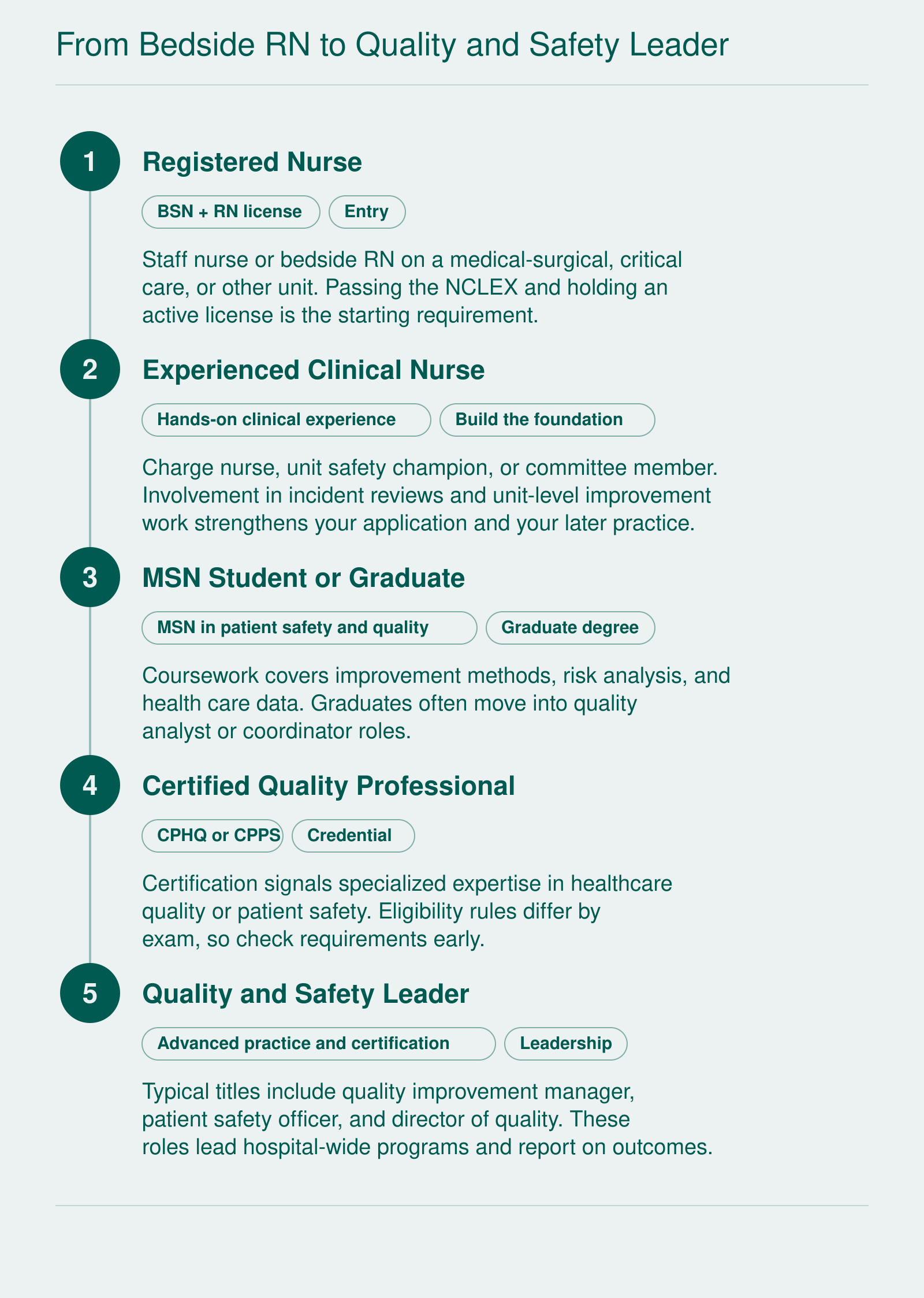
From Bedside RN to Quality and Safety Leader
Most quality and safety leaders start at the bedside. This is the typical sequence, though employers vary on which credentials they require and when.
Is an MSN in Patient Safety and Quality Worth It?
The degree pays off most for nurses who want to leave shift work and move into quality, risk, or accreditation roles without overpaying for tuition. Weigh the tradeoffs below against the net price and pay benchmarks earlier on this page, not against generic promises about advanced degrees.
Pros
- Moves you off bedside shift schedules into day-based quality, safety, and accreditation roles, which makes the tuition in our cost comparison easier to justify.
- Matches hospital priorities around Magnet recognition and Joint Commission standards, so graduates fit roles that organizations already budget for and recruit.
- Builds a direct path to the CPHQ and CPPS credentials, which can strengthen the pay benchmarks shown in the salary section.
- Suits online study well, so you can keep earning an RN income while paying tuition and avoid lost wages during the program.
Cons
- Fewer schools offer this focus than general MSN tracks, so you may have less room to compare net price and find a low-cost option.
- The focus is narrower than an MSN in nursing leadership, which can limit flexibility if you later want broad management or executive roles.
- Practicum projects often need employer buy-in, and a lack of support at your current hospital could delay completion and add cost.
- Some quality jobs hire non-nurses with other credentials, so the degree may not command a salary premium over those candidates.
Patient Safety & Quality programs by state
Frequently Asked Questions About Patient Safety and Quality MSN Programs
These answers build on the rankings, admissions, and timing sections above. Always confirm current requirements with each program before you apply.
What is the difference between patient safety and quality MSN and healthcare quality and safety?
Are patient safety MSN programs available fully online?
Can I earn this MSN while working full-time as an RN?
Is an MSN in quality and safety a good stepping stone to a DNP?
Compare Patient Safety & Quality programs on the data that matters
Explore more Nursing specializations or browse every graduate field.
All Nursing programs